2024 New Year Financial Health

Starting a new year is a great time to make sure your financial health is strong and secure. Tax season is just around the corner, but before it gets here, now is the time to review your financial plan, income, and goals.

Your stage of life will drive your financial priorities. Here are some key aspects of your financial life that should be important for you to reevaluate.

Under 40 – The Growth Phase:

For those who are working in your early careers, perhaps starting family, evaluating the purchase of your first home, and looking ahead, consider the following:

  • Short Term Goals – House purchase (mortgage), wedding, car, travel, further education, paying off or reducing debt
  • Income – New employment, increase in salary or bonus, stock options (vesting)
  • Savings – New target goals, emergency savings fund, 401(k) retirement contributions, IRA, Roth, employee benefits, other
  • Changes to marital or family status – considerations for filing in April, joint accounts, titling of assets
  • Receiving financial gifts – Do you have family considering annual gifts to you, funding 529 accounts, or assisting with a home purchase?

40-65 – The Prime Years:

For folks in your prime professional working years or just at a stage in life where you’re thinking more seriously about the timing of retirement, you’ve got a lot on your mind! You may be playing a more active role with aging parents, growing children, and everything in-between. Consider these points:

  • Goals – Timeline to retirement, second home, renovations, philanthropy, travel
  • Income – Employment changes, increase in salary or bonus, stock options (vesting), future grants
  • Savings – New target goals, HSA, 401(k) retirement contributions, IRAs, employee benefits
  • Family – Support for children, gifting, weddings, parental assistance, college funding, graduation
  • Cash Flow Needs – Portfolio income, liquidity requirements, HELOC, line of credit

65+ – The Golden Horizon:

For those of you in retirement or soon to be, you have a different perspective on life than when you were younger. Consider the following:

  • Cash Flow Needs – Annual liquidity requirements, anticipated expenses from portfolio, larger expenditures (family vacation, etc.), withdrawal rate
  • Income Replacement – Develop income strategy, Social Security benefits, RMD’s, pensions, rental income, annuities, rollover options, etc.
  • Family – Support for adult children, gifting, weddings, parental assistance, estate plans, college funding, graduation
  • Time – What is keeping you occupied during retirement? New hobbies? Luxury travel?

Keeping Your Financial Health Strong

As you review your financial picture, remember that a well-thought-out plan is key to long-term success. We’re committed to helping you navigate the complexities of financial planning, ensuring you’re well-equipped to make informed decisions throughout 2024 and beyond. With a healthy plan in place, you’ll be able to enjoy the entire year just a bit more relaxed and confident, knowing you have a strong financial foundation underneath it all.

Here’s to a year filled with prosperity, wise investments, and financial peace of mind!

The December Rally – Powell Spikes the Eggnog

Driven by expectations of a soft economic landing and potential Federal Reserve interest rate cuts, U.S. stocks rose 4.5% in December, extending the momentum that began in November.   The S&P 500 closed the year with nine consecutive weekly gains, the longest streak since 2004, finishing the month just 0.6% below its January 2022 record close. The small-cap Russell 2000 also had its best month since November 2020, gaining 12.2%. The so-called “Magnificent Seven” stocks trailed as December witnessed a rally in speculative investments, including a strong performance for junk bonds.

The December rally was fostered by the FOMC meeting when the Fed confirmed a shift toward rate cuts in 2024. In the updated Summary of Economic Projections, a.k.a. the Fed’s “Dot Plot”, the forecast for the median Fed funds rate is in the range of 4.5-4.75% by the end of 2024, down from a projection of 5.0-5.25% in September. This pivot sets the Fed’s expectations at three rate cuts in the upcoming year.

This shift in stance encouraged investors to increase their own rate cut expectations, which were already overly optimistic. Surveys show investors expect double the number of rate cuts that the Fed is projecting. While rate cuts are generally good for investors, a wide disconnect between investor expectations and economic reality reflects an environment where markets are likely to experience bouts of volatility.

Economic data for December supported the soft-landing narrative with disinflation gaining traction. Despite some positive economic indicators such as November payrolls beating expectations, there were revisions to the previous two months, and average hourly earnings gains slowed.  The JOLTS report showed job openings fell for the third straight month to the lowest level since March 2021, reflecting a cooling but persistently strong labor market.

However, despite the rally in the past two months, we believe investors should have grounded expectations. We are optimistic, but some patience is warranted given that markets may have fully priced in the most optimistic Fed rate cut scenarios, posing short-term downside risks if the Fed does not meet these expectations.

Capital Markets

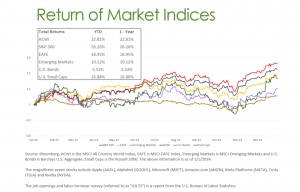
The All-Country World Index (ACWI) was up 22.81% for the year, the S&P 500 was up 26.26% and the EAFE up 18.95%. Emerging market equities and U.S. Small caps lagged but were up 10.12% and 16.88% for the year, respectively.

Treasuries saw a rally across the yield curve, with the 2-year yield dropping by nearly 0.45% to 4.25%, the lowest since May. The 10-year yield also decreased by almost 0.50% to just above 3.85%, the lowest since July. 6-month Treasury Bill yields declined slightly to 5.26%.

Wealth Planner Luke Neumann, CFP®, Discusses IRS Home Improvement Credit Changes With Financial Planning

Changes to the IRS energy efficient home improvement credit could keep money in your pocket while you upgrade your living space.

Crestwood Director and Wealth Planner Luke Neumann, CFP®, spoke with Financial Planning, sharing his expertise on how advisors can leverage tax incentives for their clients and why making eco-friendly upgrades can be monetarily beneficial to clients.

Click here to read the full article!

Navigating the 2024 Economic Landscape: Trends, Challenges, and Opportunities

2023 Consensus Forecasts – A Big Miss:

At the beginning of last year, 85% of economists forecasted a recession for the U.S. as many indicators, including an inverted yield curve, were flashing red.

Throughout 2023, the U.S. economy not only avoided a recession, but growth accelerated in the 3rd quarter to a robust rate of 4.9%.  Low unemployment and strong wage growth helped consumers shrug off higher interest rates and continue spending.

The best news from last year was that inflation continued to trend lower toward the Fed’s target of 2.0%, falling to 3.1%, even with strong economic growth. At the December Federal Reserve meeting the Fed indicated that interest rates have peaked for this cycle, shifting their focus to maintaining current growth.

Resilient U.S. Economy Continues:

This time last year, we were more optimistic than consensus forecasts because we believed consumer spending was less sensitive to interest rate increases than in past cycles.  Today, we believe that the forces affecting 2023’s growth are still in place for 2024.

Economists have underestimated two trends.  First, more stable service sectors have come to dominate the U.S. economy. Second, consumers are locked into low interest rates mortgages which have helped shield them from the Fed’s 11 interest rate hikes.

The U.S. economy is a service economy.  In 1970, consumption of services surpassed that of goods. Today, 80% of jobs in America are service jobs in industries like business services, health care, governments, and leisure. Spending on services tends to be more recession-resistant and helps to stabilize GDP growth.  Conversely, spending on goods tends to decline during recessions and sometimes the declines have been steep. During the Global Financial crisis in 2009, the consumption of goods fell -6.8%, while consumption of services fell only -1%.

Today, the strength in the U.S. economy is focused on these service sectors, driving wage growth, consumption and, in turn, contributing to inflation.

Implications: As the U.S. economy evolves and becomes more service-oriented, we should expect more consistent growth and less severe recessions. Tightness in labor markets, especially in service areas, suggests inflation may be slower to come down than many expect. As a result, it could take longer than expected to reach the Fed’s target of 2.0%.

Consumers have less variable-rate debt. Compared to prior economic cycles, higher interest rates have had less of an effect on consumer spending.  In prior cycles, higher borrowing costs pinched consumers who had credit card debt or variable-rate mortgages.  Today, it is estimated that 82% of mortgage holders have a mortgage rate below 5% and most of those loans are fixed rate.  Also, many consumers used the pandemic stimulus payments to reduce credit card debt, so consumer finances have been excellent and supported spending growth despite higher interest rates.

Implications: Consumer spending will remain healthy as higher rates pinch consumers less due to changes in consumer debt.  We expect housing markets will remain tight as many current homeowners are reluctant to transact if their house has a low-interest mortgage.  Considering consumers are somewhat interest rate immune, we expect rates to remain elevated for the foreseeable future.

Soft Landing Likely in 2024

Crestwood’s 2024 outlook for economic growth is positive.  We expect consumer spending to remain healthy considering the durability of the service economy and consumer rate insensitivity.  Combined with tight labor markets and solid wage growth, we remain optimistic that the backdrop for markets is supportive.

Since 1960, the Fed has achieved only one economic soft landing, where higher interest rates slowed the economy without an ensuing recession. 2024 is shaping up to be the second soft landing.  We are encouraged by the Fed’s comments that they are pleased with progress on containing inflation. Rates have likely peaked and appear poised to decrease in 2024.

Still, we expect this ride to be bumpy as inflation will remain sticky and slow to fall.

What could delay or derail the path forward:

  • Global geopolitical recession. Ian Bremmer of the Eurasia Group believes we are in a geopolitical recession which is like an economic recession except it affects many countries and lasts longer. With the outbreak of war in the Middle East, the ongoing war in Ukraine and the U.S. struggling with political dysfunction, geopolitical good news may be hard to find in 2024.  While the U.S. economy is largely unaffected by these conflicts, the humanitarian toll on civilians and soldiers in these regions is staggering and tragic.
  • Rates stay higher for longer. Even though the cost of debt has fallen recently, higher rates could be a risk, affecting low-end consumers and highly leveraged companies that need refinancing. Higher defaults could stress non-bank lenders who have experienced rapid growth and face little regulation.
  • Commercial office real estate is facing significant headwinds. Falling demand and increased supply are the result of a restructuring of the modern workforce to a mix of in-office, hybrid and fully remote workers. The market adjustment in office prices will likely be significant and take years to unfold. Sizable nonperforming real estate loans have yet to materialize.  If they do, losses could affect banks’ balance sheets and force them to reduce lending. Small banks are particularly exposed as 44% of their assets are commercial real estate loans.
  • China is a source of uncertainty. China’s growth model that focuses on exports and infrastructure investment has reached its limits and efforts to support domestic consumption need to be expanded. Elevated debt burdens and falling real estate prices will continue to affect consumer spending and growth. International investors are frustrated with the decline of legal protections for shareholders and increased government intervention.

Market Outlook: Optimistic Backdrop

With a positive economic backdrop, we expect 2024 to bring continued modest growth and opportunities in financial markets.  Federal Reserve commentary has become less restrictive and more positive for markets.

For equity markets, the positive economic backdrop should support continued revenue and earnings growth.  All eyes will be on the Magnificent Seven stocks – Apple, Microsoft, Alphabet, Tesla, Meta, Amazon and Nvidia – to see if they can sustain their fundamentals and valuation.  These companies are huge, with their combined market capitalization totaling over 30% of the S&P 500 Index which is equivalent to the value of all the stocks trading in Canada, France, China, UK and Japan!
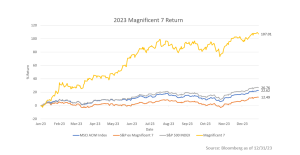
In 2023, the magnificent seven were up a combined 107% and accounted for 60% of the gain in the S&P 500 index.  Should investor sentiment sour on these companies, the S&P 500 index will struggle. For individual equities, we remain focused on quality investments which we believe outperform over a market cycle with lower volatility.

For bond markets, after decades of low interest rates, we believe higher yields – around 4% – will provide attractive returns for fixed-income investors. We believe the Fed’s December pivot towards lowering interest rates gives investors a solid backdrop to investing in fixed income.  Investors should be rewarded by extending maturities and locking in attractive interest rates.

As always, we view all market forecasts with skepticism and keep a close eye on economic data and markets.  Considering forecasters’ big miss for 2023, it is important to be flexible in our views and remain focused on improving long-term outcomes for client portfolios.


This document is provided for general informational purposes only and should not be construed as containing investment advice. For individualized investment advice, please consult your adviser.  This document contains forward-looking statements, predictions and forecasts (“forward-looking statements”) concerning our beliefs and opinions in respect of the future. Forward-looking statements necessarily involve risks and uncertainties, and undue reliance should not be placed on them. There can be no assurance that forward-looking statements will prove to be accurate, and actual results and future events could differ materially from those anticipated in such statements.


Crestwood Advisors Announces New President

FOR IMMEDIATE RELEASE

Boston-based advisory firm strengthens leadership team for continued growth and client value

Boston, Mass. (January 8, 2023) – Crestwood Advisors (“Crestwood”), a boutique investment advisory and wealth management firm based in Boston and with offices in Connecticut and Rhode Island, is pleased to announce the appointment of Leah R. Sciabarrasi, CFP® as President, effective January 1, 2024.

“Leah’s appointment as President is a natural evolution of her leadership within Crestwood,” said CEO/Managing Partner and Portfolio Manager Michael A. Eckton, CFA. “Her dedication to the growth and success of the firm has been evident throughout the years, and I am confident in her ability to guide Crestwood in the years ahead.”

Leah, who has been with Crestwood since its inception in 2003, has been instrumental in the firm’s growth and success. Starting as Director, she became a Partner in 2008 and assumed the role of Managing Partner in 2017, co-leading the firm’s direction and strategic initiatives.

“I am honored to take on the expanded role of President at Crestwood Advisors,” said Leah, who will continue to serve as Managing Partner and Wealth Manager. “I am committed to driving our organization’s mission to deliver an exceptional experience for our clients as well as continued strategic growth, and I look forward to remaining focused on the long-term success of our clients and the firm.”

Beyond her professional achievements, Leah is active in philanthropy, serving on charitable boards for over 15 years. She spent nearly 10 years on the board of Economic Mobility Pathways (EMPath), eventually serving as Chair.  Leah also served as Co-Chair of the Professional Advisory Council for the Boston Foundation. Currently, she is a dedicated member of the Board of Directors of PSC Partners Seeking a Cure and sits on the External Advisory Board of the Harvard Digestive Diseases Center. She is also a member of the Boston Estate Planning Council and Ellevate.

“Leah has played a pivotal role in our firm’s impressive growth and continued team success. She also leads by example and pours herself into our community and our industry in meaningful ways,” said John W. Morris, Managing Partner and Wealth Manager.

Last year, Crestwood Advisors celebrated its 20th anniversary, highlighting two decades of dedication to client success and financial excellence. The firm’s growth trajectory was further accentuated by the successful merger with Endurance Wealth Management, Inc., elevating Crestwood’s total headcount to more than 55 employees.

Notably, Crestwood recently expanded its Connecticut office presence in Darien and has exciting plans for 2025, having signed a 10-year lease for a larger space in the rapidly developing Corbin District.

Looking ahead to 2024, the firm anticipates further strategic growth initiatives to enhance its position as a leader in wealth management.

### 

About Crestwood Advisors
Crestwood Advisors is an independent, fee-only, wealth management firm with over $5.3 billion in assets under management. Founded in 2003, and a partner Firm of Focus Financial since 2017, Crestwood Advisors provides investment management with financial planning strategies to help high-net-worth individuals and families identify and prioritize their goals and build sustainable wealth so that they may enjoy more financially secure and purposeful lives. For more information, please visit https://www.crestwoodadvisors.com.

Wealth Planner Janie Monroe CFP®, CFA, Shares Her Thoughts with CNN On Leveraging The Latest 401(k) Plan Changes in 2024

Start the new year by leveraging the latest 401(k) plan changes to enhance your retirement planning! A notable change for 2024 is the increased contribution limit, offering a greater opportunity to grow your retirement savings.

Wealth Planner Janie Monroe CFP®, CFA, advises checking if your plan includes an automatic increase feature. This can help you effortlessly maximize your 401(k) contributions. If your plan doesn’t have this feature, you might need to set a specific annual savings target.

To read the full article click here.