April 2026 Economic and Market Update: Geopolitics at the Forefront

The U.S.-Iran conflict escalated in late February, shifting from a geopolitical risk to a real supply disruption. Markets responded with a broad risk-off move across equities and bonds.

The Strait of Hormuz and the Energy Shock

On March 4, Iranian forces declared the Strait of Hormuz closed, restricting tanker traffic through a waterway that carried roughly 20 million barrels of oil per day as of 2024, representing approximately 27% of global maritime petroleum trade.1 The commercial shipping community responded immediately: insurers withdrew coverage and major oil companies halted transits. Brent closed above $100 per barrel on March 12, the first time since August 2022.2 The International Energy Agency characterized the disruption as the largest in the history of the global oil market.3

  • The scope of the selloff: March’s selloff was broad-based, with most sectors declining and only Energy posting a meaningful gain. The S&P 500 returned -4.3% in the first quarter, but index-level results still diverged sharply: the Russell 1000 Growth Index fell 9.8%, while the Russell 1000 Value Index rose 2.1%. That gap was driven largely by index composition, as value benchmarks benefited from their heavier exposure to Energy. However, the dominant impulse across the market overall was macro de-risking, not rotation.4
  • Treasury yields increased: Treasury yields rose sharply throughout the month. The 10-year U.S. Treasury yield closed near 4.43% as of March 27, up materially from its February month-end level of 4.15%, while the 2-year yield rose in parallel as investors pared back expectations for near-term Fed cuts.5
  • The supply architecture: OPEC+ holds approximately 3.5 million barrels per day of spare capacity, concentrated in Saudi Arabia and the UAE, but a significant portion of that capacity cannot reach global markets if the Strait remains inaccessible. Saudi Arabia and the UAE moved quickly to reroute oil via overland pipelines, and the International Energy Agency coordinated an emergency stock release that could approach 3 million barrels per day. These measures provide a partial buffer, characterized as stop-gap solutions rather than structural offsets. Importantly, the strait remains the bottleneck and overland pipeline capacity covers only a fraction of normal volumes.3, 6

Implications for Investors: The near-term inflation impact is real: U.S. gas prices rose approximately $0.60 per gallon in the two weeks following the start of the conflict, and Bloomberg Economics estimated March CPI at 3.4% year-over-year, up from 2.4% in February. The medium-term economic impact depends almost entirely on how long the Strait remains disrupted. Combined with slower job growth and sluggish wage increases, higher energy costs are likely to hurt lower-income consumers. This volatility is a reminder that while geopolitical risk can never be avoided entirely, there are tangible benefits to being diversified across sectors, geographies, and asset classes.

The Fed: Holding Course While the Map Changes

The Federal Open Market Committee met on March 17 and 18 and voted 11 to 1 to hold the federal funds rate unchanged at 3.50% to 3.75%.7 The decision was widely anticipated. What made the meeting notable was what the committee said, not what it did. The FOMC statement explicitly acknowledged that developments in the Middle East create uncertainty for the U.S. economy, a direct insertion of the conflict into the official policy framework. Chair Powell summarized the committee’s posture with characteristic plainness: the Fed simply does not yet know what the economic consequences of the conflict will be.

  • The inflation data (before the shock): February CPI came in at 2.4% year-over-year, matching January’s 2.4% and down from 2.7% in December 2025, and core CPI rose 2.5%. Those readings were constructive. The energy-driven inflation shock that began in early March will not fully appear in official data until April and May releases.10
  • Updated projections: The March Summary of Economic Projections (aka the “Fed’s Dot Plot”) revised inflation projections upward, with the median Personal Consumption Expenditure (PCE) inflation forecast for 2026 increasing 0.3% to 2.7%, the largest single-year upward revision in recent memory. The median projected federal funds rate for year-end 2026 remains at 3.4%, implying one additional 25-basis-point cut over the remainder of the year.7, 8
  • Shifting Expectations: Before the conflict, futures markets were pricing two rate cuts in 2026 with a small probability of a third. By month-end, the consensus had collapsed to at most one cut, with CME FedWatch showing a meaningful probability of no cut at all this year. Seven of 19 FOMC participants indicated in the dot plot that they expect rates to stay unchanged through year-end, one more than in December.7, 9

Implications for Investors: The Fed’s current position is genuinely uncomfortable: headline inflation is heading higher in the near term due to energy prices, growth data is softening, and the committee has limited room to act in either direction without signaling something it does not intend. The Fed tends to watch Core inflation, which excludes often-volatile energy and food prices, because it is a better gauge of persistent price trends. During periods of sharply rising energy prices, like today, the Fed will be watching Core inflation to see if this results in higher costs in other goods and services.

A disruption that resolves quickly would allow the committee to resume its easing path and reassure bond markets. Prolonged disruption risks entrenching elevated inflation expectations. How events unfold from here will depend almost entirely on the timeline of the disruption. In either scenario, portfolio duration and credit quality are the levers most worth watching.

Trends Worth Noting

  • The AI investment cycle has not been disrupted by the selloff: The March drawdown was a macro event, not an AI story, and the distinction matters. AI capex commitments from major technology companies have not reversed and earnings from the tech sector are expected to significantly outpace the rest of the market. The risk is not that AI investment collapses; the risk is that a prolonged energy shock delays the translation of that investment into bottom-line results.11
  • Earnings resilience is holding: Despite the market selloff, the fundamental earnings backdrop has not broken down. S&P 500 companies are expected to report double-digit earnings growth for a sixth consecutive quarter in Q1 2026, with FactSet’s blended estimate at 13.2% year-over-year as of early April. Energy sector earnings revisions have turned sharply positive. The broader question entering the second quarter is whether oil-driven cost pressures and weakening consumer confidence begin to show up in guidance. 11, 13
  • Stagflation concerns are rising: The combination of energy-driven inflation and softening growth data has put the S-word back on investors’ radar. February job openings fell to 6.88 million, with the hires rate dropping to 3.1%. This was the lowest since the early months of the pandemic and may be an indication that the labor market is losing momentum. What distinguishes the current episode from the 1970s analogy, at least for now, is that longer-term inflation expectations remain well anchored, and corporate earnings have not yet deteriorated. If either deteriorates, stagflation could be on the horizon.12


The Takeaway

The Strait of Hormuz crisis triggered a selloff that cut across styles, market capitalizations, and sectors as a sudden repricing of inflation and growth simultaneously overwhelmed the reallocation logic that normally drives market rotation. The Fed is navigating a dual-mandate conflict with limited room to maneuver, earnings have held up but the economic landscape is changing, and the resolution of the energy shock depends on a variable no economic model can forecast. What the Trends and Implications described above share is that they were in motion before March and will outlast it: the stagflation debate, the AI capex cycle, and the argument for geographic diversification are not products of one difficult month. Patience, breadth, and a bias toward quality remain the prudent investment philosophy.


RETURNS OF MARKET INDICES

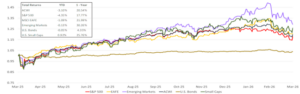
Global equity markets saw large declines in March as a whole (MSCI ACWI -7.1%) led by Emerging Markets (MSCI Emerging Market Equity Index -13%). U.S. large caps (S&P 500) fared better during this period but were still down 5%, in line with U.S. small caps (Russell 2000 -5%). International developed (MSCI EAFE) equities fell 10%. Bonds declined by 1.8% for the month.  YTD returns are shown in the chart below.14

Sources
  1. U.S. Congressional Research Service, “Iran Conflict and the Strait of Hormuz: Impacts on Oil, Gas, and Other Commodities,” R45281, updated March 2026. Approximately 27% of world maritime oil trade transits the Strait; 2024 volumes approximately 20 million barrels per day.
  2. CNBC, “Brent oil closes at $100 after Iran’s new supreme leader says Strait of Hormuz must remain closed,” March 12, 2026; CNBC, “Front-month Brent oil futures extend gains after record monthly rise in March,” April 1, 2026 (citing LSEG data). Brent closed above $100 on March 12; reached an intramonth high before easing; Brent monthly gain approximately 64%, a record per LSEG data dating to 1988. WTI gained approximately 51% in March, best month since May 2020.
  3. International Energy Agency, Oil Market Report, March 2026. Characterized as the largest supply disruption in the history of the global oil market. Global oil supply projected to fall approximately 8 mb/d in March. Brent futures traded within a whisker of $120/bbl at intramonth high.
  4. S&P Global Market Intelligence, “US REIT stocks outperform broader stock market in Q1 2026,” April 2026 (citing S&P Dow Jones Indices data as of March 31, 2026): S&P 500 Q1 2026 total return -4.3%. Russell style and size returns from Confluence Financial Partners, “First Quarter 2026 Market Recap,” April 2026, citing Morningstar and FTSE Russell data as of March 31, 2026: Russell 1000 Growth -9.78%; Russell 1000 Value +2.10%; Russell 2000 +0.89%.
  5. Federal Reserve, H.15 Selected Interest Rates (federalreserve.gov). 10-year Treasury constant maturity: approximately 4.15% at February 28 month-end, 4.43% as of March 27. Bloomberg U.S. Aggregate Bond Index: fell -1.76% in March; Q1 2026 total return -0.05%, per Confluence Financial Partners, “First Quarter 2026 Market Recap,” April 2026, citing Bloomberg data as of March 31, 2026.
  6. IEA, Oil Market Report, March 2026. OPEC+ spare capacity approximately 3.5 mb/d. IEA coordinated emergency stock release; U.S. Energy Secretary Chris Wright indicated a release that could approach 3 mb/d per CNBC, March 12, 2026.
  7. Federal Reserve, “Federal Reserve Issues FOMC Statement,” March 18, 2026; Federal Reserve, Summary of Economic Projections, March 18, 2026. Federal funds rate held at 3.50%-3.75%; 11-to-1 vote.
  8. Federal Reserve, Summary of Economic Projections, March 18, 2026. GDP median revised to 2.4% for 2026; PCE inflation median revised to 2.7% for 2026 (+0.3 percentage points vs. December 2025 projections). Median end-2026 federal funds rate projection 3.4%, implying approximately one additional 25 basis point cut.
  9. CNBC, “Fed Interest Rate Decision March 2026,” March 18, 2026; Kiplinger, “March Fed Meeting: Updates and Commentary,” March 18, 2026. Seven of 19 FOMC participants projected no cut in 2026.
  10. Bureau of Labor Statistics, Consumer Price Index Summary, February 2026 (bls.gov). February CPI +2.4% year-over-year; January CPI +2.4% year-over-year (down from 2.7% in December 2025); core CPI (all items less food and energy) +2.5% year-over-year.
  11. FactSet, Earnings Insight, week of April 2, 2026 (insight.factset.com). Q1 2026 blended EPS growth estimate: 13.2% year-over-year, which would mark the sixth consecutive quarter of double-digit earnings growth. Energy and Information Technology sectors recorded the largest upward EPS revisions since December 31.
  12. Bureau of Labor Statistics, Job Openings and Labor Turnover Survey (JOLTS), March 2026 release (bls.gov), reporting February 2026 data. Job openings fell 358,000 to 6.882 million at end of February 2026. U.S. EIA Short-Term Energy Outlook, March 2026 (eia.gov): gasoline prices forecast approximately 60 cents/gallon higher in March due to higher crude prices; national average exceeded $4/gallon by end of March per TPFG Market Pulse March 2026 (citing Bloomberg).
  13. S&P Global Market Intelligence, “Global Economic Outlook: March 2026,” March 2026. U.S. and Canada characterized as net energy exporters facing relatively mitigated Hormuz economic impact. Index return figures cross-referenced against endnote 4.
  14. Bloomberg. Returns of Market Indices chart data as of March 31, 2026. EAFE is MSCI EAFE Index; Emerging Markets is MSCI Emerging Markets Index; U.S. Bonds is Barclays U.S. Aggregate; ACWI is the MSCI ACWI Index; Small Caps is the Russell 2000 Index; S&P 500 is the S&P 500 Index. March 2026 returns shown.

Beyond the Numbers: How Women Are Redefining the Experience of Wealth

For many women, wealth is not just about accumulation, it’s about flexibility, independence, and the ability to navigate life’s complexities with confidence. That perspective is increasingly shaping how financial decisions are made and what long-term success looks like.

March offers a natural moment to pause and reflect on the achievements, influence, and evolving roles of women. In the U.S., it’s recognized as Women’s History Month, and globally, March 8th marks International Women’s Day. In that spirit, it is also an opportunity to consider how women often experience life, and wealth, a bit differently. Not in ways that need to be overcomplicated, but in ways that are important to recognize.

For many women, the financial journey is shaped less by a straight line and more by the rhythm of life itself, periods of momentum, pause, responsibility, and reinvention. Careers may evolve alongside family needs, raising children, supporting aging parents, or recalibrating priorities as circumstances change. These decisions are rarely made in isolation; they reflect values, relationships, and a broader definition of what it means to build a life of purpose.

At the same time, women often carry a longer time horizon. Living longer on average can mean more chapters, more time spent building, supporting others, and eventually navigating life independently.  Over time, many women step into greater financial responsibility, sometimes gradually, sometimes all at once. What begins as a shared effort can become more individual, bringing both opportunity and complexity.

These shifts don’t always come with a clear roadmap. Historically, many women were less involved in day-to-day financial decisions, often by design or circumstance. That dynamic is changing.  More women are engaging earlier, asking thoughtful questions, seeking context, and wanting to understand not just what decisions are being made, but why. Confidence tends to build not from having every answer, but from developing a clear sense of direction over time.

There are also broader realities that shape this experience. Differences in earnings and career paths still exist, and while they may feel incremental in the moment, they can compound over time. What stands out, however, is how many women approach these dynamics, with a steady, long-term mindset and a focus on making thoughtful, intentional decisions. That discipline, grounded in consistency rather than reaction, can be a meaningful advantage over time.

We are also in the midst of a broader shift. As wealth transitions across generations, women are increasingly stepping into the role of primary decision-maker. Often, this occurs during already significant life moments, times that require both reflection and action. With that comes an opportunity to shape not just financial outcomes, but the role wealth plays more broadly: supporting family, enabling flexibility, and creating a sense of stability and independence.

This Women’s History Month, it is worth recognizing not just how much has changed, but how women continue to shape what comes next, within families, communities, and across generations. While every path is different, the desire for clarity and confidence remains consistent.

At Crestwood, we work closely with women navigating these moments, whether that means stepping into greater financial responsibility, balancing competing priorities, or simply wanting a clearer understanding of where things stand. If this resonates, we would welcome the opportunity to continue the conversation.


Refocus, Refresh, and Reset Your Financial Life This Spring

Spring cleaning is a familiar ritual. We open the windows, clean out closets, and refresh the spaces we inhabit every day. But just as dust accumulates in the corners and under the beds of our homes, financial clutter can quietly accumulate in our accounts, documents, and financial plans.

Financial “spring cleaning” is not necessarily about making dramatic changes. Rather, it’s about restoring clarity and intention. By organizing accounts, updating beneficiaries, reviewing account titles, reevaluating cash flow, savings, and retirement assets, and refreshing your financial plan, you can keep your financial life aligned with your goals.

Update Beneficiaries
One often-overlooked aspect of financial housekeeping is designating beneficiaries. Retirement accounts, life insurance policies, and certain brokerage accounts pass directly to named beneficiaries, outside of your will. Outdated designations, especially following major life events like marriage, divorce, birth of a child, or death of a loved one, can result in unintended consequences.

Review each account and confirm that both primary and contingent beneficiaries reflect your current wishes. Don’t ignore the “per stirpes” option to ensure your intended split. If your estate plan includes a revocable trust, ensure that beneficiary designations align with that structure.

Update Estate Planning Documents
In addition to beneficiary updates, review core estate planning documents such as wills, trusts, powers of attorney, and healthcare directives. Laws change, family circumstances evolve, and financial complexity increases over time. An estate plan drafted years ago, or in another state, may no longer reflect your current circumstances.

Confirm that executors, trustees, or guardians remain appropriate choices. Ensure that your powers of attorney are current and recognized by financial institutions. Don’t forget to address digital assets, including instructions for accessing online accounts.

Simplify Your Financial Life
Financial clutter often results from career transitions. Many individuals accumulate multiple employer-sponsored retirement plans over time. Leaving assets scattered across several 401(k) accounts can make investment management more complicated and may increase fees.

Rolling these into one or two IRAs (Rollover and/or Roth, depending on the tax treatment) can centralize investments, broaden available investment options, and reduce administrative complexity.

Streamlining can also apply to non-retirement accounts. Consolidating accounts may improve reporting efficiency, reduce paperwork, and enhance coordination with your advisor. Fewer accounts often mean fewer blind spots and fewer online passwords to remember. Always use strong, unique passwords to safeguard your online presence and update them periodically.

Refresh Your Investment Strategy
Over time, market movements can cause portfolios to drift away from their intended allocation. In addition, there may have been changes to your situation that can affect your investment strategy. Spring cleaning provides an opportunity to review asset allocation, risk exposure, and performance of your investments with your team to determine if your asset allocation should be adjusted to restore alignment with your goals and risk tolerance.

Evaluate whether your portfolio still reflects your time horizon, liquidity needs, and current economic circumstances. For retirees or those nearing retirement, confirm that sufficient liquid assets are still available to fund short-term needs without forced selling during periods of volatility. For younger investors, ensure that growth-oriented allocations remain consistent with long-term objectives.

Check Your Coverage
It can also be a good time to reassess insurance coverages. Review life insurance amounts relative to income replacement needs, debt obligations, and education funding goals. Confirm that disability insurance remains adequate, especially if income has increased. Evaluate property and umbrella liability coverage to ensure sufficient asset protection.

As your net worth grows, so does your risk exposure. Proper coverage provides peace of mind and preserves financial stability in the face of unexpected events.

Plan For the Future
Finally, spring offers a natural opportunity to refresh your perspective and plan for the future. It can be a time to speak with your advisor to revisit and clarify short- and long-term goals including cash flow, retirement savings and timing, education funding, home purchases, charitable giving, business succession, or travel plans.

Cash flow planning is key. Reexamining your cash inflows and outflows allows you to best align resources with priorities. If extra cash exists, deploy it strategically toward investment or debt reduction. If constraints exist, adjust spending or savings accordingly.

Restoring Order
Spring cleaning is not always fun, but the sense of order it brings is rewarding. The same is true when you take time to bring clarity and organization to your financial life. By stepping back to organize, streamline, and revisit your plan, you can help ensure your finances remain aligned with your goals and priorities.

Just like spring cleaning your home, organizing your finances is easier with a plan. Start by building a checklist of priorities and let your Crestwood team guide you through each step with clarity and confidence.

If you are not yet a Crestwood client, we welcome the opportunity to connect and support you, contact us.

March 2026 Economic Update: The Markets Shifts on AI Expectations

February delivered rotation, drama, and a useful reminder that not all markets move in the same direction at once.

The AI Trade Gets More Complicated
Nvidia posted a genuine blowout fourth quarter, with revenue up 73% year over year and data center demand still accelerating, yet shares fell more than 5% the day earnings were released.1 The Magnificent 7 is now down roughly 7% year to date.2 It was a clean illustration of where the AI trade stands heading into 2026: fundamentals remain strong, but the market has moved from pricing in potential to demanding proof.

  • Disruption anxiety: Mentions of AI disruption on S&P 500 earnings calls nearly doubled from the prior quarter.3 That is encouraging if your company is building the infrastructure. It is considerably less so if your business model might be disrupted by AI. In the market’s crosshairs are software stocks, which have been hit hard over concerns that AI will be easily able to create competing solutions. The stock prices of private credit firms that lend to these software companies likewise pulled back on similar worries.
  • The Counterpoint: Fundamental earnings for most software stocks have remained stable. Many firms have reiterated guidance and some companies like Salesforce announced a massive share buyback, indicating that investors may be overestimating the depth and breadth of AI disruption. So too with private credit funds, where the loan books of higher quality lenders appear healthy.
  • Belief in future success of AI remains high: Open AI raised $110 billion in their most recent round of funding, bringing the estimated valuation to $840 billion.4 This reflects private capital’s seemingly insatiable appetite for AI models. For perspective, at an $840 billion market capitalization, OpenAI would be the 12th largest company in the S&P 500. OpenAI’s revenue is growing quickly, but the path from revenue to durable, defensible profit remains years away.

Implications for Investors: The AI trade is just starting to evolve. The era of rewarding any company with “AI” in its investor deck is giving way to one that demands evidence of monetization, defensible competitive position, and a credible path to returns on capital. Infrastructure providers with genuine pricing power remain attractive. Owning broad, diversified exposure rather than concentrated bets on any single theme, whether hardware, model providers, or AI-adjacent software, remains the prudent strategy. The winners of the next phase may look quite different from the leaders of the last one.

Tariffs, the Supreme Court, and a Messy Macro Backdrop

February produced the most dramatic tariff development since early 2025 when the Supreme Court ruled 6-3 that the president exceeded the International Emergency Economic Powers Act (IEEPA) authority used to impose broad reciprocal tariffs. Those tariffs had pushed the average effective U.S. tariff rate to roughly 16% at their peak, the highest level since the 1930s. The court struck down President Trump’s use of tariffs under IEEPA.

  • The legal response and new tariff authority: President Trump responded by invoking Section 122 of the Trade Act of 1974, a narrower authority that permits tariffs of up to 15% for up to 150 days to address balance-of-payments deficits. A 10% global tariff took effect February 24; the following day the president announced his intention to raise the rate to 15%. Previously negotiated bilateral framework agreements with major trading partners remain in place, for now.
  • Tariff Layer Cake: The IEEPA tariffs were the largest single layer, but not the only one. Other tariffs remain intact: 50% on steel and aluminum, 25% on imported automobiles, and 10% on lumber. The U.S.-China truce also remains in effect. The average effective tariff rate fell from roughly 16% at its peak to an estimated 13.7% following the ruling and the Section 122 replacement.7, 8
  • GDP and the macro backdrop: Fourth quarter growth came in at 1.4%, well below the 2.8% consensus, partly due to the 43-day government shutdown, which likely reduced GDP by 1-2% according to the Congressional Budget Office (CBO). Consumer spending and business investment were both positive underneath the headline, suggesting underlying momentum remains intact.5, 6
  • Inflation and the Fed: January PPI rose 0.5% for the month versus a 0.3% forecast. Core PPI gained 0.8%, more than double expectations. That combination may encourage the Federal Reserve to remain cautious about cutting rates. The next FOMC meeting is March 17 to 18, with updated economic projections to follow. Rate cuts remain possible in 2026, but a re-acceleration in wholesale prices as well as inflationary pressures coming from the new conflict in Iran makes this less certain.7, 8

Implications for Investors: The tariff story has a new chapter but is far from over. The Section 122 tariff expires around mid-July 2026 absent congressional action, creating a near-term policy cliff. New tariff authority is being pursued through additional legal vehicles while companies like Costco who were heavily impacted by the tariffs will seek reimbursement. For investors, diversified geographic exposure remains the sensible hedge. The combination of tariff uncertainty, the evolving situation in Iran and sticky inflation may limit the Fed’s ability to respond if growth weakens.

Trends Worth Noting

  • Buybacks hit a record: Corporate America authorized $233 billion in February repurchases, the largest February on record. Salesforce, Walmart, and Verizon led.9 Companies buying their own stock at this scale represents sustained, informed demand for equities.
  • Small caps outperformed: The Russell 2000 is up roughly 6% year to date while the S&P 500 is essentially flat.10 Smaller companies draw more revenue domestically and stand to benefit most from any eventual Fed rate cuts.
  • International markets led: Developed markets outside the U.S. gained roughly 10% year to date, with the MSCI EAFE logging 14 consecutive weekly gains late in the month.11 Emerging markets added 14%.12 European earnings momentum and a slight dollar decline both helped.

The Takeaway
Earnings season confirmed healthy fundamentals: roughly 14% year-over-year earnings growth, the fifth consecutive quarter of double-digit expansion.13 The underlying economy is slowing from its recent pace but still growing. The rotation toward smaller companies and international stocks validates the case for diversification we have been making for months. Patience and discipline remain the appropriate posture.

RETURN OF MARKET INDICES
Global equity markets (MSCI ACWI) were positive for the month (+1.3%) led by non-U.S. Equities. U.S. large caps were down slightly in February (S&P 500 -0.8%) while U.S. small caps (Russell 2000) were the reverse mirror image, rising by 0.8%. International developed (MSCI EAFE) and emerging market equities (MSCI Emerging Markets Index) were the standouts rising by 4.7% and 5.5%, respectively. Bonds provided quiet ballast as yields drifted lower on slowing growth data, with prices rising 1.6% for the month.


Source: Bloomberg. EAFE is MSCI EAFE Index(1), Emerging Markets is MSCI Emerging Markets(2) and U.S. Bonds is Barclays U.S. Aggregate(3). ACWI is the MSCI ACWI Index(4). Small Caps is the Russell 2000 Index(5). S&P 500 is the S&P 500 Index(6). The above information is as of 2/28/2026.

Sources

1 Bloomberg Equity Markets; Nvidia Q4 FY2026 earnings release, February 26, 2026.

2 Bloomberg Magnificent 7 Index, year-to-date return as of February 27, 2026.

3 Bloomberg transcript analysis of S&P 500 Q4 2025 earnings calls, February 2026.

4 Bloomberg News, OpenAI Series G financing, February 2026.

5 U.S. Bureau of Economic Analysis, Advance Estimate of Q4 2025 GDP, released February 20, 2026.

6 U.S. Congressional Budget Office, estimate of partial government shutdown impact on Q4 2025 GDP growth, February 2026.

7 U.S. Bureau of Labor Statistics, Producer Price Index news release for January 2026, released February 27, 2026.

8 Federal Reserve, FOMC meeting calendar. The March 17 to 18, 2026 meeting will include a Summary of Economic Projections (federalreserve.gov).

9 Birinyi Associates, U.S. corporate buyback authorization data, February 2026, as reported by Bloomberg. $233.3 billion authorized in February, the largest February on record. Individual company figures from company investor relations announcements: Salesforce $50 billion (February 25, 2026); Walmart $30 billion; Verizon $25 billion.

10 Russell 2000 Index and S&P 500 Index, year-to-date total returns as of February 27, 2026. FTSE Russell; S&P Dow Jones Indices.

11 MSCI EAFE Index, year-to-date net total return as of February 27, 2026. MSCI Inc.

12 MSCI Emerging Markets Index, year-to-date net total return as of February 27, 2026. MSCI Inc.

13 FactSet Earnings Insight, S&P 500 Q4 2025 earnings season, week of February 27, 2026 (factset.com). Blended earnings growth rate of 14.2% with 96% of S&P 500 companies reporting; fifth consecutive quarter of double-digit earnings growth.

Financial Alignment for Couples: Expectations vs. Reality

Most couples feel confident about how they communicate around money. Fidelity’s 2024 Couples & Money Study found that nearly 9 in 10 couples say they communicate well or very well about finances, and many report making important financial decisions together.¹

Yet money remains one of the most common sources of tension in long-term partnerships. While many couples report feeling aligned, a meaningful number still experience recurring disagreements, stress, or avoidance as financial decisions become more complex or emotionally charged.¹

Money decisions are rarely just about numbers.

Different Backgrounds, Different Assumptions
Each partner brings their own financial history into the relationship. How money was handled earlier in life, whether it was discussed openly, avoided, or treated as a source of security or stress, often influences attitudes toward spending, saving, and risk.

Even in strong relationships, these differences are not always fully understood. Fidelity’s related research notes that more than one-third of spouses do not know what their partner earns, and many couples disagree about how much they need to save for long-term goals.2

These gaps often reflect deeper differences in assumptions and expectations. What feels responsible to one partner may feel overly restrictive or unnecessary to the other. These differences are rarely about right or wrong, but they can quietly drive misunderstandings if left unaddressed.

Managing Financial Complexity as a Shared System
For many couples, the challenge is no longer simply combining finances. It is managing a growing and increasingly interconnected financial picture together.

Multiple accounts, investment strategies, concentrated positions, business interests, real estate, charitable planning, and estate considerations all introduce layers of complexity that require coordination and clarity. As that complexity grows, so does the impact of each decision.

Choices around investment strategy, tax planning, philanthropy, or legacy planning no longer affect just one individual, but the broader financial system the couple has built together. When roles, expectations, or levels of involvement have not evolved alongside that complexity, even well-established couples can experience frustration and misalignment around money.

Decision-Making Under Stress
Even couples who communicate frequently about money can struggle when decisions feel high-stakes or emotionally charged.

Research suggests that individuals experiencing financial stress are significantly less likely to engage in productive financial conversations with their partner.3 Anticipating conflict or discomfort can lead couples to delay or avoid conversations altogether, reinforcing miscommunication and unmet expectations.

This helps explain why confidence in communication does not always translate into confidence in decision-making.¹ It is not simply whether couples talk about money, but how they navigate decisions when uncertainty, complexity, or pressure are present.

The Role of an Advisor
For couples navigating these dynamics, professional guidance can be an effective resource. An experienced financial advisor can help bridge the gap between expectations and reality. An advisor offers a neutral perspective that can help de-escalate emotionally charged discussions and refocus conversations on shared goals rather than blame or fear.

Differences in financial knowledge can create unintentional imbalances. Advisors can help raise the overall level of understanding, so both partners feel confident participating in decisions that affect their shared financial system. Structured conversations create space for discussions that may not happen organically, while ensuring both partners remain equally engaged.

A formal financial plan provides a clear roadmap that reflects both partners’ priorities. Seeing decisions and trade-offs documented helps transform abstract goals into actionable strategies. By involving both partners consistently, advisors foster transparency and accountability.

Supporting Financial Alignment
At Crestwood, we work alongside couples to bring clarity and perspective to these conversations. Through objective guidance and shared planning, we support confident financial decisions aligned with long-term goals and legacy priorities.

If you would like to explore how these dynamics show up in your own financial decision-making, your Crestwood team is always available to serve as a thoughtful sounding board.

1  2024 Fidelity Investments Couples & Money Study
https://preview.thenewsmarket.com/Previews/FINP/DocumentAssets/660835_v4.pdf

2 Fidelity Learning Center – What Spouses Need to Know
https://www.fidelity.com/learning-center/wealth-management-insights/what-spouses-need-to-know

3  Discussing Money With the One You Love: How Financial Stress Influences Couples’ Financial Communication,
Journal of Consumer Psychology, June 15, 2024
https://myscp.onlinelibrary.wiley.com/doi/abs/10.1002/jcpy.1430

Caring for Others While Carrying So Much

More than 63 million Americans serve as family caregivers, often dedicating significant time each week to supporting a loved one, frequently for years at a time. Many are also managing careers, children, households, and broader responsibilities.*

Caregiving can be deeply meaningful, but it can also be physically exhausting, emotionally layered, and quietly overwhelming.

We often see capable, high-functioning individuals assume these responsibilities without hesitation. What’s less visible is the cumulative strain that can build over time.

If you are caring for a loved one, how can you better support yourself along the way? A few considerations may help create steadiness amid the demands:

Acknowledge the Weight

Caregiving is not just a logistical commitment; it is emotional work. The decisions, the vigilance, the sense of responsibility can be constant. Recognizing that strain is not a weakness; it is awareness. Naming it is often the first step toward managing it more sustainably.

Create Space Where You Can

Even small structures can make a difference, shared calendars among family members, clear communication about roles, technology that reduces daily friction, or designated time that protects your own rest. Thoughtful organization is not about control; it is about preserving energy.

Accept That Support Is Strength

Many caregivers default to handling everything themselves. Yet support, whether from siblings, friends, community groups, or professional caregivers, can extend capacity and reduce burnout. Seeking help is not stepping back from responsibility. It is ensuring you can continue to show up well.

Monitor Your Own Well-Being

Persistent fatigue, irritability, health changes, or emotional depletion are signals worth taking seriously. Sustainable caregiving requires caring for the caregiver. Protecting your own health is not separate from supporting your loved one, it is essential to it.

Caregiving rarely unfolds in isolation from the rest of life. It affects relationships, energy, work, and often financial decisions as well. If you are carrying these responsibilities, we encourage you to bring them into the conversation.

At Crestwood, helping families navigate complexity, including the practical and financial implications of caregiving, is part of comprehensive wealth planning. You do not need to manage it alone; your Crestwood team is here to help you approach these decisions with clarity and confidence.

If you are not yet a Crestwood client, we welcome the opportunity to connect and support you, contact us.

This document is provided for general informational purposes only by Crestwood Advisors, an investment adviser. Crestwood Advisors does not endorse, sponsor, or promote any of the products or companies listed or mentioned in this material. Any references to specific products or services are purely incidental and are included solely to illustrate potential strategies or concepts. The inclusion of such references does not imply any form of partnership, relationship, or approval by the Firm.

* Caregiving in the US Research Report, AARP®, National Alliance for Caregiving, July 2025

February 2026 Economic Update: A Fed Pause and Warsh is Nominated to Chair the Fed

January set a tone for a more cautious investor stance. Much of the U.S. was forced to trudge through snow from recent winter storms and similarly labor markets are trudging slowly along. We remain in a low-hire, low-fire equilibrium. Employers are hesitant to expand, given fiscal uncertainty but are equally loath to let go of trained staff.

While corporate earnings are projected to remain healthy, with an estimated 14% growth for the year, the variables of trade policy and central bank transition create a challenging environment.

After three consecutive cuts to end 2025, the Fed shifted stance to a wait-and-see outlook as the committee voted to hold interest rates steady at the January meeting. The FOMC’s internal debate appears centered on the neutral rate (the level at which policy neither stimulates nor restricts growth) with two of the twelve voters advocating for further cuts to support a slowing manufacturing sector.

A notable development was the nomination of Kevin Warsh to succeed Powell when his term ends in May. During his previous time as a Fed Governor (2006-2011), Warsh was initially supportive of crisis-era liquidity and low rates but opposed the second round of quantitative easing (QE2) in 2011 which he believed would lead to inflation.

Warsh has yet to be confirmed, which could be a challenging  process1, but understanding his outlook on the Federal Reserve can provide insight to how he might act as Fed Chair.

Warsh In His Own Words

In a November opinion piece in the Wall Street Journal2, Warsh outlined his vision:

“Fundamental reform of monetary and regulatory policy would unlock the benefits of AI to all Americans. The economy would be stronger. Living standards would be higher. Inflation would fall further. And the Fed will have contributed to a new golden age.”

Setting aside the utopian prose, his outlook is reflected in four theses, and we examine each in the context of what they mean for investors.

1) “The Fed should discard its forecast of stagflation in the next couple of years”. He believes that ”AI will be a significant disinflationary force, increasing productivity and bolstering American competitiveness. Productivity improvements should drive significant increase in real take-home wages.”

Translation: The Fed has been driving by looking in the rear-view mirror (backward looking data that shows a slowing economy and sluggish labor market). Future productivity growth and lower inflation from AI isn’t being factored in, so the Fed is being too conservative.

Implications for Investors:

  • Warsh’s logic is that AI productivity gains will manifest rapidly, offsetting the potential inflationary risk of lowering rates prematurely. Advances such as the widespread adoption of PCs and the internet have shown that technology that bolsters workers’ productivity has been a boon for economic growth and corporate earnings and helps to lower inflation.
  • We remain optimistic about the benefits of AI but believe that companies (and their investors) that adapt to this technology will see benefits long before the economy. While we agree with Warsh that AI is a rising tide, we believe some boats will rise faster than others.
  • If Warsh is less concerned about the potential for inflation, he’s more likely to be willing to lower rates independent of how backward-looking economy data is showing. Lower rates would stimulate the economy and encourage assets like small cap stocks and other speculative investments. This could also provide a tailwind for bond investors

2) “Inflation is a choice.”

Translation: Warsh argues that inflation isn’t the product of an overheated economy but rather the result of too much government spending and expansion of the Fed’s balance sheet. The head of the snake (the Fed) would be eating less of its own tail (buying its own debt).

Implications for Investors:

  • Warsh favors shrinking the Fed’s balance sheet, which could manifest in a withdrawal of meaningful government buying of Treasurys.
  • We agree that excessive government stimulus during the pandemic contributed to a surge in consumer spending and was a major contributor to inflation. However, the Fed’s balance sheet is used for quantitative easing (QE) programs designed to provide liquidity to markets and influence interest rates beyond short-term rates. Considering the U.S. Dollar is used globally for trade, many foreign banks and financial entities that hold U.S. Dollars need consistent access to U.S. debt markets. In periods of market stress, the Fed has used its balance sheet to support the normal functioning of cash and bond markets.
  • While shrinking the Fed’s balance sheet is a laudable financial goal, it may prove difficult if long-term rates crimp consumers or periods of financial stress require Fed intervention.
  • If this were to occur, it would likely lead to a steepening of the yield curve, which in turn would lead to higher borrowing costs across the economy (mortgages, corporate bonds, etc.). However, higher borrowing costs would slow the economy. Thus, even if the Fed decided to allow the curve to steepen, at a certain point they would be forced to resume purchases. This dichotomy raises doubt (and speculation) about the degree to which the policy might happen.

3)  “The Fed’s rules and regulations have systematically disadvantaged small and medium-sized banks, which has slowed the flow of credit”.

Translation: Warsh believes that by easing regulatory requirements for smaller lenders, there will be additional availability of credit.

Implications for Investors:

  • Improving the availability of credit would help grease the wheels of the U.S. economy by encouraging lending. Smaller banks would have more ability to lend, which could benefit smaller businesses.
  • However, the benefits of this could be muted in the context of an environment where credit is available, but at higher rates. For example, a lender might be willing to offer a larger mortgage but at a higher rate of interest.
  • This could lead to real estate prices continuing to remain high.

3) “Fed leaders have tried to bind U.S. banks to a complicated, vaunted set of rules in the name of global regulatory convergence.

Translation:

Warsh argues that the Fed should seek to deregulate U.S. banks and encourage them to de-couple rather than coordinate with their overseas counterparts.

Implications for Investors:

  • Deregulation of banks, in general, would likely lead to increased lending and profitability and therefore higher prices on bank stocks.
  • Many of the current regulations sprang out of past financial crises and were structured to try to prevent history from repeating. Often a crisis may start locally but have global implications. Notable examples like the 2008 Global Financial Crisis, the Great Depression, the Savings and Loan Crisis of the 1980’s-90’s, etc.
  • While excess regulation acts as a speed bump on the road to revenue, a lack of speed limits and guardrails wouldn’t make banks better “drivers”. It would likely result in banks using greater financial leverage, reducing loan quality and potentially repeating some of the errors that led to the Global Financial Crisis.

Capital Markets

Equity markets saw a notable rotation in January as investors grew cautious of the AI theme driving market recent gains amidst higher valuations. Notably this led to a wider breadth of stocks driving market gains including smaller companies (as measured by the Russell 2000).

Official data reported in January remains cloudy due to the late-2025 government shutdown. This data lag created a volatility vacuum where anecdotal evidence and earnings calls carried more weight than usual as earnings were released.

Emerging Market Equities lead the way returning an impressive 8.9% for the month. U.S. Small Caps (Russell 2000) and Developed International Equities (MSCI EAFE) also showed large gains, returning 5.4% and 5.2% respectively. U.S. Large Caps (S&P 500) lagged, returning 1.44% in January. Bonds, as measured by Bloomberg’s U.S. Aggregate index, were nearly flat for another month, eking out a slightly positive 0.11%.

Return of Market Indices

2025 was a year of economic uncertainty and concern, but also of resilience and growth. In this month’s Economic Update, we look back at the issues that dominated our thinking on the economy and financial markets each quarter and then look forward to what we’re focused on in 2026.

Source: Bloomberg. EAFE is MSCI EAFE Index(1), Emerging Markets is MSCI Emerging Markets(2) and U.S. Bonds is Barclays U.S. Aggregate(3). ACWI is the MSCI ACWI Index(4). Small Caps is the Russell 2000 Index(5). S&P 500 is the S&P 500 Index(6). The above information is as of 1/31/2026.

1 Warsh’s journey to become Fed Chair is unlikely to be quick. Post-nomination, the next step toward approval is for vetting to go through the Senate Banking Committee. However, committee member Senator Thom Tillis (R-NC) has indicated he would not on any Fed nominee until the Department of Justice’s investigation of Chair Powell over the Fed’s  headquarters is resolved which he believes is politically motivated Senator Tillis’ term ends in 2026, and he is not seeking re-election, making him less susceptible to political pressure. The Senate Banking Committee is narrowly divided (13 Republicans to 11 Democrats), thus if Tillis refuses to support the nominee, the committee the nomination could stall.

2 Warsh, Kevin The Federal Reserve’s Broken Leadership, Wall Street Journal Opinion 11/16/25

This document contains forward-looking statements, predictions and forecasts (“forward-looking statements”) concerning our beliefs and opinions in respect of the future. Forward-looking statements necessarily involve risks and uncertainties, and undue reliance should not be placed on them. There can be no assurance that forward-looking statements will prove to be accurate, and actual results and future events could differ materially from those anticipated in such statements.

Mindful Money Moves: How Self-Awareness Can Strengthen Financial Decision-Making

When we think about the financial decisions we make, we like to believe they’re always rational. Spend less. Save more. Invest wisely. In practice, however, emotions, habits, and social influences often play a quieter but equally powerful role.

You may find yourself maintaining a long-standing vacation routine even though your family’s schedule and interests have shifted. You might delay replacing a vehicle while weighing timing, tax considerations, or resale value. Or perhaps you’re evaluating a significant discretionary purchase after seeing peers make similar upgrades. None of these choices are inherently wrong, but they are worth considering.

Self-awareness helps surface the behavioral forces behind financial decisions. Familiarity, loss aversion, and social influence can subtly shape outcomes. When recognized, these dynamics become tools rather than blind spots, allowing you to make choices that better align with your broader financial picture and long-term priorities.

Below are several approaches designed to complement the way successful families already evaluate complex decisions.

Thoughtful Approaches to High-Quality Financial Decisions

Create distance before committing.
Significant decisions benefit from space. Allowing time between intention and execution, whether days or weeks, can surface considerations around timing, liquidity, taxes, and opportunity cost that are easy to overlook in the moment.

Clarify the objective.
Before proceeding, articulate what the decision is meant to accomplish, enhancing lifestyle, simplifying complexity, supporting family priorities, or responding to external signals. Precision around purpose sharpens judgment.

Evaluate the full context.
Consider the choice alongside your broader financial architecture: balance sheet strength, upcoming liquidity needs, investment strategy, estate planning priorities, and philanthropic objectives.  Strong decisions rarely exist in isolation.

Stress-test the alternatives.
Examine credible paths rather than defaulting to a single course of action. What changes if you act now versus later? Do you allocate capital here versus elsewhere? A structured comparison often strengthens conviction.

Preserve intentional flexibility.
Well-designed financial lives include room for enjoyment and spontaneity, within a framework that protects what matters most. Defining that flexibility in advance allows decisions to feel confident rather than reactive.

We are hard-wired to respond emotionally, and opportunities to act are constant. When faced with a meaningful financial choice, pausing to ask, “How does this fit within my broader plan?” can materially change the outcome.

At Crestwood, we help families connect day-to-day decisions to long-term purpose through a comprehensive planning process that integrates investment strategy, tax efficiency, estate considerations, and philanthropy. If you would like to explore how behavioral insights fit within your own roadmap, your Crestwood team is always available to serve as a thoughtful sounding board.

This document is provided for general informational purposes only by Crestwood Advisors, an investment adviser. Crestwood Advisors does not endorse, sponsor, or promote any of the products or companies listed or mentioned in this material. Any references to specific products or services are purely incidental and are included solely to illustrate potential strategies or concepts. The inclusion of such references does not imply any form of partnership, relationship, or approval by the Firm.

2026 Brings New Rules For Your 401(K) Accounts

As we move into 2026, retirement savers are facing important rule changes in employer plans like 401(k), 403(b), and 457(b) accounts. These changes affect base contribution limits, “catch-up” contribution limits for those over 50 and between the ages of 60-63, and the tax treatment of “catch-up” contributions for higher-income savers.

Key 401(k) Changes for 2026

The Limit for Base 401(k) Contributions Rises

For 2026, the maximum elective deferral, the amount an employee can contribute from their salary to a 401(k) plan, increases to $24,500, up from $23,500 in 2025. This adjustment reflects inflation and gives savers more room to build their nest eggs each year. Note: this change applies to contributors regardless of age.

Catch-Up Contributions Rise for Older Savers

So-called “catch-up” contributions, additional amounts that older savers can put aside beyond the standard limits, are also rising in 2026. These enhanced catch-up limits are designed to help those closer to retirement age accelerate savings, especially if they started late or temporarily paused contributions in the past.

  • If you are 50 years of age or older in 2026, you can contribute an additional $8,000 on top of the regular $24,500 limit, for a total employee contribution of $32,500. That’s a bump up from the previous catch-up limit of $7,500.
  • If you are between the ages of 60 and 63, a new “super catch-up” contribution limit applies. You can contribute up to $11,250 extra in 2026, taking your overall potential employee contribution limit to $35,750.

Catch-Up Contributions Must Be Roth for High Earners

Perhaps the most significant shift for 2026 impacts how catch-up contributions are taxed.

  • Under a SECURE 2.0 provision taking effect in 2026, catch-up contributions made by participants with prior-year FICA wages over $150,000 must be designated as Roth contributions rather than traditional pre-tax contributions. This means you will pay tax on your catch-up contribution today rather than deferring the tax until retirement.

Note that your 401(k) plan must offer a Roth option for these contributions to take place. If your 401(k) doesn’t have a Roth feature, you might not be able to make catch-up contributions at all under the new rule. Check with your HR or plan administrator about whether your plan supports Roth contributions and, if not, whether it plans to add them.

Keeping Pace with the New Rules

By knowing the rules and planning ahead, you can make smarter decisions about when and how to save. The right moves in 2026 can help you grow your retirement nest egg while managing your tax bill and securing a more predictable income stream for later years.

If you’re unsure about how the new rules will impact your financial plan, please consult with a Crestwood financial advisor or tax professional.

Internal Revenue Service. “401(k) Limit Increases to $24,500 for 2026, IRA Limit Increases to $7,500.” IRS, 13 Nov. 2025, www.irs.gov/newsroom/401k-limit-increases-to-24500-for-2026-ira-limit-increases-to-7500