February 2026 Economic Update: A Fed Pause and Warsh is Nominated to Chair the Fed

January set a tone for a more cautious investor stance. Much of the U.S. was forced to trudge through snow from recent winter storms and similarly labor markets are trudging slowly along. We remain in a low-hire, low-fire equilibrium. Employers are hesitant to expand, given fiscal uncertainty but are equally loath to let go of trained staff.

While corporate earnings are projected to remain healthy, with an estimated 14% growth for the year, the variables of trade policy and central bank transition create a challenging environment.

After three consecutive cuts to end 2025, the Fed shifted stance to a wait-and-see outlook as the committee voted to hold interest rates steady at the January meeting. The FOMC’s internal debate appears centered on the neutral rate (the level at which policy neither stimulates nor restricts growth) with two of the twelve voters advocating for further cuts to support a slowing manufacturing sector.

A notable development was the nomination of Kevin Warsh to succeed Powell when his term ends in May. During his previous time as a Fed Governor (2006-2011), Warsh was initially supportive of crisis-era liquidity and low rates but opposed the second round of quantitative easing (QE2) in 2011 which he believed would lead to inflation.

Warsh has yet to be confirmed, which could be a challenging  process1, but understanding his outlook on the Federal Reserve can provide insight to how he might act as Fed Chair.

Warsh In His Own Words

In a November opinion piece in the Wall Street Journal2, Warsh outlined his vision:

“Fundamental reform of monetary and regulatory policy would unlock the benefits of AI to all Americans. The economy would be stronger. Living standards would be higher. Inflation would fall further. And the Fed will have contributed to a new golden age.”

Setting aside the utopian prose, his outlook is reflected in four theses, and we examine each in the context of what they mean for investors.

1) “The Fed should discard its forecast of stagflation in the next couple of years”. He believes that ”AI will be a significant disinflationary force, increasing productivity and bolstering American competitiveness. Productivity improvements should drive significant increase in real take-home wages.”

Translation: The Fed has been driving by looking in the rear-view mirror (backward looking data that shows a slowing economy and sluggish labor market). Future productivity growth and lower inflation from AI isn’t being factored in, so the Fed is being too conservative.

Implications for Investors:

  • Warsh’s logic is that AI productivity gains will manifest rapidly, offsetting the potential inflationary risk of lowering rates prematurely. Advances such as the widespread adoption of PCs and the internet have shown that technology that bolsters workers’ productivity has been a boon for economic growth and corporate earnings and helps to lower inflation.
  • We remain optimistic about the benefits of AI but believe that companies (and their investors) that adapt to this technology will see benefits long before the economy. While we agree with Warsh that AI is a rising tide, we believe some boats will rise faster than others.
  • If Warsh is less concerned about the potential for inflation, he’s more likely to be willing to lower rates independent of how backward-looking economy data is showing. Lower rates would stimulate the economy and encourage assets like small cap stocks and other speculative investments. This could also provide a tailwind for bond investors

2) “Inflation is a choice.”

Translation: Warsh argues that inflation isn’t the product of an overheated economy but rather the result of too much government spending and expansion of the Fed’s balance sheet. The head of the snake (the Fed) would be eating less of its own tail (buying its own debt).

Implications for Investors:

  • Warsh favors shrinking the Fed’s balance sheet, which could manifest in a withdrawal of meaningful government buying of Treasurys.
  • We agree that excessive government stimulus during the pandemic contributed to a surge in consumer spending and was a major contributor to inflation. However, the Fed’s balance sheet is used for quantitative easing (QE) programs designed to provide liquidity to markets and influence interest rates beyond short-term rates. Considering the U.S. Dollar is used globally for trade, many foreign banks and financial entities that hold U.S. Dollars need consistent access to U.S. debt markets. In periods of market stress, the Fed has used its balance sheet to support the normal functioning of cash and bond markets.
  • While shrinking the Fed’s balance sheet is a laudable financial goal, it may prove difficult if long-term rates crimp consumers or periods of financial stress require Fed intervention.
  • If this were to occur, it would likely lead to a steepening of the yield curve, which in turn would lead to higher borrowing costs across the economy (mortgages, corporate bonds, etc.). However, higher borrowing costs would slow the economy. Thus, even if the Fed decided to allow the curve to steepen, at a certain point they would be forced to resume purchases. This dichotomy raises doubt (and speculation) about the degree to which the policy might happen.

3)  “The Fed’s rules and regulations have systematically disadvantaged small and medium-sized banks, which has slowed the flow of credit”.

Translation: Warsh believes that by easing regulatory requirements for smaller lenders, there will be additional availability of credit.

Implications for Investors:

  • Improving the availability of credit would help grease the wheels of the U.S. economy by encouraging lending. Smaller banks would have more ability to lend, which could benefit smaller businesses.
  • However, the benefits of this could be muted in the context of an environment where credit is available, but at higher rates. For example, a lender might be willing to offer a larger mortgage but at a higher rate of interest.
  • This could lead to real estate prices continuing to remain high.

3) “Fed leaders have tried to bind U.S. banks to a complicated, vaunted set of rules in the name of global regulatory convergence.

Translation:

Warsh argues that the Fed should seek to deregulate U.S. banks and encourage them to de-couple rather than coordinate with their overseas counterparts.

Implications for Investors:

  • Deregulation of banks, in general, would likely lead to increased lending and profitability and therefore higher prices on bank stocks.
  • Many of the current regulations sprang out of past financial crises and were structured to try to prevent history from repeating. Often a crisis may start locally but have global implications. Notable examples like the 2008 Global Financial Crisis, the Great Depression, the Savings and Loan Crisis of the 1980’s-90’s, etc.
  • While excess regulation acts as a speed bump on the road to revenue, a lack of speed limits and guardrails wouldn’t make banks better “drivers”. It would likely result in banks using greater financial leverage, reducing loan quality and potentially repeating some of the errors that led to the Global Financial Crisis.

Capital Markets

Equity markets saw a notable rotation in January as investors grew cautious of the AI theme driving market recent gains amidst higher valuations. Notably this led to a wider breadth of stocks driving market gains including smaller companies (as measured by the Russell 2000).

Official data reported in January remains cloudy due to the late-2025 government shutdown. This data lag created a volatility vacuum where anecdotal evidence and earnings calls carried more weight than usual as earnings were released.

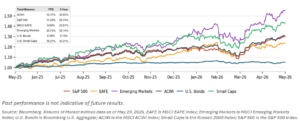
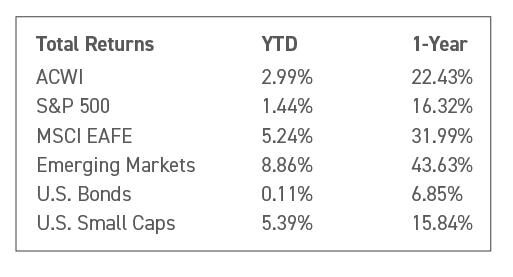
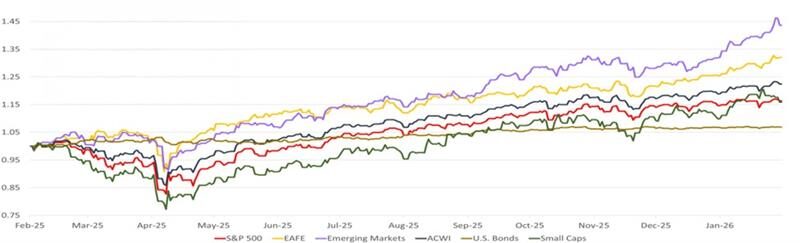
Emerging Market Equities lead the way returning an impressive 8.9% for the month. U.S. Small Caps (Russell 2000) and Developed International Equities (MSCI EAFE) also showed large gains, returning 5.4% and 5.2% respectively. U.S. Large Caps (S&P 500) lagged, returning 1.44% in January. Bonds, as measured by Bloomberg’s U.S. Aggregate index, were nearly flat for another month, eking out a slightly positive 0.11%.

Return of Market Indices

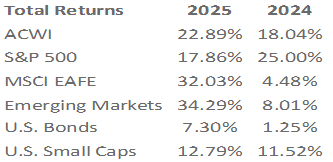
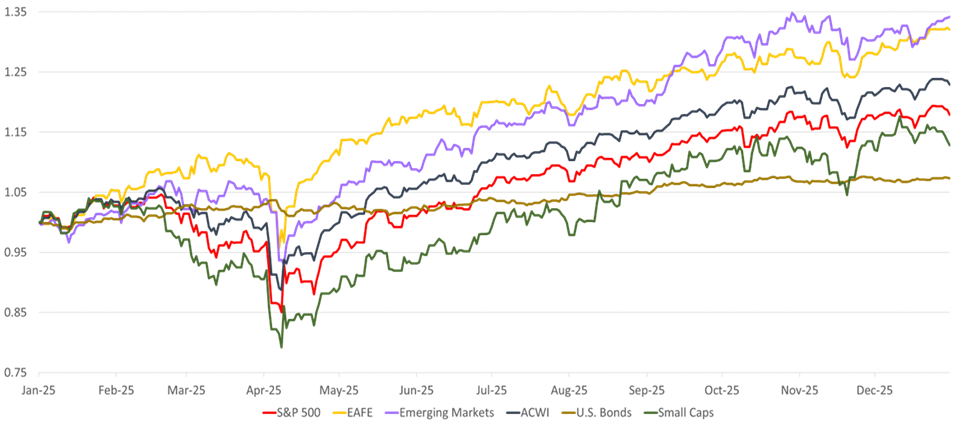
2025 was a year of economic uncertainty and concern, but also of resilience and growth. In this month’s Economic Update, we look back at the issues that dominated our thinking on the economy and financial markets each quarter and then look forward to what we’re focused on in 2026.

Source: Bloomberg. EAFE is MSCI EAFE Index(1), Emerging Markets is MSCI Emerging Markets(2) and U.S. Bonds is Barclays U.S. Aggregate(3). ACWI is the MSCI ACWI Index(4). Small Caps is the Russell 2000 Index(5). S&P 500 is the S&P 500 Index(6). The above information is as of 1/31/2026.

1 Warsh’s journey to become Fed Chair is unlikely to be quick. Post-nomination, the next step toward approval is for vetting to go through the Senate Banking Committee. However, committee member Senator Thom Tillis (R-NC) has indicated he would not on any Fed nominee until the Department of Justice’s investigation of Chair Powell over the Fed’s  headquarters is resolved which he believes is politically motivated Senator Tillis’ term ends in 2026, and he is not seeking re-election, making him less susceptible to political pressure. The Senate Banking Committee is narrowly divided (13 Republicans to 11 Democrats), thus if Tillis refuses to support the nominee, the committee the nomination could stall.

2 Warsh, Kevin The Federal Reserve’s Broken Leadership, Wall Street Journal Opinion 11/16/25

This document contains forward-looking statements, predictions and forecasts (“forward-looking statements”) concerning our beliefs and opinions in respect of the future. Forward-looking statements necessarily involve risks and uncertainties, and undue reliance should not be placed on them. There can be no assurance that forward-looking statements will prove to be accurate, and actual results and future events could differ materially from those anticipated in such statements.

January 2026 Economic Update: Looking Back at 2025

2025 was a year of economic uncertainty and concern, but also of resilience and growth. In this month’s Economic Update, we look back at the issues that dominated our thinking on the economy and financial markets each quarter and then look forward to what we’re focused on in 2026.

Q1: Fear of the Unknown
As the Trump administration in Washington found its footing, expectations for global trade reform loomed large. In Q1, our attention was on the impact that tariffs could have on inflation and economic growth, and how the unpredictability of outcomes could spook the financial markets.

A reactionary massive surge in imports contributed to a contraction in GDP of 0.5% in quarter1. At the same time, inflation remained elevated, leading the Fed to keep its restrictive monetary policy in place. In this uncertain environment, the US stock market struggled for direction as investors feared that recession, or even stagflation, might be on the horizon. By quarter’s end, volatility had returned to the market, and the S&P 500 had lost 4.3%.

In our March update, we reminded investors of the resilience of American institutions and advised them to remain patient, focusing on long-term goals rather than short-term volatility. This advice would serve them especially well in the quarter to come.

Q2: Liberation Day Selloff and Recovery
The second quarter began with the Liberation Day announcement of sweeping tariffs on America’s trading partners. The size and scope of the tariffs caught investors off guard, resulting in a swift selloff across equity markets, including an 11% decline in the S&P 500.

We pointed out that periods of extreme uncertainty may persist for a time, but they are not permanent, and that markets react favorably once a measure of predictability returns.

The announcement of a three-month “pause” in the tariff rollout signaled such a window of predictability. By the end of the quarter, equity markets had recovered, and the S&P was up nearly 6% YTD.

Q3: Shooting the Messenger and Divergence at the Fed
Tariff risk persisted into the third quarter; however, delayed implementation timelines and constructive progress in trade negotiations helped ease market concerns. In Q3, the Bureau of Labor Statistics revised estimates on job growth downward. The reaction was swift: President Trump fired the head of the BLS, the dollar weakened, and equity markets declined. Though the Fed was divided on the pace of rate cuts, the slowing economic data proved enough to convince them to cut rates by 0.25% in September. Equity markets responded favorably, with the S&P 500 rising by a healthy 7.8% in the quarter.

Q4: Closing Time and K-Shaped Data
The fourth quarter began with the shutdown of the Federal government. While every shutdown is unique, we expected the impact on equities to be modest and temporary, and recommended clients stay the course rather than trading on this news. This was indeed sound advice. Despite becoming the longest shutdown on record, the impact on equity markets was mild.

As economic growth took center stage toward year-end, we brought attention to the distinctive nature of the current K-shaped data, which evidenced a bifurcated mix of “winners and losers” in equity markets, higher vs. lower-income households, and other areas of the economy.

The fourth quarter was a victor lap for patient equity investors. The government reopened, and the Fed committed to a “normalization” path with 0.25% rate cuts in October and December.

Looking Ahead: 2026 Rhymes, but will not Repeat

We believe three trends will play out in 2026:

  1. Steady Fundamentals. The US economy remains resilient, benefitting from pro-growth fiscal policy, healthy corporate balance sheets, and robust consumer spending, with the anticipated 2026 tax rebate likely to provide a modest incremental boost to household consumption and aggregate demand.
  2. (Relative) Rate Stability. We expect monetary policy to normalize with a bias towards slowly lowering rates. Incoming Fed members are likely to be sympathetic to the administration’s preference for lower rates. Compared to the last 6 years, where rates rose from zero to over 5% rapidly and then gradually trickled down, we are entering a period of relative stability. In addition, there is a potential for lower rates regardless of economic trends. Stability and lower rates benefit both companies and investors.
  3. Earnings Expansion 2. Meaningful earnings growth likely won’t be confined to AI stocks and the Magnificent 7 3 in 2026. There is a pronounced shift in earnings expectations toward companies beyond the Magnificent 7. While Mag 7 stocks are still expected to deliver strong earnings growth, the change in year-over-year expectations is modest – only +2% higher in 2026 (+22.7% vs. +22.3% for 2025). By contrast, analyst earnings estimates for the other 493 companies are 33% higher for 2026 than in 2025 (+12.5%vs. +9.4%).

The combination of these three trends points toward a favorable backdrop for investors in 2026. However, we continue to recommend a diversified and flexible portfolio philosophy, rather than chasing last year’s “winners” and shunning last year’s “losers.”

No one could have predicted the events of 2025 that we recapped above, but veteran investors know that every new year holds unexpected twists. As we noted many times throughout 2025, the best maxim for long-term investment success is “Patience and Discipline.”

Capital Markets
December was a soft month for US investment returns, while overseas equities saw an appreciable rise. The All-Country World Equity Index (ACWI) rose 1%. Both Developed Non-US equities, as measured by the EAFE and Emerging Market Equities, as measured by the MSCI EM Equity Index, rose by 3%. The S&P 500 finished nearly flat for the second month in a row (+0.1%). Likewise, bonds as measured by Bloomberg’s US Aggregate index were nearly flat, declining by 0.2%. US Small Caps declined 0.6% for the month.

Source: Bloomberg. EAFE is MSCI EAFE Index(1), Emerging Markets is MSCI Emerging Markets(2) and U.S. Bonds is Barclays U.S. Aggregate(3). ACWI is the MSCI ACWI Index(4). Small Caps is the Russell 2000 Index(5). S&P 500 is the S&P 500 Index(6). The above information is as of 12/31/2025.


1 Since GDP is a measure of domestic production, imports represent foreign 2 production and thus are subtracted from the GDP calculation as these are already accounted for in domestic spending.

2 Source: FactSet Earnings Insight 12/19/25

3 The Magnificent 7 currently include Nvidia, Apple, Microsoft, Amazon, Alphabet (Google), Meta (Facebook), and Tesla. While Broadcom replaced Tesla as one of the 7 largest stocks in the S&P 500 by market capitalization, Tesla is still commonly included in the Mag 7 group.


This document contains forward-looking statements, predictions and forecasts (“forward-looking statements”) concerning our beliefs and opinions in respect of the future. Forward-looking statements necessarily involve risks and uncertainties, and undue reliance should not be placed on them. There can be no assurance that forward-looking statements will prove to be accurate, and actual results and future events could differ materially from those anticipated in such statements.

December 2025 Economic Update: Three Positive Trends for 2026

November saw a convergence of three storms of worry from investors: doubts about the continuing run-up of AI-themed stocks, lack of access to economic data because of the government shutdown, and mixed messages about the Fed’s next move.

While uncertainty will persist, we expect the three trends outlined below to form a durable engine for corporate earnings growth, providing fundamental support for market valuations into 2026.

Trend #1: Economic Resilience and Pro-Growth Fiscal Policy

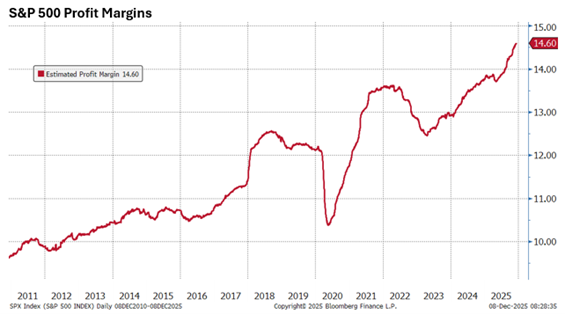
  • Healthy Corporate Fundamentals: Corporate balance sheets remain generally sound. The confluence of lower financing costs and productivity-driven earnings growth creates a powerful backdrop for sustained profit. As the chart below illustrates, margins have been rising for years, and AI has the potential to further this trend.
  • Wealth Effects and Spending Power: Despite ongoing uncertainty around policies like tariffs and reduced immigration, the consumer remains supported by low unemployment and the wealth effects of rising asset prices. As a result, consumer spending continues to provide a strong floor for corporate revenue expectations.
  • Targeted Fiscal Stimulus: The long-term effects of infrastructure bills and tax cuts from the One Big Beautiful Bill will continue to feed into the economy, promoting targeted investments in key sectors and ensuring U.S. GDP growth remains at or above trend.

Source: Bloomberg. The above information is as of 12/08/2025.

Trend #2 Monetary Policy Normalization: Lower Rates and Valuation Support

The Federal Reserve’s ongoing pivot from a restrictive stance to neutral will be a meaningful tailwind. As inflation pressures ease, the Fed is anticipated to execute further interest rate cuts through 2026, fundamentally altering the calculus for risk assets. The result:

  • Decreased Cost of Capital: Lower rates reduce corporate borrowing costs, supporting both capital investment tied to the AI transition, increased share repurchases and additional M&A activity, all of which support equity valuations. Likewise, lower rates act as a potential tailwind to make consumer borrowing more affordable (lower costs for mortgages, car loans, and credit cards).
  • Lowering the Discount Rate: The Discount Rate is a financial hurdle that a potential investment must exceed to be worth your time and money. This is the opportunity cost for investors choosing a very low risk asset (ex: cash or CDs) versus a higher risk asset with more potential return (ex: equities). Lower interest rates reduce the relative appeal of low risk-assets and support higher stock market valuations.
  • Support for Cyclical Sectors: While financial markets react relatively quickly to lower rates, the impact on the economy takes more time and can lag by 6-12 months. We are just starting to see the boost to rate-sensitive and cyclical sectors of the market that underperformed during the higher rate environment.

Trend #3: The Transition of AI Investment from Hype to Productivity

While the initial waves of AI investment favored companies directly involved in development like semiconductor and cloud infrastructure firms, the 2026 narrative is set to shift toward enterprise adoption and tangible productivity gains.

  • Sustained IT Infrastructure Spending: The build-out of data centers and the proliferation of number-crunching semiconductors is expected to continue at a staggering pace in 2026. While this spending will likely eventually slow, these multi-year projects which are still underway. This monumental capital expenditure acts as an economic stimulus and directly feeds the revenues of the hardware and infrastructure sectors.
  • Operating Leverage Expansion: As publicly traded companies outside the tech sector embed AI into their operations, we expect meaningful gains in operating leverage. Efficiency improvements spanning R&D, supply chains, and customer service should translate directly into higher profit margins.
  • Revaluation Driven by Innovation: The market is likely to reward a broader set of companies that demonstrate clear, measurable Return on Investment (ROI) from their AI investments. This dynamic supports a re-rating of valuations for high-quality firms that translate AI adoption into new revenue streams and improved profitability.

Implications for Investors
Collectively, these three trends suggest a favorable backdrop for investors in 2026. Short-term market movements will continue to be driven by macro data releases, like the whipsaw market reaction to the September revised job report and speculation around Fed rate cuts. However, long-term focus should remain on measured investment in companies positioned to capitalize on the coming productivity boom, supported by a constructive shift in monetary policy. As always, patience and remaining invested for the long-term are the best approaches.

Capital Markets
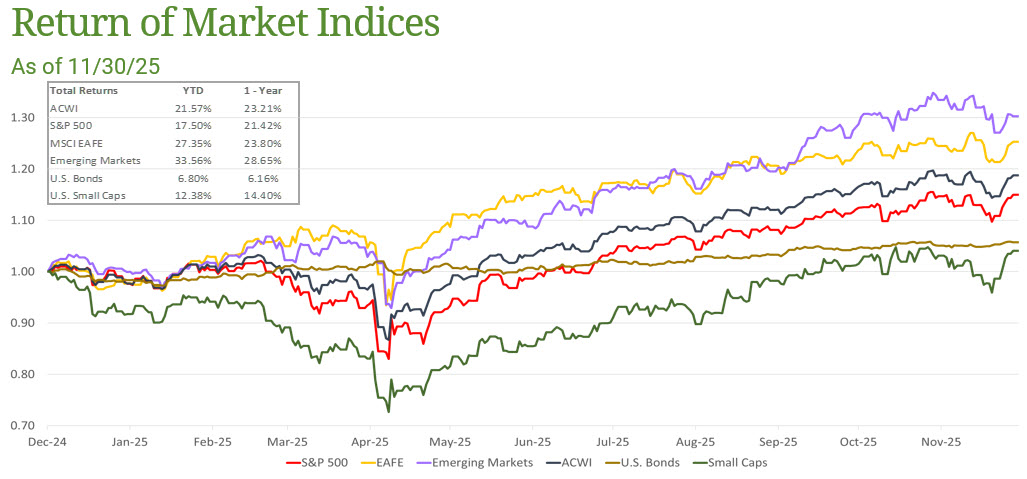
November was a volatile month for markets as investors fretted over the possibility of the Fed potentially changing course on rates. The All-Country World Equity Index (ACWI) and S&P 500 both finished nearly flat (+0.02% and +0.25% respectively) after a mid-month drop of close to 4%. US Small Cap equities, measured by the Russell 2000, finished up by close to 1% (+0.96%) but saw an even larger intramonth swing, dropping over 6% briefly. International Developed stocks, as measured by the EAFE, were less influenced by US interest rate worries and increased by 0.65%. Emerging market equities reversed course after last month’s strong performance, dropping 2.38% for the month. US bond prices rose 0.62% for the month.

Source: Bloomberg. EAFE is MSCI EAFE Index(1), Emerging Markets is MSCI Emerging Markets(2) and U.S. Bonds is Barclays U.S. Aggregate(3). ACWI is the MSCI ACWI Index(4). Small Caps is the Russell 2000 Index(5). S&P 500 is the S&P 500 Index(6). The above information is as of 11/30/2025.

This document contains forward-looking statements, predictions and forecasts (“forward-looking statements”) concerning our beliefs and opinions in respect of the future. Forward-looking statements necessarily involve risks and uncertainties, and undue reliance should not be placed on them. There can be no assurance that forward-looking statements will prove to be accurate, and actual results and future events could differ materially from those anticipated in such statements.

November 2025 Economic Update: Everything is K

When you come to a fork in the road, take it.” – Yogi Berra

The term “K-shaped recovery” gained prominence in 2020 during the uneven rebound from the Covid-19 recession. Popularized by economist Peter Atwater, the concept describes how, following an economic downturn, certain economic groups and industry sectors recover rapidly while others stagnate. A K-shaped recovery differs from the more familiar V-shaped recovery (a sharp decline followed by a strong rebound) or U-shaped recovery (a slower return to growth). The K-shape is defined by unequal growth: some “arms” of the economy rise while others continue to fall, creating a pattern that resembles the letter “K.”

In the years since the pandemic, this “K” pattern has persisted, and we currently have a K-shaped economy. Wealth has grown disproportionately among high-income households, large corporations (especially tech and capital-light firms), and asset‐owners, while lower‐income households, small and medium employers, and service-industries reliant on physical presence continue to struggle.

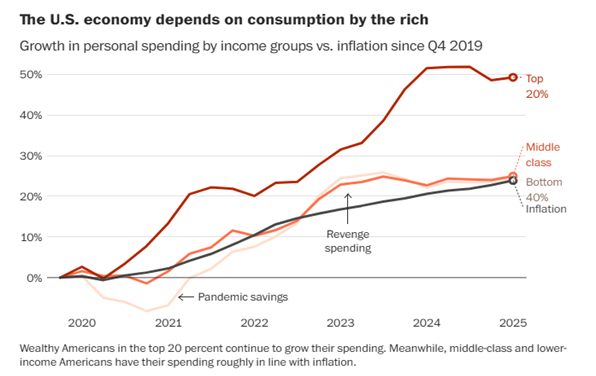
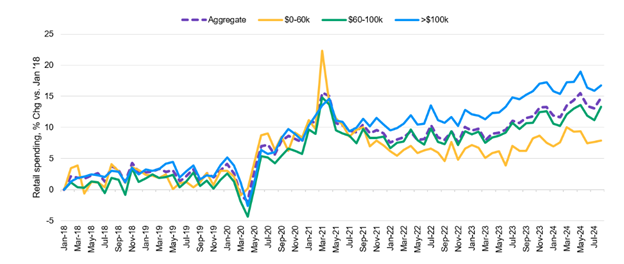
Consumer spending is a primary driver of the U.S. economy and a key indicator of economic growth and illustrates the K-phenomenon. Before the onset of Covid, spending patterns were broadly similar across income groups. However, the chart below illustrates that spending by the highest 20% of earners outpaced that of other groups as we emerged from the pandemic, and the gap continues to widen.

Source: Moody’s

Similarly, a report from October 2024 from the Federal Reserve shows that retail spending of the bottom 80% of Americans, as measured by income, has roughly kept pace with inflation, while the highest 20% of earners have increased their spending by close to 50% in the post-pandemic period!

Source: Hacıoğlu Hoke, Sinem, Leo Feler, and Jack Chylak (2024). “A Better Way of Understanding the US Consumer: Decomposing Retail Sales by Household Income,” FEDS Notes. Washington: Board of Governors of the Federal Reserve System, October 11, 2024, https://doi.org/10.17016/2380-7172.3611.

What’s Driving the K-Shaped Economy?
There are four primary factors driving the K-shaped economy that help to explain the widening disparity between winners and losers among both producers and consumers. These include:

  • The Impact of Technology
    The rapid adoption of artificial intelligence, automation, and digital platforms has accelerated productivity and profitability in key high-tech sectors. Workers and companies equipped to leverage technology are pulling ahead, while those dependent on manual or low-skill labor are being left behind.
  • Uneven Wage and Employment Growth
    The post-pandemic labor market remains divided. High-income professionals in technology, finance, and healthcare enjoy steady job growth and salary increases, while many service-sector and blue-collar workers face stagnant wages or reduced hours. Automation and AI-driven efficiencies have increased productivity while displacing many lower-wage roles.
  • The Unequal Impact of Inflation and Interest Rates
    Inflation and elevated interest rates have widened the gap between economic winners and losers. Wealthier households with greater savings and investment portfolios can absorb higher prices and even benefit from rising interest income. Meanwhile, lower-income families, who spend a higher share of income on essentials like food, energy, and rent, feel the strain. Rising credit card balances and delinquency rates show how unevenly these costs are distributed.
  • Asset Price Divergence aka “The Wealth Effect”
    Financial markets have surged over the past two years. Homeowners and investors have seen their wealth grow as real estate and stock values appreciate. In contrast, renters, and those without substantial assets, have missed out on these wealth effects, widening the financial gap between households.

Implications for Investors
Aggregate metrics like GDP growth, corporate profits and stock market indices reflect activity as a whole rather than how each segment is faring. Overall, the U.S. economy appears healthy. But underneath the surface there is deep inequality, fragility in many out-of-favor sectors, and risks that reflect an asymmetric weakness in the economy.

For investors, the K-shaped economy creates both opportunities and risks, as returns will vary sharply across sectors and industries.

Sector Divergence Reflects “Two Economies”
In 2025, stock market performance mirrors the same K-shaped pattern. Technology stocks related to AI have soared while consumer staples and other sectors lagged.

According to S&P sector data through the end of October:

  • The Upper-Arm of the K Leaders: The Technology sector saw a total return of +29.9% and the Communications sector +26.8%, fueled by corporate investment in AI, automation and productivity tools. The Industrial and Utility sectors saw a rise of +18.9% and +20.2%, respectively.
  • The Lower-Arm Laggards: By contrast, all other sectors saw single-digit returns: the Financial sector (+9.6%), Consumer Discretionary sector (+7.8%), Healthcare sector (+6.3%), Energy sector (+5.8%), Materials sector (+3.8%), Real Estate sector (nearly flat at +0.2%).

Source: Standard and Poor’s

Rising Inequality Alters Market Dynamics
As wealth becomes more concentrated, stock market participation increasingly reflects the spending and investment behavior of affluent households. Gains in financial markets boost high-income spending, which supports certain sectors, while the rest of the economy remains subdued. For investors, paying close attention to demographic and income-driven consumption trends is more important than ever.

Defensive Positioning for Uneven Growth
In a K-shaped environment, diversification across economic segments becomes crucial. Investors should favor companies with pricing power, strong balance sheets, and exposure to higher-income consumers. Long-time readers will note that the first two criteria are also hallmarks of Quality-focused investing, which we have frequently advocated.

The K-shape is becoming a defining feature of the modern U.S. economy. For investors, understanding this divergence is essential to navigating risk and identifying opportunity as the winners in 2025 likely will continue to be firms that cater to higher-income consumers and those that best leverage technology and maintain pricing power.

Capital Markets
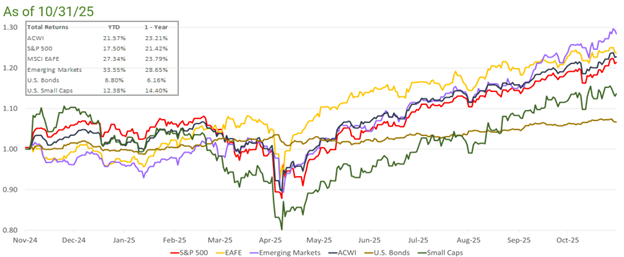
Following on the recent pattern of market rises after each rate cut, once again all boats rose with the tide in October. The All-Country World Equity Index (ACWI) and S&P 500 both rose 2.3%. US Small Cap equities, measured by the Russell 2000, gained 1.8%. International Developed stocks, as measured by the EAFE, increased by 1.2%. Emerging market equities had another strong month, surging 4.2% Not to be left out, US bond prices rose 0.6% for the month.

Source: Bloomberg. EAFE is MSCI EAFE Index(1), Emerging Markets is MSCI Emerging Markets(2) and U.S. Bonds is Barclays U.S. Aggregate(3). ACWI is the MSCI ACWI Index(4). Small Caps is the Russell 2000 Index(5). S&P 500 is the S&P 500 Index(6). The above information is as of 10/31/2025.

October 2025 Economic Update: The Fed Cut Rates and Closing Time for the US Government

One Small Cut, More to Come
In last month’s Economic Update, we identified four areas of particular interest regarding the upcoming September meeting of the Federal Reserve’s Open Market Committee (FOMC).

The Interest Rate Decision
We expected the Committee would lower the federal funds rate by 0.25% to 4.00% -4.25% based on a generally held view that the economy was slowing. In a nearly unanimous 11-1 decision, members voted to drop rates by a quarter percent. The lone dissenter was the newly appointed Fed Governor, Stephan Miran, who was in favor of a more aggressive 0.50% reduction.

Forward Guidance
The FOMC updated its Statement of Economic Projections (SEP), commonly referred to as the “Dot Plot,” at the September meeting.

As noted last month, the SEP outlines where individual Fed members expect inflation and interest rates to trend over the coming quarters and provides members’ future year-end target ranges. Investors watch the Dot Plot closely for insight into the Fed’s future policy path and interest rate expectations which, in turn, influence everything from bond yields to equity valuations.

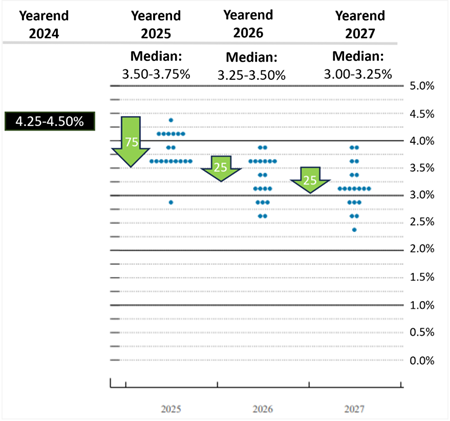
The chart below shows the updated SEP dot plot for September. Each blue dot on the chart represents the opinion of one of the 19 FOMC participants.
September 2025 Fed Dot Plot Showing Projected Target Range of Fed Funds Rate and moves per calendar year (Green Arrows)

Source: September 17, 2025 FOMC Summary of Economic Projections and Bondsavvy calculations.

The median of the September dot plot projections sees the Fed Funds rate falling by a further 0.5% in 2025, an additional 0.25% in 2026 and 2027.

The dot plots as a group have shifted down 0.25% for each calendar year, apart from the outlier (Miran) who projected a significantly lower rate in 2025 and 2027 than the rest of the FOMC.

Dissent!
Stephen Miran, who formerly served as Chairman of Economic Advisers in the current Trump Administration, argued the Federal Funds rate is currently about 2% too high, proposing that structural shifts in immigration, tariffs, regulation, and tax policy have pushed the “neutral” rate downward. The neutral rate is the theoretical “sweet spot” where the economy has both full employment and stable inflation.

Miran asserted that the inflationary pressure from policy changes is overstated, especially pressure attributed to tariffs, and that more aggressive easing is necessary to forestall deterioration in labor markets.

While Miran’s views are consistent with those of the Administration, they stand in contrast to the majority view on the FOMC that changes to American policy (tariffs, immigration) continue to be a near-term reinflationary risk.

Inflation and Labor Market Trends
Powell emphasized that while inflation has eased from its peaks, it “remains somewhat elevated,” especially noting that goods prices have driven part of the pickup in inflation recently. PCE rose 2.0% over the 12 months ending in August.   While overall unemployment remains low, Powell described it as a “low-firing, low-hiring environment” noting that younger people entering the workforce are having a hard time finding work.

Overall, economic data is somewhat mixed. Labor markets are slowing, but not collapsing, which is consistent with the Fed lowering interest rates. However, the economy seems to be humming along. Q2 GDP came in at 3.8% quarter over quarter, boosted by healthy consumption. The US consumer continues to spend.  Forecasts for Q3 show this trend continuing.  According to the Atlanta Fed, the GDPNow forecast for Q3 is projected to come in at 3.8%, which suggests the economy is still on reasonable footing, even if the economic terrain appears uneven.

Closing Time – The Federal Government Shuts Down (Again)
Effective October 1st, the Federal Government has shut down.

Over the last 50 years, the US government has shut down a remarkable 21 times. Most shutdowns have been brief, lasting only a few days.

The current shutdown is interesting for several reasons:

  • In the past, these typically occurred at times when Congress had already passed some funding resolutions, so the shutdown only impacted a subset of government agencies. In the current case, Congress has not passed any annual spending bills, so this would result in funding for all agencies to lapse.
  • Office of Management and Budget Director Russell Vought has indicated that in addition to the usual furloughs, the administration may start to permanently fire federal employees in the days to come.
  • The longest shutdown of the last 50 years was the most recent one: December 2018’s 35-day shutdown during the previous Trump administration.

What are the Effects of a Shutdown?
The immediate effect is furlough – temporary unemployment – of ~40% of federal employees considered non-essential. Furloughed employees are reimbursed for lost pay when they return to work. These employees hold a variety of roles across the economy, so their absence manifests in a host of ways: travelers would expect longer travel times at the airport (fewer TSA employees), potential changes at the grocery store (fewer USDA food inspectors), closures of national parks (fewer park workers) and so forth. If the shutdown is brief, the economic disruption is primarily felt by the furloughed Federal workers.

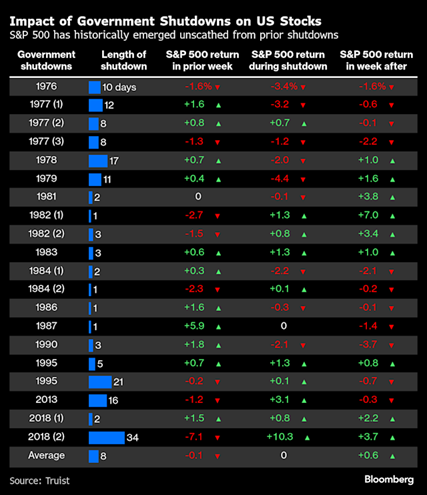
Historically, financial markets have typically shrugged off government shutdowns. Goldman Sachs notes that 10 yr Treasury yields and the USD, which are a barometer of the global financial system’s faith in the smooth functioning of the US government, have typically weakened following government shutdowns and subsequently taken time to recover once the government reopens. However, these effects are not long-lasting.

US equity markets have likewise seen muted impacts from shutdowns, as shown in the chart below:

When might we see a resolution?
There is no reliable way to predict the duration of the shutdown. Military pay, which stands to be impacted this time around, has historically encouraged a deadline for reopening. The first military pay date at risk is October 15th. Another deadline for a possible resolution could be the second week of October, when funding for the Women Infants and Children (WIC) nutrition program is set to run out of money.

Given the uncertain, and likely temporary market impact associated with the shutdown, we recommend clients maintain their long-term investment focus and avoid a change in strategy as a result of the current shutdown.

Capital Markets
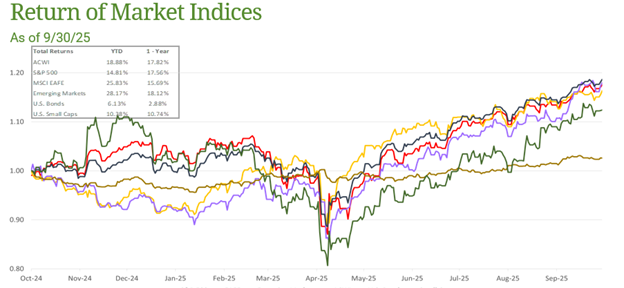
As the Fed moved to cut rates, all boats rose with the tide in September. Equity markets saw the biggest moves, with the All Country World Index (ACWI) rising 3.7%. The S&P 500 was slightly behind, climbing 3.6% for the month. Emerging market equities surged 7.2% while International Developed stocks, as measured by the EAFE, increased by 2%. US Small Cap equities, measured by the Russell 2000, had another strong month, increasing by 3.1%. US bond prices rose 1.1% for the month.

Source: Bloomberg. EAFE is MSCI EAFE Index(1), Emerging Markets is MSCI Emerging Markets(2) and U.S. Bonds is Barclays U.S. Aggregate(3). ACWI is the MSCI ACWI Index(4). Small Caps is the Russell 2000 Index(5). S&P 500 is the S&P 500 Index(6). The above information is as of 9/30/2025.


September Economic Update: Q&A about the Upcoming Fed

The Federal Reserve meets next week, and once again, it faces a mixed economic picture.

On an encouraging note, inflation appears to be stabilizing. The latest Producer Price Index (PPI) fell 0.1% in August after a 0.7% increase in July.4 The Atlanta Fed’s GDPNow model is forecasting a healthy 3.1% growth rate for the third quarter.3

However, recent downward revisions to employment data and slower job growth suggest the economy may be cooling more than previously thought. The Fed’s challenge remains the same: striking the right balance between keeping inflation in check and supporting continued growth.

The prospect of one, possibly two, new Federal Reserve members has prompted a wave of questions about the Fed’s structure and decision-making process. This month, we will cover a few of the most common questions, as well as highlight what we are watching for at the next Fed meeting.

Q: How often does the Federal Open Market Committee (FOMC) meet?

A: The FOMC has eight regularly scheduled meetings per year where they share their review of financial and economic conditions and discuss the target for monetary policy in the context of their dual mandate of price stability and maximum employment.

Q: Who votes at the FOMC?

A: The FOMC has 12 voting members: the seven members of the Board of Governors, the president of the Federal Reserve Bank of New York, and four of the eleven other Reserve Bank presidents.

The four voting Reserve Bank presidents serve on rotating one-year terms, with seats filled from the following four groups with one president from each group:

  • Boston, Philadelphia, and Richmond
  • Cleveland and Chicago
  • Atlanta, St. Louis, and Dallas
  • Minneapolis, Kansas City, and San Francisco

Non-voting Reserve Bank presidents still attend the FOMC meetings and weigh in on discussions, even though they don’t have a vote.

Q: What happens when there is a Board vacancy?

A: The process begins with the President nominating a candidate. These nominations are expected to provide a “fair representation of the financial, agriculture, industrial, and commercial interests and geographical divisions of the country.”1.  Importantly, no two Governors may come from the same Federal Reserve District. Board membership is intended to reflect the various economic interests across the entire country.

A candidate must then undergo a thorough background check and submit financial and ethics disclosures. Next comes the Senate Banking Committee’s confirmation hearing, where the nominee shares their views on economic policy. If the Senate Banking Committee votes to move the nomination forward, it goes to the full Senate for debate and a final vote. Once confirmed, the nominee is sworn in and begins their term.

Governors serve a term of 14 years and appointments are staggered so that one term expires on January 31st of each even-numbered year. Once a Governor has served 14 years, they may not be re-appointed, however a Governor who served a shorter term could be re-appointed at a later date to serve up to the full 14-year term.

Once appointed, Fed Governors may not be removed based on their policy views. The staggered, lengthy terms are intended to help insulate the Federal Reserve system from day-to-day political pressures.

Q: What happens at the end of Chair Jerome Powell’s term?

A: Powell’s term as Chair of the Federal Reserve ends in May 2026. If he is not reappointed at that time, the President will nominate a new Chair from among the seven members of the Board of Governors, who will then be confirmed by the Senate for a four-year term.

Powell is eligible to remain a part of the Board of Governors until his term ends in January 2028.

Q: What are you watching at this upcoming meeting?

A: We are watching four areas:

  • The interest rate decision. A 0.25% rate cut is widely expected due to the declining inflation trend and weakening labor data. A larger cut would suggest the FOMC views economic conditions to be weaker than expected, while keeping rates unchanged would suggest they are concerned that inflation may reverse course.
  • Forward Guidance. The FOMC updates its Statement of Economic Projections (SEP), commonly referred to as the “Dot Plot”, four times a year. The SEP outlines where individual Fed members expect inflation and interest rates to trend over the coming quarters. When the dots cluster closely around certain levels, it suggests a consensus view; when they are more widely dispersed, it reflects significant differences of opinion among policymakers. Investors watch the Dot Plot closely for insight into the Fed’s future policy path and interest rate expectations, which in turn influence everything from bond yields to equity valuations.
  • Inflation and Labor Market Data. The Fed will build an outlook by drawing on a wide range of economic data and indicators. While precise forecasting is never possible, identifying consistent patterns across multiple data points can reveal underlying trends that might be overlooked when focusing on any single metric in isolation .
  • Dissent! The FOMC member opinions often have a high degree of consensus as, ultimately, they are all reviewing the same set of information from slightly different perspectives. Thus, outlier views can help highlight data points which are otherwise easily missed. For instance, as we noted in last month’s Economic Update2, Fed Governor Waller had opined weeks in advance the July meeting that there was a high likelihood of downward revisions in the labor market. This was long before the Bureau of Labor Statistics (BLS) disclosed that from March 2024 to March 2025, 911,000 fewer jobs were created than previously estimated. Both Bowman and Waller dissented from the decision at the last meeting to hold rates steady, favoring a rate cut sooner. We will be watching to see if they push for a larger cut or align with the likely consensus for a 0.25% reduction as this could signal an increasing appetite to cut further and/or faster.

Capital Markets
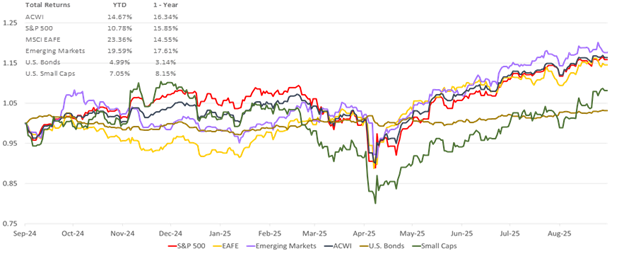
Equity markets rose broadly in August. The All Country World Index (ACWI) climbed 2.5%. The S&P 500 rose 2%. International Developed stocks, as measured by the EAFE, increased by 4.3%. Emerging Market equities (MSCI Emerging Markets Index) rose by 1.5%. US Small Cap equities, measured by the Russell 2000, lead the way with a rise of 7.1%, likely the result of a highly anticipated Fed rate cut in September. US bond prices rose 1.2% for the month.

1: Board of Governors of the Federal Reserve System. March 28, 2017. America’s Central Bank: The History and Structure of the Federal Reserve. Speech by Governor Powell on America’s central bank: the history and structure of the Federal Reserve – Federal Reserve Board

2: Crestwood August 2025 Economic Update: Shooting the Messenger and the Shifting Fed

3: Federal Reserve Bank of Atlanta. GDPNow. GDPNow – Federal Reserve Bank of Atlanta

4: U.S. Bureau of Labor Statistics. Economic New Release – Producer Price Index News Release summary. Producer Price Index News Release summary – 2025 M08 Results

This document contains forward-looking statements, predictions and forecasts (“forward-looking statements”) concerning our beliefs and opinions in respect of the future. Forward-looking statements necessarily involve risks and uncertainties, and undue reliance should not be placed on them. There can be no assurance that forward-looking statements will prove to be accurate, and actual results and future events could differ materially from those anticipated in such statements.

August Economic Update: Shooting the Messenger (Even if the Message Wasn’t All Bad)

A report from the Bureau of Labor Statistics (BLS) released after July’s FOMC meeting showed weaker job growth in the May-July period than previously estimated. Job growth for June and July was significantly revised downward, with 258,000 fewer reported new jobs.  The labor market is feeling the pressures of broad uncertainty, higher tariffs, and reduced immigration.

The reaction was swift: President Trump fired the head of the BLS, the dollar weakened, and equity markets reacted poorly to both the numbers and the firing.

As we have noted in prior Economic Updates, data gathering is a slow process and subject to frequent revision. Further, Fed Governor Waller noted in a speech on July 17 that there was a likelihood of downward revisions when the data was released1. So, for those closely listening to the Fed, the BLS announcement was not completely out of the blue.

Importantly, while the disappointing job growth numbers show that economic activity is slowing, the data also support the case that the job market is still generally healthy.  The weaker data increases the odds that the Fed cuts interest rates during its next meeting on September 17.

Divergence of Opinions at the FOMC
At its July 30 meeting, the Federal Open Market Committee (FOMC) opted to hold the federal funds rate at 4.25% – 4.50% for the fifth consecutive session. The recurring theme behind the Fed’s decision to leave rates unchanged has been persistent uncertainty.

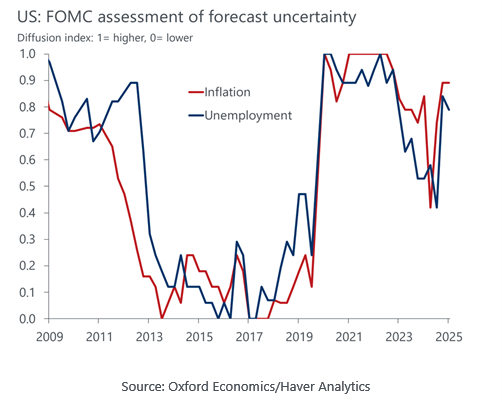
The FOMC Diffusion Index (shown below) captures the distribution of individual FOMC participants’ judgments about economic forecasts like GDP, inflation or unemployment. The chart shows that index levels have risen significantly this year. In fact, they are reaching points not seen since the period surrounding the Pandemic or the years following the Great Financial Crisis of 2008.

In the current environment, it’s not surprising that the decision of the FOMC this time was not unanimous. While individual dissents among Fed governors and presidents of the various Federal Reserve banks are not uncommon, July’s meeting marked the first time since 1993 that two governors dissented from the majority decision. Who dissented is worth noting: Michelle Bowman and Christopher Waller both favored a rate cut now. Their premise was that inflationary pressure from tariffs will be temporary and that risks to employment warrant a cut sooner rather than later.

Readers will note that Waller had signaled his pending dissent weeks in advance in the speech noted above, and Bowman was among the potential candidates to succeed Powell as the next Fed Chair. Their opinions may be foreshadowing the direction of the next iteration of the Fed.

September will be eventful for several reasons:

  1. President Trump has nominated Stephen Miran, often credited as the chief architect of the administration’s tariff policy, to fill the vacancy left by Fed Governor Adriana Kugler’s August departure. In 2024, Miran co-wrote a paper critical of the Fed and argued that governance should be overhauled. Among the recommendations were giving the President the power to remove Fed board members and Reserve Bank leaders at will2. The Senate Banking Committee will hold hearings on Miran’s nomination, which will include questioning him about his qualifications, policy positions, and perspective on the role of the Fed.
  2. The Fed will have several more months of labor market and inflation data to contextualize the effect of tariffs and immigration policy on the US economy.
  3. The FOMC will release an updated Statement of Economic Projections (aka, their “Dot Plot”), which captures the Fed members’ estimates for the range of interest rates over the next few years.

What does this mean for investors?
Investors should continue to expect further economic impact from an evolving tariff policy and reduced immigration as well as deportations. Although their impact on prices and growth can be slow to manifest, their effects inevitably show in data such as the labor market report. Investors should anticipate this and not be taken off guard when data appears to ‘surprise’ the market by showing evidence of this. As always, patience and discipline are the best approaches.

Capital Markets
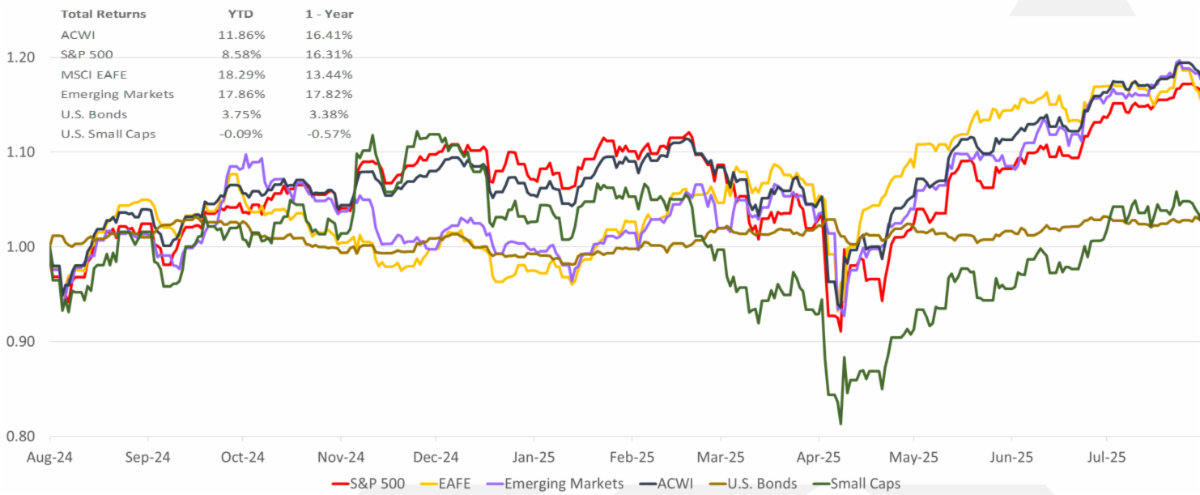
The MSCI All Country World Index (ACWI) rose 1.4% in July. The S&P 500 rose for a third straight month returning 2.2%. The Index is now up 8.6% year-to-date after being down as much as 15% in early April. Developed International equities (MSCI EAFE) weakened, losing 1.4% for the month, while Emerging Markets rose by 2%. US Small and Mid Caps (Russell 2000) rose 1.7%, while bonds were flat.

Source: Bloomberg. EAFE is MSCI EAFE Index(1), Emerging Markets is MSCI Emerging Markets(2) and U.S. Bonds is Barclays U.S. Aggregate(3). ACWI is the MSCI ACWI Index(4). Small Caps is the Russell 2000 Index(5). S&P 500 is the S&P 500 Index(6). The S&P 500 Ex-NVDA/ AVGO represents the S&P 500 excluding the stocks Nvidia and Broadcom, the remaining stocks are then weighted by their market cap. The above information is as of 7/31/2025.


Footnotes:
1: The Case for Cutting Now by Governor Christopher Waller. Full text available at: https://www.federalreserve.gov/newsevents/speech/waller20250717a.htm
2: Reform the Federal Reserve’s Governance to Deliver Better Monetary Outcomes by Dan Katz, Stephen Miran. Full text available at: https://manhattan.institute/article/reform-the-federal-reserves-governance-to-deliver-better-monetary-outcomes

This document contains forward-looking statements, predictions and forecasts (“forward-looking statements”) concerning our beliefs and opinions in respect of the future. Forward-looking statements necessarily involve risks and uncertainties, and undue reliance should not be placed on them. There can be no assurance that forward-looking statements will prove to be accurate, and actual results and future events could differ materially from those anticipated in such statements.

June Economic Update: The Deficit Could be Rising—But it’s Not Necessarily Cause for Alarm

June Economic Update: The Deficit Could be Rising—But it’s Not Necessarily Cause for Alarm

The recent passage of the One Big Beautiful Act or OBBBA (also known as HR 1) by the U.S. House of Representatives could have implications for the budget deficit in its current form, and in turn for domestic and international bond markets and the economy.

Although there will no doubt be significant changes to the House version of the bill before it passes, a major impact on taxes would be the extension of many provisions of the 2017 Tax Cuts and Jobs Act and substantial additional spending on defense and border security.

The current administration believes the current bill will generate economic growth, lead to lower deficits, and put the country on a more fiscally sustainable path.

Reactions in the Bond Market
However, not everyone agrees the current bill will achieve these goals. The bond market’s reaction has been a decline in bond prices leading to an increase in yields. Notably, the 10-year Treasury yield has climbed to around 4.5% (from 4% earlier in the year), while the 30-year bond yield has risen to 5%, well above the 4.75% long term average.  While many factors affect trends in bond yields, this year bond markets have been skittish about the effects of increased tariffs and inflation fears.  The Federal government’s unwillingness to address deficit spending have added to the bearish narrative.

With higher interest rates driving up the cost of servicing debt, strong economic growth becomes even more critical to balancing the budget and maintaining fiscal stability.

Today’s Deficit is Manageable
While reducing the deficit is a worthwhile goal, it’s important to recognize that the US’s Federal debt level of 118% debt-to-GDP is not an outlier.  Among G7 nations, the average debt-to-GDP ratio stands at around 125%. Notably, Japan’s debt-to-GDP stands at 250% and has been above 100% for over two decades all while maintaining both economic stability and investor confidence.* Although elevated debt can contribute to risks like inflation or slower growth, it does not necessarily signal financial distress—particularly for an economy like the U.S., which continues to serve as the world’s benchmark.

Safe Haven Status
The U.S. can sustain high debt levels and still be a destination for global capital inflows due to a unique combination of structural, institutional and economic strengths. As the issuer of the world’s primary reserve currency, the U.S. benefits from constant demand for its debt, allowing it to borrow at relatively low costs. Its financial markets are the largest, most liquid, and among the most transparent in the world, reinforcing investor confidence. The U.S. economy is also highly innovative and productive, driven by leadership in technology, finance, and consumer sectors.

During times of global uncertainty, the U.S. is viewed as a safe haven, with investors flocking to its assets despite rising debt. Strong institutions like the Federal Reserve and a long-standing reputation for honoring debt further support its credibility. All of these factors make the U.S. an attractive and reliable place to invest, even with a high (and potentially rising) debt-to-GDP ratio.

Capital Markets
Equities bounced back in May after a turbulent April. The All-Country World Index (ACWI) finishing up 5.7%, led by the US with a gain of 6.3% for the S&P 500. Developed international equities, as measured by the EAFE index, had another strong month, adding 4.7%, to close May up17.3% YTD. Emerging market equities increased by 4.0%. Bond prices declined by .7% as interest rates rose.

Source: Bloomberg. EAFE is MSCI EAFE Index(1), Emerging Markets is MSCI Emerging Markets(2) and U.S. Bonds is Barclays U.S. Aggregate(3). ACWI is the MSCI ACWI Index(4). Small Caps is the Russell 2000 Index(5). S&P 500 is the S&P 500 Index(6). The above information is as of 5/30/2025. See last page for important information.

We continue to be focused on investing for the long term while remaining sensitive to potential short-term opportunities and risks. We encourage you to reach out to your Crestwood Advisor with any questions or concerns you may have. If you are not yet working with a Crestwood Advisor, we invite you to schedule some time to discuss how Crestwood works with individuals and families like yours to help them achieve their wealth goals.

This document contains forward-looking statements, predictions and forecasts (“forward-looking statements”) concerning our beliefs and opinions in respect of the future. Forward-looking statements necessarily involve risks and uncertainties, and undue reliance should not be placed on them. There can be no assurance that forward-looking statements will prove to be accurate, and actual results and future events could differ materially from those anticipated in such statements.

*International Monetary Fund: https://www.imf.org/external/datamapper/d@FPP/USA/FRA/JPN/GBR/SWE/ESP/ITA/ZAF/ What Lessons Can Be Drawn from Japan’s High Debt-to-GDP Ratio? Federal Reserve Bank of St. Louis, November 14, 2023

May Economic Update: This Uncertainty (Too) Will Pass

Uncertainty around economic policy has become a defining feature of recent economic and financial market news. This heightened period of ambiguity has been extreme and is affecting financial markets and expectations for the future of the economy.

Investors and businesses are operating with limited information during the current “pause” in tariff activity. However, we anticipate the current lack of clarity to subside as specific details surrounding trade policy emerge leading up to the July 9th deadline. The U.S. economy has demonstrated resilience through this rocky period, with higher-than-expected job growth and a continued abundance of job openings.

Measuring the Unknown
Economists are a clever bunch and have developed tools to measure uncertainty, including scanning top news articles and counting usage of similar terms. It is no surprise that this sentiment affects decisions around consumption, investment, hiring and even monetary policy.

As measured by the U.S. Economic Policy Uncertainty Index1, the numbers spiked around tight presidential elections, the Gulf Wars, the 9/11 attacks, during the COVID-19 crisis and more recently, the 2025 Trump Tariffs. The gray boxes on the chart below indicate recession periods, illustrating a correlation between economic uncertainty and financial distress.

Uncertainty is Temporary
We expect continued volatility in the markets until economic policy mandates and goals become clearer, and consequences become more predictable

However, as long-term investors, we understand that while “fiscal fog” may persist for a time, it is not permanent. History has shown that markets often respond favorably once a measure of predictability returns.

Case in point: the size and scope of the Liberation Day tariffs caught investors off guard, causing stock prices to fall. In an unusual move, bond prices also declined. However, the subsequent announcement of the 90-day “pause” to allow time for international negotiations quickly restored order to the markets. In the weeks that followed, many stocks recovered to pre-Liberation Day levels. In fact, the S&P 500 finished April down only 0.7%.

As we navigate these turbulent market waters, it’s helpful to remember a time-tested investing maxim: “Where there is Volatility, there is often Opportunity.” Attractive investment opportunities can emerge during periods like these, when some investors trade quickly based on emotion rather than staying focused on data and analysis.

Patience and discipline tend to pay off in the long run.

Capital Markets
Equities were mixed in April. The S&P 500 fell sharply following the Liberation Day announcement, but recovered after the “pause” to finish down 0.7%. The All-Country World Index (ACWI) rose slightly, finishing up 0.77%. Developed international equities, as measured by the EAFE index, had a strong month, rising 4.17%. Emerging market equities increased by 1%. Bonds were nearly flat, posting a 0.39% gain.


Source: Bloomberg. ACWI is the MSCI All Country World Index, EAFE is MSCI EAFE Index, Emerging Markets is MSCI Emerging Markets and U.S. Bonds is Barclays U.S. Aggregate. Small Caps is the Russell 2000. The above information is as of 4/30/2025.

At Crestwood Advisors, we’re passionate about guiding our clients toward their long-term goals, easing their concerns, and helping them make the most of the opportunities that wealth brings. If you are not yet working with Crestwood, we would love to start a conversation!


1The U.S. Economic Uncertainty Index was first introduced by Scott Baker, Nicholas Bloom, and Steven Davis in an NBER Working Paper Series, Measuring Economic Policy Uncertainty, Working Paper 21633, published by the National Bureau of Economic Research. http://www.nber.org/papers/w21633

April Economic Update: Tariff Update – The Latest Version

We revised this note repeatedly, only to have each version overtaken by new developments. As of April 11, 2025, this represents our latest commentary on tariff announcements; anything introduced after this date will naturally render parts of this update outdated.

On Wednesday, April 2, 2025 – labeled “Liberation Day” by the White House – President Trump unveiled new tariff measures in the Rose Garden, declaring, “The day will always be remembered as the day American industry was reborn.”

Markets React Sharply to Tariffs

The initial U.S. tariff proposals in early March triggered an immediate market downturn, with the S&P 500 falling around 2.0% on Monday, March 4, followed by further declines that effectively erased all post-election gains. A similar negative reaction occurred after the 10% baseline tariff announcement on April 2, and it is likely that markets will remain volatile in the near term.

Will “Liberation Day” Tariffs Meet Their Objectives?

A primary goal of these tariffs is to boost domestic production by making U.S.-made goods more price-competitive, in turn driving economic growth, corporate expansion, GDP increases, and job creation. However, raising tariffs also pushes prices higher and exerts upward pressure on inflation and interest rates—particularly for goods the U.S. produces minimally or not at all, such as steel. Tariffs on steel imports have done little to stimulate U.S. steel production or job growth, and the industry continues to weaken despite the tariffs. Moreover, foreign imports—like specialized foods from Italy—often do not serve as direct alternatives to pricier U.S. items because their unique qualities make them distinct products rather than interchangeable substitutes.

Potentially Significant Economic Consequences

While the ultimate outcome of these tariffs is uncertain, The Budget Lab at Yale, a non-partisan research center, has estimated that tariffs enacted so far in 2025 could increase annual costs for the average American household by $3,800 as food, clothing, textiles, and automobiles would become meaningfully more expensive1. In addition, they project lower GDP in both the short and long term.

Likewise, IMF Managing Director Kristalina Georgieva has noted that the IMF is continuing to study the broader economic implications, but she emphasized that current tariff measures “clearly represent a significant risk to the global outlook at a time of sluggish growth.” 2

Despite widespread speculation about how tariffs will evolve, our focus remains on well-established information while remaining alert to possible opportunities and challenges. It is worth noting that the S&P 500 and other major equity markets have still shown substantial gains over the past two years, and market fluctuations are a normal, expected aspect of investing. Historically, equities have provided robust returns over time, and price drops often present attractive entry points.

Rather than attempting to time the market, remaining invested is generally the strongest strategy for achieving long-term objectives.

Consider the following3:

  • Over the last 30 years ending 12/31/24, the S&P 500 had an annualized return of 10.9% per year.
  • If you missed the 30 best days out of a possible 7,500 trading days, your return would have 80% lower.
  • This is because the best and worst days tend to be clustered together, making market timing a risky proposition.
  • 50% of the best 50 days in the market occurred during bear markets!

Capital Markets

In March, developed equity markets dropped, with the S&P 500 down 5.75%, the Russell 2000 off 6.99%, and the EAFE index slipping 0.90%. Emerging Market equities were a bright spot, edging up 0.38%. Bonds remained nearly unchanged, posting a slight 0.04% gain.

Source: Bloomberg. ACWI is the MSCI All Country World Index, EAFE is MSCI EAFE Index, Emerging Markets is MSCI Emerging Markets and U.S. Bonds is Barclays U.S. Aggregate. Small Caps is the Russell 2000. The above information is as of 3/31/2025.

At Crestwood Advisors, we’re passionate about guiding our clients toward their long-term goals, easing their concerns, and helping them make the most of the opportunities that wealth brings. If you are not yet working with Crestwood, we would love to start a conversation!

1 Where We Stand: The Fiscal, Economic, and Distributional Effects of All U.S. Tariffs Enacted in 2025 Through April 2, The Budget Lab, April 2, 2025

2 Statement by IMF Managing Director Kristalina Georgieva, International Monetary Fund, April 3, 2025

3 FactSet, J.P. Morgan Asset Management, Bloomberg, 2025

This document contains forward-looking statements, predictions and forecasts (“forward-looking statements”) concerning our beliefs and opinions in respect of the future. Forward-looking statements necessarily involve risks and uncertainties, and undue reliance should not be placed on them. There can be no assurance that forward-looking statements will prove to be accurate, and actual results and future events could differ materially from those anticipated in such statements.