Navigating Inflation

Rising interest rates and recession fears continue to weigh on investors as the Consumer Price Index (CPI) report for August was stubbornly high at 8.3%.  With rising interest rates impacting bond markets, most investors have seen both their equity and bond portfolios lose value.  This environment may remain challenging until there is clarity on inflation as the Fed’s stance is firm that they intend to fight inflation regardless of the consequences to the U.S. economy.

Inflation metastasizes across the economy

Earlier this summer, inflation spiked to 9.1%, a 30-year high, ending a goldilocks period of low interest rates, contained inflation and steady growth. The initial spike in inflation was driven by surging demand for goods aided by stimulus payments to individuals, strong wage growth and rising commodity prices.  Initially, inflation was believed to be transitory and due to supply chain congestion, but as higher prices spread into housing, services and wages, inflation has admittedly become more entrenched across the economy.

The Fed – higher rates

The Fed’s primary tool to combat inflation is raising interest rates which increases borrowing costs for consumers.  Consumers who use credit will see higher costs to buy goods – especially more expensive items like homes and cars.  The Fed anticipates that higher rates will lead consumers to reduce spending and slow aggregate demand which will help to cool out-of-control inflation.  One input, pending home sales for July were down -22.5% year over year as higher interest rates sharply reduced home affordability.

Reducing inflation will take time

As Tuesday’s August CPI showed, the Fed’s battle against inflation will take time. There are three main reasons why we expect inflation to remain stubbornly high:

  1. The U.S. consumer is healthy.  Low debt service ratios, soaring prices for houses, rising wages and generous stimulus payments have helped consumers’ balance sheets and bolstered spending. So far, higher interest rates have had little effect on the U.S. consumer who continues to drive GDP growth.
  2. Sticky components of inflation are high.  Inflation has spread into areas of the economy where prices are slow to change like services, wages, and housing.  In particular, shelter prices (rents) have followed soaring home prices. Shelter is an important component of CPI (32%) and core CPI (40%).  In August’s CPI report, shelter prices increased 6.3% year over year, rising at the fastest rate since 1991. Over the past 20 years shelter has helped to anchor low inflation, now shelter is doing the opposite.
  3. Tight labor markets.  With the U.S. economy running at or near full employment of 3.7% and with job openings at 2x the number of unemployed persons, labor markets are the tightest in post WWII history. It will be challenging for the Fed to slow the economy enough to create the slack needed in the labor markets to cool wage growth. There are some signs that workers who may have left the workforce due to the pandemic are returning to work, but the labor market remains very tight.

Typically, actions by the Federal Reserve take 3-6 months to have an impact on the economy, so we expect to see demand gradually decline as consumers feel an increasing impact of higher interest rates. We expect the Fed to continue to raise interest rates until they see sustained signs of lower prices and some slack in labor markets.  The August CPI number highlights that the Fed has a long way to go to tame inflation.

Recession fears

Our base case remains that U.S. economic growth continues to slow but remains positive year over year.  Considering economists estimate the long-term growth rate of the U.S. economy to be 1.0%-2.5%, the chance a slowdown dips the economy into a recession is higher than normal.  Importantly, a deep recession similar to the Global Financial Crises in 2008/2009 is unlikely.  Consumers remain in great financial shape with lower debt service and higher household wealth.  Similarly, banks who sailed through the pandemic are much better prepared for any downturn.  We expect any recession would be a shallow one.

Russia rankles Europe

In response to sanctions for their invasion of Ukraine, Russia has sharply restricted natural gas flowing to Europe.  Germany is particularly vulnerable as before the war 55% of Germany’s consumption of natural gas came from Russia.  In anticipation of higher winter demands, Germany has been building natural gas storage, curtailing consumption, and switching to other sources for electrical generation.  Uncertainty runs high as no one can predict Russia’s actions, but a prolonged shutoff could affect GDP growth as gas will need to be rationed.

Positioning

We continue to focus on quality for both fixed income and equity investments. For fixed income investors, we have built an allocation to short-duration, high-quality bonds to protect from rising interest rates and credit concerns.  Shortening duration has been important to help offset falling prices as interest rates have risen sharply this year.  Investors have favored high quality bonds over lower quality bonds as slowing economic growth and higher borrowing costs may stress some issuers.

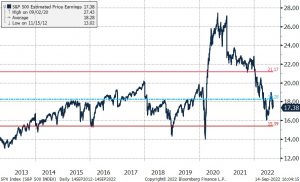
In the U.S. stock market, we remain focused on quality companies with solid growth prospects.  Earnings growth has been solid as the S&P 500 index posted 6.2% earnings growth in the second quarter. With the S&P 500 down -16.1% YTD, market valuations have improved dramatically. The below chart shows the forward price to earnings multiple (a measure of how much stocks cost), has fallen from 22.8x at the beginning of the year to 17.4 which is just below the 10-year average of 17.8.
We remain underweight international equities and defensively positioned in European equities.  Though the energy crisis and war in Ukraine are concerns, European earnings have held up relatively well and are helped by the U.S. Dollar strength.

We continue to be patient and opportunistic as we evaluate companies and make portfolio adjustments. To that end, we have added several new investments in strong businesses that now offer compelling valuations. Additionally, your position in short term bonds, including U.S. Treasuries, offers an attractive yield, high degree of safety and a source of potential liquidity. Finally, while incurring losses is never our goal, the volatility & weakness throughout 2022 has provided us opportunities to focus on new opportunities and tax-loss harvesting across taxable portfolios.

Times like these are never easy as an investor; however, historically, these volatile periods present opportunities to long term investors. As always, we caution against reacting to short-term volatility and encourage sticking with well-considered, long-term investment plans.

Crestwood Advisors Welcomes New Portfolio Manager, Wealth Advisor in Connecticut

Crestwood Advisors Welcomes New Portfolio Manager, Wealth Advisor in Connecticut

FOR IMMEDIATE RELEASE

Boutique RIA firm experiencing continued team growth in Fairfield County

Boston, Mass. (August 30, 2022) – Crestwood Advisors (“Crestwood”), a boutique investment advisory and wealth management firm based in Boston, today announced the growth of its Connecticut teams with the recent additions of Alexandra Blake and Jason Hendricks.

Alexandra Blake | Alex joins Crestwood as Director, Wealth Advisor. She brings more than 12 years of experience helping high-net-worth families develop customized asset allocations, wealth planning and strategic investment recommendations. She previously served as a Director at Next Capital Management and a Vice President at BBR Partners, where she provided investment and wealth management advice to multi-generational families. Alex has an undergraduate degree from Lehigh University and a master’s degree from Columbia University.

Jason Hendricks, CFP®, CSRIC™| Jay joins Crestwood as a Portfolio Manager. He brings over 16 years of financial experience as an advisor and portfolio manager in Connecticut. Before joining Crestwood, Jay spent 14 years as a Senior Portfolio Manager at Bank of America Private Bank, formerly U.S. Trust, where he consistently ranked among the top portfolio managers in Fairfield County for the last decade. He graduated from Vassar College with a degree in psychology and is currently pursuing his Chartered Financial Consultant® credential.

As a growing advisory firm committed to client success, our nearly 50 financial planning and investment professionals across New England strive to meet clients wherever they are in life, providing guidance, tools and financial solutions to help individuals and families succeed.

Since the start of 2021, the Crestwood team has expanded by nearly 20 percent, which has played a key role in supporting new client growth in the local market with best-in-class services guided by decades of experience, integrity and wisdom.

“We are thrilled to welcome Alex and Jay to our growing team,” said Crestwood CEO/Managing Partner Michael Eckton. “With their unique industry experiences and perspectives, we’re confident they’ll not only go above and beyond to address our clients’ financial goals but also add depth to the experiences and relationships of current clients while enabling us to comfortably absorb continued growth of new clients.”


Director, Equity Analyst Julie Praline Discusses Inflation Reduction Act Impacts

Director, Equity Analyst Julie Praline Discusses Inflation Reduction Act Impacts

As the Inflation Reduction Act seeks to support clean energy, many investors are questioning whether or not to invest in renewable energy companies.

“The broad [sustainable-energy and eco-friendly] sector will see a long-term boost from the Inflation Reduction Act, lifting demand [and] the profitability profile of some players,” says Director, Equity Analyst Julie Praline in a recent Financial Advisor Magazine story.

Read the full article here.

June 2022 Market Update

With Monday’s -3.9% decline, the S&P 500 has now fallen over 20% from a January peak and officially entered ‘bear market’ territory.  Down markets grab headlines and swiftly erase gains that have been made over what feels like years.

In risk assets the selloff has been more of a meltdown, especially for cryptocurrencies. Bitcoin, crypto’s bellwether, has fallen -21% in the past 3 days and is now down over 66% since November. Last month, so-called stablecoin, TerraUSA, plummeted from $80 to near $0, wiping out over $80 billion in value in 5 days.  Recently, crypto lending platform Celsius has faced a liquidity crisis and the price of their coin has fallen below $0.33.  Since November, the total market capitalization of cryptocurrencies has fallen from $3 trillion to below $1 trillion.

Stock markets have been selling off since Friday’s Consumer Price (CPI) report for May which showed that inflation rose to 8.6% year over year – a new 40-year high.  Investors were expecting CPI to begin to moderate so this report was a major disappointment.  It showed that price increases have become broad-based across the economy and more ingrained in consumer expectations, which is bad news for slowing inflation back down.

In hindsight, the Fed erred by not acting early enough and believing inflation was initially transitory. They are now laser focused on getting inflation under control. Historically, raising interest rates has been a very effective tool for slowing economic growth and thereby curbing inflation.  Unfortunately, concern is now rising that the Fed will raise interest rates at an aggressive clip that might dip the economy into a recession.  After the CPI report on Friday, markets expectations for the Fed Funds rate jumped higher to 3.5% by year end from 1.0% today.

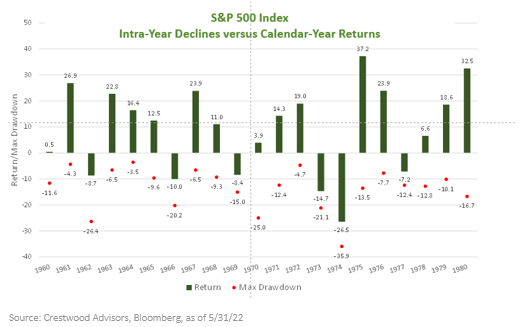
Today’s rampant inflation and rising interest rates reminds many of the 1970’s when the price of gas rose sharply due to the OPEC embargo and gas shortages across the U.S.  Though the economic data is different this time (tight labor markets, strong consumer balance sheets, etc.), the inflationary headwinds rhyme and until the Fed is successful, investors will have to live with uncertainty and market volatility.  The below chart looks back at the annual performance of the S&P 500 Index (Green bars) and the intra-year market decrease (Red dot) for each year:

Clearly, markets were volatile (and difficult) then as they are now but, importantly there were periods that provided positive returns for the patient and prudent investors.

Growing Recession Fears

Most economist believe that the average growth rate of the U.S. economy is currently between 2.0% and 3.0%, so any Fed induced slowdown has a risk of overshooting and causing a recession.  After the Global Financial Crises in 2008/09, investors expect that a recession would again collapse stock prices.

We believe there are three reasons why today’s recession-will-kill-the-stock-market concerns may be overblown.  First, consumer debt ratios are now in the best shape during post war history, making a prolonged downturn like the Global Financial Crisis less likely.  Second, earnings of corporate America remain healthy with EPS growth of over 9% for the S&P 500 in first quarter.  Third, investors appear to be pricing in a recession, by driving indexes into a bear market.  However, economic growth is still healthy and expected to grow ~3.0% this year, so the markets seem to be pricing in a lot of bad news.

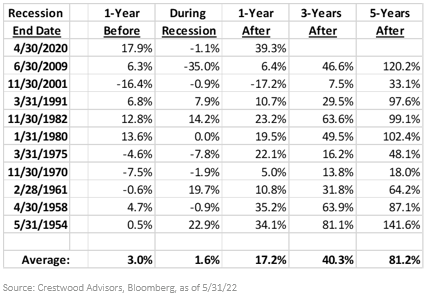
Looking at stock market returns before, during and after recessions, demonstrates that returns have been more mixed:

Since 1950, on average, stocks have shown modest gains before and during recessions.  Sometimes stocks fall before a recession as in the recessions ending in 2001 and 1970.  There are even cases of stocks rising during recessions – 1954, 1961 and 1991.  Most promising is that after a recession ends, stock market returns have been excellent with 1-year, 3-year and 5-year returns up 17.2%, 40.3% and 81.2%, respectively.

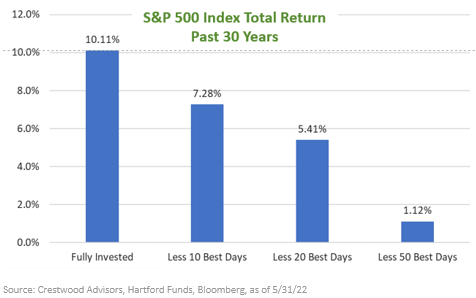
Given the high level of uncertainty in the economy and markets, it is important to remember to stick to your investment plan.  Selling stocks after a 20% decline usually turns a temporary loss into a permanent one.  Staying invested is critical especially considering the impact of missing the best days in the market.

Over the last 30 years, missing the best 50 days in the market erases 89% of your return.  That is missing just 50 days out of 7,500 trading days!  Surprisingly, 50% of the best 50 days occur during bear markets! Selling during periods of stress and buying when the outlook is clearer, will usually hurt long-term returns.

As investors, we recognize how disconcerting this volatility can be no matter what your investment horizon. As we have watched markets sell off, we’ve been comforted that many of the businesses you hold continue to see strong operational success, with many businesses showing an ability to pass price increases to their consumers. This is unlike previous bear markets which typically see lower earnings and more cautious outlooks. While the stock prices are lower, the businesses you are exposed to continue to deliver robust earnings and strong free cash flow which will allow them to not just survive the current challenges, but also gain market share. As markets are forward looking, they will typically turn upwards well before a recession has ended. We know it is not easy, but staying invested through these difficult times is the best way to maximizing your risk adjusted returns over time and ensuring you participate in the future recovery.

A Challenging Start to the New Year

2022 is off to a rough start for investors.  The broad selloff across global stock and bond markets accelerated in April and has continued into May with the S&P 500 index falling over -12.5% year to date, including a dramatic -3.5% drop on Thursday.

Why?

Though the recent weakness in investment markets has lacked a single catalyst, it follows investor angst over a long list of concerns that has sharply increased uncertainty – inflation, rising interest rates, stock market valuations, slowing economic growth, deglobalization fears and war in Europe.  Looking at markets in the U.S., uncertainty centers around inflation spiking to its highest level since the 1980’s.

Inflation is the Problem

The pandemic changed nearly everything.  Inflation, which has been modest over the past 30 years, spiked to 8.5% last month.  A pandemic-driven storm of consumer demand, supply chain constraints, and production shortages led to surging prices in goods like used cars and home goods.  Making matters worse, the war in Ukraine caused food and energy prices to increase sharply.  Extraordinarily tight labor markets with rising wages and soaring housing prices raise concerns that reducing inflation will now be more difficult for the Fed.

Last summer as prices started to rise, the Fed believed that inflation was ‘transitory’ and was slow to react.  This policy error has undermined investor confidence and added to uncertainty. Investors are now realizing that regaining control over inflation will take time and be more difficult than previously thought.

Shifting Monetary Policy

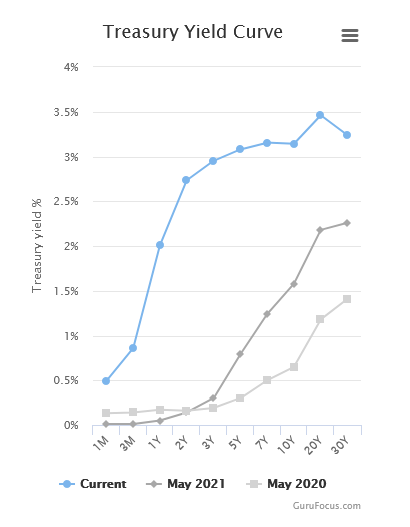
To bring inflation back under control, the Fed has started to increase short-term interest rates with plans to continue to do so in steps over the next several months.  In anticipation of future Fed rate increases, market interest rates have risen sharply this year.  (See chart below.)

Though the increase in market yields has been swift and severe, it is too early to say rates have peaked.  How aggressive the Fed’s pace of future rate hikes will depend on the direction of inflation and economic activity.  The Fed is walking a narrow path to raise rates sufficient to slow inflation but not raise rates too far too fast to damage the economy and create a recessionary slowdown.  Importantly, with the Feds’ objective to slow the economy, we should anticipate that economic results will be more challenging and may add to uncertainty and volatility.

Stock Markets and Recession Concerns

The Fed is also further shifting their monetary policies from so called “Quantitative Easing” (QE) to a more restrictive monetary policy, “Quantitative Tightening’ (QT).  Such changes will naturally impact businesses and the prices of stocks.

Higher interest rates also raise the “discount rate” used to value future business earnings, which mathematically lessens stock valuations.  While the higher discount rate will impact all stock valuations, growth companies whose valuation rely heavily on earnings well into the unknown future are affected even more so.  This is most apparent in many technology companies and investment funds targeting future innovation and one reason why the NASDAQ declines are greater than 20% and why certain investment products holding so-called “innovation” and “next gen” businesses have fallen 50%-70%.  These businesses rely heavily on outside capital to fund their ambitious growth goals and will have a particularly difficult time in a QT world where access to money is scarce.

Is There any Good News?

The good news is that the U.S. economy is still exceptionally strong.  U.S. households are arguably in the best condition in modern history with high savings, income growth and low debt service levels.  Additionally, labor markets remain strong with over 11.5 million job openings, compared to less than 8 million before the pandemic, and wage growth is healthy, especially for hourly wage earners, which ultimately further strengthens households and consumers.

Stock market valuations have also improved with the recent declines and the fundamentals of the businesses that dominate our portfolios remain mostly strong and earnings continue to grow.  Despite some high-profile earning misses, many companies continue to meet or exceed earnings expectations.  In these differentiated markets, we believe owning businesses that can weather this storm with pricing power and strong earnings growth is critical.  Though market volatility is painful, we believe our positions in quality stocks and funds will be better able to withstand the macro risks and generate competitive returns.

 Opportunities in Portfolios

The broad stock market weakness has resulted in significant declines across most stocks, including many high-quality businesses that were formerly too rich in valuation for us to find worthwhile to include in client portfolios.  For some of these businesses, the recent declines have seemed to overly-discount a future that we believe to be still bright and we have been able to add these high-growth businesses to further strengthen portfolios.

Bond markets have also been rattled and off to one of the worst starts of any previous calendar year.  The very low interest rate environment of recent years caused us to favor shorter-duration and high-quality bonds as there was simply insufficient income being generated to be compensated for taking on significant credit or interest-rate risk.  The recent spike in short-term rates (see chart above) has provided us another opportunity, where appropriate, to further shorten bond duration, improve quality and enhance the yield profile.

Similar to the early spring of 2020, the market weakness and volatility is allowing us the opportunity to harvest available tax losses, among both equity and bond holdings, so that we mitigate already realized gains or create an asset to help shelter future gains.

Since the onset of the pandemic, we have faced higher uncertainty and a series of unprecedented macro events from economic shutdowns to fiscal/monetary stimulus and now inflation and a reversal of monetary policy.  While at times the stock market may feel like a rollercoaster, these periods are often ultimately beneficial for investors who remained invested.  Since the bottom of the market during the onset of the pandemic, the S&P 500 index is still up over 90%.  During these volatile periods it is important to avoid making emotionally charged decisions and strive to remain focused on long-term goals and stick to one’s investment plan.

Ukrainian War – A Humanitarian Disaster

Ukrainian War – A Humanitarian Disaster

A Humanitarian Disaster 

Even as the war unfolds “live” in real time, it is hard to comprehend the scale of the humanitarian costs for those in Ukraine. Estimates already suggest that over 2 million refugees have fled the country. As the war drags on, Ukraine will face a rising death toll, shortages of essential goods and worsening of the crisis. The methods of the Russian President, Vladimir Putin, are ruthless and include the use of banned weapons on civilians. It appears that Putin will continue to escalate forces and tactics to bring Ukraine to its knees and, sadly, a truce seems distant. Surging Ukrainian national pride and a willingness to fight for their freedom, argues for a prolonged and destructive battle. Putin’s willingness to use force to obtain his larger goal of rebuilding the former USSR is a threat the world now takes seriously.

Though we are in the early days of this conflict, Putin’s aggression has many geopolitical implications. Since the invasion began, market volatility has jumped as investors have flocked to safe assets like U.S. Treasuries. More recently, the volatility has further increased as world leaders have acted with a high degree of unison in applying layer upon layer of sanctions. Notable was the first ever sanction of a central bank which froze most of Russia’s foreign reserve assets. On Monday, March 7th, selling pressure accelerated as many countries openly discussed banning Russian energy imports, sending gas and oil prices soaring.

Commodities

Although the current volatility raises the appeal for investing in commodities, long-term returns for commodities have been pitiful. Since 2000, the S&P 500 is up 354% while a broad basket of commodities is up only 24%. Commodities generate returns through price change only, while stocks compound earnings and dividends. Over time this growth in earnings and dividends is a powerful driver of returns and builder of wealth in client portfolios.

Energy prices are at the nexus between war and sanctions. While countries are trying to maximize the effect of sanctions, Europe is reliant on Russia for 40% of their energy. Germany has few options to source their gas other than from Russian pipelines. Prices for natural gas in Europe have soared and are trading at approximately 15x natural gas prices in U.S.

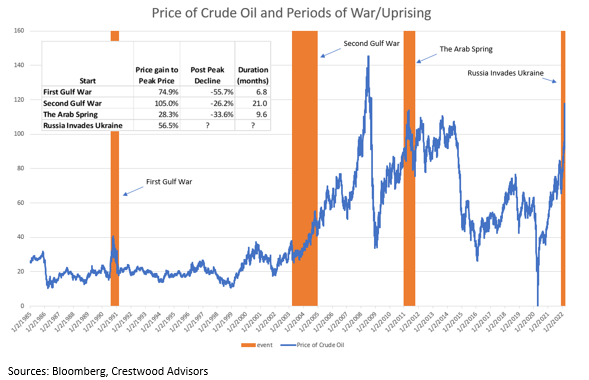
Historically, energy prices are cyclical, moving in tandem with economic growth and prices tend to fall sharply during recessions when demand slows. Wars in regions that produce energy typically cause energy prices to spike. These increases have historically proven to be temporary, except for the second Gulf War beginning in 2003, which was in the middle of a prolonged energy shortage. Prices tend to decline once supply chains and production levels adjust. Hence, these large price swings in commodities makes investment timing very difficult.

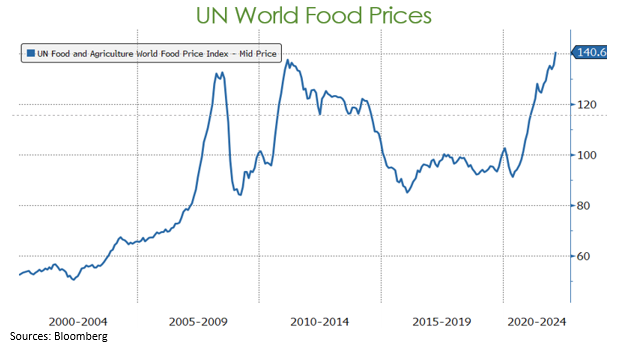
In addition to being significant world suppliers of oil and gas, Russia and Ukraine are also significant producers/exporters of important grains. As the chart below highlights, food prices have also risen to record highs.


U.S. Economy

From a U.S. economic perspective, the current invasion is likely to remain less impactful to domestic economic growth. While we do not want to minimize the human tragedy, over time, investment markets tend to follow “economic” events and, for better or worse, discount wars and other geopolitical events (see chart below). According to a Bloomberg survey of economists, global GDP estimates for 2022 have fallen from 4.5% to 4.3%, so economists are still expecting solid GDP growth.


Portfolios

Our base scenario remains that U.S. economic growth will remain healthy and equity investors will be rewarded for not panicking. That said, this conflict is a major and evolving humanitarian crisis, which will affect energy and commodity markets, particularly in Europe. We remain committed to well diversified portfolios that should serve as a buffer as we navigate through these challenging times. We will continue to make modest adjustments in client holdings where fundamentals remain healthy, and valuations are compelling. Please reach out to your Crestwood team if you have any specific market or portfolio questions or concerns.

A Tumultuous Stock Market to Start the New Year

A Tumultuous Stock Market to Start the New Year

What’s Happening In Equity Markets?

The new year has started with a tumultuous U.S. stock market and the broader economic and investment environment is one of heightened risks.  COVID remains a central theme and is contributing to inflationary pressures (i.e. strained supply chains, production slowdowns) and impairing the workforce and productivity, causing slowing GDP growth expectations.  Concerns over accelerating inflation has caught the attention of the Fed and markets are now pricing in 3-4 rate increases and a shift from Quantitative Easing (QE) to Quantitative Tightening (QT).  The shift to QT will be a difficult balancing act as “too slow” may not sufficiently dampen inflation and “too fast” risks a recession. Neither of these outcomes are great for investors so we’re likely to see some stock market swings as investors judge the relative success of the Fed.

The concerns of tighter monetary policy and a slowing economy have already been hitting the “growthiest” stocks and other speculative investments. “Meme” stocks are buckling, pandemic darlings like Peloton & Zoom have cratered and even the “future of money” cryptocurrencies are down significantly.  Cathie Wood, founder of ARK Innovation funds, got a lot of attention in 2020 as her “disruptive innovation” ETF strategies exploded higher have now lost ~50% over the past year.  Even with such carnage, too many money-losing tech companies remain generously valued based on robust growth expectations that may or may not be forthcoming. A world with QT and higher interest rates makes the potential for profitability more difficult and tossing in a recession ensures some of these types of businesses will be lucky to survive.

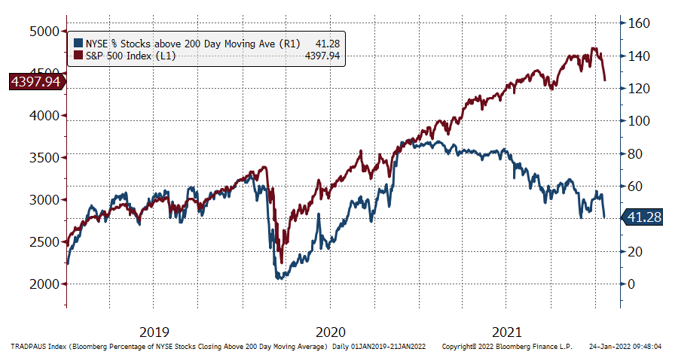
While stock prices for many individual companies are down significantly with many stocks trading well below their 200 Day moving average (see chart below), broader market indices are down more modestly.  So far in 2022, the tech-heavy NASDAQ composite is down about 13%, the S&P 500 is down 8% and the Dow Jones Industrial Average is down a bit more than 6%.


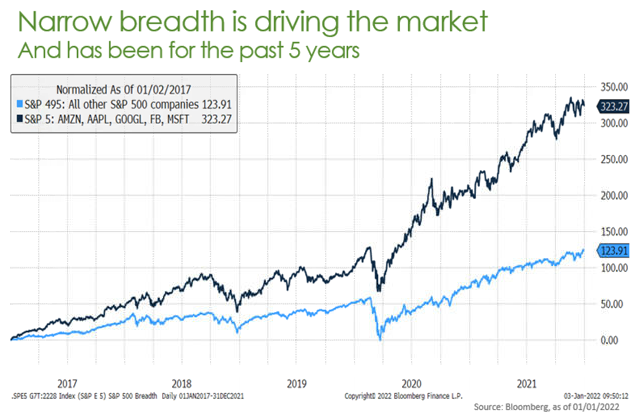
A closer look at the S&P 500 shows some of the risks as well as some explanation as to why this index continues to hold its ground.  As highlighted in the chart below, 5 stocks (Microsoft, Amazon, Alphabet, Meta, Apple) have dominated the S&P 500 index in recent years and the performance gap between the “S&P 5” and “S&P 495” has exploded ever wider over the last 24 months.  We have been fortunate to widely own AAPL, GOOGL & MSFT during this time given what we believe are their strong operational characteristics and favorable valuation levels. Today, if you add Tesla to this group, the top 6 stocks represent about 25% of the total S&P 500.  This is highly unusual and the last time stock markets were so concentrated in just a few names was in tech boom of late 1990s, which didn’t end so well when investors eventually began to question the growth assumptions built into the rich valuations of those stocks.

Importantly, this does not suggest we are on the precipice of a similar market “crash” as we experienced when the tech/telecom bubble burst in the early 2000s, but we do not believe this performance gap is sustainable.  The concentration of the S&P 500 in just a handful of companies presents a heightened level of risk for the market, especially should anything (i.e. slowing growth, more aggressive regulation, etc.) specifically adverse happen to any of those 5-6 businesses.

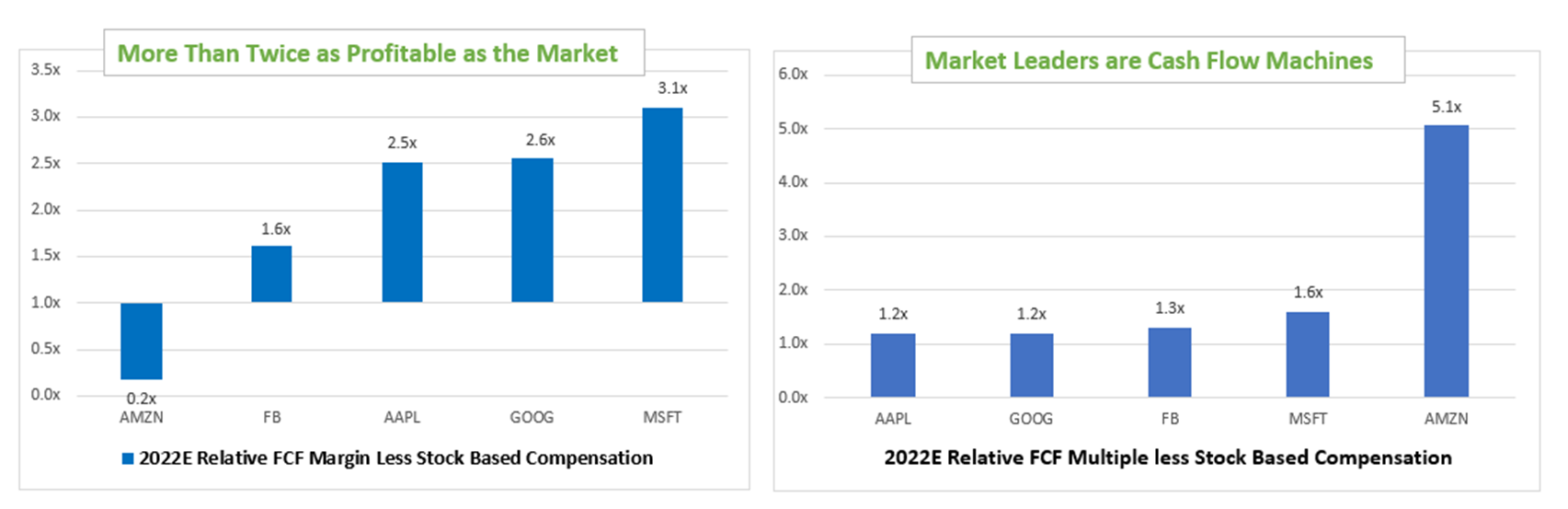
In general, with the possible exception of Tesla, valuations of these top stocks are much lower than what occurred during the tech bubble of the late 1990s.  The charts below highlight how AAPL, MSFT, GOOG & FB generate enormous cash flow and are significantly more profitable companies vs. the S&P 500.

Where we see opportunity?

We believe near-term weakness and enhanced volatility creates longer-term opportunity. While GDP growth may slow, the economy is still expanding and consensus earnings growth for the S&P 500 is expected to be up nearly 10% for 2022.  Higher interest rates may adjust market multiples lower but, as always, we believe businesses with leading positions in secular growing industries that are self-financing with strong positive cash flow will have advantages in both a slowing economy and during any QT when access to outside capital becomes more difficult.  Our portfolios are filled with such businesses and we remain committed to investing in a diversified portfolio of such strong businesses in order to mitigate risk and protect against an always unknown future.

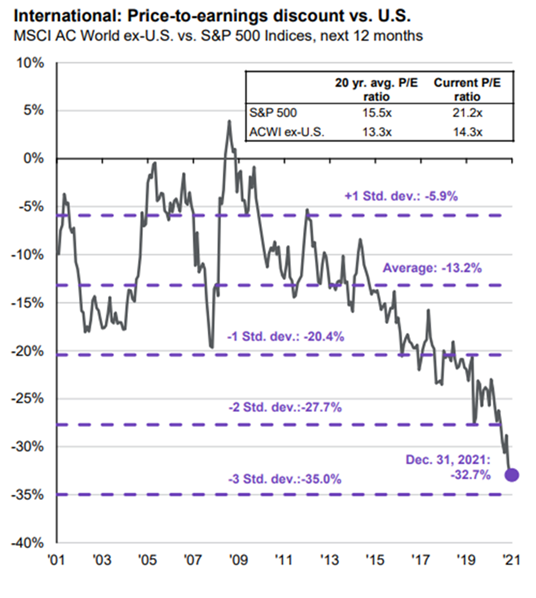
It is also worth noting, that the U.S. stock market’s “advantages” vs. the rest of the world may be fading and valuations of international stocks relative to the U.S. have grown extraordinarily wide (See chart below).  Last year, the U.S. got an economic & profit boost from more front-loaded monetary (i.e. asset purchases) and fiscal (i.e. the direct stimulus payments) policies but these are now largely done or slowing.  In contrast, the Eurozone had more backend- loaded measures including loan guarantees to businesses/individuals and broader reserve lending, which may lead to faster earnings growth vs. the U.S. in 2022.  Given current valuation levels, this would boost relative returns from international & emerging market stocks.

What you should expect

We remain disciplined in our approach to constructing risk-appropriate portfolios that enhance the opportunity for each client to achieve their individual goals. Generally speaking, this includes a healthy allocation to sometimes volatile equities.  Stock market volatility is always uncomfortable but periodic declines in stock prices are an unfortunate part of the experience in seeking the higher long-term returns offered by investing in the stock market.  March 2020 was the last significant downturn in stocks and we don’t know whether the current weakness will prove to be as short-lived but we do see a constructive economic environment supported by a recovering labor market and solid corporate earnings growth.  We intend to use any near-term weakness and volatility to improve portfolios, perhaps adding to current investments that may trade lower but where we see our long-term thesis for the business intact.  Likewise, our research team continues to evaluate opportunities that any further market weakness may make more attractive.

Extreme valuations and get-rich-quick schemes like retail investors chasing “meme” stocks distort performance and will eventually harm those who got in too late.  While the unwinding of the more speculative investments may take time and involve some pain, a renewed focus on the importance of business fundamentals together with a rational long-term investing will increase market stability and reward those with a disciplined consistent approach.

Should you like to discuss the current environment or other matters related to your investment portfolios, we encourage you to reach out to your Wealth Team.

We remain humble and grateful for the opportunity to be working with you.