Crestwood Advisors Names New Partner, Promotes Staff

Crestwood Advisors Names New Partner, Promotes Staff

FOR IMMEDIATE RELEASE

New England RIA firm committed to growth from within

Boston, Mass. (January 6, 2022) – Crestwood Advisors (“Crestwood”), a boutique investment advisory and wealth management firm based in Boston, is excited to announce newly-appointed firm Partner Leigh Hurd, CFA, as well as the promotions of three other teammates:

“Our greatest asset is our people. We’re proud to foster an environment that champions growth from within and we are committed to recognizing and rewarding our team’s talent and integrity with opportunities for advancement and self-improvement,” said Crestwood CEO/Managing Partner Michael Eckton.

Hurd joined Crestwood as a Portfolio Manager and Director in 2013. She has spent close to 20 years building relationships with individuals and families to help structure their investment portfolios to meet their life goals. She holds the Chartered Financial Analyst designation and is a member of the CFA Society Boston and the CFA Institute. She earned her bachelor’s and master’s degrees from Boston College’s School of Management.

“Crestwood is extremely pleased to share the news of Leigh’s partnership, as well as the promotions of Kayla, Peter and Brandon. Together and individually, each of our team members are willing to adapt, learn and evolve – all in the name of putting clients first through our recommendations and actions,” said John Morris, Managing Partner and Wealth Manager.

Over the past three years, the firm has doubled to a total of 42 fiduciary professionals who strive to meet clients wherever they are in life and provide guidance, tools and solutions to help them succeed. Strategic hires and opportunities for internal advancement have poised Crestwood for continued growth in years to come.

Crestwood Advisors’ Team Advancing Industry Roles, Skillsets

Crestwood Advisors’ Team Advancing Industry Roles, Skillsets

FOR IMMEDIATE RELEASE

Client advisors named director of regional committee, earn CFP® designation

Boston, Mass. (December 20, 2021) – Crestwood Advisors (“Crestwood”), a boutique investment advisory and wealth management firm based in Boston, is proud to announce the recent accomplishments of Client Advisors Kayla Holland and Tiffany So.

Holland was elected Director of the NexGen Committee within the Financial Planning Association (FPA) of New England, while So recently earned the Certified Financial Planner (CFP) designation.

The New England chapter in Massachusetts, which has the second largest NexGen chapter in the country, is dedicated to serving aspiring and early-career financial planners. An organization that prides itself on thought leadership, its members are proud to bring energy, enthusiasm and new perspectives to the forefront of the financial planning industry in an effort to ensure standards are forward-thinking and addressing ever-evolving client needs.

An esteemed credential, the CFP designation has been the standard of excellence for financial planners for 30 years. CFP professionals complete extensive training and commit to the CFP Board’s ethical standards, which require designees to put their clients’ interests first, among other things.

“We’re extremely proud to have Kayla and Tiffany on our team,” said Crestwood CEO/Managing Partner Michael Eckton. “Their contributions to the success of our clients, the firm and our communities are admirable and inspiring. We remain grateful for their talent and their efforts and look forward to the impact they’ll make at Crestwood and in our industry for years to come.”

An intro to Bitcoin and Blockchain

An intro to Bitcoin and Blockchain

Talk of cryptocurrencies and blockchains is everywhere. With so much to learn in what seems like an ever-changing landscape, it may seem hard to keep up. We want to share a high-level introduction of the basics, along with some real-world examples, which will hopefully allow you to follow the conversation. For ease of understanding we’ve divided our comments into two sections: we will first discuss Bitcoin and then after the conclusion, address blockchain technology.

Bitcoin – The First Cryptocurrency

Bitcoin’s beginnings
In October 2008, “Satoshi Nakamoto” (whose identity remains disputed) released the Bitcoin whitepaper describing a “peer-to-peer electronic cash system” which serves as the genesis for every blockchain. By January of 2009, the software was launched and Bitcoin, the first blockchain and cryptocurrency, was born. Many believe Satoshi was inspired by the housing bubble forming in 2007 and the events of the Global Financial Crisis to create an alternative, transaction-based system free of top-down control, not governed by one single entity. As the Bitcoin whitepaper concluded, “we have proposed a system for electronic transactions without relying on trust.”

Trading of Bitcoin varies based on supply and demand of owners. Over the last several years, Bitcoin’s value has increased dramatically, spurring a mania of buying as early buyers were rewarded handsomely.

Miners – keepers of the network
The network of computers that track ownership of the Bitcoin blockchain are rewarded or paid with new shares of Bitcoins. These computers are called ‘miners’ and they all race to solve a mathematical computation when a batch of transactions forms each new block. The first to complete the task is rewarded with a share of Bitcoin. Given Bitcoin’s price growth, there are many miners competing for new Bitcoins, which increases the security of Bitcoin, but uses a lot of electricity. It is estimated that annually the Bitcoin network uses as much energy as a small country like Sweden or Malaysia.

Limits around supply
Bitcoin has a maximum supply cap set at 21 million bitcoin and is equipped with a disinflationary supply mechanism. There are 18.86 million bitcoins already in circulation today which is about 90% of the total Bitcoin supply. As a blockchain, the rules for issuance of new Bitcoins are written in its code which is unlike most central banks who have the authority to issue new money as needed.

Bitcoin’s appeal
Bitcoin is a decentralized currency operating without a central bank or political influence. History has shown that central banks have sometimes undermined the value of their currency by printing too much of it. Bitcoin advocates point to the Federal Reserves’ quantitative easing programs and the rapid growth in the supply of money as concerns that the Fed is currently undermining the value of the U.S. Dollar. While U.S. Dollar concerns have, so far, been overblown, currency concerns are very real in many countries like Venezuela, Turkey and Argentina, where politicians have influenced central banks to print more currency. In 2020, Venezuela’s inflation rate ran at a crushing rate of 2,355%. For many, Bitcoin appeals because it is a currency that offers a store of value which cannot be inflated away. Bitcoin is decentralized and issuance is predetermined and not susceptible to political aspirations.

The second reason for Bitcoin’s growth is due to its own rapid success. Early adopters have made a fortune as the price has skyrocketed. Bitcoin has created an estimated 100,000 new millionaires. Speculative fever has been rampant during the economic recovery after the pandemic shutdowns. Especially in younger investors, we are seeing higher usages in leverage and investing the stock market via options. In a 2021 MagnifyMoney survey, 80% of Gen-Z investors indicated they use leverage to invest. Bitcoin’s speculative nature and history of high returns appeals to these and many other investors.

The third reason for Bitcoin’s success is broader acceptance in the financial community. Smartphone apps like Coinbase have facilitated investments in Bitcoin. Microsoft, AT&T, Overstock and more companies now accept payments in Bitcoin. Especially in countries like Venezuela and El Salvador where Bitcoin usage has risen, many firms accept payments in Bitcoin. Ease of access for purchase and increased acceptance has continued to move Bitcoin from fringe currency to mainstream usage.

Risks and concerns
First, Bitcoin lacks a valuation metric or rationale for price. The price is determined by supply and demand which varies widely. Investing in Bitcoin is very similar to investing in gold, except more volatile. Neither Bitcoin nor gold generate income or pay a dividend. Return on investment is dependent on someone else paying more than your cost. It is impossible to accurately value Bitcoin at any price. $1 or $100,000 can be justified as either cheap or expensive.

Second, the Security and Exchange Commission has filed to regulate Bitcoin. Though the outcome is not known, regulation could remove some of Bitcoin’s appeal, especially anonymity. Bitcoin has been used for illegal activities like drug deals or ransomware demands outside of bank and regulatory authority oversight. Writers for Wired Magazine have speculated that Satoshi Nakamoto is actually a former programmer turned drug dealer who lived in the Philippines. A big part of the reforms post the September 11th terrorist attacks were anti money laundering rules that strove to defund terrorist organizations.

Given that Bitcoin’s total value is now over $1 trillion, authorities are keen to know the identities of holders and track the flow of money through the Bitcoin network. Authorities are gaining on illegal activities. For example, in June of 2021 they recovered $2.3b of the $4.4b ransomware payment Colonial Pipeline made after hackers shut down a major pipeline that runs up and down the east coast. Clearly, unfettered money transfers, money laundering, ransomware and tax avoidance represent Bitcoin’s dark side and should be monitored. Arguably, regulation might be a good thing for Bitcoin as well-constructed oversight might bring broader adoption by banks and payment networks.

Third, there is no guarantee that Bitcoin will be the cryptocurrency of the future. Certainly, Bitcoin is the most popular, but its wide price fluctuations and relative slow transaction speeds present issues for replacing the role of U.S. Dollars. It is possible that someday the Federal Reserve issues a crypto U.S. Dollar that is better suited for everyday transactions and whose price is stable. Another reason Bitcoin may not be the cryptocurrency of the future is due to environmental concerns given that extraordinary energy consumption consumed by Bitcoin miners.

Crestwood’s View
While we understand that many are excited about Bitcoin and cryptocurrencies, we feel the risks and concerns stated above are too great to ignore and any investment in these assets in our client portfolios would add immeasurable risk – something that we are not comfortable with today.

For clients who are interested in trading cryptocurrencies, please take the time to understand the rules that govern the currency, like fees, new issuances and trading. If you are still determined to make an investment, we suggest you keep the investment small relative to your wealth. That way, if the price should fall, your long-term financial goals will not be impacted.


Blockchain – A Revolutionary Technology

A blockchain is a shared, immutable ledger that digitally tracks ownership and verifies transactions of an asset, without reliance on an entity overseeing the process.

Shared, immutable ledger
A blockchain is a digital ledger that tracks ownership of an asset. The ledger is public and shared on the internet. The history of ownership is never deleted and is therefore immutable. The ledger is like a check-in sheet that keeps track of every person who has entered a building and at what time. Like this check-in sheet, blockchains are a public record of each approved transaction and the history of ownership. The term blockchain refers to how the ownership data is stored. Each transaction represents a block, the history of transactions are linked together in a chain, and once approved, cannot be changed.

Tracks ownership and verifies transactions
Blockchains have shown to be safe and accurate for two main reasons: First, most blockchains use hash encryption to keep personal details like password and identity unknown. While the digital ledger is public and accessible, the identity of owners is kept safe and secure. Second, decentralized blockchains use a network of computers to approve transactions and agree on ownership. Deceiving the blockchain would require fooling more than 50% of the computers verifying ownership, which is near impossible for larger networks.

Without reliance on an entity overseeing the process
Blockchains are decentralized and do not have a bank, agency or regulator tracking ownership and facilitating the transfers. Instead, blockchains use software and a network of computers that validate a set of transactions, a block, which is added to the blockchain, the history. Owners of computers in the network receive a fee for their computational efforts in maintaining the blockchain. Despite this fee, blockchains are far lower in costs than central oversight like bank or government. This lack of central control is a big part of what makes blockchain technology so unique and appealing for many applications.

Promising Future
Many believe blockchain technology may be the most important innovation since the internet.  Potential applications of blockchain technologies might be stock exchanges, lending, insurance, real estate titles, voting, music royalties, car sharing, healthcare, supply chain logistics and so on.  We will continue to see more applications built using blockchain technology which should lower costs and improve how humans interact. The future for blockchain technology is exciting.

Crestwood Advisors Named to Barron’s Top RIAs List 2021

FOR IMMEDIATE RELEASE

Boston-based firm earns spot on prestigious annual list for second year in a row

Boston, Mass. (September 20, 2021) – Crestwood Advisors (“Crestwood”), a boutique investment advisory and wealth management firm based in Boston, today announced for the second year in a row it has earned a place on Barron’s list of the top 100 RIA firms in the country. The firm ranked 81st on the list, jumping four places ahead of its 2020 ranking.

Experiencing continued growth, Crestwood – a team of 40+ financial planning and investment professionals – currently oversees approximately $4.7 billion in total assets under management. To be considered for Barron’s list, firms are required to have at least $1 billion in assets under management.

Released annually, the Barron’s RIAs list recognizes the top 100 independent wealth management firms across the country. Placements are based on a detailed questionnaire, firm technology spending, staff diversity and succession planning.

“Our team’s grit and determination to provide nothing short of the very best outcomes for our clients has led us to experience exceptional growth opportunities over the last year,” said Michael Eckton, Crestwood CEO and Managing Partner. “Our boutique firm continues to compete and compare to the biggest firms across the country. We’re proud to earn such prestigious recognition for our diligence and commitment to simplifying the complexities of wealth and helping our clients invest with purpose.”

To read more on the methodology of the award please click here.

Please see Crestwood Advisors important disclosures regarding awards and recognition’s here.


Crestwood Advisors Expands Portfolio Management Team in Connecticut

Crestwood Advisors Expands Portfolio Management Team in Connecticut

FOR IMMEDIATE RELEASE

Boston-based RIA firm adds depth to Westport and Darien offices

Boston, Mass. (August 9, 2021) – Crestwood Advisors (“Crestwood”), a boutique investment advisory and wealth management firm based in Boston, today announced the growth of its Connecticut offices with the recent hires of Chris Auten, CFA, CFP®, and Charlie Tricomi, Jr., CFA, CFP®.

Chris Auten, CFA, CFP® | Chris brings more than a decade of extensive experience in financial analysis, trading, research and constructing and managing portfolios to his role at Crestwood. A Stamford resident, he joins the firm at its Westport office as a Portfolio Manager. He graduated from New Mexico State University, where he was the recipient of the university’s Peter Wichert Award for Outstanding Achievement in Finance as the top graduating finance student.

Charlie Tricomi, Jr., CFA, CFP® | Charlie joins Crestwood as Director, Portfolio Manager, working out of its Darien office. He brings more than seven years of wealth management experience to his role, along with an advanced understanding of constructing and implementing multi-asset class investment portfolios. He currently resides in Greenwich and is a member of the Rising Professional Advisors Council for Fairfield County’s Community Foundation and a member of the Greenwich Chamber of Commerce Golf Outing committee.

Across its network of offices, Crestwood’s team of 40+ financial planning and investment professionals work to provide outstanding client services guided by experience and integrity. As the firm remains committed to helping clients achieve their financial goals, it is working to forge new relationships across Connecticut while also investing in top regional talent.

“We’re elated to welcome Chris and Charlie to our Westport and Darien offices. With their expertise and knowledge of the Stamford and Greenwich markets, we’re confident they’ll achieve stellar outcomes for clients and help Crestwood make inroads in the surrounding communities,” said Crestwood CEO/Managing Partner Michael Eckton.

Crestwood Advisors Breaks Down Common Questions About Inflation

inflation

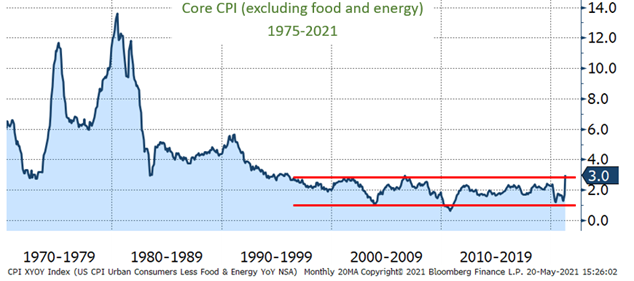
Inflation has been top-of-mind for many investors and consumers this year, particularly as the economy reopens and prices for some goods have seen sharp increases from a year ago. The Bureau of Labor Statistics reported that April’s Consumer Price Index (CPI) excluding food and energy (core inflation) rose 3.0%, the largest year over year increase since 1995.  The larger than expected increase spurred inflation fears across stock and bond markets.  Although the negative market reaction has proved to be short lived, the spike in inflation has prompted many questions regarding the ongoing risk of inflation.  While inflation, the change in prices, is a simple concept, the drivers behind inflation are complex and have changed over time.  In the following, we look to answer the following questions:

  • Why the sudden jump in inflation?
  • Why do investors dislike inflation?
  • Will higher inflation continue?
  • Why has inflation for the past 20 years been low?

Why the sudden jump in inflation?

There are two main causes for the jump in inflation: 1) comparisons to a low base and 2) pandemic driven shortages.  To calculate the year-over-year change, current price levels are compared to price levels a year ago during pandemic shutdowns.  For example, a year ago prices for hotels and travel fell sharply during the shutdowns as few people were travelling.  These prices have returned to approximately pre-pandemic levels and recorded sharp gains.  So, some of the jump in core CPI is due to the comparison to prices at historic lows during the height of economic shutdowns.

In addition to these base effects, the report showed pockets of strong price gains which skewed the total increase.  Prices for several items have soared as manufacturers are unable to keep up with a sharp recovery in demand.  Supply chains for many items have broken due to Covid shutdowns, weather problems, shipping delays or plant slowdowns. A perfect example is used car demand where used cars prices saw a shocking 21% increase from last year. Production for new cars this year has stalled due to pandemic related plant closures and shortages in semi-conductors, a vital component for new cars.  Without new cars to buy, consumers have purchased used cars and driven up prices.

The U.S. economy has been hit by a storm of factors disrupting supply chains and surges in demand exacerbated by Covid shutdowns.  Changing consumer patterns, like working from home, has led to sharp increases in demand for houses, furniture, lumber, and home repair, all driving up prices just as plants were shut down due to pandemic restrictions. Also contributing to delays was the February deep freeze in Texas which led to shortages of plastics and other components and the March blockage of the Suez Canal. Shutdowns and weather disruptions such as these typically have a lagging, but temporary effect on the overall economy. Analysts believe it might take several months to over a year for some items like semiconductors to resolve the shortages.

Why do investors dislike inflation?

Bond investors typically monitor inflation gauges very closely as higher inflation erodes the purchasing power of future cash flows.  Additionally, higher inflation could force the Federal Reserve (Fed) to raise interest rates to slow inflation, reducing bond returns.  During this recovery, the Fed has repeatedly stated that they are comfortable running higher inflation, because there is still slack in the labor market and they believe higher inflation will be short-lived.  After the higher-than-expected CPI release, yields rose slightly, but have since fallen back.  For now, bond investors appear to agree with the Fed that the increase in inflation is temporary.

The impact of higher inflation on equities will vary depending upon each company’s ability to pass on higher production costs to consumers.  For companies without strong pricing power, inflation could erode their margins and earnings.  The broad-based market selloffs centered around inflation news appear to be a result of fading market sentiment rather than fundamental changes in earnings expectations or valuations.  Since pandemic lows, equities markets have seen strong performance.  With the growth of retail investors, many using Robinhood platform, speculative investments like SPACs, Bitcoin and Gamestop have soared.  Recently, many of these hot investments have soured.  Our view is that rising interest rates may undo some of the market froth as market sentiment changes, but fundamental valuation is not significantly changed due to recent changes in inflation.

Will higher inflation continue?

Though inflation is notoriously hard to predict, April’s CPI report does not indicate higher inflation for the long term.  The CPI report did not indicate widespread pricing pressures, instead showed strong pricing gains in categories affect by shortages.  For example, one third of the core inflation increase of 3.0% was due to the 21% increase in used car prices.  It is unlikely these gains will be sustained.  Analysts expect most of the shortages will work themselves out as the economy returns to normal.

An important part of core CPI (33% of weight) are prices for shelter, mainly rents, which were up 2.1% year over year.  The level of rents are still below pre-pandemic levels, bouncing off a low base too.  Part of the increase in shelter has been higher prices for hotels.  Over the past decade, inflation in shelter has been low and has helped moderated CPI gains.

Perhaps the most important factor for sustained inflation is wage growth.  Higher wage growth increases demand for goods and services allowing companies to increase prices.  The cycle of higher wages leading to higher prices was prevalent during the inflationary periods of the 70’s.  Normally, during the early stages of a recovery, wage growth is not a concern.  However, the pandemic and the strong fiscal response has affected the job market creating some wage pressure.  This past month job growth slowed dramatically due to a reluctancy for some pockets of workers to return to work.  These include older workers, workers with health concerns and women caring for young children who have left the workforce and are not searching for a job.   Also, contributing are generous unemployment benefits which can exceed more than $30,000 in annual pay in some states, creating a disincentive for workers to return to work.  As a result, many small businesses are reporting difficulties finding workers and are having to pay more for low-skilled labor.  Wages for hourly workers in leisure and hospitality have jumped up 5.6% above pre-pandemic levels.  Despite these pay gains in hourly workers, overall wage growth has been consistent with wage growth over the past 5 years – below 3.5%.  Thus far, gains in wages for lower-paid workers has not led to a similar increase in the level of overall wages for the U.S. economy.  Certainly, we will continue to monitor wage growth for signs of sustained inflation.

Why has inflation for the past 20 years been low?

The U.S. economy has changed drastically since we last had sustained inflation over 20 years ago.  Secular forces and trends have reduced and limited the rate of inflation and kept core CPI gains range around 2% per year.

The below chart shows core the year-over-year change in CPI starting in 1975.  The red lines highlight that since 1995 core CPI has been modest and mostly range bound between 1.5% and 3.0%.  The chart shows that inflation prior to 1995 was significantly higher than the most recent reading of 3.0%.

  • Globalization – Supply chains, outsourcing and increased competition through trade has reduced companies’ ability to raise prices, especially in manufacturing. Growth in trade with China after their inclusion in the World Trade Organization has increased these pressures.  Research reports estimate that global trade factors account for over 50% of CPI changes.  Globalization has helped to limit wage gains for workers especially in lower skilled jobs.
  • Technology – Advancements in technology have dramatically changed the way prices flow through the economy. Online shopping has greatly enhanced price transparency and limited retailer’s pricing power.  Advancements in automation have lowered companies’ production costs and reduced demand and pay for low-skilled workers.  Additionally, economists have argued that all the benefits of technology have not been fully captured in CPI data, suggesting that reported CPI is higher than it should be.  For example, CPI data does not include free services like Facebook and Google search which are used daily by millions of people.
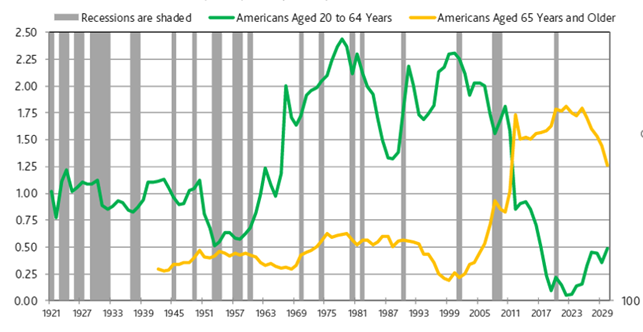
  • Demographics – As baby boomers age, growth in working age adults has fallen to close to zero, while growth in Americans aged 65 or older has spiked 3.8% per year. Overall, the percentage of adults over 65 has growth from 11.5% of the U.S. population in 1980 to over 16% today. This demographic shift reduces demand for goods in the U.S. as baby boomers retire, earn, and spend less.  Reduced growth in working age populations will reduce overall economic growth. The below chart shows population growth for working age adults and adults 65 and older.

Source: Moody’s Analytics

Secular changes brought on by globalization, technology and demographics have not gone away since the pandemic and will continue to reduce pricing gains.  These forces support our belief that recent spikes in inflation will be transitory.

Conclusion

While the recent higher rate of inflation is above the Fed’s target and may continue for several months, we believe the increase in CPI is transitory and will moderate once shortages are resolved and easy year-over-year comparisons are behind us.  Overall wage growth remains benign despite pay gains in low-skilled workers.  Further, the secular forces of globalization, technology and demographics will continue to limit gains in wages and prices.   Knowing that inflation is hard to predict, we will continue to monitor wage growth and changes in pricing behavior beyond pockets like used cars. We continue to focus our investments on high quality businesses that have pricing power to grow their top line revenue and cash flow to protect their long-term value.

Crestwood Advisors Expands Team by 25% During Pandemic, AUM Has Doubled in Two Years

Crestwood Advisors Expands Team by 25% During Pandemic, AUM Has Doubled in Two Years

FOR IMMEDIATE RELEASE:

Boutique RIA firm experiences continued growth with additional hires in Darien and Boston offices, outlines future expansion goals

Boston, Mass. (April 12, 2021) – Crestwood Advisors (“Crestwood”), a boutique investment advisory and wealth management firm based in Boston, today announced it has eclipsed two key milestones in its strategic growth plan.

In two years’ time, Crestwood has more than doubled its assets under management. During the pandemic, the firm has also expanded its team by 25% to support growing client needs.

The newest team additions include Charles W. Tricomi Jr., Hillary Urbancic-Davis and Nathan Gore.

Charles W. Tricomi, Jr., CFA, CFP® | Charles joins Crestwood as a Portfolio Manager, working out of its Darien, Connecticut office. He brings CFA & CFP® designations as well as 7+ years of wealth management experience to his role.

Hillary Urbancic-Davis, CPWA® | Hillary joins Crestwood at its headquarters as a Client Advisor. She possesses 7 years of direct client engagement experience with high-net-worth families. She holds a CPWA designation and is pursuing a CIMA designation.

Nathan Gore | Nathan joins Crestwood at its headquarters as an in-house Technology Specialist. He is a Certified Salesforce Administrator and brings a vast technical background to his role at the firm.

Committed to holding itself to a standard of fiduciary excellence, these strategic additions will aid Crestwood in its mission of developing client strategies that seek to protect, preserve and grow wealth. Now equipped with a team of 41 financial planning and investment professionals across its three offices, Crestwood has hired eight people over the past year.

“We’re thrilled to see our team growing and thriving,” said Crestwood CEO/Managing Partner Michael Eckton. “As we continue stewarding the most advantageous financial solutions for our clients through the growth of our staff, we’re also setting our sights on market growth, with a focus on enhancing Crestwood’s footprint in the Connecticut region and across the New England region.”

In 2019, Crestwood merged with Westport-based Catamount Wealth Management and MacGuire, Cheswick & Tuttle Investment Counsel in Darien to expand its footprint into Connecticut and broaden its team.

The mergers have helped the firm grow to three offices that now manage approximately $4.17 billion in assets, as of March 31, on behalf of high-net-worth individuals and families. Two years ago, Crestwood had approximately $1.99 billion in assets under management.

Crestwood continues to experience increased client growth and greater demand for more holistic financial planning services and investment strategies, which could fuel additional staffing needs.

“We’re optimistic about the significant progress we’ve made over the past two years, and hope to continue in this direction by attracting talent organically and acquiring it,” Eckton said.

Crestwood’s executive team remains active in its recruiting efforts of wealth management professionals from New York to Maine, including financial planners and portfolio managers, to further enhance client support and achieve results that meet current and future objectives.

Crestwood Fosters Talent Expansion – From A Distance

Your Team

FOR IMMEDIATE RELEASE

Remote work success allows firm to continue along growth trajectory

Boston, Mass. (January 21, 2021) – Crestwood Advisors (“Crestwood”), a boutique investment and wealth management firm with offices in Massachusetts and Connecticut, today announced recent additions to its team of financial professionals and expansion plans for 2021.

Since switching to a remote work model in 2020, Crestwood has made five hires, including four at the end of the fourth quarter.

The latest team additions include:

“When the pandemic began, we weren’t sure how going virtual would impact team expansion, but we adapted quickly and it has worked in our favor as there has been a dramatic uptick in financial professionals who are looking for added flexibility, including remote work options,” said Crestwood CEO/Managing Partner Michael Eckton.

“Dynamic firms like Crestwood, who have embraced technology and the flexible work environment that will likely remain in place, may continue to have a competitive advantage in the recruitment and retention of employees,” Eckton added. “We’re thrilled to welcome our new teammates to add depth and expand client engagement in 2021.”

Increasing demands from high-net-worth individuals and families for comprehensive financial planning services and investment strategies has allowed Crestwood to continue growing. With its recent additions, the firm has surpassed 40 employees across three regional offices.

Crestwood leaders remain active in their remote recruiting efforts of wealth management professionals, including financial planners and portfolio managers to further enhance client support and achieve results that meet their current and future growth objectives.


About Crestwood Advisors
Crestwood Advisors is an independent, fee-only, wealth management firm with approximately $4 billion in assets under management. Founded in 2003, Crestwood Advisors provides investment management with financial planning strategies to help high-net-worth individuals and families identify and prioritize their goals and build sustainable wealth so that they may enjoy more financially secure and purposeful lives. For more information, please visit https://www.crestwoodadvisors.com.

Crestwood CEO Joins Lenny Zakim Fund Board of Directors

Crestwood CEO Joins Lenny Zakim Fund Board of Directors

FOR IMMEDIATE RELEASE

Eckton looks to help Boston-based grassroots organization advance mission with further involvement

Boston, Mass. (January 4, 2021) – Crestwood Advisors (“Crestwood”), a boutique investment and wealth management firm based in Boston, today announced that CEO and Managing Partner Michael Eckton has joined the Lenny Zakim Fund (“LZF”) board of directors.

Eckton will serve an initial three-year term on the board of the Boston-based nonprofit organization. Having supported the Lenny Zakim Fund on a personal level for more than a decade, Eckton asserts his involvement stemmed from his strong belief in the organization’s mission of achieving social, racial and economic justice for all.

Over the past 10 years, Eckton has served as a site visitor, bridge builder and volunteer on internal committees with LZF, including those tasked with allocating funds to grantees.

“For 25 years, the Lenny Zakim Fund has played a vital role in grant making to address the countless needs in our local communities, and I’m honored to play a small part in encouraging and highlighting the ongoing work being done by LZF and its leadership team,” Eckton said. “I’m committed to doing my part to uplift our grassroots community organizations who are forever challenged and especially struggling under the current circumstances.”

 Supporting the community is also a central part of Crestwood Advisors’ mission. Under Eckton’s leadership, the firm embraces the opportunity and responsibility to support the communities in which its team works and lives through leadership, volunteer or financial contributions.

“Joining the board of the Lenny Zakim Fund is a wonderful opportunity to help continue acknowledgment and support of social issues, and directly help disadvantaged populations,” Eckton said.