Debt Ceiling Limit – A Game of Chicken

Debt Ceiling Limit – A Game of Chicken

Debt Ceiling Limit – A Game of Chicken

Congress is facing a stalemate on raising the debt ceiling limit as Republicans and Democrats continue a dangerous game of brinksmanship. If the debt ceiling is not raised by June, the United States could default on interest due on its debt jeopardizing the country’s reputation and credit rating. From a credit perspective, the U.S. is generally perceived as the safest borrower and a re-evaluation of our creditworthiness could increase interest rates and further slow US economic growth.

The debt ceiling limits the amount the US Treasury can borrow.  The reason the U.S. government is hitting the debt limit, yet again, is because most years the government spends more than it receives in taxes. The annual shortfall is referred to as ‘the deficit’.  Each year that we run a deficit, it increases the debt load.  Below is a chart showing the annual deficit and the amount added to the debt load each year:

    Annual Federal Deficit
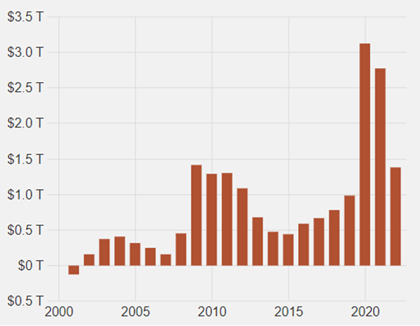
Source: US Treasury 9/30/22

At a basic level, deficits are not always bad.  The U.S. government needs flexibility to run deficits, especially during recessionary periods.  During the pandemic and shutdowns, the U.S. government spent $5 trillion in stimulus programs which helped support families and the U.S economy. To pay for this stimulus, the government issued debt and the deficit increased sharply.  Ideally, after the economy recovers, governments should return to a balanced budget.

Currently, the total Federal debt stands at $31.4 trillion, a number so large it is hard to comprehend.  The is the equivalent of $93,870 per every living person in the States. Yikes!

To the brink!

For the current Republican-led Congress, Kevin McCarthy was elected speaker of the House of Representatives after 15 rounds of voting.  During this process he offered many concessions, one of which was to force spending cuts with any bill extending the debt ceiling limit.  Since McCarthy controls the voting agenda in the House, he can effectively block any bill not to his liking.

Democrats seem equally motivated to protect their priorities.  Since 2020, Biden and the Democrats enacted several hard-won legislative victories including the Infrastructure and Jobs Act and Inflation Reduction Act, which ushered in broad changes to spending and taxes.  Few Democrats will be keen to make cuts to these programs.

The debt ceiling debate will require compromise which seems in short supply in today’s charged political environment.  Heightened bipartisanship, especially in Congress, further raises concerns that one party could be influenced by their more extreme members despite the massive financial and historical implications of defaulting on our debt.

Tough choices

The current deficit is enormous. For 2023, the Congressional Budget Office projected the deficit to be $908b, a sizable 15% of total outlays.  Spending cuts to close this gap will be substantial and painful.  Further, many big spending areas are politically untouchable like Social Security, defense, veteran benefits, and interest on debt.  Balancing the budget would require significant cuts to the ‘touchable’ areas like healthcare and social services.

Treasury’s options

Having reached the debt ceiling, the Treasury has stopped payments to government-controlled retirement plans which buys time.  The Treasury can still pay wages and interest on debt until sometime in June.

There are two somewhat radical solutions that the Treasury could try.  One option is the Treasury could invoke the 14th Amendment, which states that the U.S. cannot default on its debt, arguing that the debt ceiling limit is unconstitutional and hence ignore it.

Alternatively, the Treasury has authority to issue collector coins and could print a $1 Trillion coin, which would give the Treasury funds to pay its bills. Both workarounds would do little to reassure investors that Congress stands behind the debt and would exacerbate the perception that our government is dysfunctional.

Hopefully we don’t end up with either of these ‘solutions’.

Wake up Voters!

The long-term effects of debt are too easily ignored by politicians when voters don’t demand progress on deficits.  Compared to the fiery rhetoric that motivates today’s voters, a conversation on debt reduction excites no one. Politicians rarely face consequences for increasing debt and most want to increase spending and stimulate economic growth when voters hit the polls, helping reelection efforts.

Unfortunately, it may take a crisis for voters to realize that debt and deficits matter. Politicians need to know that voters care about the fiscal standing of their country.  Most would argue that the debt ceiling limit legislation is useless, considering the limit has been raised 78 times since 1960.  This time, perhaps, the game of chicken increases the public’s awareness of our debt situation and forces politicians to focus on the budgetary consequences of their legislation.

We last had a similar crisis in 2011, when an agreement was not reached until very close to the deadline. Markets temporarily sold off but recovered within the following months once the debt ceiling was raised and the “crisis” was resolved albeit at the 11th hour. If history is an example, we do not believe this should cause anyone to alter long-term investment strategies as short-term market moves are invariably hard to predict and markets can bounce back quickly.

Often it is the case that things need to break before politicians find the will to fix them. Ultimately, we view an inability to raise the debt ceiling as a very low probability but high-risk event – it should be monitored but not cause panic. While we do not believe the U.S. will default on its obligations and has ample capacity to service debs, it is likely that this game of chicken affects markets and raises short-term volatility.


Portfolio Manager, Ryan Kenny, Speaks to Financial Advisor on the Benefits of Borrowing Against a Portfolio

Portfolio Manager, Ryan Kenny, Speaks to Financial Advisor on the Benefits of Borrowing Against a Portfolio

“Investors are able to borrow a percentage of their portfolio value based on the underlying holdings,” said Ryan Kenny, director, Portfolio Manager at Crestwood Advisors in Boston. “This gives investors purchasing power to buy more securities, make a large purchase or use as a bridge loan for short-term liquidity needs.”

Click here to read the full article


Financial Advisors Adapting New Business Models for Millennials: How younger advisors can teach older advisors a thing or two about millennial finances

Financial Advisors Adapting New Business Models for Millennials:

Move over baby boomers because in 2019 millennials surpassed you by becoming the largest generation in the United States. With this generation’s increase of financial inheritance compared to the previous generation, financial advisors need to adapt new business models to attract and retain younger clients.

One suggestion is that advisors should consider a subscription fee schedule. “Create a model based on an annual fee, monthly fee or percentage of income,” says Billy Spencer, a wealth planner at Crestwood Advisors.

Click to read more from Financial Advisor here.

Year of the Tiger: End with a Roar!

Year of the Tiger: End with a Roar!

2022 Planning Opportunities

So far, 2022, which is the Chinese Year of the Tiger, has been a tumultuous and eventful year full of change! We are likely to continue to experience significant volatility as the Fed continues to raise interest rates in hopes of curtailing inflation, and there remains a hefty amount of uncertainty in the economy, the markets, and the world.

As we approach the end of the year, this can be a good time to take stock and be courageous and assertive regarding your current financial picture and long-term life goals.

Here are a few considerations:

Capital Gains and Losses
Where appropriate, we are working to take advantage of tax optimization strategies within your portfolios, as we do throughout the year, including tax-loss harvesting strategies. Additionally, holdings with large gains, including legacy stock, are often good candidates for charitable contributions.

Roth IRA Conversions
If you plan to do a Roth IRA conversion, the transfer will need to take place by the end of the year. A Roth conversion transforms all or part of a Traditional IRA into a Roth IRA. The amount converted is taxed in the year of the conversion as ordinary Income. The benefit is that this allows the Roth assets to avoid future federal taxes on distributions. If you can afford the tax now (using outside assets) and your income situation makes sense, this can be a powerful long-term strategy.

An additional benefit of Roth IRAs is there are no RMDs (Required Minimum Distributions), making these particularly appealing for investors with long horizons.

Backdoor Roth IRAs
“Backdoor” Roth IRAs are still appealing to high earners who are prohibited from contributing to Roth IRAs and do not have traditional IRAs. They can use after-tax dollars to create a Traditional IRA and convert it to a Roth IRA with minimal or no tax consequences.

Employer Retirement Plans and HSAs
You may wish to double-check on your 401(k) and HSA at work to see if you are contributing the maximum amount allowed by the IRS.

• For 2022 the maximum employee 401(k) contribution is $20,500, with an additional $6,500 “catch-up” allowed if you are age 50 or older by the end of the year.

• If you are covered by a High Deductible Health Plan (HDHP) and have access to contribute to a Health Savings Account (HSA), you can contribute pre-tax dollars which can then be used tax-free to pay for qualified medical expenses in the future (near or long term). HSA funds can also be used to pay for long-term care policy premiums, COBRA coverage, health care coverage while unemployed, Medicare premiums, or other health coverage once age 65 or older. If you do not need the money for health-related expenses, after age 65 the funds can be withdrawn just like an IRA where you pay ordinary Income tax.

Family Gifting and Estate Tax Planning
The annual gift tax exclusion for 2022 is $16,000 per individual and $32,000 for married couples per recipient. There is still no limit to the number of recipients each year.

Direct payment of tuition or medical bills is not subject to the annual exclusion limit if made to the institution. As an example, a married couple could give $32,000 to one child without owing any gift tax on the transfer or reducing their lifetime exclusion amount. Family gifting can be used as an estate planning tool to reduce the estate annually by gifting to children, grandchildren, and others.

The federal lifetime estate tax exemption is over $12.06 million per person for 2022 ($24.12 million for a married couple). It is important to note that this exemption is expected to sunset in 2025, so we remain in an attractive window to take advantage before the exemption drops to $5 million per individual (plus an adjustment for inflation) in 2026.

For families who may have to contend with estate taxes, a wide variety of trusts and tax planning techniques are available, including:
CLATS (Charitable Lead Annuity Trusts) grant a charitable income tax deduction combined with a tax-efficient way to transfer assets to the next generation.
Dynasty Trusts shield assets for multiple generations from creditors, divorce claims, as well as future estate tax rate increases.
GRATS (Grantor Retained Annuity Trusts) allow the individual to pass appreciation of an asset to the next generation while retaining control of the principal.
ILITs (Irrevocable Life Insurance Trusts) protect life insurance proceeds from estate taxes.
Lifetime QTIPs (Qualified Terminable Interest Properties) allow an individual to leave assets for a surviving spouse and determine how the remaining assets are distributed after the survivor dies.
SLATs (Spousal Lifetime Access Trusts) protect assets from future estate taxes while allowing the spouse to have access during their lifetime.

Charitable Giving
Gifts to qualified charities are a great way to benefit the causes you believe in as well as reduce your tax liabilities. The choice of whether to give cash or securities should be made in combination with your Crestwood advisory team as well as your tax advisor.

Donor Advised Funds (DAF) may be more advantageous than traditional gifting strategies, depending on your circumstances. For investors facing a particularly large tax year due, a DAF allows them to “super-size” multiple years’ worth of gifts into a single tax year for a larger tax deduction while allowing the donor the flexibility to make distributions to charitable causes at their discretion over multiple years.

Charitable individuals with Traditional IRAs have another avenue for tax-efficient gifting of up to $100,000 per individual. Qualified Charitable Distributions (QCDs) are a tax-free distribution directly from your IRA to a qualified charity if you are age 70.5 or older. As an additional benefit, a QCD can be used to satisfy your Required Minimum Distribution (RMD) for the year.

A Time for Resilience
As the Year of the Tiger begins its final stretch, let us know if you have any questions about how these topics affect your family’s financial situation.

Have you moved to a new state, had a new grandchild, or have any other major changes taken place that your planning team should be aware of as we near 2023?

The tiger also represents natural leadership which can be reflected on your end and ours as we work together to stay ahead of important planning opportunities and challenges.

Your team at Crestwood is available and ready to assist you, so please do not hesitate to reach out to us. Let’s go out with a roar!

Crestwood Advisors Recognized on Inaugural Forbes/Shook Top 100 RIA Firms List 2022

forbes top 100 shook

FOR IMMEDIATE RELEASE

Boston advisory firm continues year of growth with prestigious national accolade

Boston, Mass. (October 27, 2022) – Crestwood Advisors (“Crestwood”), a boutique investment advisory and wealth management firm based in Boston, is pleased to announce it has been named to the inaugural Forbes/Shook Top RIA Firms list of the top 100 firms in the nation, ranking at No. 57.

This is the second national list Crestwood has made this fall. In September, the firm was ranked No. 93 on the prestigious Barron’s 2022 Top 100 RIA Firms list.

As a growing advisory firm committed to client success, Crestwood’s nearly 50 financial planning and investment professionals across New England strive to meet clients wherever they are in life, providing guidance, tools and financial solutions to help individuals and families succeed.

“It is an honor to be included in this inaugural Forbes list,” said Crestwood CEO/Managing Partner Michael Eckton. “It confirms what we already know – that the dedication to quality client services by our team of seasoned professionals is a recipe for ongoing success. We are grateful every day for their hard work and the personalized approach they take to managing our clients’ investments.”

This first Forbes/Shook Top RIA list represents firms with assets totaling $730 billion. It was created by Shook Research using quantitative and qualitative data to determine the rankings.

The full methodology can be found here.

Please see Crestwood Advisors important disclosures regarding awards and recognition’s here.


Crestwood CIO discusses market outlook on TD Ameritrade Network

Crestwood CIO discusses market outlook on TD Ameritrade Network

Why is it good to be bullish, believing prices will rise, when the majority are bearish, believing prices will fall?


“There are two important indicators this week: the job openings survey and the September job report. Job growth cooling would show Federal Reserve policies are taking hold. The percentage of bearish individual investors has jumped over 60%. History says it is good to be bullish when the majority are bearish,” John Ingram, Chief Investment Officer, Partner, told Oliver Renick on TD Ameritrade Network’s Market on Close.


Click to watch the interview here.

Crestwood Co-Founders talk team career paths on RIA Podcast

Crestwood Co-Founders talk team career paths on RIA Podcast

John Morris and Michael Eckton, Co-founders of Crestwood Advisors, spoke on Seth Greene’s podcast, The RIA Podcast, about the importance of team culture and ensuring client satisfaction with their financial goals at Crestwood. “We aim to deliver optimal excellent experiences for the clients that we serve so they can then share that experience with other people,” said Morris.


Listen to the full podcast here.

Crestwood Wealth Planner Gives Advice to Young Advisors Entering the Industry with Financial Advisor

Crestwood Wealth Planner Gives Advice to Young Advisors Entering the Industry with Financial Advisor

FA-IQ reached out to advisors to ask: What’s a piece of advice you have for young advisors entering the industry?

“Join a firm that genuinely cares about its clients! You’ll learn more, become a better advisor, and probably have more fun while doing so,” said Luke Neumann, a wealth planner at Crestwood Advisors.

Read the full article now to find out more about Luke’s advice for young advisors!

Financial Advisor IQ

Crestwood Advisors Ranked No. 93 in Barron’s Top 100 RIA Firms List 2022

barrons 2022 top ria ranking

FOR IMMEDIATE RELEASE

Boston advisory firm caps year of growth with prestigious national accolade

Boston, Mass. (September 20, 2022) – Crestwood Advisors (“Crestwood”), a boutique investment advisory and wealth management firm based in Boston, is thrilled to announce it has been named to the Barron’s 2022 Top 100 RIA Firms list.

Crestwood ranked No. 93 on the prestigious national list.

This year’s list was Barron’s 7th annual ranking of independent advisory companies. The rankings are based on assets managed by the firms, technology spending, staff diversity, succession planning, and other metrics. The goal of this list is to highlight the nation’s best financial advisors with the intention of raising industry standards.

As a growing advisory firm committed to client success, Crestwood’s nearly 50 financial planning and investment professionals across New England strive to meet clients wherever they are in life, providing guidance, tools and financial solutions to help individuals and families succeed.

“We are beyond excited to make this distinguished national list,” said Crestwood CEO/Managing Partner Michael Eckton. “Such recognition is a testament to the hard work and dedication our team gives to our clients and our business every single day. Our goal is to use this continued success to attract quality professionals and invest in our business so that we may continue to best serve clients and be recognized among the ‘best’ RIAs in the country.”

To read more on the methodology of the award please click here.

Please see Crestwood Advisors important disclosures regarding awards and recognition’s here.