July Economic Update: Mixed Economic Data and What History Tells Us About Investing at Market Peaks

Economic Data: Getting Cooler

Despite the recent heat wave roiling the U.S., this month also brought data supporting the Fed’s soft landing narrative. May’s CPI was cooler than expected, with core CPI at its lowest since August 2021. Likewise, pending home sales were at their slowest pace since 2001. The May Core PCE reading of 2.6% over the past twelve months met expectations. Economists broadly expect price pressures to continue to fall in the latter half of 2024, with further consumer goods discounting in June and ongoing disinflation in services. Alas, the data was not ice cold: May nonfarm payrolls and average hourly wage data exceeded expectations, which bolsters the Fed’s case for sticking with the higher-for-longer stance.

Given the disinflation trend, cooling labor markets, and weaker economic data, markets are now pricing in a 67% chance of a September rate cut, up from 45% at the beginning of the month. The June FOMC meeting concluded with projections indicating just one rate cut this year, down from three projected in March.

Investing at the Top: Should you wait for a pullback?

One of the most common challenges for investors is timing. Behavioral finance research suggests that we often fall prey to a phenomenon known as “Anchoring”, where we consciously or unconsciously use a fixed reference point (the “anchor”) as the context for determining relative value. This can be helpful in short term decisions, such as determining which cuts of steak are on sale when shopping for a holiday barbecue. However, this bias is less helpful for long-term investing as it often leads to investors sitting on the sideline while waiting for the “right” time to commit.

Many investors look at the current price of an index, like the S&P 500, and see reports of all-time highs as a reason to wait. However, research indicates that investing at all-time highs is a reasonable strategy. Market highs tend to occur in clusters and strong performance runs are often followed by further highs.

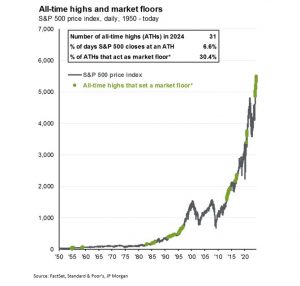
Since the start of the year, there have been a whopping 31 new all-time highs in the S&P 500. As one will note looking at the chart below, historically 30% of the time these all-time high moments created a new “floor” (highlighted in green) which the market subsequently didn’t fall below. Indeed, research done by JP Morgan indicates that investors who bought at S&P 500 peaks since 1950 did better in the 1-, 2-, 3-, and 5-year periods that followed compared investors who bought at the average price during each of those periods.
Investors waiting for an ideal moment often miss out on the opportunity to participate in rising markets. Missing even a small number of days in any given market cycle tends to result in lower returns compared to those who remain fully invested. As we have noted previously, missing the 30 best days in the S&P 500 over the last 30 years would have resulted in less than half the return of those who were fully invested over the entire time period.

Investors with a long time horizon should heed the adage “Time in the market is more important than timing the market”.


Capital Markets

In June, enthusiasm for AI was evident as Nvidia surpassed Microsoft mid-month to become the world’s most valuable company. However, Nvidia’s shares subsequently dropped over 15% due to concerns about extended valuations, an overcrowded trade, and a concentrated revenue base. Meanwhile, Apple’s shares rose nearly 10% after announcing several AI integrations into its platforms, including a partnership with OpenAI to incorporate ChatGPT into Siri and other applications.

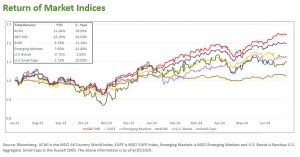
Equity returns were mixed in June. The All-Country World Index (ACWI) rose 2.3% and the S&P 500 rose 3.6%, while the EAFE and U.S. small caps fell -1.6% and -0.9%, respectively. There continues to be a wide dispersion both in valuation and performance between the large and small cap stocks. Emerging markets rebounded upward nearly 4% after falling last month on slower growth expectations in China.
Transform Your Philanthropy: Charitable Giving Strategies for 2024

By being thoughtful and strategic with your philanthropy, individuals can achieve their charitable goals while also being tax efficient and fostering future financial growth. Here, we explore effective charitable giving strategies and highlight how Crestwood Advisors can support your journey towards impactful giving.

Be strategic with your giving to maximize tax benefits

Donating appreciated securities allows you to avoid capital gains taxes while securing a charitable deduction for the asset’s full market value. Additionally, contributions to qualified charitable organizations are deductible from income taxes, providing immediate financial benefits. Collaborating with your Crestwood advisor can ensure you are giving as tax efficiently as possible.

Leveraging Donor-Advised Funds (DAFs)

When donating cash, securities, cryptocurrency or other assets into a Donor-Advised Funds (DAFs), donors receive an immediate tax deduction but can make grants to charities over time. One key advantage of DAFs is flexibility: donors can contribute in one year and then decide on the timing of gifts across one or more years. Additionally, unused funds within the DAF can be invested, maximizing the impact of your charitable giving. Administrative ease (no more keeping track of all those individual donations throughout the year!) and potential for growth make DAFs a powerful tool for integrating philanthropy into long-term financial plans.

Planning for Legacy Giving

Legacy giving, or planned giving, involves integrating charitable bequests into estate plans, ensuring your philanthropic goals endure beyond your lifetime. By designating a portion of your estate to charitable organizations, you can leave a lasting impact while potentially reducing estate taxes. Legacy giving ensures your charitable vision continues to benefit future generations.

Implementing Charitable Trusts

Charitable trusts, such as Charitable Remainder Trusts (CRTs) and Charitable Lead Trusts (CLTs), offer structured approaches to philanthropy while delivering significant tax benefits. A CRT provides an income stream over a specified period, with the remainder distributing to charity upon the beneficiary’s death. Conversely, a CLT allocates income to charity for a set term, with remaining assets eventually returning to you or your beneficiaries. These trusts are ideal for aligning charitable intentions with personal financial planning goals in 2024.

Exploring Qualified Charitable Distributions (QCDs)

Individuals over 70½ years old can donate up to $100,000 directly from their IRAs to qualified charities without incurring income taxes on the distributions through Qualified Charitable Distributions (QCDs). This strategy not only satisfies required minimum distributions (RMDs) but also significant tax benefits while supporting charitable causes directly.

Ready to transform your philanthropic impact in 2024?

Contact your team at Crestwood Advisors today to discuss how we can help you develop a charitable giving plan that aligns with your financial goals and maximizes your philanthropic impact.

June Economic Update: Big Tech has a Big Month and Trade Settlement gets Shorter

Big Tech: Big Earnings

The S&P 500 constituents closed out the first quarter with strong earnings. The Q1 blended growth rate for S&P 500 companies reached 5.9%, the highest since Q1 2022 and significantly above the 3.4% analysts expected as of March 31.

Notably, when excluding the “Magnificent 7” companies, the blended earnings growth rate for the rest of the S&P 500 was -1.80%. Those 7 stocks alone swung the S&P 500 earnings by over 7%! In that context, it doesn’t seem unreasonable for the companies generating a disproportionate amount of earnings to see a disproportionate amount of affection from investors. Accordingly, in May, “Big Tech” stocks posted outsized gains relative to the rest of the market, with more than half of the S&P 500’s returns coming from NVIDIA (+27%), Apple (+13%), Microsoft (+7%) and Alphabet (+6%).

The Evolution of Trade Settlement

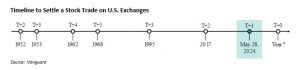
Effective May 28th, U.S. security trades shortened standard trade settlement to one business day (T+1) from two (T+2). For those unfamiliar with the term, the settlement period is the time between when a security is bought or sold and when the trade is considered final. During this window of time, the buyer must make the payment and the seller must deliver the securities.

The change received little attention from the media, however it has subtle but important ramifications for investors. To understand why, we need to look at a brief history of stock trading in the U.S.


The New York Stock Exchange began trading in 1817 with paper stock certificates which would require physical delivery for the next 150 years. In the early years, settlement could take up to 30 days. By 1952 train and airplane travel shortened settlement time to just two days (T+2). However, as overall volume of trading increased, settlement times became longer and a surge in trading in 1968 overwhelmed Wall Street with paperwork. Five business days settlement became the norm due to a shortage of couriers to transport bags of checks and stock certificates. This led to frequent Wednesday closures to settle trades.

With the advent of fax machines and the 1973 founding of the Depository Trust & Clearing Corporation (DTCC), electronic book entry transfer of securities allowed settlement periods to shorten. By 1993, the standard settlement time improved to three business days (T+3), a standard that remained for another 24 years until it dropped to two business days (T+2) in 2017. (Readers who noted the timeline above may be amused to note that it took 55 years of technological advances in processing trades to get back to the same two-day settlement period the U.S. had in 1952!)

Trading volumes continue to rise each year. To address this, securities exchanges have turned to machine learning. This technology analyzes data to identify patterns and allow most trades to settle through “straight-through” processing, where trades are executed, confirmed and settled without human intervention. As AI pushes the boundaries for the speed of crunching large amounts of data, we may eventually see trades settle on the same day.

What does a shorter settlement time mean for investors?

A shorter settlement period has three primary benefits:

  1. Improved capital market efficiency. Shorter settlement times result in increased liquidity, as cash is freed up more quickly post-trade. This gives investors the freedom to reinvest or spend the proceeds from their investments sooner.
  2. Reduced counterparty risk. Shorter settlement time reduces default risk by the other party involved in the trade, as well as the perceived risk of potential for default which can lead to actual illiquidity. A recent example of this was in 2020, where a perceived lack of liquidity in the less newsworthy investment grade bond market led to wild swings in prices. The Fed took the unusual step of announcing they were willing to buy baskets of corporate bonds and backstop municipal issuers, effectively creating an additional risk-free counterparty. Almost immediately thereafter liquidity resumed and volatility fell as investors were reassured.
  3. Less time for market volatility and black swan events to affect the execution of trades. Shorter settlement times reduce the likelihood of a repeat of the “short squeeze” of January 2021 which caused a rise in meme stocks of broken companies like Gamestop. While there is no quick fix for social media hype and rampant option speculation, relieving some of the forced buying by market makers will make these types of pump-and-dump strategies less profitable than they have been in the past.

Capital Markets

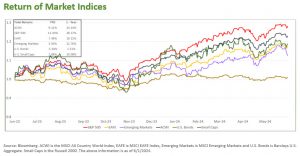
Major U.S. indices closed higher in May, following a weak April. The S&P 500 and Nasdaq saw five consecutive weeks of gains before declining during the last week of the month. In May, the All-Country World Index (ACWI) rose 4.3%, the S&P 500 rose 4.8%, the EAFE rose 4.1%. and U.S. small caps rose 4.9%. Emerging market lagged, rising just 0.61% as slowing growth in China led stocks lower.

Crestwood Advisors Portfolio Manager Discusses ETFs and Index Funds Pros and Cons with CNN

Want to invest smartly but can’t decide between ETFs and index funds? While both offer a diversified, low-cost way to grow your wealth over time, they also have unique advantages and disadvantages.

Crestwood Advisors Portfolio Manager Jimmy Doogan, CFA, recently spoke with CNN on the pros and cons of these popular investment options.

Make the best choice for your financial future – read his insights by clicking here

Trust Protectors: A Powerful Estate Planning Tool

What exactly is a Trust Protector? You may be familiar with phrases like “objective third party,” “check and balance for the trust administration process,” or the “superhero of trust administration.” But what does this mean and do Trust Protectors live up to the hype?

The short answer is yes, they live up to their hype and can positively impact the administration of a trust well beyond the grantor’s lifetime. A Trust Protector is a third party given power within the trust to oversee the trust administration and act as the eyes, ears, and voice of the grantor when they are no longer available. They can provide flexibility in an otherwise inflexible irrevocable document, often being granted powers to change trustees, alter administrative provisions, and sometimes even change beneficiaries.

Who Can Serve as a Trust Protector?

Typically, an attorney or another independent trusted professional is called upon to serve in this role. The individual should be close enough to the family to understand family dynamics and apply an objective lens to balance those dynamics with the grantor’s intent. It is generally not recommended for a beneficiary to serve as a Trust Protector due to potential conflicts of interest.

Powers of a Trust Protector

Trust Protectors are typically given broad authority over trust administration, including advising and supervising trustees, overseeing distributions to beneficiaries, resolving disputes, and responding to changes in the law or family circumstances. Here are some common powers a Trust Protector may be granted:

  • Advise parties regarding trust terms.
  • Choose or remove trustees and advisors.
  • Direct trustees regarding special distributions.
  • Veto trustee decisions or distributions.
  • Determine compensation for trustees and other advisors.
  • Amend the trust, including technical and broader adjustments for changes in the law.
  • Arbitrate disputes between trustees and beneficiaries or between beneficiaries.
  • Grant, modify, or revoke a beneficiary’s power of appointment.

Importance of a Trust Protector

The Trust Protector holds a powerful role in ensuring the grantor’s aspirations are fulfilled and navigating the ongoing trust administration process, which can last many years after a grantor’s passing. We encourage everyone to discuss the merits of including a Trust Protector with their estate planning professionals.

Our team at Crestwood is here to provide further insights and support. Please reach out to us to start the conversation and explore how we can assist you in this important decision.


The above is provided for general informational purposes only by Crestwood Advisors, an investment adviser. Crestwood Advisors does not provide legal advice, and this document should not be construed as containing legal advice. For legal advice, consult with a licensed attorney.

Director, Portfolio Manager Discusses Bond Investing Ahead of Fed Rate Cuts with Financial Advisor Magazine

To the disappointment of many, the Fed has shown it’s not yet ready to cut interest rates. However, this could be beneficial for fixed-income investors if they act fast.

Director and Portfolio Manager Jason Hendricks, CFP®, ChFC®, CSRIC® shared with Financial Advisor Magazine that owning intermediate maturity bonds “allows investors to lock in yields [and] likely see a rise in principal when the Fed cuts rates.”

Click here to read the full article.


Crestwood Advisors Recognized as a Top RIA by Worth Media Group for 2024

We’re excited to share that Crestwood Advisors has been included in @Worth Media Group’s 2024 list of top RIAs.

Click here to see the full list.


The 2024 edition of the Leading Advisors List showcases over 275 independent Registered Investment Advisor firms, chosen through a rigorous selection process. This process incorporates benchmarks such as assets under management, average client size, and whether the firm focuses on comprehensive financial planning.  Crestwood did not pay a fee to obtain or market the award.

May Economic Update: Fed Stays the Course and How Politics Influence Perception of the Economy

The May 1st Fed meeting concluded with no change to the policy rate, which remains at 5.25-5.5%. Prior to the meeting, there was some concern the Fed might shift its stance after recent data suggested inflation ticked up slightly and Fed Governor Bowman indicated higher rates were a possibility.

However, Powell made a point of saying that he doesn’t believe the next policy rate move will be a hike and that he expects the Fed to gain confidence in a cut based on expectations of further disinflation and a more balanced labor market. The net result was a continuation of the Fed’s “watch and wait” posture.

How Political Leanings Skew Perception of the Economy

As we have noted in other recent Monthly Economic Updates, investors often perceive the health of the economy based on political affiliation. The onslaught of disinformation, AI-generated content, and click-bait skews people’s biases even further.

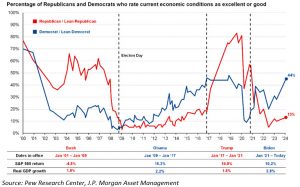
As shown in the chart below, a recent update of a survey by Pew Research Center confirms that Republicans tend to view the economy more favorably when a Republican is in the White House, and likewise for Democrats when the situation is reversed.

Although the average annual returns on the S&P 500 during the Obama administration (+16.3%) and during the Trump administration (+16.0%) were nearly indistinguishable and exceeded the average return over the past three decades, perception of leadership drove sentiment more than actual economic results or stock market performance.


Eagle-eyed readers will also note that perception of economic conditions often changed immediately following election day or soon after, rather than after a President’s policies actually had any influence over the economy.

Is Consumer Sentiment a reliable Predictor of Market Returns?

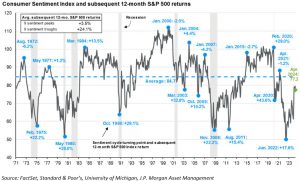
Famed investor John Templeton once quipped: “Bull markets are born in pessimism, grow on skepticism, mature on optimism and die on euphoria. The time of maximum pessimism is the best time to buy, and the time of maximum optimism is the best time to sell.”

As the chart below shows, over the last 60 years, the 12 months that followed a pessimistic period when consumer sentiment was low were often followed by outsized returns in the S&P 500 (+24.1% on average). By contrast, the twelve months that followed consumer sentiment peaks saw much lower returns (+3.5% on average).


The troughs in sentiment had only a modest correlation with periods of actual economic weakness, with only 4 of the troughs occurring during recessions. Likewise, sentiment was often quite high shortly before a recession was about to begin.

This inconsistency is yet another reminder that how one feels when watching the news is not a predictor of future returns. Regardless of how chaotic geopolitical events are here and abroad, staying invested and separating your feelings from your investment strategy is a prudent approach to building wealth.

Capital Markets

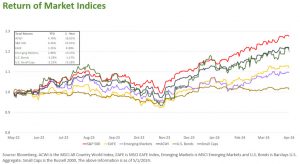
The S&P 500 closed at a new record high of 5,254 at the end of March before momentum reversed resulting in the major indices giving back some of the earlier Q1 gains. During April, the All-Country World Index (ACWI) declined -3.53%, the S&P 500 fell -4.51%, the EAFE fell -2.59%. and U.S. small caps forfeited all their 2024 gains in a -7.4% drop. Emerging market equities were the only area of strength, rising +0.48% for the month.