April Economic Update: Tariff Update – The Latest Version

We revised this note repeatedly, only to have each version overtaken by new developments. As of April 11, 2025, this represents our latest commentary on tariff announcements; anything introduced after this date will naturally render parts of this update outdated.

On Wednesday, April 2, 2025 – labeled “Liberation Day” by the White House – President Trump unveiled new tariff measures in the Rose Garden, declaring, “The day will always be remembered as the day American industry was reborn.”

Markets React Sharply to Tariffs

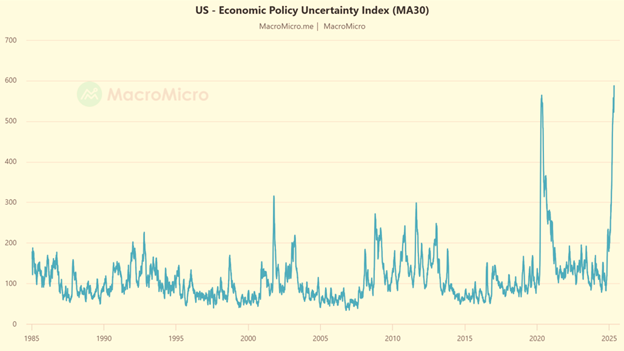
The initial U.S. tariff proposals in early March triggered an immediate market downturn, with the S&P 500 falling around 2.0% on Monday, March 4, followed by further declines that effectively erased all post-election gains. A similar negative reaction occurred after the 10% baseline tariff announcement on April 2, and it is likely that markets will remain volatile in the near term.

Will “Liberation Day” Tariffs Meet Their Objectives?

A primary goal of these tariffs is to boost domestic production by making U.S.-made goods more price-competitive, in turn driving economic growth, corporate expansion, GDP increases, and job creation. However, raising tariffs also pushes prices higher and exerts upward pressure on inflation and interest rates—particularly for goods the U.S. produces minimally or not at all, such as steel. Tariffs on steel imports have done little to stimulate U.S. steel production or job growth, and the industry continues to weaken despite the tariffs. Moreover, foreign imports—like specialized foods from Italy—often do not serve as direct alternatives to pricier U.S. items because their unique qualities make them distinct products rather than interchangeable substitutes.

Potentially Significant Economic Consequences

While the ultimate outcome of these tariffs is uncertain, The Budget Lab at Yale, a non-partisan research center, has estimated that tariffs enacted so far in 2025 could increase annual costs for the average American household by $3,800 as food, clothing, textiles, and automobiles would become meaningfully more expensive1. In addition, they project lower GDP in both the short and long term.

Likewise, IMF Managing Director Kristalina Georgieva has noted that the IMF is continuing to study the broader economic implications, but she emphasized that current tariff measures “clearly represent a significant risk to the global outlook at a time of sluggish growth.” 2

Despite widespread speculation about how tariffs will evolve, our focus remains on well-established information while remaining alert to possible opportunities and challenges. It is worth noting that the S&P 500 and other major equity markets have still shown substantial gains over the past two years, and market fluctuations are a normal, expected aspect of investing. Historically, equities have provided robust returns over time, and price drops often present attractive entry points.

Rather than attempting to time the market, remaining invested is generally the strongest strategy for achieving long-term objectives.

Consider the following3:

  • Over the last 30 years ending 12/31/24, the S&P 500 had an annualized return of 10.9% per year.
  • If you missed the 30 best days out of a possible 7,500 trading days, your return would have 80% lower.
  • This is because the best and worst days tend to be clustered together, making market timing a risky proposition.
  • 50% of the best 50 days in the market occurred during bear markets!

Capital Markets

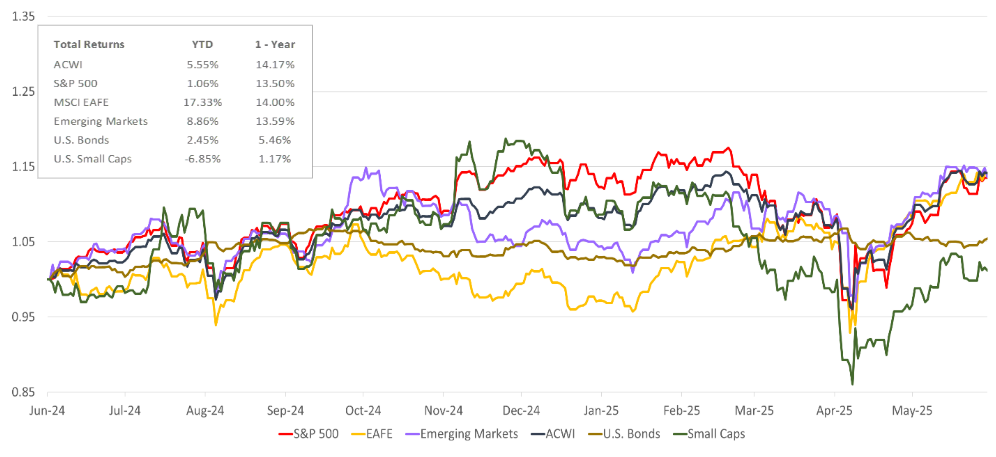
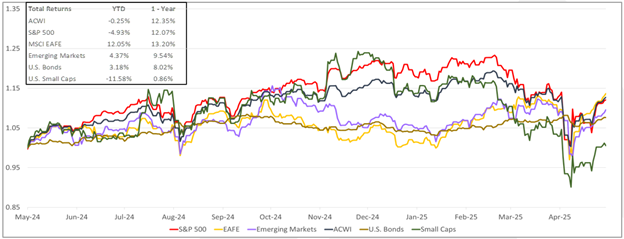
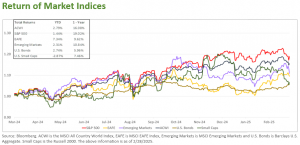
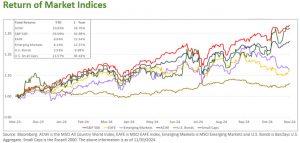
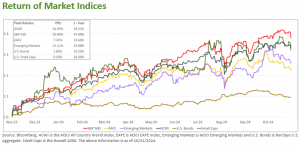
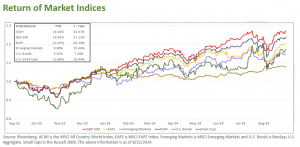
In March, developed equity markets dropped, with the S&P 500 down 5.75%, the Russell 2000 off 6.99%, and the EAFE index slipping 0.90%. Emerging Market equities were a bright spot, edging up 0.38%. Bonds remained nearly unchanged, posting a slight 0.04% gain.

Source: Bloomberg. ACWI is the MSCI All Country World Index, EAFE is MSCI EAFE Index, Emerging Markets is MSCI Emerging Markets and U.S. Bonds is Barclays U.S. Aggregate. Small Caps is the Russell 2000. The above information is as of 3/31/2025.

At Crestwood Advisors, we’re passionate about guiding our clients toward their long-term goals, easing their concerns, and helping them make the most of the opportunities that wealth brings. If you are not yet working with Crestwood, we would love to start a conversation!

1 Where We Stand: The Fiscal, Economic, and Distributional Effects of All U.S. Tariffs Enacted in 2025 Through April 2, The Budget Lab, April 2, 2025

2 Statement by IMF Managing Director Kristalina Georgieva, International Monetary Fund, April 3, 2025

3 FactSet, J.P. Morgan Asset Management, Bloomberg, 2025

This document contains forward-looking statements, predictions and forecasts (“forward-looking statements”) concerning our beliefs and opinions in respect of the future. Forward-looking statements necessarily involve risks and uncertainties, and undue reliance should not be placed on them. There can be no assurance that forward-looking statements will prove to be accurate, and actual results and future events could differ materially from those anticipated in such statements.

March Economic Update: The Three R’s – Understanding Tariffs Today in a Historical Context

Given the recent volatility in the stock market, investors are left wondering about the potential disruptive effects of tariffs.

Douglas Irwin, a professor at Dartmouth, is a widely recognized as an expert on both historical and contemporary U.S. trade policy. He uses three R’s to summarize the history of tariffs in the US: Revenue, Restriction, and Reciprocity.

Prior to the establishment of federal income taxes, tariffs were used for Revenue. For the last 70 years, tariffs have generated approximately 2% of federal Revenue, but when the US was a pre-industrial society, it accounted for nearly 100%. During the Civil War, the addition of excise taxes on items like liquor, tobacco, and most retail goods helped to generate revenue in addition to tariffs. After the war, the revenue generated from the combination of excise taxes and tariffs created a surplus, allowing the US to pay off the war debt. After reducing government debt, Congress debated ways to increase economic growth by reducing taxes and tariffs.

Congress had two choices: lower the tariff rate, which would make imports cheaper, or raise the tariff rate to make imports so expensive that consumption declines and therefore the amount of revenue generated by tariffs would also decline. William McKinley, who would later become president, was chair of the House Ways and Means Committee in Congress and argued for the latter. Tariffs at these high levels fell in the category of Restriction, referred to as Protectionism at the time, since the goal was to protect domestic production.

In the short run, McKinley’s approach worked: prices rose quickly, and US industry filled in the gap left by foreign producers. The drop in imports reduced tariff revenue and alleviated the problematic surplus in federal revenue. McKinley won the presidency in 1896. He then shifted to using tariffs for the third R: Reciprocity. As part of a tariff package, Congress gave McKinley the authority to reduce tariffs selectively so he could use this as leverage to renegotiate trade agreements. By the end of his first term, economies around the world were beginning to boom and the US was so successful that it needed to expand surplus production to foreign markets. As a result, Protectionism was doing more harm than good.

President McKinley planned to reduce tariffs(1) but he was assassinated in 1901. Vice President Teddy Roosevelt then took office. Roosevelt wasn’t as focused on trade policy, and as a result, it took a decade before tariffs began to decrease after the establishment of the federal income tax system. In the years that followed, Reciprocity became a key bargaining tool, ultimately leading to free trade agreements.

Where are we now?

President Trump has described the goal of higher tariffs as encompassing all three Rs – raising Revenue, Restricting foreign competition, and using them as a tool for Reciprocity in trade negotiations.

This presents a challenge of balancing objectives, as all three cannot be accomplished simultaneously:

• If tariffs are to generate a significant amount of Revenue, they must be set at a modest level to still allow enough foreign goods to come in to be taxed.
• If tariffs are too high, their Restriction will result in a drop-off in consumption and therefore less Revenue.
• However, if tariffs aren’t high enough, the prospect of lowering them won’t provide leverage for trade negotiations, thus limiting the potential for beneficial Reciprocal agreements.

Since modern industrialized economies have supply chains with parts and materials from across the globe, high tariffs have the potential to be much more disruptive than McKinley’s day when the US was a relatively isolated nation. Thus, the confirmation of tariffs on Canada, Mexico, and China taking effect immediately with additional tariffs on other nations to come represents an upheaval of the existing trade environment. Since President Trump has made clear that he favors using tariffs as negotiating tools, it remains unclear how long they will be in place.

The near-term implications are:

  1.  Businesses and investors may feel uncertain about how best to put capital to work. This uncertainty manifests in stock market volatility.
  2. Retaliatory tariffs from affected nations are inevitable.
  3. The immediate outcome will be higher prices for consumers and businesses in countries on both sides of a trade war, along with an increased risk of reinflation.

Historically, equity market volatility has been the norm

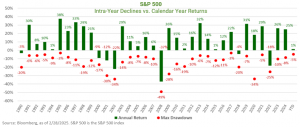
Every calendar year sees periods of market declines. History shows us that volatility is not a predictor of market returns, as illustrated in the chart below. Many of the downturns in the below chart have been caused by economic issues, political crises, wars, debt crises and even a pandemic. At the time, these situations may appear to be lasting disruptions to the US economy, prosperity, and investors’ ability to grow capital. It is difficult to see that short-term dislocations are just that – short-term.

Over time, American institutions have proven to be incredibly resilient and, indeed, the US has been the land of opportunity. As Warren Buffett said, “For 240 years, it’s been a terrible mistake to bet against America.”

The takeaway: Investors should remain patient and disciplined, focusing on long-term goals rather than short-term volatility.

Capital Markets

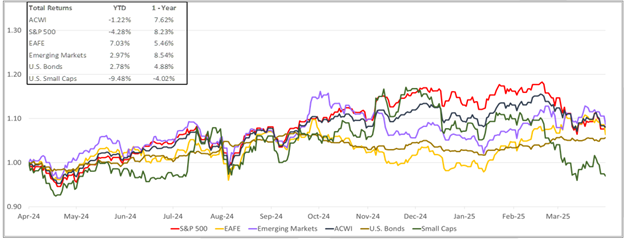
Equity returns in February were mixed. The S&P 500 fell 1.42%, the All-Country World Index (ACWI) declined 0.7%, and the Russell 2000 fared the worst, falling 5.45%. Meanwhile, developed international equities rose by 1.8% and emerging market equities increased by 0.35%. Bonds rose by 2.20%.


This document contains forward-looking statements, predictions and forecasts (“forward-looking statements”) concerning our beliefs and opinions in respect of the future. Forward-looking statements necessarily involve risks and uncertainties, and undue reliance should not be placed on them. There can be no assurance that forward-looking statements will prove to be accurate, and actual results and future events could differ materially from those anticipated in such statements.

(1) McKinley, the self-described “Tariff Man”, gave a speech in 1901 to a large crowd in Buffalo, New York saying “The period of exclusiveness is past. Reciprocity treaties are in harmony with the spirit of the times. Measures of retaliation are not. If perchance, some of our tariffs are no longer needed for revenue or to encourage and protect our industries at home, why should they not be employed to extend and promote our markets abroad?” McKinley assassinated the following day, died shortly after.


January Economic Update: 2024 in Review

As we look back at 2024, we want to summarize the major economic highlights of the year.

Economic Data Mostly Positive
US economic growth, job creation, and inflation continued to improve through 2024, though progress came with some caveats.

Stable GDP Growth: GDP came in at a 1.6% for Q1 2024, the lowest since Q2 2022, but Q2 2024 came in at 3.0% and Q3 2024 at 3.1%.
Non-farm employment rose by ~2.2 million jobs from January through December, though the unemployment rate moved up to 4.1%, 0.5% higher than December 2023. 4.1% is still a low figure compared to the longer-term average of 6.2% but does reflect a slowing pace of US growth.
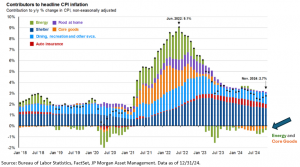
Inflation improving (for now). The consumer price index (CPI) was up 2.7% and core CPI was up 3.3% year/year in November. This is a marked improvement from the 3.3% and 3.9% pace in December 2023. However, as shown in the chart below, it’s noteworthy that declining prices in core goods (in orange) slowed in the second half of the year and lower energy costs (in green) contributed to much of the decline in total inflation for the year. This suggests that independent of other potential inflationary factors (wage pressure, tariffs, etc.) we could see inflation pick up, should energy prices reverse course.

Fed Preached Patience before Cutting Rates
Early in 2024, investors questioned when the Fed would begin the process of easing from the 5.25-5.5% peak, maintained since August of 2023. It took until August 2024 before Fed Chair Powell’s announcement that “the time has come for policy to adjust”.

September’s FOMC meeting resulted in a 0.5% cut, followed by 0.25% cuts at the November and December meetings. Notes from the December FOMC meeting, as well as a revised Summary of Economy Projections (aka the “Dot Plot”) suggest the Fed may delay further cuts in the near term with rates falling a further 0.25-0.5% by the end of 2025. That’s both a slower pace and a higher end rate than many investors expected.

US Equity Markets Rally Immediately Post Election Before Ending on Mixed Note

The market’s initial reaction was positive, with both the S&P 500 and the Russell 2000 logging their best monthly performances of 2024 during November. This reflected investor optimism about several factors, notably:

A further lowering of the corporate tax rate from 21% to either 20% or 15%. This would be a huge boon to corporate earnings and like push stock prices higher. For perspective, the highest 2016 marginal rate was 35%.
An extension of the 2017 personal income tax rate cuts set to expire in 2026. If this were to sunset, US consumers would have less money to spend on discretionary purchases.
Deregulation: This could boost domestic energy production, lower the barrier to mergers and acquisitions, and usher in a pro-crypto administration.

However, a narrowly averted government shutdown in December raised questions about how effectively President Trump will be able to use Republican congressional majorities. Equity markets pulled back amidst a backdrop of speculation about tariffs, disruption with long-time trading partners (Mexico, Canada) and the US potentially assuming control of Canada, the Panama Canal and/or Greenland. Collectively these are distractions and potential disruptions from the pro-business policies noted above.

Corporate Earnings – Strong but Top Heavy
S&P 500 constituents posted average year/year EPS growth of 5.8% in Q3, which was the fifth consecutive quarter of positive earnings growth. Q4 results are forthcoming, but S&P 500 firms are forecast to record annual earnings growth of 9.5%, which exceeds the ten-year average of 8.0%. The Mag 7 names (Apple, Microsoft, Amazon, Alphabet, Meta, NVIDIA and Tesla) accounted for a disproportionate share of earnings growth estimated at 33% vs 4% for the “Non-Magnificent 493”.

Looking ahead, analyst estimates for 2025 in aggregate are an optimistic 14.8% based on expectations of durable EPS growth, progress on inflation and a favorable regulatory backdrop from the incoming administration. Importantly, analysts expect broader based earnings growth with a stronger contribution from companies outside the Mag 7 names which dominated earnings and returns last year.

Capital Markets
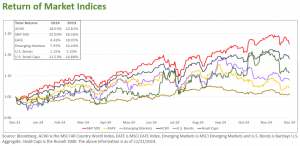
Both equities and bonds pulled back in December, capping off an otherwise strong year. The S&P achieved its second straight year of 20%+ gains for the first time since 1998, hitting 57 new record highs in the process. Small caps were a winner in November, but reversed course in December, falling -8.4%. The All-Country World Index (ACWI) and the S&P 500 both declined -2.5%, while developed international equities a measured by the EAFE index fared slightly better with a -2.3% decline. Emerging market equities were down only slightly by -0.3%. Bonds declined -1.6%.

This document contains forward-looking statements, predictions and forecasts (“forward-looking statements”) concerning our beliefs and opinions in respect of the future. Forward-looking statements necessarily involve risks and uncertainties, and undue reliance should not be placed on them. There can be no assurance that forward-looking statements will prove to be accurate, and actual results and future events could differ materially from those anticipated in such statements.

December Economic Update: Politics and Perception Revisited

With the election results now in, many investors are wondering if they should adjust their portfolio strategy. We have written in the past about how political affiliation can frame investors’ perception about the economic environment.(1) This month, we discuss how that carries over to trading behavior.

Bias and Sell us

Politics have a marked influence on an investor’s perception of the market and their ability to evaluate risk. Interestingly, this phenomenon isn’t limited to “retail” investors trading via Robinhood, but extends even to sophisticated investors, such as hedge funds.(2)

Research on investor psychology reveals that investors of all skill levels report feeling more optimistic and view markets as less risky and more undervalued when their preferred political party is in power. Conversely, they often maintain a lower weighting in risk assets, like equities, when the opposing party holds power, regardless of market or economic conditions.(3)

For example, following the 2016 election, a greater proportion of GOP-identified mutual fund managers increased exposure to equities than Democrat-identified mutual fund managers. Likewise, retail investors in predominantly GOP-leaning zip codes increased their equity allocations more than those in Democrat-leaning areas.(4)

Thus, following the 2024 election left-leaning investors may be thinking about how to position their portfolios defensively while right-leaning investors may be seeking opportunities to invest more aggressively.

A Quick Refresher

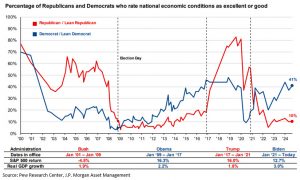
As shown in the chart below, market returns during the Obama and Trump administrations were almost identical (+16%), far above the 30-year average of 10%. Despite similarly strong equity markets, surveys consistently show that individuals rated economic conditions more favorably when their preferred political party wins an election or was currently in power and less so when their party wasn’t in power.

Rather than Gambling on Red or Blue, Invest in Black and White

In the last few weeks, we have seen flows in and out of areas dubbed “Trump Trades” such as cryptocurrencies, banks, and pharma companies. However, it is difficult to do well in the long run by speculating on political agendas.

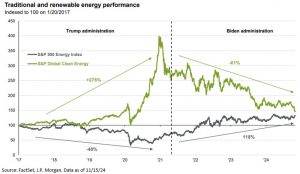
For instance, during the 2016 election cycle Trump campaigned to support the traditional oil and gas industries during his presidency. On the other hand, Biden campaigned to support renewables and promised to reduce exposure to fossil fuels.

However, sector performance was exactly the opposite of what politically focused investors expected. Under Trump, the S&P 500 Energy index, which held oil and gas companies fell 40%, while the S&P 500 Global Clean Energy index rose a remarkable 275%! Conversely, under Biden the S&P 500 Energy index nearly doubled, while the S&P 500 Global Clean Energy index fell more than 60%.

At the end of the day, market performance is shaped by macroeconomic forces. Fluctuations in supply and demand, along with changes in interest rates around the world, had a greater impact than any policies from the White House.

Ultimately, it is policy rather than political posturing that drives the economy. Thus, investors would do well to maintain diversified portfolios of companies with good balance sheets, strong cash flows, and solid business models regardless of political change. Your equity allocation should be driven by your financial plans and time horizons, rather than election outcomes. Maintaining a long-term focus is the key to achieving your financial success.

Capital Markets
The S&P 500 is on pace to see the first back-to-back years of annual gains of 20%+ since the 1995-1998 market run, but U.S. small caps were the star of the month, rising by 10.8%. The All-Country World Index (ACWI) rose 3.8%, the S&P 500 climbed 5.7%. However, international equities underperformed due to a stronger dollar and trade concerns, with the EAFE down 0.7% and emerging market equities down 3.7%. U.S. Bond prices rose slightly by 1% for the month.

This document contains forward-looking statements, predictions and forecasts (“forward-looking statements”) concerning our beliefs and opinions in respect of the future. Forward-looking statements necessarily involve risks and uncertainties, and undue reliance should not be placed on them. There can be no assurance that forward-looking statements will prove to be accurate, and actual results and future events could differ materially from those anticipated in such statements.
1. See our May 2024 Economic Update “How Politics Influence Perception of the Economy”
2. Source: “Hedge Fund Politics and Portfolios”, DeVault and Sias June 2016
3. Source: “Political climate, optimism, and investment decisions”, Bonaparte et al, May 2017
4. Source: “Partisanship and Portfolio Choice: Evidence from Mutual Funds”, Cassidy and Vorsatz, January 2024


November Economic Update: Tariff Talk

This election cycle, presidential candidates have characterized tariffs as both a miracle cure for all economic injustices as well as a potential tool for mass disruption.

President Trump has described potential tariffs ranging from 20% to 2,000%, sometimes saying they would apply only to certain countries or industries and at other times suggesting they might be applied to all imports. Meanwhile, Vice President Kamala Harris has framed these policies as an unavoidable sales tax paid by American consumers.

This month we want to discuss the history of tariffs, how they are applied, and their economic impacts.

A brief history of Tariffs and how they work

A tariff is a tax imposed on the imports or exports of goods. In modern parlance, it is most often used to refer specifically to a charge on imports.

Tariffs have been a documented part of economic systems as far back as ancient Greece, when Athens levied a two percent charge on goods such as grain that arrived through the docks of Piraeus. Tariffs have been widely used throughout history to raise revenue and compete against economic rivals.

In the United States, the Customs and Border Protection agency collects tariffs and transfers the revenue to the U.S. Treasury. Tariffs are typically levied as a percentage of the price a buyer pays a foreign seller.

Before federal income tax was established in 1913, tariffs were a major source of revenue. Douglas Irwin, a Dartmouth College economist studying the history of trade policy, estimates that from 1790 to 1860, tariffs accounted for 90% of federal revenue.

The most infamous tariff act was the Smoot-Hawley Tariff Act of 1930, which sharply raised tariffs before the Great Depression. Most economists don’t believe the increase in tariffs had a big influence on the Great Depression considering global trade was only 9% of GDP. However, one outcome of this tariff was the Reciprocal Trade Agreements Act of 1934 which gave presidents authority to negotiate and update trade agreements and tariffs without approval from Congress.

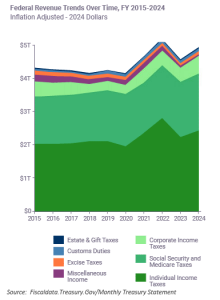
After the Great Depression and World War II, tariffs declined as global trade increased and as a result, they are now a meager source of revenue compared to individual income taxes, Social Security taxes, and Medicare taxes (shown in shades of green below). The chart breaks down sources of Federal Revenue for the last decade, with tariffs listed as “Customs Duties”. Note that even during the 2017-2021 period of the Trump presidency which saw new tariffs, they were still not a significant source of Federal revenue.

Are Tariffs a ‘sales tax’? Who pays the cost?
A tariff is not a ‘sales tax’ in the traditional sense. However, importers who pay the tariff typically raise prices to pass on the increased the cost of bringing goods to market to their end customers. Thus, tariffs result in higher costs on imported goods.

If Tariffs raise costs, what’s the benefit?
Tariffs protect domestic producers by making foreign goods less competitive and harder to sell.

For illustration, imagine a U.S. company that produces chocolate bars for $2.50 each competing with a Swiss company that produces similar bars for $2 each. A sweet-toothed President looking to protect jobs in the U.S. chocolate industry might decide that a tariff of 50% would be applied to all imported chocolate, effectively raising the cost of Swiss chocolate bars to consumers by $1 to $3/bar, making them the more expensive choice. This would likely lead to consumers buying American rather than Swiss chocolate bars.

Tariffs have frequently been employed in the past to combat unfair trade practices. For instance, if the Swiss government was subsidizing their chocolatiers to allow them to sell their bars for $0.50 each, a sizable tariff could help even the playing field. Foreign countries’ support of their manufacturing can take many forms: cheap credit, low wages, currency manipulation, and lax environmental laws can provide unfair advantages in trade.

Levying or lifting of tariffs can also be used to form strategic alliances. For instance, NAFTA (1994-2020) and its replacement policy USMCA (2020 – today) reduced barriers to trade across North America and established a process to handle economic disputes between the members. It also further extended U.S. influence beyond our borders.

What are the downsides of Tariffs?
Tariffs frequently lead to trade wars, where one country levies a tariff and in response the targeted country levies a tariff in return. For instance, in response to President Trump’s tariffs on aluminum and steel, the European Union taxed a variety of U.S. products such as bourbon and Harley-Davidson motorcycles. In a similar vein, China responded to Trump’s tariffs by adding their own tariffs to soybeans and pork, which hurt American farmers.

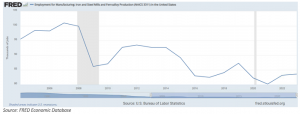
While a targeted tariff can help protect domestic businesses against a foreign rival, in cases where there is little to no domestic production, a tariff is often inflationary and results in higher costs without a meaningful economic benefit. For example, the U.S. continues to have a tariff on certain steel and aluminum products, yet the chart below from the U.S. Bureau of Labor Statistics illustrates how the number of jobs in the steel industry in 2024 is virtually identical to what it was in 2018 and has trended significantly lower over time.

Tariffs are here to stay, but their impact is dependent on their application

The goal with tariffs is to reshape a trade imbalance and reduce unfair trade. Unfortunately, they are not a magic solution capable of halting the advance of foreign competition. For instance, many companies in targeted countries like China avoid tariffs by shipping goods through other countries like Vietnam or Mexico.

Tariffs will continue to be a part of American economic policy for the foreseeable future. However, this is not without risk. Since tariffs result in higher prices, they can slow the pace of progress when battling inflation.


Capital Markets

Equity markets were lower in October, breaking the pattern of five months of back-to-back gains. The All-Country World Index (ACWI) declined -2.2%, the S&P 500 declined -0.9%, while the EAFE retreated -5.4%. U.S. Small caps declined -1.4%. Emerging market equities fell -4.3%. U.S. Bond prices fell -2.5% for the month.

This document contains forward-looking statements, predictions and forecasts (“forward-looking statements”) concerning our beliefs and opinions in respect of the future. Forward-looking statements necessarily involve risks and uncertainties, and undue reliance should not be placed on them. There can be no assurance that forward-looking statements will prove to be accurate, and actual results and future events could differ materially from those anticipated in such statements.

October Economic Update: The Fed Makes the First Cut

Equity markets finished September higher, after a rough start with the S&P 500 down over 4% during the first week, the biggest weekly pullback of the year. Investors initially fretted over softer than expected August employment that featured negative revisions to prior months and a disappointing ISM manufacturing report. These data points exacerbated existing worries about U.S. election uncertainty, potential further escalation in Middle East conflicts, U.S. labor disputes (port workers and Boeing) and ongoing economic woes in the Chinese economy.

However, several developments reversed this pessimism. The Fed announced a 0.5% rate cut at their September meeting while telegraphing another likely 0.5% in cuts before year-end. The September cut was supported by positive data showing continued disinflation, a stable (albeit slowing) labor market, still-healthy consumer spending, and continued earnings growth projected for U.S. corporations. The soft-landing narrative was further buttressed by initial unemployment claims falling to the lowest level since May.

A 0.5% drop in policy rates is significant paired with the Fed’s updated Statement of Economic Projections (aka their “Dot Plot”) penciling in another 1% in cuts during 2025 and 0.5% in 2026. Car loans, credit cards, some adjustable-rate mortgages and some other forms of borrowing are based on the Prime Rate, which typically runs approximately 3% above the Fed Funds rate. Thus, a full 1% drop in the Fed Funds rate by year-end would represent a meaningful reduction in borrowing costs for many U.S. consumers.

When Will Fed Rate Cuts Help Homebuyers and Refinancers?

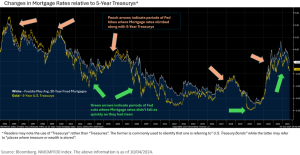
The short answer is “Eventually.” Unlike the Fed Fund rate, which is decided by the Fed, mortgage rates tend to be closely related to 5-year Treasury yields, which are driven primarily by supply and demand factors. These yields tend to rise when the economic outlook is strong and fall when the economic outlook is weak. Over time, Treasury rates tend to follow the direction of changes in the Fed Fund rate.

  • The caveat is that mortgage rates don’t always adjust at the same pace:
    When the 5-year yield is rising, borrowing rates tend to go up quickly as lenders are eager to offer loans at higher and higher rates while the economic outlook appears strong. From their perspective, this is a win-win: they’re charging higher rates to borrowers in an environment where defaults are less likely.
  • Not surprisingly, when 5-year Treasury yields are falling, lending rates don’t fall quite as fast as they rose. In other words, when the economic future looks more uncertain, lenders prefer to keep rates higher for longer to hedge against future risk.
  • This phenomenon is observable in the chart below: the gap between 5-Year Treasurys (yellow line) and 30-year average Fixed Mortgage Rates (white line) is minimal when rates are rising (as in 2022) but tends to widen when rates are flat or declining.

The takeaway: Homebuyers and refinancers should be optimistic that lower rates on mortgages are coming, however they should also expect that these lower borrowing costs for consumers may lag the decline in Fed rate cuts.

Chinese Equity Markets: Avaricious Stimulus

During the last week of September, Chinese equities rose nearly 20% in response to the Chinese government’s announcement of a tidal wave of stimulus measures intended to jump start their economy. The stimulus included cuts to mortgage rates, a decline in down payment requirements for second homes, relaxed capital reserve requirements for banks, and a large stimulus program that explicitly incents brokers, insurance companies and other entities to buy Chinese stocks.

While this caused Chinese stocks to move into positive territory for the year, it does little to address fundamental issues plaguing their economy. China still faces weak retail sales, falling real estate prices, and a crippling dependence on government investment, rather than consumption, to maintain growth. Perhaps worst of all is that the heavy hand of communist rule has undermined shareholder rights, especially those of foreigners. In June this year, foreign direct investment in China turned negative for only the second time since 2005.

Despite the recent rise in Chinese equity prices, we continue to believe investors should be wary of rallies driven by government spending and policies intended to entice speculative investments.

Capital Markets

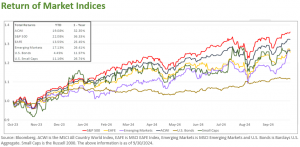
Equity and fixed income markets rose in September. The All-Country World Index (ACWI) rose +2.17%, the S&P 500 rose +2.02%, while the EAFE rose +0.62%. Emerging markets surged with a gain of +6.68%, driven primarily by the aforementioned move in Chinese equities. U.S. Bond prices rose +1.34% for the month.


This document contains forward-looking statements, predictions and forecasts (“forward-looking statements”) concerning our beliefs and opinions in respect of the future. Forward-looking statements necessarily involve risks and uncertainties, and undue reliance should not be placed on them. There can be no assurance that forward-looking statements will prove to be accurate, and actual results and future events could differ materially from those anticipated in such statements.

September Economic Update: All Eyes on the Fed

August began with a pullback in the stock market, with the S&P 500 falling over 6% in the first three trading days and the “Magnificent Seven” stocks dropping nearly 10% in the first week. The selloff was fueled by concerns that the Federal Reserve had been too slow to cut interest rates. The labor market has softened considerably with July’s nonfarm payrolls significantly missing expectations and with June’s figures also revised downward. The unemployment rate in July ticked up to 4.3%, compared to the consensus of 4.1%, sparking discussions that the economy was headed for a hard landing.

Following the July labor report, expectations for a Fed rate cut soared, with the market pricing in a high probability of a 0.5% cut in September given hard landing concerns. The market reaction was further intensified by an unwinding of the yen carry trade, given the divergence between Fed and Bank of Japan policies, after the BoJ unexpectedly raised rates at a time when the US and most other central banks are lowering them.

As we discussed last month, we believe the rise in unemployment in July was likely due to a temporary increase in the labor force and weather-related layoffs. It was therefore unsurprising when the August jobs report, released last week, showed a decrease in the unemployment rate to 4.2%. Additionally, the job market showed signs of stabilizing, with the ratio of job openings to unemployed workers falling to a healthy 1.07, in-line with the pre-pandemic average since 2004.

Last month saw the Fed release the FOMC Minutes from the July meeting which shared insight into where the Fed is most focused. Members concluded that the risks to achieving the Committee’s employment and inflation goals were becoming more balanced, though the economic outlook remained uncertain. They noted that consumer spending had slowed from the strong pace of last year, reflecting restrictive monetary policy, easing labor market conditions, and slowing income growth. Some members also pointed out that lower-and-moderate-income households were facing increasing financial pressures, as seen in rising credit card delinquency rates and a growing number of households paying the minimum due on their balances.

The equity market rebounded and erased the early-month declines as soft landing odds rose over the course of the month and the Fed essentially confirmed it would cut in September as recession risks remain low. Powell said that the upside risks to inflation have diminished, downside risks have cooled, and the Fed was committed to doing everything it could to support a strong labor market.

Skipping Stones: What are the implications of a shift in Fed policy?

We don’t know for certain how the Fed’s actions will unfold, but in his speech at Jackson Hole, Federal Chair Powell made clear that “The time has come for policy to adjust. The direction of travel is clear, and the timing and pace of rate cuts will depend on incoming data, the evolving outlook, and the balance of risks.” We expect the initial result of a lower Fed Funds rate will be modest: a proportionate decline in the yield of money markets, savings accounts, and new Treasury Bills.

Secondary effects will likely take time to manifest. Banks will lower CD rates, and investors seeking yield may shift funds from cash and short term Treasury Bills to bonds with longer maturities which in turn puts downward pressure on yields farther along the curve. Mortgage rates and other loans, which tend to track changes in 5-Year Treasuries, have been falling, albeit slowly. The average rate on the 30-year mortgage is now at 6.7% which is below last year’s peak of 8.1%. Eventually, lower rates could provide a tailwind to consumers who face higher interest costs.

Like a stone thrown into still water, the magnitude of the secondary effects – the splash and the ripples – will be dependent on the size of each rate move and how quickly each subsequent move follows. We believe that a single 0.25% pebble or even a handful of pebbles thrown before the end of the year (such as three 0.25% cuts), would likely cause much less of a disruption than a chunky 0.75% boulder.

Capital Markets

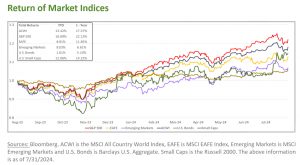
Both equity and fixed income markets rose in August, except for U.S. Small Caps. The All-Country World Index (ACWI) rose +2.57%, the S&P 500 rose +2.43%, while the EAFE rose +3.27%. Small Caps gave back part of July’s 10% surge, falling -1.5% in August. Emerging markets finished with a gain of +1.64%. U.S. Bond prices rose +1.4% for the month.

This document contains forward-looking statements, predictions and forecasts (“forward-looking statements”) concerning our beliefs and opinions in respect of the future. Forward-looking statements necessarily involve risks and uncertainties, and undue reliance should not be placed on them. There can be no assurance that forward-looking statements will prove to be accurate, and actual results and future events could differ materially from those anticipated in such statements.

August Economic Update: Labor Pains

U.S. stocks started July on a high note bolstered by healthy second quarter earnings. While both equity and fixed income markets rose, sentiment had begun to shift with investors rotating out of growth and stocks as the month went on.

Several recurring themes whittled away at investors’ appetite for risk:

  • Companies reported investing heavily in AI without a corresponding immediate increase in revenue or earnings which called into question the timeline between capex and monetization.
  •  June retail sales data remained healthy, but corporations continued to note signs of deterioration in their earnings calls.
  •  Investors continued to speculate about the presidential race, given early polling suggesting President Biden’s withdrawal and VP Harris’s entrance may have made the contest more challenging for Trump. Markets and corporate boards tend to prefer landslides (more certain outcomes) vs. close calls (less certain outcomes).
    The July Fed meeting ended as expected with no change to rates. Fed Chair Powell noted at the press conference which followed that if the Fed sees the softening economic data it hopes for, a cut could be on the table in September. He acknowledged that the case for rate cuts was strengthened by some weaker labor market and manufacturing data.

Labor Report Startles Investors but it’s Premature to Declare a Recession

The Bureau of Labor Statistics announced that nonfarm payrolls rose 114,00 in July vs. the consensus estimate of 175,000. That shortfall coupled with slight downward revisions to job growth numbers for May and June suggests the economy grew at a slower pace than expected. Of note, a shortfall in payroll growth is not the same as a contraction in payrolls, but nonetheless this spooked investors. In addition, the unemployment rate rose from 4.1% to a still low 4.3%, whereas expectations were for the rate to remain unchanged. While the three-month average of payroll gains was virtually unchanged at 170,000, this was overshadowed by the July headline.

As a result, some economists were quick to claim that based on the July unemployment data the U.S. is already in a recession, pointing to the “Sahm rule”, named after former Fed economist Claudia Sahm. The rule suggests the economy is already in a recession if the three-month average of the unemployment rate rises 0.5% or more above the prior 12-month low of that average.

This speculation propelled an already anxious market into a bout of volatility, particularly in the tech space. Tech leaders like Nvidia which have propelled the market higher by rising over 170% YTD fell over 6% in one day. Likewise, semiconductor stocks like Broadcom, AMD, Qualcomm, Intel and others saw similar drops.

While the Sahm rule does have a strong historical record, Dr. Sahm stated in an interview with CNBC on August 2nd “We are not in a recession now – contrary the historical signal from the Sahm rule – but the momentum is in that direction. A recession is not inevitable and there is substantial scope to reduce interest rates.” She elaborated, saying “The Fed has a big lever still to pull, they have a lot of interest rate cuts they could go through if they need to.” She added “This economy is in a good place – it just needs some pressure taken off it.”.

What Might be Skewing the Numbers?

Workers on temporary layoffs accounted for a startling 70% of the increase in the number of unemployed in July. Yardeni Research Inc points out that according to the Bureau of Labor Statistics household employment survey, 1.54 million workers were either not working or had only part-time employment specifically due to weather in July, a vast increase compared to the 280,000 figure in June. In fact, the July figure was so large that it is one of the top five monthly readings for workers impacted by weather since 2018.

Another factor in the labor data is a surge of individuals joining the work force. Nancy Vanden Houten, Lead U.S. Economist at Oxford Economics states that it’s unlikely we’re in a recession currently as the labor force participation rate among prime age workers increased in July hitting 84% – the highest rate since 2001. This is a sign of strength rather than weakness. She noted “In a recession, individuals are more apt to get discouraged and leave the labor force.”

The Fed has repeatedly stressed that they are watching the data closely and focus on trends, rather than a single data point. This is necessary because monthly data is calculated and then subject to two further revisions while also being subject to wide margins of error. For instance, according to the Bureau of Labor Statistics, from 2021-2023 the Nonfarm Payroll monthly numbers were subject to a total of 108 revisions with 107 of those reviews resulting in different final numbers.

Chicago Fed President Austan Goolsbee pointed out in a CNBC interview on August 5th that the jobs growth number came in 61,000 short of expectations but noted “The payroll jobs number is plus or minus 100,000 a month so be a little careful over-concluding about things in the margin of error.”

What This Means for Investors

We believe the US economy is slowing but this is to be expected and is not a cause for alarm. The decline in the inflation rate as well as the softening labor market both support the case that the Fed is likely to cut rates in the months to come. It’s impossible to predict the pace or exact timing of cuts, however equity markets have historically risen in their wake, thus staying invested remains the best course of action.


Capital Markets

Both equity and fixed income markets rose in July. The All-Country World Index (ACWI) rose +1.6%, the S&P 500 rose +1.2%, while the EAFE rose +2.9%. As we noted last month, there continues to be a wide dispersion both in valuation and performance between large and small cap stocks. Small Caps saw a notable gain, rising +10.2% for the month on hopes for Fed rate cuts to come soon. Emerging markets were the slowest to rise, finishing with a slight gain of +0.4%. U.S. Bond prices rose +2.3% for the month.

July Economic Update: Mixed Economic Data and What History Tells Us About Investing at Market Peaks

Economic Data: Getting Cooler

Despite the recent heat wave roiling the U.S., this month also brought data supporting the Fed’s soft landing narrative. May’s CPI was cooler than expected, with core CPI at its lowest since August 2021. Likewise, pending home sales were at their slowest pace since 2001. The May Core PCE reading of 2.6% over the past twelve months met expectations. Economists broadly expect price pressures to continue to fall in the latter half of 2024, with further consumer goods discounting in June and ongoing disinflation in services. Alas, the data was not ice cold: May nonfarm payrolls and average hourly wage data exceeded expectations, which bolsters the Fed’s case for sticking with the higher-for-longer stance.

Given the disinflation trend, cooling labor markets, and weaker economic data, markets are now pricing in a 67% chance of a September rate cut, up from 45% at the beginning of the month. The June FOMC meeting concluded with projections indicating just one rate cut this year, down from three projected in March.

Investing at the Top: Should you wait for a pullback?

One of the most common challenges for investors is timing. Behavioral finance research suggests that we often fall prey to a phenomenon known as “Anchoring”, where we consciously or unconsciously use a fixed reference point (the “anchor”) as the context for determining relative value. This can be helpful in short term decisions, such as determining which cuts of steak are on sale when shopping for a holiday barbecue. However, this bias is less helpful for long-term investing as it often leads to investors sitting on the sideline while waiting for the “right” time to commit.

Many investors look at the current price of an index, like the S&P 500, and see reports of all-time highs as a reason to wait. However, research indicates that investing at all-time highs is a reasonable strategy. Market highs tend to occur in clusters and strong performance runs are often followed by further highs.

Since the start of the year, there have been a whopping 31 new all-time highs in the S&P 500. As one will note looking at the chart below, historically 30% of the time these all-time high moments created a new “floor” (highlighted in green) which the market subsequently didn’t fall below. Indeed, research done by JP Morgan indicates that investors who bought at S&P 500 peaks since 1950 did better in the 1-, 2-, 3-, and 5-year periods that followed compared investors who bought at the average price during each of those periods.

Investors waiting for an ideal moment often miss out on the opportunity to participate in rising markets. Missing even a small number of days in any given market cycle tends to result in lower returns compared to those who remain fully invested. As we have noted previously, missing the 30 best days in the S&P 500 over the last 30 years would have resulted in less than half the return of those who were fully invested over the entire time period.

Investors with a long time horizon should heed the adage “Time in the market is more important than timing the market”.


Capital Markets

In June, enthusiasm for AI was evident as Nvidia surpassed Microsoft mid-month to become the world’s most valuable company. However, Nvidia’s shares subsequently dropped over 15% due to concerns about extended valuations, an overcrowded trade, and a concentrated revenue base. Meanwhile, Apple’s shares rose nearly 10% after announcing several AI integrations into its platforms, including a partnership with OpenAI to incorporate ChatGPT into Siri and other applications.

Equity returns were mixed in June. The All-Country World Index (ACWI) rose 2.3% and the S&P 500 rose 3.6%, while the EAFE and U.S. small caps fell -1.6% and -0.9%, respectively. There continues to be a wide dispersion both in valuation and performance between the large and small cap stocks. Emerging markets rebounded upward nearly 4% after falling last month on slower growth expectations in China.

June Economic Update: Big Tech has a Big Month and Trade Settlement gets Shorter

Big Tech: Big Earnings

The S&P 500 constituents closed out the first quarter with strong earnings. The Q1 blended growth rate for S&P 500 companies reached 5.9%, the highest since Q1 2022 and significantly above the 3.4% analysts expected as of March 31.

Notably, when excluding the “Magnificent 7” companies, the blended earnings growth rate for the rest of the S&P 500 was -1.80%. Those 7 stocks alone swung the S&P 500 earnings by over 7%! In that context, it doesn’t seem unreasonable for the companies generating a disproportionate amount of earnings to see a disproportionate amount of affection from investors. Accordingly, in May, “Big Tech” stocks posted outsized gains relative to the rest of the market, with more than half of the S&P 500’s returns coming from NVIDIA (+27%), Apple (+13%), Microsoft (+7%) and Alphabet (+6%).

The Evolution of Trade Settlement

Effective May 28th, U.S. security trades shortened standard trade settlement to one business day (T+1) from two (T+2). For those unfamiliar with the term, the settlement period is the time between when a security is bought or sold and when the trade is considered final. During this window of time, the buyer must make the payment and the seller must deliver the securities.

The change received little attention from the media, however it has subtle but important ramifications for investors. To understand why, we need to look at a brief history of stock trading in the U.S.


The New York Stock Exchange began trading in 1817 with paper stock certificates which would require physical delivery for the next 150 years. In the early years, settlement could take up to 30 days. By 1952 train and airplane travel shortened settlement time to just two days (T+2). However, as overall volume of trading increased, settlement times became longer and a surge in trading in 1968 overwhelmed Wall Street with paperwork. Five business days settlement became the norm due to a shortage of couriers to transport bags of checks and stock certificates. This led to frequent Wednesday closures to settle trades.

With the advent of fax machines and the 1973 founding of the Depository Trust & Clearing Corporation (DTCC), electronic book entry transfer of securities allowed settlement periods to shorten. By 1993, the standard settlement time improved to three business days (T+3), a standard that remained for another 24 years until it dropped to two business days (T+2) in 2017. (Readers who noted the timeline above may be amused to note that it took 55 years of technological advances in processing trades to get back to the same two-day settlement period the U.S. had in 1952!)

Trading volumes continue to rise each year. To address this, securities exchanges have turned to machine learning. This technology analyzes data to identify patterns and allow most trades to settle through “straight-through” processing, where trades are executed, confirmed and settled without human intervention. As AI pushes the boundaries for the speed of crunching large amounts of data, we may eventually see trades settle on the same day.

What does a shorter settlement time mean for investors?

A shorter settlement period has three primary benefits:

  1. Improved capital market efficiency. Shorter settlement times result in increased liquidity, as cash is freed up more quickly post-trade. This gives investors the freedom to reinvest or spend the proceeds from their investments sooner.
  2. Reduced counterparty risk. Shorter settlement time reduces default risk by the other party involved in the trade, as well as the perceived risk of potential for default which can lead to actual illiquidity. A recent example of this was in 2020, where a perceived lack of liquidity in the less newsworthy investment grade bond market led to wild swings in prices. The Fed took the unusual step of announcing they were willing to buy baskets of corporate bonds and backstop municipal issuers, effectively creating an additional risk-free counterparty. Almost immediately thereafter liquidity resumed and volatility fell as investors were reassured.
  3. Less time for market volatility and black swan events to affect the execution of trades. Shorter settlement times reduce the likelihood of a repeat of the “short squeeze” of January 2021 which caused a rise in meme stocks of broken companies like Gamestop. While there is no quick fix for social media hype and rampant option speculation, relieving some of the forced buying by market makers will make these types of pump-and-dump strategies less profitable than they have been in the past.

Capital Markets

Major U.S. indices closed higher in May, following a weak April. The S&P 500 and Nasdaq saw five consecutive weeks of gains before declining during the last week of the month. In May, the All-Country World Index (ACWI) rose 4.3%, the S&P 500 rose 4.8%, the EAFE rose 4.1%. and U.S. small caps rose 4.9%. Emerging market lagged, rising just 0.61% as slowing growth in China led stocks lower.