Is Your Child College Bound?

For many of us, college was a transformative chapter filled with learning, growth, and the beginnings of lasting friendships. It’s also where career paths begin to take shape, making it one of the most significant investments you can make in your children’s future.

There is nothing a parent wants more than the best education for their children, and it’s never too soon or too late to start planning. To help support your children’s educational goals, consider these five important steps:

Discuss how you’d like to support your child’s education. Before crunching numbers or filling out FAFSA forms, take a moment to step back and have a thoughtful family conversation about what college support means to you. Every parent brings different values, beliefs, and experiences to the table. Some parents prioritize fully covering tuition so their children can graduate debt-free. Others feel it’s important for their children to contribute, whether through work, loans, or scholarships, so they have some “skin in the game.” In some families, grandparents or other relatives offer to help, while in others, loans may be the only realistic path. There’s no one right answer. What matters is clarifying your family’s intentions, limitations, and hopes around paying for college. This shared understanding is the foundation for building a plan that aligns with both your financial reality and your core values.

Set your savings target. When planning for your child’s future, it’s important to consider how much a college education might cost by the time they’re ready to enroll. As of 2025, the average annual cost of attendance is $25,668 for in-state public colleges and $60,358 for private universities.¹ However, these figures are just averages, actual costs can vary widely. In fact, attending a top-tier private college can cost nearly $100,000 per year.² Should college attendance be several years away, be cognizant that tuition and related expenses are expected to rise, which often outpace the rate of inflation.

Many parents ask if they should save the full amount. While we all hope our children might earn a generous merit scholarship, become standout athletes, or contribute financially themselves; planning to cover the full cost remains the most reliable strategy for meeting your family’s education goals. Your Crestwood team can work with you to create a personalized financial plan that incorporates college savings as part of your overall wealth strategy.

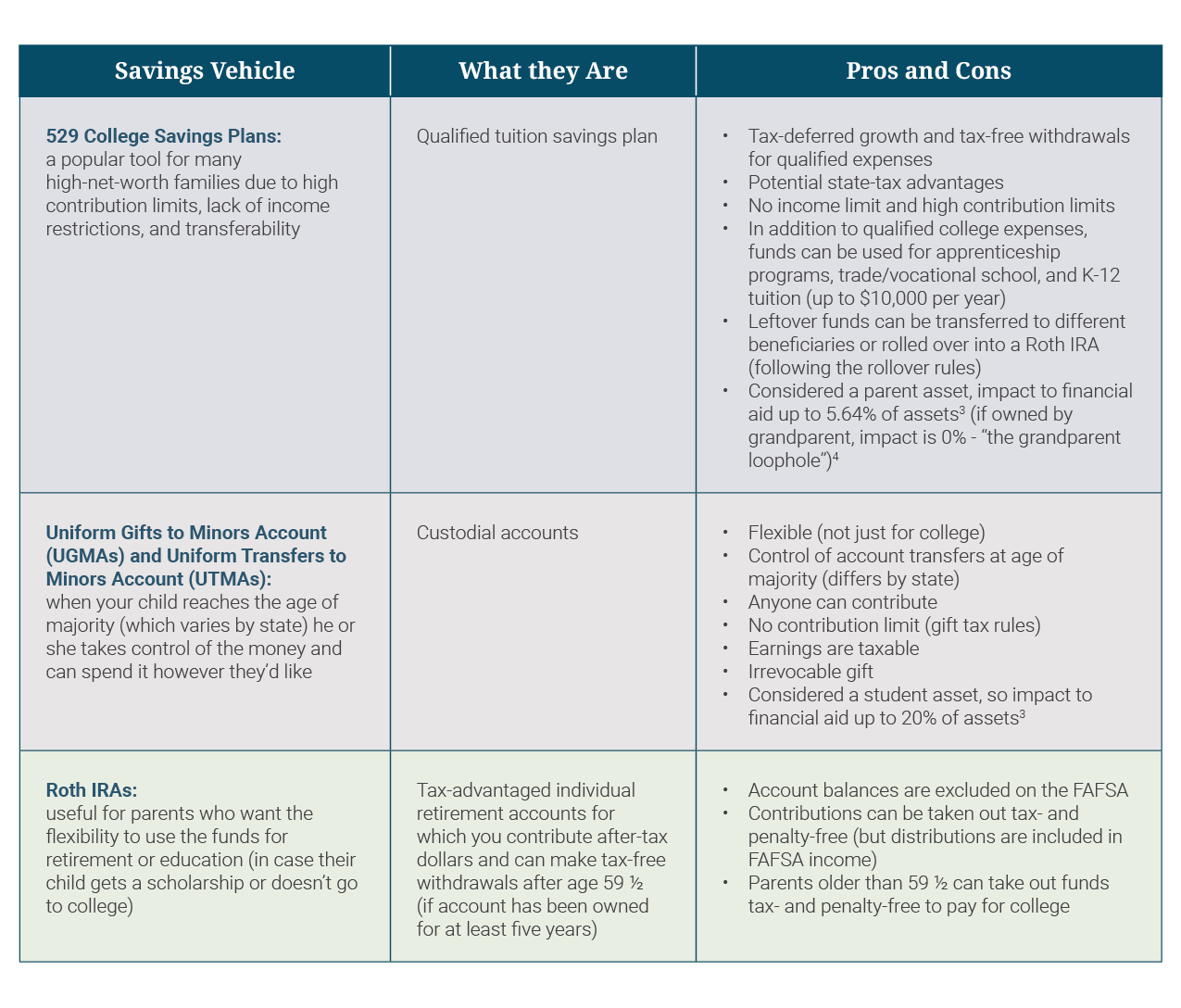
Choose how to save. There are several college savings options to consider, including:

Invest the assets. Your Crestwood team can help you invest your college savings using an asset allocation strategy tailored to your children’s timeframe and educational goals. We will also work with you to reassess your strategy over time, as your children get closer to college enrollment or if they graduate with leftover funds.

Reach Out to Crestwood. When the college acceptance notices arrive, will you be ready to pay the bill? Turn to your Crestwood team for guidance on college savings as part of your comprehensive wealth plan. The sooner you begin planning, the better.

If you are not yet working with Crestwood, please contact us to start a conversation about college planning and your broader wealth management goals.


This document is provided for general informational purposes only by Crestwood Advisors, an investment adviser. Crestwood Advisors does not provide legal advice, and this document should not be construed as containing legal advice. For legal advice, consult with a licensed attorney. This document should not be construed as containing tax advice. For tax advice, consult with your tax adviser.
Source1: College Cost Projector, MEFA
Source2: Elite College Annual Pricing, EdSource
Source3: How Different Assets Affect Financial Aid, Saving For College
Source4: 529 Grandparent Loophole, Kiplinger

Examining Concierge Care

“The greatest wealth is health” is a timeless insight often attributed to the Roman poet, Virgil.

Prioritizing a healthy lifestyle, including preventive medical care, not only enhances your well-being but also allows you to fully enjoy the wealth you’ve worked hard to build. One question we often hear from clients is, “Is concierge medical care worth the investment?”

Concierge medicine, also known as retainer-based medicine, was introduced in the mid-1990s as a way for doctors to reduce their case load and provide a more customized and exclusive healthcare experience.1 In exchange for an annual fee, you gain special access to your physician and a more in-depth level of care.

To determine whether concierge medicine is right for you, consider these three factors:

  1. The Benefits: Concierge physicians offer 24/7 access via cell phone, email, or text, same- or next-day appointments, and longer, unhurried visits. With fewer patients to manage, concierge doctors have more time to focus on wellness planning and proactive management of chronic conditions—tailoring care specifically to your needs and lifestyle. They also facilitate connections to, and relationships with, specialists you need to see.
  1. Your Needs: If immediate access to your doctor is a priority or you have complex healthcare issues that require dedicated oversight, a concierge practice can provide the level of service you need. It offers added convenience that busy professionals often appreciate and a deeper level of care.
  2. The Cost: While the benefits of concierge medicine are many, it’s important to consider the cost. The annual (or monthly) fee varies by practice, typically ranging from approximately $1,200 to $10,000 per year,2 and can increase as you age. In some practices, the fee covers all well and sick visits. However, many concierge practices take a hybrid approach—by providing greater access but billing your insurance for each visit. In either scenario, you need health insurance to pay for services (such as hospitalization) not covered under their plan.

Reach Out to Crestwood

Crestwood takes a holistic, forward-looking approach that focuses on your well-being. Please reach out to your advisory team if you’d like to factor the cost of concierge care into your financial plan. And if you are not yet working with Crestwood, please contact us to start a conversation.


1 A literature review on the impact of concierge medicine services on individual healthcare, National Library of Medicine, June 14, 2024
2 What Is Concierge Medicine And Is It Worth The Price Tag? Forbes, May 18, 2023

This document is provided for general informational purposes only by Crestwood Advisors, an investment adviser. Crestwood Advisors does not provide legal advice, and this document should not be construed as containing legal advice. For legal advice, consult with a licensed attorney. This document should not be construed as containing tax advice. For tax advice, consult with your tax adviser.

May Economic Update: This Uncertainty (Too) Will Pass

Uncertainty around economic policy has become a defining feature of recent economic and financial market news. This heightened period of ambiguity has been extreme and is affecting financial markets and expectations for the future of the economy.

Investors and businesses are operating with limited information during the current “pause” in tariff activity. However, we anticipate the current lack of clarity to subside as specific details surrounding trade policy emerge leading up to the July 9th deadline. The U.S. economy has demonstrated resilience through this rocky period, with higher-than-expected job growth and a continued abundance of job openings.

Measuring the Unknown
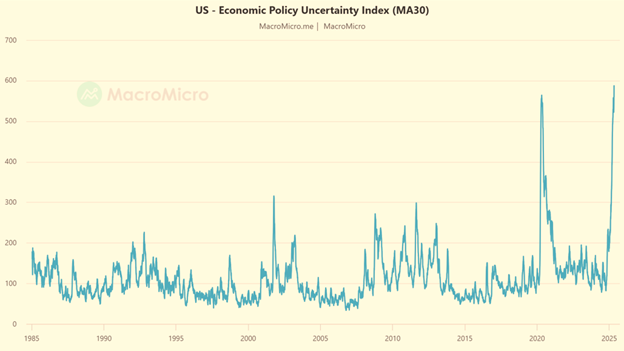
Economists are a clever bunch and have developed tools to measure uncertainty, including scanning top news articles and counting usage of similar terms. It is no surprise that this sentiment affects decisions around consumption, investment, hiring and even monetary policy.

As measured by the U.S. Economic Policy Uncertainty Index1, the numbers spiked around tight presidential elections, the Gulf Wars, the 9/11 attacks, during the COVID-19 crisis and more recently, the 2025 Trump Tariffs. The gray boxes on the chart below indicate recession periods, illustrating a correlation between economic uncertainty and financial distress.

Uncertainty is Temporary
We expect continued volatility in the markets until economic policy mandates and goals become clearer, and consequences become more predictable

However, as long-term investors, we understand that while “fiscal fog” may persist for a time, it is not permanent. History has shown that markets often respond favorably once a measure of predictability returns.

Case in point: the size and scope of the Liberation Day tariffs caught investors off guard, causing stock prices to fall. In an unusual move, bond prices also declined. However, the subsequent announcement of the 90-day “pause” to allow time for international negotiations quickly restored order to the markets. In the weeks that followed, many stocks recovered to pre-Liberation Day levels. In fact, the S&P 500 finished April down only 0.7%.

As we navigate these turbulent market waters, it’s helpful to remember a time-tested investing maxim: “Where there is Volatility, there is often Opportunity.” Attractive investment opportunities can emerge during periods like these, when some investors trade quickly based on emotion rather than staying focused on data and analysis.

Patience and discipline tend to pay off in the long run.

Capital Markets
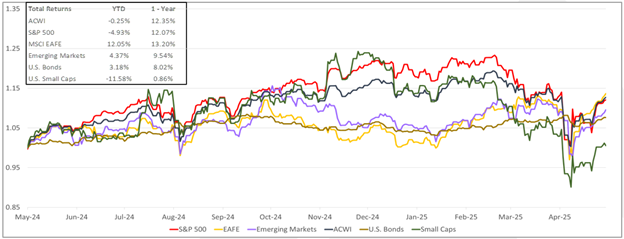
Equities were mixed in April. The S&P 500 fell sharply following the Liberation Day announcement, but recovered after the “pause” to finish down 0.7%. The All-Country World Index (ACWI) rose slightly, finishing up 0.77%. Developed international equities, as measured by the EAFE index, had a strong month, rising 4.17%. Emerging market equities increased by 1%. Bonds were nearly flat, posting a 0.39% gain.


Source: Bloomberg. ACWI is the MSCI All Country World Index, EAFE is MSCI EAFE Index, Emerging Markets is MSCI Emerging Markets and U.S. Bonds is Barclays U.S. Aggregate. Small Caps is the Russell 2000. The above information is as of 4/30/2025.

At Crestwood Advisors, we’re passionate about guiding our clients toward their long-term goals, easing their concerns, and helping them make the most of the opportunities that wealth brings. If you are not yet working with Crestwood, we would love to start a conversation!


1The U.S. Economic Uncertainty Index was first introduced by Scott Baker, Nicholas Bloom, and Steven Davis in an NBER Working Paper Series, Measuring Economic Policy Uncertainty, Working Paper 21633, published by the National Bureau of Economic Research. http://www.nber.org/papers/w21633

It Takes a Village

More than 3 million children in the U.S. live with disabilities.* If you have a loved one with special needs, you have likely asked yourself, Who will care for them when I no longer can? How can I be sure they are supported, and their unique needs are being met?

One of the most important steps you can take is to create a strong support network, people who understand your challenges and are genuinely committed to assisting you and your family. And communication is key.

Your Crestwood team is here for you, always.

We understand that families may hesitate to ask questions or share concerns during meetings with their advisors. These conversations can be deeply personal and, at times, difficult. But avoiding them can lead to unintended consequences for the very people you are working to provide for and protect.

By opening up and sharing key details about your loved one’s unique needs, you empower your Crestwood team, and other trusted advisors and advocates, to offer thoughtful, informed and comprehensive guidance.

Crestwood helps you address your complex wealth planning needs in a number of ways, including:

  • Protecting what matters with an estate plan: We work with you and your estate planning attorney to make sure you have the appropriate estate planning documents in place, including wills, powers of attorney, healthcare documents, revocable trusts, and whatever additional trust vehicles that might be advisable, i.e., special needs trusts, irrevocable gifting trusts, etc. We can also help ensure that well-meaning family members craft their estate plans with the special needs beneficiary in mind.
  • Choosing the right fiduciary: Families often appoint a sibling, other relative, or friend as a trustee and/or guardian. However, putting a loved one in this situation can create undue hardship and resentment. We sometimes suggest that families consider using an independent third party to serve as fiduciary to help alleviate some of the burden. Another possibility is a hybrid approach, where an independent fiduciary serves with a family member as co-fiduciaries. Your Crestwood team can facilitate family conversations about your loved one’s care and recommend the approach that works best for you and your family.
  • Creating financial clarity: Your family’s financial health starts with you. In addition to helping you plan for the care of your loved one, Crestwood will create your personalized wealth roadmap to guide your financial future.

Reach Out to Crestwood

If you have a loved one with special needs, you want the peace of mind that they will always be provided for and protected. Although you will always be your loved one’s biggest advocate, Crestwood is by your side to help every step of the way, because sometimes it takes a village.

If you have any questions about financial planning for you and your family’s unique needs, please reach out to your advisory team. And if you are not yet working with Crestwood, please contact us to start a conversation.


This document is provided for general informational purposes only by Crestwood Advisors, an investment adviser. Crestwood Advisors does not provide legal advice, and this document should not be construed as containing legal advice. For legal advice, consult with a licensed attorney. This document should not be construed as containing tax advice. For tax advice, consult with your tax adviser.


*United States Census Bureau

Crestwood Advisors Named to USA Today’s 2025 Best Financial Advisory Firms List

BOSTON (May 1, 2025) – Crestwood Advisors (“Crestwood”), a boutique investment advisory and wealth management firm based in Boston with offices in Connecticut and Rhode Island, is pleased to announce it has been named to the USA Today ranking of Best Financial Advisory Firms in the U.S. for 2025.

“We are honored to be recognized by USA Today as one of the nation’s best financial advisory firms,” said Crestwood President and Managing Partner Leah R. Sciabarrasi, CFP®. “This acknowledgment is a testament to the hard work, dedication and personalized service our team provides to clients every day.”

This prestigious ranking, compiled in partnership with market research firm Statista, highlights the top 500 Registered Investment Advisors (RIAs) across the nation.

More than 30,000 companies were evaluated based on key criteria, including the growth of assets under management (AUM) over both the short and long term, as well as the number of recommendations received from clients and peers.

This recognition reflects Crestwood’s continued growth, strong client relationships and its ongoing commitment to delivering tailored advice and solutions that help clients achieve their long-term goals.

The full methodology for the Best Financial Advisory Firms 2025 list can be found here. Crestwood did not pay a fee to appear on the published list.


About Crestwood Advisors
Crestwood Advisors is an independent, fee-only, wealth management firm with approximately $7.02 billion in assets under management as of December. Founded in 2003, Crestwood Advisors provides investment management with financial planning strategies to help high-net-worth individuals and families identify and prioritize their goals and build sustainable wealth so that they may enjoy more financially secure and purposeful lives.

April Economic Update: Tariff Update – The Latest Version

We revised this note repeatedly, only to have each version overtaken by new developments. As of April 11, 2025, this represents our latest commentary on tariff announcements; anything introduced after this date will naturally render parts of this update outdated.

On Wednesday, April 2, 2025 – labeled “Liberation Day” by the White House – President Trump unveiled new tariff measures in the Rose Garden, declaring, “The day will always be remembered as the day American industry was reborn.”

Markets React Sharply to Tariffs

The initial U.S. tariff proposals in early March triggered an immediate market downturn, with the S&P 500 falling around 2.0% on Monday, March 4, followed by further declines that effectively erased all post-election gains. A similar negative reaction occurred after the 10% baseline tariff announcement on April 2, and it is likely that markets will remain volatile in the near term.

Will “Liberation Day” Tariffs Meet Their Objectives?

A primary goal of these tariffs is to boost domestic production by making U.S.-made goods more price-competitive, in turn driving economic growth, corporate expansion, GDP increases, and job creation. However, raising tariffs also pushes prices higher and exerts upward pressure on inflation and interest rates—particularly for goods the U.S. produces minimally or not at all, such as steel. Tariffs on steel imports have done little to stimulate U.S. steel production or job growth, and the industry continues to weaken despite the tariffs. Moreover, foreign imports—like specialized foods from Italy—often do not serve as direct alternatives to pricier U.S. items because their unique qualities make them distinct products rather than interchangeable substitutes.

Potentially Significant Economic Consequences

While the ultimate outcome of these tariffs is uncertain, The Budget Lab at Yale, a non-partisan research center, has estimated that tariffs enacted so far in 2025 could increase annual costs for the average American household by $3,800 as food, clothing, textiles, and automobiles would become meaningfully more expensive1. In addition, they project lower GDP in both the short and long term.

Likewise, IMF Managing Director Kristalina Georgieva has noted that the IMF is continuing to study the broader economic implications, but she emphasized that current tariff measures “clearly represent a significant risk to the global outlook at a time of sluggish growth.” 2

Despite widespread speculation about how tariffs will evolve, our focus remains on well-established information while remaining alert to possible opportunities and challenges. It is worth noting that the S&P 500 and other major equity markets have still shown substantial gains over the past two years, and market fluctuations are a normal, expected aspect of investing. Historically, equities have provided robust returns over time, and price drops often present attractive entry points.

Rather than attempting to time the market, remaining invested is generally the strongest strategy for achieving long-term objectives.

Consider the following3:

  • Over the last 30 years ending 12/31/24, the S&P 500 had an annualized return of 10.9% per year.
  • If you missed the 30 best days out of a possible 7,500 trading days, your return would have 80% lower.
  • This is because the best and worst days tend to be clustered together, making market timing a risky proposition.
  • 50% of the best 50 days in the market occurred during bear markets!

Capital Markets

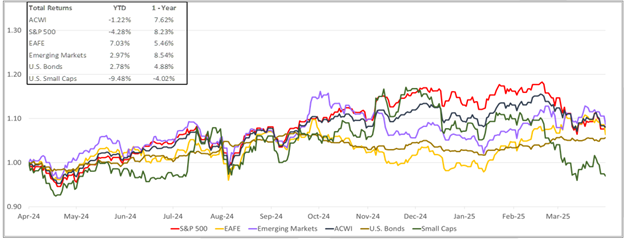
In March, developed equity markets dropped, with the S&P 500 down 5.75%, the Russell 2000 off 6.99%, and the EAFE index slipping 0.90%. Emerging Market equities were a bright spot, edging up 0.38%. Bonds remained nearly unchanged, posting a slight 0.04% gain.

Source: Bloomberg. ACWI is the MSCI All Country World Index, EAFE is MSCI EAFE Index, Emerging Markets is MSCI Emerging Markets and U.S. Bonds is Barclays U.S. Aggregate. Small Caps is the Russell 2000. The above information is as of 3/31/2025.

At Crestwood Advisors, we’re passionate about guiding our clients toward their long-term goals, easing their concerns, and helping them make the most of the opportunities that wealth brings. If you are not yet working with Crestwood, we would love to start a conversation!

1 Where We Stand: The Fiscal, Economic, and Distributional Effects of All U.S. Tariffs Enacted in 2025 Through April 2, The Budget Lab, April 2, 2025

2 Statement by IMF Managing Director Kristalina Georgieva, International Monetary Fund, April 3, 2025

3 FactSet, J.P. Morgan Asset Management, Bloomberg, 2025

This document contains forward-looking statements, predictions and forecasts (“forward-looking statements”) concerning our beliefs and opinions in respect of the future. Forward-looking statements necessarily involve risks and uncertainties, and undue reliance should not be placed on them. There can be no assurance that forward-looking statements will prove to be accurate, and actual results and future events could differ materially from those anticipated in such statements.

Helping the Next Generation of Women Succeed

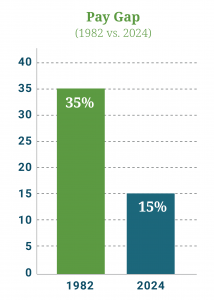
Despite significant progress in closing the gender pay gap, women have not yet achieved full equality. This year, Equal Pay Day falls on March 25th, signifying how far into the new year women have to work, on average, to earn what men had by the end of the year.

Pay Gap (1982 vs. 2024)1

Although the gap has narrowed, it still exists. If you have a daughter, granddaughter, or other young women in your life, here are some ways to help give them an edge.

  1. Teach Them to Negotiate

Negotiation is a powerful tool. Women who advocate for themselves can secure higher salaries, better benefits, and advance their career opportunities. Strategies for negotiation can include:

  • Research market salaries using platforms like LinkedIn, Glassdoor, as well as professional networks to understand fair compensation. Many employers expect applicants to negotiate, yet only 32% of men and 28% of women do.2
  • Demonstrate their worth by highlighting achievements, skills, and experiences that add value to an employer.
  • Remember to request benefits, such as professional memberships and educational reimbursements, which can further enhance their careers.
  • Choose employers wisely by seeking companies with strong diversity initiatives and a track record of supporting women.
  1. Discuss Career Choices Early

Throughout their lives, women face important career and life decisions — being informed will enable them to make the choices that align with their personal and financial goals. For example, according to a McKinsey study, men and women often have divergent career trajectories which contribute significantly to the wage gap. Even today, more women than men leave the workforce to be family caregivers or choose jobs that offer greater flexibility and fewer demands but often lower pay. This can result in fewer promotions and raises with a compounded impact adding up to about $500,000 dollars over a 30-year career.3 Encourage the young women in your lives to thoughtfully consider these factors and develop a plan that supports their long-term goals.

  1. Be a Changemaker

If you are a business owner, executive, or leader, you have the power to create an inclusive workplace. Support gender pay equity by:

  • Advocating for transparent salary practices.
  • Investing in mentorship and career development programs for women.
  • Fostering a culture where women feel valued and empowered.

At Crestwood, we believe in taking meaningful action toward gender equity. As an early signer of the 100% Talent Compact with the Boston Women’s Workforce Council, we are committed to closing gender and racial wage gaps. Through this initiative, we actively support policies and practices that drive workplace equity. Learn more about this initiative here.

Shaping the Future

Academic success equips young women with knowledge, but navigating their career paths and financial futures requires additional guidance. As parents, grandparents, and mentors, we can teach the next generation the art of managing their life journeys — and how to mind the pay gap.

For further assistance and information on guiding your children along their wealth journey, please reach out to your Crestwood team.


Sources:
1Gender pay gap in U.S. has narrowed slightly over 2 decades, Pew Research Center, March 4, 2025
2 When negotiating starting salaries, most U.S. women and men don’t ask for higher pay, Pew Research Center, April 5, 2023
3Tough trade-offs: How time and career choices shape the gender pay gap, Anu Madgavkar, Kweilin Ellingrud, Sven Smit, Chris Bradley, Olivia White, and Kanmani Chockalingam, McKinsey Global Institute, February, 2025

Who Are You Working For?

In their 1966 hit album, Revolver, the Beatles cautioned that the “Taxman” tries to take it all. We may not sing as well as the Beatles, but if you don’t want to pay more taxes than you need to, Crestwood Advisors can help.

At Crestwood, we take a holistic view of your tax situation – past, present, and future – to help you keep more of what you earn. We’ll work with you to create a tax strategy that is personalized to you and your family, considering all personal and professional factors and any changes that may lie ahead. Taxes can take a big bite out of your earnings; your team at Crestwood will recommend strategies to help manage how large of a bite, including:

Tax-Loss Harvesting

Many individuals have heard about tax-loss harvesting – the practice of selling assets that have declined in value in order to “harvest” a capital loss. This loss can be used to offset capital gains on the sale of assets that have appreciated in value since their purchase. For example, suppose you’re preparing to sell your home before moving to a warmer climate for retirement, and you expect to make a substantial profit on the sale. If you also hold an investment that has declined in value, selling those underperforming securities can create a capital loss. You can then use this loss to help reduce the taxable gain you’ll owe on your home.

In this scenario, you might even use the proceeds from selling the underperforming investments toward your new property purchase. While some firms only pursue tax-loss harvesting at the end of the year, at Crestwood, we look for these opportunities throughout the year to help manage your tax liabilities.

Philanthropic Strategies

Your approach to charitable giving can significantly impact your taxes. While many people simply write a check, that may not be the most strategic option—for you or for the organizations you support. For example, donating appreciated securities allows charitable recipients to benefit from the higher value of your gift while protecting you from capital gains taxes. Alternatively, giving through structures such as a donor-advised funds (DAFs) can give you additional flexibility: you can take a tax deduction in a high-income year and decide later which specific causes you want to support.

Before making any recommendations on when and how much to give, we evaluate both your current and projected tax situation to identify the most beneficial approach. In some cases, consolidating your donations into a single year may be advantageous, while in others, spreading out contributions might make more sense. By tailoring your plan, we aim to maximize the impact of your gifts while aligning with your financial and philanthropic goals.

Required Minimum Distribution (RMD) Planning

The tax consequences of RMDs can take recipients by surprise, often placing them in a higher tax bracket than expected. We factor the impact of RMDs into your entire tax strategy, thinking about timing and the best way to take your distributions. Assuming you meet the eligibility requirements, you may want to use your RMD to make a Qualified Charitable Distribution (QCD). A QCD is not subject to taxation and does not count toward your maximum charitable deduction if you are itemizing your deductions. So, if you always make an annual donation to a cherished cause, a QCD can be an effective way to give.

Looking Forward to Retirement

When retirement is on the horizon, we’ll incorporate your anticipated change in income into your plan. This may mean delaying distributions from retirement accounts or executive compensation to the future, where possible, when you may be in a lower tax bracket. We’ll also help you manage your Income-Related Monthly Adjustment Amount (IRMAA) to potentially minimize the premium you pay on Medicare Parts B and D based on your Modified Adjusted Gross Income (MAGI). We will also explore your current retirement accounts and whether a Roth conversion might be beneficial.

We may also recommend a Roth conversion in which part or all of a traditional IRA or 401(k) is converted to a Roth IRA. Although the amount you convert is taxed as ordinary income in the conversion year, future account growth and distributions are free from Federal taxes.

Contact Crestwood

At Crestwood, we are committed to helping you achieve your financial goals. We encourage you to reach out to let us know about life changes you foresee or when they happen, so that we can adjust your tax strategy and address your evolving needs. We stand ready to work with your outside accounting, legal, and other experts to coordinate your strategy and help ensure that you get integrated advice and guidance to help grow and preserve your wealth.

If you have any questions about tax optimization, please reach out to your advisory team. And if you are not yet working with Crestwood, please contact us to start a conversation.

This document is provided for general informational purposes only by Crestwood Advisors, an investment adviser. Crestwood Advisors does not provide legal advice, and this document should not be construed as containing legal advice. For legal advice, consult with a licensed attorney. This document should not be construed as containing tax advice. For tax advice, consult with your tax adviser.

Are you up to date on the Social Security Fairness Act?

On January 5, 2025, the Social Security Fairness Act (Act) was signed into law. The Act eliminates the Windfall Elimination Provision (WEP) and Government Pension Offset (GPO), which negatively impacted the Social Security benefits for many individuals who received pensions on work for which they did not pay Social Security taxes and, therefore, was not covered by Social Security. Many of these retirees also received public pensions.

What this Might Mean for You

If your benefits were reduced due to WEP and GPO, you may be eligible for the following: 

Retroactive Payments: You may receive a one-time lump sum covering the benefits lost between January 2024 and December 2024. The Social Security Administration (SSA) has announced that most retroactive payments should be distributed by the end of March 2025. In order to receive your benefits, please double check that you have the correct direct deposit information or address on file with the SSA by logging into your my Social Security Account (if you do not have an account you can set one up there). As always, beware of scams, and anyone asking you to send personal or financial information.

NOTE: If you have filed for spouse’s or widow(er)’s benefits but are not receiving any monthly benefits due to GPO, please call the SSA at 1-800-772-1213 to update your direct deposit information.

Filing for Spousal and Survivor Benefits: If you did not file for spousal or survivor benefits knowing that they would be eliminated under the GPO, you may be entitled to Social Security benefits under the Act. However, you must file for benefits in order to receive any benefits for which you are now eligible. If you never applied for retirement or spousal benefits, you can apply online or call 1-800-772-1213. You cannot apply for surviving spouse benefits online, but you can call the SSA at 1-800-772-1213 to apply.


Sources:

Social Security Fairness Act: Planning Considerations For the Repeal Of The Windfall Elimination Provision (WEP) And Government Pension Offset (GPO), Kitces, January 15, 2025

Social Security Fairness Act: Windfall Elimination Provision (WEP and Government Pension Offset (GPO) update, Social Security Administration, updated March 3, 2025

March Economic Update: The Three R’s – Understanding Tariffs Today in a Historical Context

Given the recent volatility in the stock market, investors are left wondering about the potential disruptive effects of tariffs.

Douglas Irwin, a professor at Dartmouth, is a widely recognized as an expert on both historical and contemporary U.S. trade policy. He uses three R’s to summarize the history of tariffs in the US: Revenue, Restriction, and Reciprocity.

Prior to the establishment of federal income taxes, tariffs were used for Revenue. For the last 70 years, tariffs have generated approximately 2% of federal Revenue, but when the US was a pre-industrial society, it accounted for nearly 100%. During the Civil War, the addition of excise taxes on items like liquor, tobacco, and most retail goods helped to generate revenue in addition to tariffs. After the war, the revenue generated from the combination of excise taxes and tariffs created a surplus, allowing the US to pay off the war debt. After reducing government debt, Congress debated ways to increase economic growth by reducing taxes and tariffs.

Congress had two choices: lower the tariff rate, which would make imports cheaper, or raise the tariff rate to make imports so expensive that consumption declines and therefore the amount of revenue generated by tariffs would also decline. William McKinley, who would later become president, was chair of the House Ways and Means Committee in Congress and argued for the latter. Tariffs at these high levels fell in the category of Restriction, referred to as Protectionism at the time, since the goal was to protect domestic production.

In the short run, McKinley’s approach worked: prices rose quickly, and US industry filled in the gap left by foreign producers. The drop in imports reduced tariff revenue and alleviated the problematic surplus in federal revenue. McKinley won the presidency in 1896. He then shifted to using tariffs for the third R: Reciprocity. As part of a tariff package, Congress gave McKinley the authority to reduce tariffs selectively so he could use this as leverage to renegotiate trade agreements. By the end of his first term, economies around the world were beginning to boom and the US was so successful that it needed to expand surplus production to foreign markets. As a result, Protectionism was doing more harm than good.

President McKinley planned to reduce tariffs(1) but he was assassinated in 1901. Vice President Teddy Roosevelt then took office. Roosevelt wasn’t as focused on trade policy, and as a result, it took a decade before tariffs began to decrease after the establishment of the federal income tax system. In the years that followed, Reciprocity became a key bargaining tool, ultimately leading to free trade agreements.

Where are we now?

President Trump has described the goal of higher tariffs as encompassing all three Rs – raising Revenue, Restricting foreign competition, and using them as a tool for Reciprocity in trade negotiations.

This presents a challenge of balancing objectives, as all three cannot be accomplished simultaneously:

• If tariffs are to generate a significant amount of Revenue, they must be set at a modest level to still allow enough foreign goods to come in to be taxed.
• If tariffs are too high, their Restriction will result in a drop-off in consumption and therefore less Revenue.
• However, if tariffs aren’t high enough, the prospect of lowering them won’t provide leverage for trade negotiations, thus limiting the potential for beneficial Reciprocal agreements.

Since modern industrialized economies have supply chains with parts and materials from across the globe, high tariffs have the potential to be much more disruptive than McKinley’s day when the US was a relatively isolated nation. Thus, the confirmation of tariffs on Canada, Mexico, and China taking effect immediately with additional tariffs on other nations to come represents an upheaval of the existing trade environment. Since President Trump has made clear that he favors using tariffs as negotiating tools, it remains unclear how long they will be in place.

The near-term implications are:

  1.  Businesses and investors may feel uncertain about how best to put capital to work. This uncertainty manifests in stock market volatility.
  2. Retaliatory tariffs from affected nations are inevitable.
  3. The immediate outcome will be higher prices for consumers and businesses in countries on both sides of a trade war, along with an increased risk of reinflation.

Historically, equity market volatility has been the norm

Every calendar year sees periods of market declines. History shows us that volatility is not a predictor of market returns, as illustrated in the chart below. Many of the downturns in the below chart have been caused by economic issues, political crises, wars, debt crises and even a pandemic. At the time, these situations may appear to be lasting disruptions to the US economy, prosperity, and investors’ ability to grow capital. It is difficult to see that short-term dislocations are just that – short-term.

Over time, American institutions have proven to be incredibly resilient and, indeed, the US has been the land of opportunity. As Warren Buffett said, “For 240 years, it’s been a terrible mistake to bet against America.”
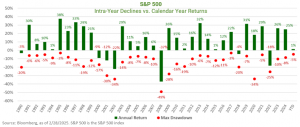
The takeaway: Investors should remain patient and disciplined, focusing on long-term goals rather than short-term volatility.

Capital Markets

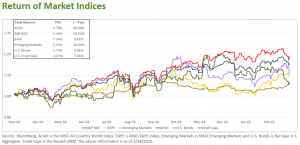
Equity returns in February were mixed. The S&P 500 fell 1.42%, the All-Country World Index (ACWI) declined 0.7%, and the Russell 2000 fared the worst, falling 5.45%. Meanwhile, developed international equities rose by 1.8% and emerging market equities increased by 0.35%. Bonds rose by 2.20%.
 

This document contains forward-looking statements, predictions and forecasts (“forward-looking statements”) concerning our beliefs and opinions in respect of the future. Forward-looking statements necessarily involve risks and uncertainties, and undue reliance should not be placed on them. There can be no assurance that forward-looking statements will prove to be accurate, and actual results and future events could differ materially from those anticipated in such statements.

(1) McKinley, the self-described “Tariff Man”, gave a speech in 1901 to a large crowd in Buffalo, New York saying “The period of exclusiveness is past. Reciprocity treaties are in harmony with the spirit of the times. Measures of retaliation are not. If perchance, some of our tariffs are no longer needed for revenue or to encourage and protect our industries at home, why should they not be employed to extend and promote our markets abroad?” McKinley assassinated the following day, died shortly after.