Trust Protectors: A Powerful Estate Planning Tool

What exactly is a Trust Protector? You may be familiar with phrases like “objective third party,” “check and balance for the trust administration process,” or the “superhero of trust administration.” But what does this mean and do Trust Protectors live up to the hype?

The short answer is yes, they live up to their hype and can positively impact the administration of a trust well beyond the grantor’s lifetime. A Trust Protector is a third party given power within the trust to oversee the trust administration and act as the eyes, ears, and voice of the grantor when they are no longer available. They can provide flexibility in an otherwise inflexible irrevocable document, often being granted powers to change trustees, alter administrative provisions, and sometimes even change beneficiaries.

Who Can Serve as a Trust Protector?

Typically, an attorney or another independent trusted professional is called upon to serve in this role. The individual should be close enough to the family to understand family dynamics and apply an objective lens to balance those dynamics with the grantor’s intent. It is generally not recommended for a beneficiary to serve as a Trust Protector due to potential conflicts of interest.

Powers of a Trust Protector

Trust Protectors are typically given broad authority over trust administration, including advising and supervising trustees, overseeing distributions to beneficiaries, resolving disputes, and responding to changes in the law or family circumstances. Here are some common powers a Trust Protector may be granted:

  • Advise parties regarding trust terms.
  • Choose or remove trustees and advisors.
  • Direct trustees regarding special distributions.
  • Veto trustee decisions or distributions.
  • Determine compensation for trustees and other advisors.
  • Amend the trust, including technical and broader adjustments for changes in the law.
  • Arbitrate disputes between trustees and beneficiaries or between beneficiaries.
  • Grant, modify, or revoke a beneficiary’s power of appointment.

Importance of a Trust Protector

The Trust Protector holds a powerful role in ensuring the grantor’s aspirations are fulfilled and navigating the ongoing trust administration process, which can last many years after a grantor’s passing. We encourage everyone to discuss the merits of including a Trust Protector with their estate planning professionals.

Our team at Crestwood is here to provide further insights and support. Please reach out to us to start the conversation and explore how we can assist you in this important decision.


The above is provided for general informational purposes only by Crestwood Advisors, an investment adviser. Crestwood Advisors does not provide legal advice, and this document should not be construed as containing legal advice. For legal advice, consult with a licensed attorney.

Director, Portfolio Manager Discusses Bond Investing Ahead of Fed Rate Cuts with Financial Advisor Magazine

To the disappointment of many, the Fed has shown it’s not yet ready to cut interest rates. However, this could be beneficial for fixed-income investors if they act fast.

Director and Portfolio Manager Jason Hendricks, CFP®, ChFC®, CSRIC® shared with Financial Advisor Magazine that owning intermediate maturity bonds “allows investors to lock in yields [and] likely see a rise in principal when the Fed cuts rates.”

Click here to read the full article.


Crestwood Advisors Recognized as a Top RIA by Worth Media Group for 2024

We’re excited to share that Crestwood Advisors has been included in @Worth Media Group’s 2024 list of top RIAs.

Click here to see the full list.


The 2024 edition of the Leading Advisors List showcases over 275 independent Registered Investment Advisor firms, chosen through a rigorous selection process. This process incorporates benchmarks such as assets under management, average client size, and whether the firm focuses on comprehensive financial planning.  Crestwood did not pay a fee to obtain or market the award.

President/Managing Partner and Wealth Manager Talks Firm Success with InvestmentNews

The secret to firm success? Continued growth and strong relationships.

“When we think about growth, that’s the opportunity to continue to invest in our business to bring the best solutions for our clients. That’s also the opportunity to have vibrant careers for the talented professionals who join our team,” emphasized President/Managing Partner and Wealth Manager Leah Sciabarrasi, CFP®, in a recent article with InvestmentNews.

Click here to read the full article

May Economic Update: Fed Stays the Course and How Politics Influence Perception of the Economy

The May 1st Fed meeting concluded with no change to the policy rate, which remains at 5.25-5.5%. Prior to the meeting, there was some concern the Fed might shift its stance after recent data suggested inflation ticked up slightly and Fed Governor Bowman indicated higher rates were a possibility.

However, Powell made a point of saying that he doesn’t believe the next policy rate move will be a hike and that he expects the Fed to gain confidence in a cut based on expectations of further disinflation and a more balanced labor market. The net result was a continuation of the Fed’s “watch and wait” posture.

How Political Leanings Skew Perception of the Economy

As we have noted in other recent Monthly Economic Updates, investors often perceive the health of the economy based on political affiliation. The onslaught of disinformation, AI-generated content, and click-bait skews people’s biases even further.

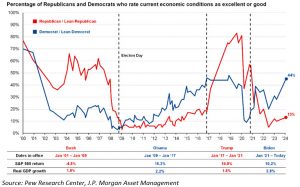
As shown in the chart below, a recent update of a survey by Pew Research Center confirms that Republicans tend to view the economy more favorably when a Republican is in the White House, and likewise for Democrats when the situation is reversed.

Although the average annual returns on the S&P 500 during the Obama administration (+16.3%) and during the Trump administration (+16.0%) were nearly indistinguishable and exceeded the average return over the past three decades, perception of leadership drove sentiment more than actual economic results or stock market performance.


Eagle-eyed readers will also note that perception of economic conditions often changed immediately following election day or soon after, rather than after a President’s policies actually had any influence over the economy.

Is Consumer Sentiment a reliable Predictor of Market Returns?

Famed investor John Templeton once quipped: “Bull markets are born in pessimism, grow on skepticism, mature on optimism and die on euphoria. The time of maximum pessimism is the best time to buy, and the time of maximum optimism is the best time to sell.”

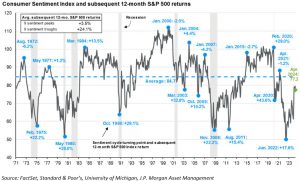
As the chart below shows, over the last 60 years, the 12 months that followed a pessimistic period when consumer sentiment was low were often followed by outsized returns in the S&P 500 (+24.1% on average). By contrast, the twelve months that followed consumer sentiment peaks saw much lower returns (+3.5% on average).


The troughs in sentiment had only a modest correlation with periods of actual economic weakness, with only 4 of the troughs occurring during recessions. Likewise, sentiment was often quite high shortly before a recession was about to begin.

This inconsistency is yet another reminder that how one feels when watching the news is not a predictor of future returns. Regardless of how chaotic geopolitical events are here and abroad, staying invested and separating your feelings from your investment strategy is a prudent approach to building wealth.

Capital Markets

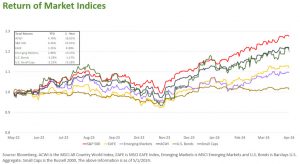
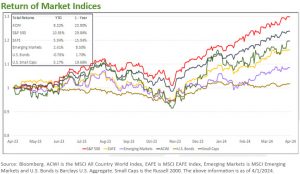
The S&P 500 closed at a new record high of 5,254 at the end of March before momentum reversed resulting in the major indices giving back some of the earlier Q1 gains. During April, the All-Country World Index (ACWI) declined -3.53%, the S&P 500 fell -4.51%, the EAFE fell -2.59%. and U.S. small caps forfeited all their 2024 gains in a -7.4% drop. Emerging market equities were the only area of strength, rising +0.48% for the month.

Gifting Strategies to Manage Unrealized Gains: Downstreaming and Upstreaming

Navigating the complexities of wealth management often involves strategic moves to optimize tax efficiency. Two such strategies, Downstreaming and Upstreaming, are approaches to managing unrealized gains by moving securities between generations.

Downstreaming: Passing unrealized gains to someone in a lower tax bracket

Gifting stocks with unrealized gains to people in lower tax brackets can be a thoughtful and potentially tax-efficient way to share wealth. The cost basis and acquisition date of the stock will carry over to the recipient. They will not owe taxes at the time of the gift but will owe taxes at the time of sale. However, since the recipient is in a lower bracket, the amount of taxes due could be lower.

For example, consider the hypothetical case of the Clampett family. They have amassed a large amount of wealth in the family’s oil business and live in Beverly Hills, California. The patriarch, Jed, has a combined Federal and State long term capital gain tax rate of 33%. Jed has a large amount of Clampett Oil stock with a zero-cost basis that currently has a market value of $100 per share.

He wants to support his nephew Jethro and his wife by giving them each an annual gift of $18,000. They live in Florida, have a household income of $80,000 and two children. Thus, an extra $36,000 annually would be a significant windfall.

If Jed sold Clampett Oil stock to raise cash for the gift, for each share sold he would realize $100 of long-term gains taxed at 33%. Thus, he would have to sell $53,731 of stock to transfer $36,000 of cash.

If Jed were to give Jethro and his wife shares of Clampett Oil totaling $36,000 market value and have them sell the shares instead, due to their income, living in Florida, and having two dependents, they would owe zero capital gains. Downstreaming the appreciated stock allowed Jed to avoid paying $17,731 in taxes to make his $36,000 gift.

An additional benefit for those who may be facing estate taxes is that these gifts help reduce the size of the giver’s taxable estate.

There are many common situations where it may be advantageous to use appreciated securities rather than cash:

  • Wealthy parents or grandparents helping their less-wealthy adult children or grandchildren with rent and other living expenses.
  • Helping extended family members who are living on fixed income or Social Security.
  • New college graduates, who commonly have income from only May to December of their graduation year.

It is essential to have a good understanding of both the giver and the receiver’s Federal, State, and Local taxes. In the example above, California has a high tax on capital gains, while Florida has none. If Jethro and his wife were residents of New York City rather than Florida, their Federal tax bracket would not change but they would have faced both New York State and City taxes when the shares were sold, thus decreasing the final amount of the total gift.

Your Crestwood team can help you identify situations where Downstreaming may make sense and work through each step of this process.

Upstreaming: Passing unrealized gains up one or more generations

In contrast to the gifting strategy above, Upstreaming is the practice of giving appreciated securities from a younger generation giver to an older generation receiver who then passes assets back to the younger party upon their passing.

The process works like this:

  1. A younger party who has significant unrealized gains makes a gift to the older party.
    • This can be in the form of recurring annual exclusion amount gifts ($18,000 in 2024) or as a larger amount in a single year (which requires the giver to file a gift tax return as this uses a portion of the giver’s lifetime exclusion amount.)
  2. After the gift is given, the older party updates his or her estate documents to bequeath the assets back to the younger giver or another party upon their passing.
    • If multiple family members are Upstreaming, a best practice is to create individual accounts to track each person’s gifts to simplify estate settlement.
  3. At death, the older party person’s assets receive a “step-up” in cost basis, meaning the cost for determining taxable gains is adjusted to the market price at the time of passing.
  4. The earmarked assets are then passed back to the younger party with the stepped-up basis.

This strategy works particularly well if the younger party would likely have estate taxes at their passing while the older recipient’s estate is below the lifetime estate tax exemption ($13.61 million in 2024).

Section 1014(e) of the tax code does place restrictions on how this process works, however they can be manageable by planning ahead:

  1. The older party must live beyond one year from the gift date OR
  2. The older party must bequest the appreciated asset to someone other than the original donor or their spouse

Failure to meet either requirement would result in the securities not receiving a step-up in basis.

Returning to the Clampett Oil family above, Jed’s mother-in-law Daisy is 80. Daisy owns her home but has no assets of her own. Jed’s daughter Elly has $6 million of Clampett Oil stock gifted to her by her father with the same zero cost basis. She has no other assets and thus would like to diversify her portfolio, but capital gains are an obstacle.

Using the Upstreaming technique:

  1. Elly transfers her $6 million of Clampett Oil to Daisy. Elly will need to file a gift tax return since this is over the $18,000 annual gift exclusion amount.
  2. Daisy updates her will and creates a new taxable account to hold the shares.
  3. Daisy passes away over a year later and in that time, Clampett Oil stock has increased in value from $100 to $120 per share.
  4. The cost basis of the Clampett Oil shares in the account for Elly is stepped up from zero to $120 per share.
  5. The executor follows through on the instructions in the will and distributes the shares back to Elly. Daisy’s other assets such as her home pass through her will normally.
  6. Elly is now free to sell the Clampett Oil shares and diversify without having to pay capital gains.

Managing Capital Gains is an Ongoing Process:  Start Planning Now

A small investment of time and planning today may lead to lower tax bills tomorrow. Whether you’re looking to support loved ones or safeguard your legacy, Downstreaming and Upstreaming strategies may offer tangible benefits. If you are interested in learning more about these and other strategies, please reach out to your Crestwood team.


The information contained in this document is provided by Crestwood Advisers Group, LLC (“Crestwood”) for general informational purposes only. For estate planning advice, consult with your team of advisers. Crestwood is not a law firm and does not provide legal advice. Crestwood is not a CPA firm and does not provide tax, audit, or attest services.

April Economic Update: Grounding Expectations in Reality

“The secret to happiness is having low expectations.” – Warren Buffett

We have written numerous times in the last six months about the disconnect between investor expectations of Fed rate cuts and the Fed’s own projections. In Q4 2023 when the Fed made clear they were holding off on further rate hikes and were expecting two cuts in 2024, investor expectations were for at least four. Earlier this year, when the Fed adjusted their projections to three possible cuts, investor expectations climbed further to a starry-eyed seven cuts.

February and March saw a reversal of these overly optimistic hopes, which was a welcome change.

Fed Chair Powell finally brought the message home to investors with an appearance on 60 Minutes in February, echoing the same talking points he and the Fed governors have shared for months. Two economic reports in February supported the Fed’s decision to delay: a hot January CPI report and higher than expected forecasted growth in nonfarm payrolls. In January, a steeper than expected decline in retail sales suggested that the Fed’s approach is working, albeit slowly. Last week, the San Francisco Fed updated the central bank’s favorite inflation gauge, the Personal Consumption Expenditures price index (PCE). The index rose 2.5% last month on an annual basis, still well above the Fed’s 2% target. Powell noted that this was “pretty much in line with our expectations” and cautioned investors again that the Fed is not in a rush to cut rates: “If we reduce rates too soon, there’s a chance that inflation would pop back and we’d have to come back in and that would be very disruptive.”

The message seems to be getting through. Investor expectations for the first rate cut shifted from March to June. In addition, the number of cuts expected is now in line with the Fed’s projections.

This removes a potential distraction for investors, who should accept two undeniable truths:

  • Forecasting the time it will take to curb inflation is an exercise in futility.
  • Progress will be made at a sluggish pace.

While we cannot predict when the Fed will cut rates, we can look at how the market has reacted after past rate hike cycles ended.

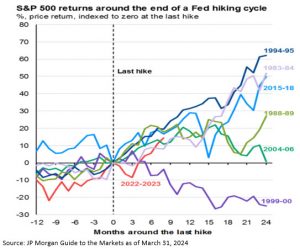
The chart below shows S&P 500 returns for the 12 months before and 24 months after the end of a rate hike cycle. The 12-month periods leading up to a final hike tend to have negative returns, while the periods following the final hike tend to fare much better. Our current hiking cycle is marked in red, and the hope is that we continue to see a return pattern similar to the 1994-95, 1983-84, and 1988-89 cycles.

Most importantly, historically, for long-term investors: S&P 500 returns for periods 3+ years following a final hike were healthy, with only the 1999-2000 hiking cycle showing negative returns 3 years out.


Capital Markets

In March, most major equity indices finished higher. The All-Country World Index (ACWI) was up +3.4%, the S&P 500 rose +3.4%, the EAFE gained +3.5% and Emerging market equities rose +2.5%. U.S. Small caps had another strong month, finishing up +4.2%. Bonds rose slightly by 0.76%. Treasuries were virtually unchanged for the month, with the 2-year yield at 4.6% and the 10-year yield at 4.2%.


Affirming your Financial Foundation for 2024

Following our January conversation about starting the year with strong financial health, we invite you to keep the momentum going with Crestwood Advisors. As your life and goals evolve, so should your financial strategy. Let’s take this opportunity to deepen our collaboration, ensuring your financial plans are as dynamic and forward-looking as you are.

Focus on What Matters to You:
• Thinking about a big purchase or investment? Let’s plan it together.
• Experiencing changes in your life priorities, like family or health? Your financial plan should reflect these.
• Considering adjustments in your family or living situation? We’re here to guide you.
• Approaching a significant birthday or milestone? Let’s make sure you’re prepared.

Strengthen Your Financial Base:
• Review your emergency fund to ensure it’s sufficient.
• Maximize your retirement contributions, based on this year’s limits.
• Explore the best tax strategies for your situation, including Roth contributions.
• Consider other savings options, like HSAs and brokerage accounts, for long-term benefits.

Family and Future Planning:
• Need help with family financial goals, like buying a home or saving for college? We can help.
• Estate planning is crucial, especially with changing tax laws. Let’s discuss how to best secure your legacy.

At Crestwood Advisors, we’re more than just advisors; we’re partners in your financial journey. Building on our earlier insights, we’re here to support, guide, and empower you as you navigate through 2024 and beyond. Whether you’re refining your goals, boosting your savings, or planning for your family’s future, we encourage you to reach out with any questions or for further discussion. Let’s work together to make this year one of growth, security, and financial well-being.