
Unlike the famous Jackie Wilson song,1 it was not love, but a confluence of multiple forces that pushed bond yields “higher and higher” last month.
The Fed Delivers Its First Hike in Three Years
On September 16, the Federal Reserve voted 12 to 0 to raise the target range for the federal funds rate to 3.75% to 4%.2 It was the first rate increase since July 2023 and ended a more than 2-year period where rates were unchanged. Federal Reserve Chair Kevin Warsh described the hike as removing “a dose of accommodation” and said in his press conference that “inflation is too high and has been for too long.”2 The unanimity of the vote was notable. The three regional presidents who favored a hike in July, Beth Hammack, Neel Kashkari, and Lorie Logan, got the hike they publicly argued for, and the committee’s doves joined them. Chair Warsh declined to submit his own estimate in the Summary of Economic Projections, but the median year-end 2026 federal funds rate projection stood at 4.1%, which is consistent with one additional 25 basis point hike before year end, and 16 of 18 participating policymakers anticipate at least one more increase this year.
- August employment surprised to the upside: The Bureau of Labor Statistics reported nonfarm payrolls rose by 162,000 in August, well above the 53,000 consensus.3 July was revised up to a gain of 21,000 from a previously reported decline of 23,000. The unemployment rate held at 4.1%, and labor force participation rose to 61.6% from a five-year low of 61.4%.
- August Consumer Price Index (CPI) matched expectations but showed gasoline as an ongoing pressure: Headline CPI rose 0.4% month-over-month and 3.4% year-over-year, matching consensus and holding steady from July.4 Gasoline prices rose 3.9% during the month, accounting for more than one third of the headline increase, and energy overall rose 2.1%.4
- August PCE arrived with a methodology change: August Personal Consumption Expenditures (PCE) data, the Fed’s preferred metric for inflation, arrived two weeks after the Federal Open Market Committee (FOMC) hike. Core PCE, which excludes food and energy, rose 0.2% month-over-month and 3% year-over-year, well below the 3.3% consensus estimate.5 The headline number was shaped by an annual Bureau of Economic Analysis (BEA) update that applied new measurement methods to portfolio management fees, legal services, and computer software, retroactively back to 2021. July core PCE, originally reported at 3.3%, was revised down to 3.0% in the same release. Notably, economists at the Wall Street Journal estimated that roughly 0.2 percentage points of the apparent cooling reflected the methodology change rather than genuine price easing.5
Implications for Investors: The Fed is now tightening rather than easing, and the committee’s own projections anticipate at least one more hike before year end. Chair Warsh and most FOMC participants have characterized recent inflation readings as insufficient evidence of a durable improvement, so while the Fed may skip a hike in October, a hike in December is likely if inflation does not improve.
The 10-year Treasury yield reached an intraday high of 5.04% on September 15, the day before the FOMC decision, its highest level since July 2007, and then rose further to a session high of 5.27% by September 29.6 The 30-year Treasury yield touched 5.39% on September 15 and finished the month near its highest closing level in more than two decades. The move represents more than a reaction to the Fed decision. It reflects a convergence of forces that have been building and resets the cost of capital across the economy.
Four factors drove the long end higher:
- The Fed’s hike and the committee’s signal of more to come suggest the rate path is higher for longer.
- Oil prices tied to the ongoing Iran conflict kept inflation expectations elevated, with the one-month rolling correlation between crude oil prices and the 10-year yield reaching 0.96 according to BMO Capital Markets.6
- Heavy Treasury issuance tied to the federal deficit outpaced investor demand, requiring higher yields at auctions to attract buyers. Macquarie strategist Thierry Wizman identified bond issuance as a bigger driver this year than the inflation story itself.7
- Elevated capital spending by AI hyperscalers and their suppliers has driven corporate bond issuance higher, adding further supply to a market already working to absorb record Treasury issuance. Investors now have attractive buying opportunities beyond Treasuries, intensifying competition for capital.7
What are the effects of yields at these levels?
Mortgage rates and borrowing costs reset higher: The rise in Treasury yields quickly lifted borrowing costs for consumer and corporate borrowers. The 30-year mortgage rate exceeded 7% for the first time since early 2025, adding pressure to an already stretched housing market.8 Higher borrowing costs also hit rate-sensitive and dividend-oriented sectors, as Financials, Materials, REITs, Consumer Staples, and Utilities all fell between 5% and 7%. Notably, the only positive sector for the month was Technology, which rose 5%.9
After accounting for inflation, yields are now meaningfully higher: With the 10-year yield above 5% and core PCE around 3%, nominal yields now exceed current inflation by roughly 2% – the highest spread since before the global financial crisis. This is a materially different environment from the past 15 years, during which real yields were often negative or barely positive. Investors can now earn a return above inflation on high-quality intermediate and long-duration bonds, a condition that has not been durably true since 2007.6
Chair Warsh and other officials characterized market pricing as doing some of the Fed’s work: Chair Warsh addressed the long end move at his press conference, suggesting he views it as healthy that bond markets respond to economic data rather than Fed forward guidance.2 New York Fed President Williams, who votes at every meeting, called another hike by year end “a reasonable expectation” on September 24 and linked higher Treasury yields to a strong underlying economy.10 Governor Lisa Cook said on September 28 that she expected “continued pressure on inflation from the AI build-out and from the pass-through of higher oil prices.”11 The combined message from the committee is that the long end move is consistent with the policy stance, not something the Fed is working to correct.10, 11
Implications for Investors: Bond yields at these levels are attractive on a historical basis, as investors have not had such an opportunity since before the global financial crisis. Intermediate maturity high-quality bonds now compete meaningfully with equities on an after-tax risk-adjusted basis. For taxable accounts in particular, the sharp moves in bond prices this year have created opportunities to harvest tax losses in existing bond positions and reposition portfolios at today’s higher yields, converting a mark-to-market loss into a durable improvement in future income. Investors with maturing bonds or new cash to invest should consider modestly extending duration while maintaining quality, since the opportunity to lock in current yields may not persist if growth weakens or inflation data continues to come in on the softer side.
Returns of Market Indices | September 2026
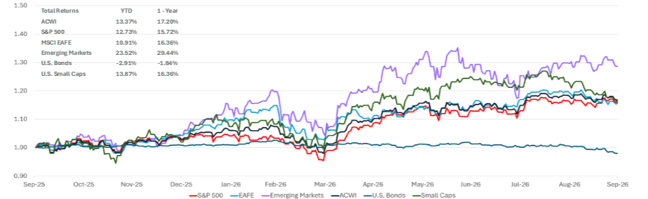
Markets pulled back in September, partially giving up the August gains across indices. Global equities (MSCI ACWI) fell 1.4% for the month. U.S. large caps (S&P 500) held up comparatively well, down 0.7%, and emerging market equities (MSCI EM) were similarly resilient, declining 0.8%. The weakness was concentrated elsewhere, as developed international equities (MSCI EAFE) lost 3.4%, and U.S. small caps (Russell 2000) dropped the most at 5.8%. Fixed income offered no cushion, as the Bloomberg U.S. Aggregate declined 2.7%, falling alongside equities.
Source: Bloomberg. EAFE is MSCI EAFE Index, Emerging Markets is MSCI Emerging Markets and U.S. Bonds is Bloomberg U.S. Aggregate Bond Index. ACWI is the MSCI ACWI Index. Small Caps is the Russell 2000 Index. S&P 500 is the S&P 500 Index. The above information is as of 9/30/2026. Past performance is not indicative of future results.
Sources
- Jackie Wilson, “(Your Love Keeps Lifting Me) Higher and Higher,” written by Gary Jackson, Carl Smith, and Raynard Miner. Released on Brunswick Records, 1967. Worth adding to your playlists.
- Federal Reserve, Transcript of Chairman Warsh’s Press Conference, September 16, 2026 (federalreserve.gov/mediacenter/files/FOMCpresconf20260916.pdf); Federal Reserve, FOMC Statement, September 16, 2026. FOMC voted 12-0 to raise the target range for the federal funds rate by 25 basis points to 3.75-4.00%, first increase since July 2023. Chair Warsh characterized the hike as removing “a dose of accommodation” and said “inflation is too high and has been for too long.” Chair Warsh declined to submit his own dot in the Summary of Economic Projections. The SEP median year-end 2026 federal funds rate projection stood at 4.1%; 16 of 18 participating policymakers anticipated at least one additional rate increase before the end of 2026.
- U.S. Bureau of Labor Statistics, Employment Situation Summary, August 2026, released September 4, 2026 (bls.gov/news.release/empsit.htm). Total nonfarm payroll employment rose by 162,000 in August 2026 versus consensus of approximately 53,000 (Dow Jones). July 2026 payrolls revised up to +21,000 from a previously reported decline of 23,000. Combined June-July revisions +55,000 higher than previously reported. Unemployment rate unchanged at 4.1%. Labor force participation rate rose to 61.6% from 61.4% in July.
- U.S. Bureau of Labor Statistics, Consumer Price Index Summary, August 2026, released September 11, 2026 (bls.gov/news.release/cpi.htm). Headline CPI rose 0.4% month-over-month seasonally adjusted and 3.4% year-over-year, unchanged from July. Core CPI rose 0.3% month-over-month and 2.4% year-over-year, down from 2.5% in July. Gasoline index rose 3.9% in August, accounting for more than one third of the headline increase. Energy index rose 2.1% month-over-month.
- U.S. Bureau of Economic Analysis, Personal Income and Outlays, August 2026, released September 30, 2026 (BEA 26-43). Headline PCE rose 0.3% month-over-month and 3.4% year-over-year. Core PCE rose 0.2% month-over-month and 3.0% year-over-year, below consensus estimate of 3.3%. The release incorporated an annual BEA methodology update applying revised measurement methods to portfolio management fees, legal services, and computer software, retroactively applied to 2021. July 2026 core PCE revised down to 3.0% from an originally reported 3.3%. CNBC, “Fed’s preferred gauge showed core inflation at 3.0% in August, much lighter than expected,” September 30, 2026 (cnbc.com) referencing Wall Street Journal estimate that approximately 0.2 percentage points of the apparent cooling reflected the methodology change.
- Bloomberg, “US 10-Year Yield Rises to Highest Since 2007 as Fed Looms,” September 15, 2026 (bloomberg.com); CNBC, “10-year Treasury yield hits highest level since 2007 as traders bet a Fed rate hike is coming,” September 15, 2026 (cnbc.com). 10-year Treasury yield reached 5.04% on September 15, 2026, highest level since July 2007. 30-year Treasury yield touched 5.39% on September 15. CNBC, “10-year Treasury yield is at its highest in 19 years. How we got here,” September 26, 2026. 10-year yield reached 5.23% intraday on September 25. 24/7 Wall Street, September 29, 2026, citing ING data: 10-year intraday high of 5.274% on September 29; 30-year closed at 5.56%; 20-year at 5.60%. One-month rolling correlation between front-month WTI crude and the 10-year Treasury yield at 0.96 per BMO Capital Markets.
- CNBC, “10-year Treasury yield is at its highest in 19 years. How we got here,” September 26, 2026 (cnbc.com). Macquarie strategist Thierry Wizman cited bond issuance as a larger driver of the 2026 yield move than the inflation story. Capital spending plans of hyperscalers and their suppliers cited as a factor keeping corporate bond issuance elevated through 2026 and into 2027.
- CNN Business, “Bond market bust: A key rate just blew through another decades-old record,” October 1, 2026 (cnn.com). 30-year mortgage rate topped 7% for the first time since early 2025 during late September 2026.
- Investrade, Market Review: September 30, 2026 (investrade.com). S&P 500 sector returns for September 2026: Technology sector (XLK) approximately +5%; Financials (XLF), Materials (XLB), and REITs (XLRE) approximately -7%; Consumer Staples (XLP) approximately -5%; Utilities (XLU) approximately -6%; Consumer Discretionary (XLY) approximately -6%. S&P 500 approximately -0.4% for the month; Dow Jones Industrial Average approximately -4.3%; Nasdaq Composite approximately +1.9%; Russell 2000 approximately -5% through September 30, 2026.
- Reuters via Investing.com, Williams speech reporting, September 24, 2026. New York Fed President and FOMC Vice Chair John Williams called another rate hike by year end “a reasonable expectation” on September 24, 2026. Williams linked higher Treasury yields to a strong underlying economy in prior comments on September 2, 2026 (CNBC).
- Federal Reserve Governor Lisa Cook, remarks of September 28, 2026, as cited in 24/7 Wall Street, September 29, 2026. Governor Cook stated she expected “continued pressure on inflation from the AI build-out and from the pass-through of higher oil prices.”