A Simpler Way to Stay Current with the IRS: IRA Withholding vs. Quarterly Estimated Taxes

Key Takeaways:

  • Clients over age 59½ who take IRA distributions may be able to reduce or eliminate the need for quarterly estimated tax payments by increasing withholding on those distributions.
  • The IRS treats IRA withholding as if it were paid evenly throughout the year, even if the transaction happens once, in December.
  • This treatment can help avoid missed deadlines and remove the need to sell taxable assets to raise cash for the IRS.
  • The strategy works best for clients already subject to Required Minimum Distributions.
  • Coordination with a client’s accountant is crucial to avoid under or overpayment.

If you are self-employed, own a business, or have meaningful investment income, you are likely accustomed to paying quarterly estimated taxes. Many clients mail checks to the IRS for tax payment. While the IRS is still accepting paper checks, they are strongly encouraging the transition to electronic payments,

These tax payments can be tedious as they call for four calculations, payments, and deadlines each year. For clients who are already taking distributions from an IRA, there is often a simpler way. Having taxes withheld directly from your IRA distributions can replace some or all of your estimated payments.

Here’s how it works, when it makes sense and what to watch out for:

Who needs to pay estimated taxes?

The United States operates on a “pay-as-you-go” tax system. If you are a W-2 employee, your employer handles this automatically by withholding taxes from your paycheck. However, if you are a business owner, self-employed, or receive income that does not have taxes already withheld, you become responsible for making the payment to the IRS.

Generally, if you anticipate owing more than $1,000 in federal taxes for the year after accounting for any tax withholdings made throughout the year, then you are expected to make quarterly estimated payments.

What is the IRS Safe Harbor Rule for estimated taxes?

It can be difficult to accurately pay taxes throughout the year, especially if your income fluctuates as it may feel like shooting at a moving target. Fortunately, the IRS provides a Safe Harbor Rule which if conditions are met, can protect you from potential underpayment penalties. Your safe harbor payment options can vary depending on whether your prior year’s adjusted gross income (AGI) is above or below $150,000. This $150,000 threshold applies to both single filers and married couples filing jointly. For married couples filing separately, it is $75,000.

If your prior year’s AGI was $150,000 or less, you can generally avoid an underpayment penalty by paying either:

  • 90% of what you owe for the current year, or
  • 100% of what you owed last year

If your prior year’s AGI was above $150,000, you can generally avoid an underpayment penalty by paying either:

  • 90% of what you owe for the current year, or
  • 110% of what you owed last year

In practice, it is typically easier to satisfy the prior-year safe harbor requirement (100% or 110%) as it is based on a known and finalized figure from last year’s tax return. Solving for 90% of the current year requires projecting out your income through the end of the year, demanding precision and ongoing monitoring throughout the year.

What are advantages of withholding from an IRA?

One of the unique benefits of withholding taxes from an IRA is that the IRS treats taxes withheld from a retirement account as if they were paid evenly throughout the year, regardless of when the withholding occurred. This means that a single withholding in December is treated as a quarter of it was paid in each period.

This differs from estimated taxes as the payment is credited on the date it is received. If you skip the April and June installments and make a larger catch-up payment in December, the IRS views this as two late quarters and can assess an underpayment penalty.

This provides several benefits for clients who are over age 59 ½ and are distributing from their IRA.

Simplified Tax Management: Rather than calculating and submitting four payments, your custodian sends the money directly to the IRS. This eliminates the need to mail checks or log into an online portal to pay.

Year-End Safety Net: If you reach the last few months of the year and realize your income ran well ahead of projections, or that you simply missed a quarter, a larger year-end IRA withholding can retroactively cover the shortfall and eliminate a penalty that an equivalent estimated payment would not cover.

Liquidity in taxable accounts: Writing estimated tax checks throughout the year means keeping cash in hand, and potentially triggering capital gains to raise cash. If you are subject to Required Minimum Distributions (RMDs), you can withhold taxes on these distributions that are required to be withdrawn anyways.

What should I consider before switching to IRA withholding?

This approach is not right for everyone, and it is important to discuss these details with your tax advisor.

It works best if you are already taking distributions. The strategy is most natural for clients that are subject to (RMDs) or who are otherwise drawing from retirement accounts to fund their spending.

Withheld amounts are still taxable income. Money withheld for taxes counts as part of your gross IRA distribution. If you need $10,000 withheld, that $10,000 comes out of the IRA and is included in your ordinary income for the year.

Age matters. IRA distributions before age 59½ are generally subject to the 10% early withdrawal penalty. This strategy is primarily for clients beyond this threshold.

Look at your other income sources. If your pension or Social Security benefits have insufficient tax withholding, adjusting the withholding on your IRA distribution can absorb the gap and may eliminate the need for estimated payments altogether.

Monthly distributions need a slightly different approach. If you take your RMD in monthly or periodic installments, we generally recommend withholding taxes throughout the year and reserving December (or your last distribution in the calendar year) for smaller withholding adjustments if needed.  By this point in the year, most of your RMD has likely been satisfied already. Because the gross distribution is taxable whether paid directly to you or withheld for taxes, withholding levels should be coordinated carefully with your broader tax and cash-flow needs.

Roth conversions add a wrinkle. If you are subject to RMDs, the RMD must be satisfied before any Roth conversion. If your RMD is $100,000, only distributions beyond that $100,000 can be converted. That said, you can increase the withholding on the RMD portion to cover the taxes generated by the conversion.

Why is communication so important here?

Whatever approach you take, everyone involved needs to be on the same page. If you have already made estimated payments and then add withholding on top, you may substantially overpay. If your accountant is unaware that withholding is now covering your obligation, they may continue to prepare quarterly vouchers.

We coordinate directly with clients’ accountants throughout the year, sharing year-to-date investment income, realized gains, and withholding figures so that the plan holds together and you avoid any surprises at tax time.

Wondering whether this makes sense for your situation? Reach out to your Client Service Team. We can review your prior-year safe harbor figures, look at what is already being withheld from other income sources, and determine whether shifting from estimated tax payments to IRA withholding is a suitable method for you.

Contact Us


This material is provided for informational and educational purposes only and should not be construed as tax or legal advice. The concepts discussed may not be appropriate for all individuals and are based on current federal tax laws, which are subject to change. Any examples provided are for illustrative purposes only and are not intended to predict or guarantee any particular outcome. For legal advice, consult with a licensed attorney. For tax advice, consult with your tax adviser.


Crestwood Advisors Earns Continued Recognition on Barron’s 2026 Top 100 RIA Firms List


BOSTON (September 15, 2026) – Crestwood Advisors (“Crestwood”), a boutique investment advisory and wealth management firm based in Boston and with offices in Connecticut and Rhode Island, today announced it has been named to the Barron’s 2026 Top 100 RIA Firms list

Now in its 11th year, Barron’s annual ranking of independent advisory firms considers factors including assets under management, growth, technology spending, succession planning and other metrics.

“Recognition like this is meaningful because the work behind it is deeply personal,” said Crestwood President and Managing Partner Leah R. Sciabarrasi, CFP®. “Our clients trust us with decisions that can shape their families, businesses and futures. We don’t take that responsibility lightly, and we’re grateful for the opportunity to keep earning that trust.”

Crestwood’s approach combines thoughtful planning, disciplined investing and genuine partnership, with advice centered on each client’s goals and circumstances. As a fiduciary, the firm draws on the collective expertise of its team to help clients navigate complex financial decisions and make informed, intentional choices with greater clarity and confidence. 

The Barron’s recognition follows additional industry recognition for Crestwood in 2026, including Financial Advisor Magazine’s 2026 RIA Survey & Ranking and USA TODAY’s 2026 Best Financial Advisory Firms list.

The full methodology for the Barron’s 2026 Top 100 RIA Firms list can be found here. Crestwood did not pay a fee to appear on the published list.

Please see Crestwood Advisors’ important disclosures regarding awards and recognitions .


###


About Crestwood Advisors 

Crestwood Advisors is an independent, fee-only, wealth management firm with approximately . Founded in 2003, Crestwood Advisors provides investment management with financial planning strategies to help high-net-worth individuals and families identify and prioritize their goals and build sustainable wealth so that they may enjoy more financially secure and purposeful lives. For more information, please visit https://www.crestwoodadvisors.com.

Crestwood in the Media: Recent Highlights From Our Team

It’s been a strong few weeks for Crestwood in the press. Across national outlets and leading industry publications, our advisors have been sought out to weigh in on everything from estate and succession planning to the future of the profession to what’s moving the markets. Here’s a look at where you can find the team this month.

Katie Sheehan on Estate Planning, From Succession to Send–Offs

Katie Sheehan, Managing Director and Wealth Strategist, had a busy August. In the Wealth Strategies Journal, Katie authored “Putting the Success in Succession Planning,” making the case that the strongest business transitions don’t rely on a single technique, but integrate estate planning, tax strategy, governance, and family dynamics from the start. Drawing on nearly three decades in estate planning, she walks through the questions an advisory team should ask before recommending any gift, trust, or sale strategy, and why succession planning is best treated as an ongoing process rather than a one–time transaction.

Katie also brought her estate–planning background to Kiplinger for “Why Pre–Planning Your Funeral Is the Ultimate Final Gift to Your Family,” speaking to the fine print families should watch for in prepaid funeral arrangements and the peace of mind that comes from documenting final wishes as part of a broader estate plan.

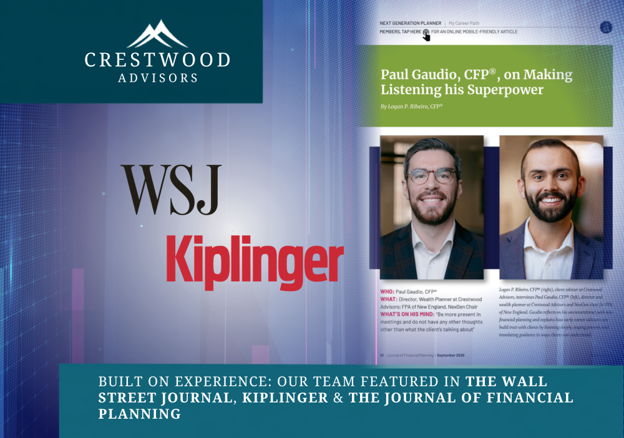
Paul Gaudio and Logan Ribeiro in the Journal of Financial Planning

In the Journal of Financial Planning’s “Next Generation Planner” series, Crestwood’s Logan Ribeiro interviewed colleague Paul Gaudio, Director and Wealth Planner and NexGen Chair for FPA of New England, about his path into the profession. Paul reflects on the unconventional way he broke into the industry as a college student, and the lesson that’s stuck with him since: that earning a client’s trust has far more to do with listening well than with having every answer. It’s a candid, worthwhile read for any planner early in their career, and a nice showcase of the next generation of talent at Crestwood.

Jason Hendricks on the Markets, for The Wall Street Journal

Portfolio Manager Jason Hendricks was called on twice this August by The Wall Street Journal for his take on market conditions: once as stocks slipped for a second straight session amid rising oil prices, and again on what growing federal deficits could mean for Treasury yields. It’s a reflection of the kind of steady, plain–spoken market perspective clients and reporters alike turn to Jason for.

This coverage reflects the range of expertise across our team, from technical estate and tax strategy to the everyday judgment calls that shape client relationships and market outlooks alike.

Learn more about our team.

September Economic and Market Update: Divergence: When Jobs Weaken but Inflation Won’t Fall

Q2 Earnings Wrap: A Very Strong Quarter, With a Very Familiar Caveat

The Q2 earnings season closed with the S&P 500 posting a blended year-over-year earnings growth rate of 52%, the highest quarterly reading since Q4 2020.1 Revenue grew 15.5%, the fastest pace since Q4 2021, while the 17% net profit margin was the highest FactSet has ever recorded for a full quarter.

  • The concentration story is now more measurable than ever: Alphabet’s Q2 earnings included a $98 billion mark-to-market gain on equity securities driven primarily by its stakes in SpaceX and Anthropic. Amazon’s GAAP earnings included a separate $53.4 billion gain on equity securities, primarily its investment in Anthropic. Excluding Alphabet alone, the blended growth rate falls from 52% to 40.6%. Excluding both, it falls to 33.8%. The gains are real accounting entries even though no shares changed hands.1
  • The Hearty 493: The Magnificent Seven reported blended earnings growth of 118.5% for Q2, the highest since Q4 2020. An equally noteworthy figure is the other 493 companies in the index grew earnings at 31.8%.1
  • Guidance for the back half remains strong: Analysts expect double-digit growth to continue and currently project Q3 2026 earnings growth of 28.2% and Q4 growth of 25.8%. Full-year 2026 earnings are projected to grow 31.2%, with 2027 projected at 14.4%. The forward 12-month P/E ratio stands at 19.6, below the 5-year average of 19.9 but above the 10-year average of 19.0.1

Implications for Investors: Q2 earnings results were enormous. While Q2 results for Magnificent 7 were outsized, the earnings growth excluding those stocks is a healthy signal that strength is not confined to a handful of mega-cap tech stocks.

The Warsh Fed Signals It Is More Willing to Hike Than to Cut

On August 28, Chair Warsh delivered his first Jackson Hole address, marking his 100th day at the Federal Reserve.2 The speech, titled “In Our Time,” walked through his approach to monetary policy and closed with a section on current conditions. In that closing section, Chair Warsh said, “I would be hard pressed to describe broad financial conditions as restrictive.”2 He added that while summer inflation readings were better than expected, they “do not tell me that underlying inflation trends have meaningfully improved.”2 He restated the 2% PCE inflation target as a firm objective and observed that “price stability is not self-executing, nor is inflation necessarily mean-reverting.”2 Markets took the address as leaning toward higher rates for longer. The 30-year Treasury yield closed the following week at approximately 5.25%, near multi-decade highs, and bond markets began pricing higher rates as a more likely probability.

Three regional Fed presidents are now publicly advocating for a hike: Cleveland’s Beth Hammack, Minneapolis’s Neel Kashkari, and Dallas’s Lorie Logan each dissented at the July 29 meeting in favor of a 0.25% hike, and each has since made the case publicly. Hammack said, “Now is the time for the FOMC to act to speed the return of PCE inflation to our 2% objective.”3 Kashkari argued for a series of small hikes rather than waiting: “A potential series of small policy moves would be better than waiting and eventually concluding that even bolder actions were necessary.”4 Logan said, “Without any policy restraint, inflation will likely continue to trend above target until there is an unanticipated shock,” adding that “the FOMC cannot count on unanticipated shocks to achieve its goals.”3 Richmond Fed President Tom Barkin called the case for adding restraint “a strong case.”3

Other Macro Developments

  • July payrolls fell for the first time in the cycle: The Bureau of Labor Statistics reported that nonfarm payrolls declined by 23,000 in July, well below a consensus estimate for an 83,000 gain.5 May and June payrolls were also revised sharply lower. The two months combined were 103,000 lower than previously reported. The unemployment rate ticked down to 4.1% from 4.2%, though the decline was driven by lower labor force participation rather than employment strength.5
  • Inflation split by measure in July: The BLS reported on August 12 that July headline CPI rose 0.1% month-over-month and 3.4% year-over-year, cooler than June’s 3.5% year-over-year figure.6 Two weeks later July PCE, the Fed’s preferred inflation gauge, showed the opposite pattern: core PCE rose 0.2% month-over-month with the year-over-year rate unchanged at 3.3%.7 Core PCE has now been in the range of 3.3% to 3.4% for four consecutive months. This is the reading Chair Warsh referenced when he said that summer inflation data did not indicate meaningful improvement in underlying trends.7
  • Oil returned to the top of the risk ledger: Brent crude closed August above $90 per barrel following renewed U.S. and Iran hostilities that culminated in a U.S. strike on Iranian mine positions at Larak Island on August 30.8 Energy inflation was a modest driver of the July CPI data improving, since gasoline prices fell during the month, but the August oil rally is very likely to reverse that effect.8

Implications for Investors: The FOMC now faces a policy choice where each side of the dual mandate – maximum employment and price stability – is pulling in opposite directions. Chair Warsh’s Jackson Hole address materially raised the probability that the next rate move is a hike rather than a cut, and market pricing shifted accordingly during the final week of August.  With labor market conditions beginning to soften while core inflation remains elevated and rising oil prices present another inflation risk, uncertainty around the Fed’s next move is likely to persist. Longer-term bonds have already repriced to reflect higher interest rate expectations, strengthening the case for favoring shorter maturity and higher quality bonds.

The Cost of Waiting Has Two Sides

Behind every FOMC decision to hold rates steady is a judgment about which mistake is more costly: cutting too early and letting inflation reaccelerate or waiting too long and allowing the labor market to weaken further.

The record from the past sixty years suggests the character of the mistake depends heavily on which data the Fed anchors to at the moment of decision.

  • The Burns Fed cut too early and paid for it for a decade: The most cited cautionary tale, and the one Kashkari’s dissent explicitly invoked, is the Burns Federal Reserve of the 1970s. Chairman Arthur Burns raised rates in 1972 to 1974 as inflation climbed above 6%, then reversed course and cut in 1975 as the economy fell into recession following the first oil shock. Inflation, which had briefly fallen below 5%, rebounded sharply and reached above 11% by 1979.9 Volcker, who took the chair in August 1979, ultimately had to push the federal funds rate to a peak of 20% in June 1981 to break the wage-price expectation loop that had become entrenched with Burns. The direct cost was a double-dip recession in 1980 and 1981 to 1982, with unemployment reaching 10.8% in November 1982. The lesson, cited in Kashkari’s public statement, is that a Fed which cuts too early to protect employment can be forced to raise more late9
  • The Bernanke Fed of 2007 to 2008 waited to cut and paid a different price: After raising rates 17 times from 2004-2006, the Fed held them at 5.25% into 2007, despite mounting stress in mortgage markets.10 The first cut came in September 2007, and by the time the Fed had cut aggressively into early 2008, the credit crisis had already advanced. The Fed paused from April to October 2008 amid inflation concerns, only to be forced back into aggressive cuts as the global financial crisis deepened. Peak-to-trough employment losses reached 8.7 million by early 2010, and unemployment reached 10% in October 2009. The 2008 pause is regarded by many economists as an example of a Fed that mistook a temporary energy-price spike for a durable inflation problem and paid for that mistake with a deeper recession than was necessary.10
  • Greenspan in 1994 to 1995 achieved the only clean soft landing: The lone example of a Fed that navigated a similar policy tension without a recession is the Greenspan Federal Reserve of 1994 to 1995. Chairman Alan Greenspan raised the federal funds rate from 3% to 6% between February 1994 and February 1995 to head off an incipient inflation acceleration, then paused for six months as data softened, then cut only 0.75% over the balance of 1995 and 1996 as inflation stayed contained and the labor market held. The 1994 to 1995 sequence remains the only clear soft landing in the post-1980 record; every other easing cycle in the modern era has either preceded or coincided with a recession.11 Two features made it possible: inflation expectations remained anchored throughout, and the Fed acted before the labor market had begun to visibly weaken. The current environment lacks the first condition and is closer to a live test of the second.11

Implications for Investors: History highlights that both errors, cutting too early and waiting too long, carry real costs. Economic turning points are difficult to identify in real time, which can leave monetary policy too restrictive even as growth and labor market conditions begin to weaken. That risk is particularly relevant today, as the Fed weighs persistent inflation against emerging signs of softer employment while considering whether rates need to remain elevated or move higher.

The historical lesson implication for bond holders is that neither an aggressive tilt to long duration (betting on a future where rapid cuts occur at some point) nor an aggressive tilt to short duration (betting on hikes) is likely to be well rewarded from here. The prudent strategy is to align duration with an investor’s goals while favoring high quality and both geographic and industry diversification. This reduces exposure to any single central bank error.

In both equities and fixed income markets, investors should remain diversified and expect bouts of volatility as it is impossible to predict exactly when the Fed may choose to hike. For investors positioned for distributions, earmarking a portion of their fixed income allocation to short maturity bonds will help buffer some of this unpredictability and price movement.

Returns of Market Indices | August 2026

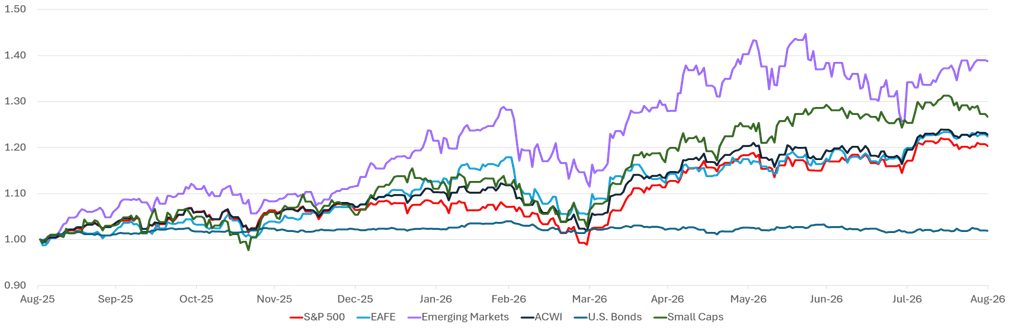
Equities rebounded in August on the heels of volatile July markets.  Global Equities (MSCI ACWI) and U.S. Large Caps (S&P 500) rose by 2.7%. U.S. Small caps (Russell 2000) posted a smaller gain of 1% for the month. Developed International Equities (MSCI EAFE) and Emerging Market Equities (MSCI EM Equity) posted gains of 2% and 3.5% respectively. Fixed income (Bloomberg US Aggregate) sold off but finished slightly positive (0.4%) as long-term yields rose to their highest levels since 2007.

Source: Bloomberg. EAFE is MSCI EAFE Index(1), Emerging Markets is MSCI Emerging Markets(2) and U.S. Bonds is Barclays U.S. Aggregate(3). ACWI is the MSCI ACWI Index(4). Small Caps is the Russell 2000 Index(5). S&P 500 is the S&P 500 Index(6).The above information is as of 8/31/2026. Past performance is not indicative of future results.


Sources

  1. FactSet Earnings Insight, S&P 500 Earnings Season Update: August 28, 2026, John Butters (factset.com). Blended Q2 2026 earnings growth rate 52.0%; excluding Alphabet, 40.6%; excluding Alphabet and Amazon.com, 33.8%. Revenue growth 15.5% (highest since Q4 2021). Net profit margin 17.0% (record). Magnificent Seven Q2 earnings growth 118.5% (highest since Q4 2020); other 493 companies 31.8%. Forward 12-month P/E ratio 19.6. Analyst projections: Q3 2026 EPS growth 28.2%; Q4 25.8%; CY 2026 31.2%; CY 2027 14.4%. Alphabet Q2 GAAP EPS included $98 billion gain on equity securities, primarily related to unrealized gains in equity securities portfolio from SpaceX and a private company (Anthropic). Amazon Q2 GAAP EPS included $53.4 billion other income primarily due to investments in Anthropic.
  2. Federal Reserve, “Keynote remarks by Chairman Warsh at the 2026 Jackson Hole Economic Policy Symposium,” August 28, 2026 (federalreserve.gov/newsevents/speech/warsh20260828a.htm). Address titled “In Our Time.” Direct quotations: “I would be hard pressed to describe broad financial conditions as restrictive.” “This summer’s inflation readings were better than expected, [but] they do not tell me that underlying inflation trends have meaningfully improved.” “Price stability is not self-executing, nor is inflation necessarily mean-reverting.” Chair Warsh marked his 100th day in office at the address.
  3. CNBC, “Fed officials who voted to hike rates say action is needed now against inflation,” July 31, 2026 (cnbc.com). AOL/Reuters, “Fed dissenters sketch the case for a rate hike,” July 31, 2026. Direct statements from Cleveland Fed President Beth Hammack, Dallas Fed President Lorie Logan, and Richmond Fed President Tom Barkin as cited. Hammack: “Now is the time for the [Federal Open Market Committee] to act to speed the return of PCE inflation to our 2 percent objective.” Logan: “Without any policy restraint, inflation will likely continue to trend above target until there’s an unanticipated shock.” Barkin: “a strong case” for adding restraint (Wall Street Journal interview cited in CNBC).
  4. CNBC, “Fed’s Kashkari says ‘now is the time to start slowly moving’ rates up,” August 5, 2026 (cnbc.com/2026/08/05). Direct quotation from Minneapolis Fed President Neel Kashkari: “A potential series of small policy moves would be better than waiting and eventually concluding that even bolder actions were necessary.” “I would rather get going now in small steps than wait till later, then we have a really entrenched inflation problem and have to raise rates aggressively.”
  5. U.S. Bureau of Labor Statistics, Employment Situation Summary, July 2026, released August 7, 2026 (bls.gov). Nonfarm payrolls declined 23,000 in July 2026 versus consensus estimate of +83,000. May revised down 66,000 to +63,000; June revised down 37,000 to +20,000. Unemployment rate 4.1% (down from 4.2%). Labor force participation rate declined. Average hourly earnings +0.1% month-over-month, +3.2% year-over-year (lowest annual wage growth reading since May 2021).
  6. U.S. Bureau of Labor Statistics, Consumer Price Index Summary, July 2026, released August 12, 2026 (bls.gov). Headline CPI +0.1% month-over-month, +3.4% year-over-year (down from +3.5% in June). Core CPI +0.2% month-over-month, +2.5% year-over-year. Gasoline component -2.9% month-over-month. Shelter contributed approximately two-thirds of monthly headline increase.
  7. U.S. Bureau of Economic Analysis, Personal Income and Outlays: July 2026, released August 26, 2026 (bea.gov). Headline PCE +0.2% month-over-month, +3.7% year-over-year (unchanged from June). Core PCE +0.2% month-over-month, +3.3% year-over-year (unchanged from June). Personal income +0.4% month-over-month, personal spending +0.2% month-over-month. Core PCE year-over-year has remained in the 3.3% to 3.4% range for four consecutive months (April 3.3%, May 3.4%, June 3.3%, July 3.3%).
  8. International Energy Agency, Oil Market Report, August 2026 (iea.org). Brent (North Sea Dated) rose approximately $25.67 per barrel during July 2026 to close the month at approximately $96.80 per barrel. Intra-month high of approximately $105 per barrel on July 23, 2026. August-end price above $90 per barrel following renewed U.S. and Iran hostilities and the reported U.S. strike on Iranian mine positions at Larak Island on August 30, 2026 (as reported by Reuters and Wall Street Journal).
  9. Richmond Fed Economic Brief 16-11, “The Burns Disinflation of 1974” (richmondfed.org). Reed College Economics Department, “Disinflation in 1979-82 Case” (reed.edu/economics). Federal funds rate reached peak of 20% in June 1981 under Chairman Paul Volcker. Unemployment rate peaked at 10.8% in November 1982. CPI inflation rose from approximately 3.2% at end of 1972 to above 11% by 1975 during Chairman Arthur Burns’s tenure, then declined and rose again to above 13% by 1980. The 1972 to 1975 sequence of rate increases followed by cuts is the primary “stop-go” precedent cited in modern hawkish arguments.
  10. Bankrate, “Federal Funds Rate History: 1980 Through the Present” (bankrate.com); Forbes Advisor, “Federal Funds Rate History 1990 to 2026” (forbes.com/advisor). Federal Reserve raised federal funds rate seventeen consecutive times between June 2004 and June 2006, from 1.00% to 5.25%. First rate cut of the 2007 to 2008 easing cycle was announced September 18, 2007. Fed paused between April 2008 and October 2008 before resuming aggressive cuts as the global financial crisis intensified. Peak-to-trough nonfarm payroll losses in the 2007 to 2009 recession totaled approximately 8.7 million (BLS). Unemployment rate reached cycle peak of 10.0% in October 2009 (BLS).
  11. CFA Institute Enterprising Investor, “When the Fed Cuts: Lessons from Past Cycles for Investors,” September 17, 2025 (blogs.cfainstitute.org). Federal Reserve Bank of St. Louis On the Economy blog, “The Dual Mandate in Conflict: Balancing Current Tensions between Inflation and Employment,” March 2026 (stlouisfed.org). Greenspan Federal Reserve raised federal funds rate from 3.00% in February 1994 to 6.00% in February 1995, paused approximately six months, then reduced by 75 basis points over the balance of 1995 and 1996. The 1994 to 1995 sequence is the only case in the post-1980 record where a substantial rate increase was followed by a soft landing with no ensuing recession.


Managing Director & Wealth Strategist Katie Sheehan Shares Insights on Successful Business Succession Planning in the Wealth Strategies Journal

For business owners, succession planning is about more than deciding who will take over the business.

A successful transition requires thoughtful coordination of estate planning, tax strategy, governance, financial planning, and family dynamics.

In her recent article published in the Wealth Strategies Journal, Katherine M. Sheehan, J.D., AEP®, ATFA, Managing Director and Wealth Strategist, explores the key considerations for planning a successful business transition.

Read Katie’s full article here.