Director and Wealth Manager Discusses Emerging Trends in Philanthropy with Crain Currency

What’s your giving strategy for 2025? The new year signals fresh opportunities to give back—are you prepared?

Director and Wealth Manager Luke B. Neumann, recently spoke with Crain Currency about emerging trends in charitable giving, including the impact of potential tax changes and how donor-advised funds (DAFs) and qualified charitable distributions (QCDs) are shaping the future of philanthropy.

Read the full article to learn more about these developments and how they may affect the future of giving by clicking here

The Global Trading System – Time for a Reboot?

Since 1980, US trade policy has been largely pro-trade which has allowed unfettered access to US markets for goods and capital. During this time, countries like China aggressively increased exports via state-supported industries, which distorted the US economy through large trade deficits and lost manufacturing and capital inflows.

Undoubtedly, US consumers have benefitted from inexpensive imported goods. However, trade is a double-edged sword. Less expensive imports mean less demand for US goods which harms US manufacturers and workers. Falling living standards for workers, especially in rural areas, has increased voter frustration and spurred the rise of populism.

This article is meant to provide a basic framework for understanding trade deficits, capital flows, and the implications of remedies like tariffs. After the 2024 election, one thing is clear – voters are tired of listening to pro-trade rhetoric and want results, in the form of higher wages and living standards.

Unfair Trade  

Economists tell us that all countries can benefit from trade by exchanging goods from the industries in which they have a low-cost production advantage. While true, countries like China have taken extraordinary measures to support their export industries, benefits which US manufacturers do not enjoy. The Chinese government supports producers with access to cheap credit, lax environmental policies, repression of workers’ wages, and a favorable currency exchange rate. China spends considerable financial effort controlling the value of its currency, the Renminbi. Weakening the Renminbi reduces the prices of goods exported to the US and increases China’s competitiveness. China has used these beggar-thy-neighbor strategies to export subsidized goods to the US and other developed countries, taking market share and crushing competitors.

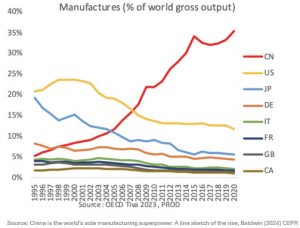
All the inexpensive imports have devastated US manufacturing. From its peak in 1979 to 2019, manufacturing employment in the US has been gutted, with the loss of approximately 6.8 million jobs including a loss of over 80% of employment in the textile industry.This decline has hit rural communities especially hard given the lack of other well-paying job opportunities in these areas. Since 1979, US manufacturing has declined from 22% of nonfarm employment to just 9% in 2019.ii As seen in the chart below, China comprises a whopping 29% of global manufacturing while only 17% of global GDP.iii  

The pace of China’s manufacturing expansion is unprecedentediv and has forced down manufacturing across the developed world.

Trade Imbalances Distort Capital Flows, too

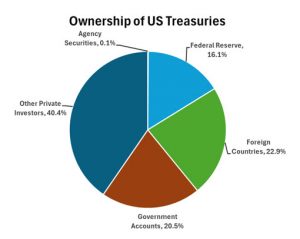
In exchange for goods, foreign surplus economies receive US Dollars which are typically re-invested in US Dollar assets. Exporting countries prefer not to exchange these US Dollars through currency markets for fear of depressing the value of the US Dollar and raising the value of their home currency (or whatever currency they purchased). This preference helps explain why trade deficits are not self-correcting as countries keep US Dollar assets to maintain a currency advantage. For September 2024, the reported monthly trade deficit was $84b, which means foreigners bought roughly $84b in US assets that month. Over time, these purchases of US assets accumulate and are substantial. As illustrated in the chart below, foreigners own over $7 trillion of US Treasuries, which is 22% of the total, and more than the amount the Federal Reserve holds via its quantitative easing programs.v

Economists incorrectly worry that countries may stop buying US debt; exporting countries have little choice but to buy US assets to maintain a trade advantage through exchange rates. The purchase of US assets represents a capital inflow of excess capital as the US has plenty of capital to meet its investment needs – just look at the $2.6t in dry powder at private equity firms.vi Excess capital can lead to asset bubbles and potential economic instability.

Tariffs and Measures to Reform Trade

Countries that run a trade surplus (China, Germany, and Vietnam, for example) should face incentives to consume more of their production at home. Those incentives could include tariffs, capital flow restrictions, and new trade agreements that focus on balanced trade with commitments to curb exports to the US and consume more US exports. During his campaign, President Trump promised a wide array of tariffs, even considering them a meaningful source of revenue for the US Treasury.

While all of these measures have shortcomings, there are a few concerns about tariffs:

  • Targeted country tariffs have shown little success. Since 2018, the US has enacted several country-specific tariffs that have had little impact on the overall trade deficit. While targeted tariffs reduced reported trade from China, many exporters rerouted Chinese goods through other countries like Vietnam, Taiwan, and Mexico and avoided paying tariffs.vii
  • Across-the-board tariffs will have unintended consequences. While solving the rerouting issue, broad tariffs would likely raise prices for items we may never produce like bananas or popular consumer items like iPhones. Further, across-the-board tariffs will likely increase prices generally, considering the time and investment it takes to relocate production to the US.

Global role of US Dollar

Another point of consideration is the role of the US Dollar as the world’s dominant currency. The US Dollar comprises 54% of foreign trade invoices and 59% of foreign currency reserves.viii Unfortunately, the US pays a cost for the global role of the US Dollar through increased capital inflows and a higher value of the US Dollar. While many believe a strong US Dollar shows US economic strength, it counteracts the effect of tariffs. The US should focus on lowering the value of the US Dollar to help domestic manufacturing and raise the cost of imported goods.

The US may consider a multifaceted approach to fixing trade – well-designed tariffs, limits on foreign asset purchases, and trade agreements focused on balanced trade. Importantly, the US needs to lower the value of the US Dollar through policies that could include reducing the role of the US Dollar in global finance. However, fixing the global trading system will take time.

Takeaways 

As we think about pending tariffs from the Trump administration, here are a few takeaways:

  • Change is coming: The 2024 election shows that voters believe the global trading system is badly broken and needs to be fixed.ix Tariffs aren’t perfect but may prove a good starting point for a discussion about what the US wants for fair trade.
  • Timing: Changes in tariffs will take some time to implement with the earliest impact near the end of 2025. Most likely, higher tariffs will take effect in 2026.
  • Higher prices: Imports are 14% of US GDPx, so across-the-board tariffs will have a large economic impact. Goldman Sachs’s tariff rule of thumb is every 10% increase in the US tariff rate would increase inflation by 1.0%.xi
  • Manufacturing rebuild: Rebuilding the manufacturing base will take time – think decades given complex supply chains and existing manufacturing bases. Manufacturing companies will want to see durable change before building a new plant, not tariff policies which could change every four years.

At Crestwood, we continue to watch for economic changes that may impact your investments. Importantly, we focus on constructing diversified portfolios designed to weather storms which include changes to industrial policy. Financial markets try to anticipate these changes and frequently overreact based on emotions. We believe it important to keep an eye on the long term and focus on durable changes to policy that may affect financial markets and possibly portfolios. Constructive policies on reshaping trade to a greater balance between imports and exports could have the potential to increase US GDP growth and raise living standards across the US. We will be watchful for policy changes and continue to position portfolios to meet clients’ long-term goals.


iForty years of falling manufacturing employment, Harris U.S Bureau of Labor Statistics: https://www.bls.gov/opub/btn/volume-9/forty-years-of-falling-manufacturing-employment.htm
iiIbid.
iii“Trade Intervention for Freer Trade” Pettis and Hogan 2024 Carnegie Endowment for International Peace: https://carnegieendowment.org/research/2024/10/trade-intervention-for-freer-trade?lang=en
ivIbid.
v“The US breached $34 trillion in national debt. Here’s who owns every dime.” Rosaria Straight Arrow News
https://san.com/cc/the-us-breached-34-trillion-in-national-debt-heres-who-owns-every-dime/
vi“Private equity dry powder growth accelerate in H1 2024” S&P Global https://www.spglobal.com/marketintelligence/en/news-insights/latest-news-headlines/private-equity-dry-powder-growth-accelerated-in-h1-2024-82385822
vii(Still) Made in China: how tariff hikes may trigger re-routing circumvention Shi and Liu 2019, CEPR https://cepr.org/voxeu/columns/still-made-china-how-tariff-hikes-may-trigger-re-routing-circumvention
viii“The changing role of the US dollar” Boocker and Wessel, Brookings
https://www.brookings.edu/articles/the-changing-role-of-the-us dollar/#:~:text=The%20dollar%20makes%20up%20a,of%20foreign%20trade%20invoices%20globally.
ix“Trade Intervention for Freer Trade” Pettis Hogan 2024 Carnegie Endowment for International Peace: https://carnegieendowment.org/research/2024/10/trade-intervention-for-freer-trade?lang=en
xSt Louis Federal Reserve FRED https://fred.stlouisfed.org/series/B021RE1A156NBEA
xi“Global Economic Comment: Economic Impacts of Tariff Proposals on USMCA Participants” Briggs, Phillips and Ramos 2024 Goldman Sachs

Crestwood Advisors Named One of America’s Top Financial Advisory Firms 2025 by Newsweek

Boston, Mass. (November 25, 2024) – Crestwood Advisors (“Crestwood”), a boutique investment advisory and wealth management firm based in Boston with offices in Connecticut and Rhode Island, is pleased to announce it has been named to Newsweek’s prestigious list of America’s Top Financial Advisory Firms 2025.

This recognition celebrates firms that provide transparent, client-centric services, empowering individuals and businesses to make informed financial decisions.

“We are truly honored to be recognized by Newsweek as one of the top financial advisory firms in the country,” said Crestwood President and Managing Partner Leah R. Sciabarrasi, CFP®. “This recognition is a testament to our team’s unwavering commitment to delivering personalized, client-first strategies that empower our clients to reach their goals, while always staying ahead of the curve.”

The Newsweek ranking highlights the top 750 RIAs from a pool of more than 15,000 financial advisory firms registered with the SEC. Firms were evaluated on factors such as asset performance, client satisfaction, adviser expertise, service breadth, and conflicts of interest.

Conducted in partnership with Plant-A Insights Group, the evaluation process awarded high scores based on a client-focused approach and comprehensive wealth management solutions. The top-scoring firms earned recognition as America’s Top Financial Advisory Firms 2025.

Crestwood Advisors prides itself on its dedication to offering tailored, holistic wealth management solutions designed to help clients achieve their financial goals.

For more information on the methodology behind Newsweek’s ranking, click here.

###

About Crestwood Advisors
Crestwood Advisors is an independent, fee-only, wealth management firm with approximately $6.7 billion in assets under management as of October 31, 2024. Founded in 2003, Crestwood Advisors provides investment management with financial planning strategies to help high-net-worth individuals and families identify and prioritize their goals and build sustainable wealth so that they may enjoy more financially secure and purposeful lives. For more information, please visit https://www.crestwoodadvisors.com.

Investment Research Analyst Discusses S&P 500 Index Funds with U.S. News & World Report

In a recent conversation with U.S. News & World Report, Investment Research Analyst Joe Alger, CFA, shared key insights on how different replication strategies impact the performance of popular S&P 500 index funds.

“Funds that use a full replication method of an index are likely to have lower tracking errors than funds that use partial or optimized replication methods,” he said.

Read the full article by clicking here.

November Economic Update: Tariff Talk

This election cycle, presidential candidates have characterized tariffs as both a miracle cure for all economic injustices as well as a potential tool for mass disruption.

President Trump has described potential tariffs ranging from 20% to 2,000%, sometimes saying they would apply only to certain countries or industries and at other times suggesting they might be applied to all imports. Meanwhile, Vice President Kamala Harris has framed these policies as an unavoidable sales tax paid by American consumers.

This month we want to discuss the history of tariffs, how they are applied, and their economic impacts.

A brief history of Tariffs and how they work

A tariff is a tax imposed on the imports or exports of goods. In modern parlance, it is most often used to refer specifically to a charge on imports.

Tariffs have been a documented part of economic systems as far back as ancient Greece, when Athens levied a two percent charge on goods such as grain that arrived through the docks of Piraeus. Tariffs have been widely used throughout history to raise revenue and compete against economic rivals.

In the United States, the Customs and Border Protection agency collects tariffs and transfers the revenue to the U.S. Treasury. Tariffs are typically levied as a percentage of the price a buyer pays a foreign seller.

Before federal income tax was established in 1913, tariffs were a major source of revenue. Douglas Irwin, a Dartmouth College economist studying the history of trade policy, estimates that from 1790 to 1860, tariffs accounted for 90% of federal revenue.

The most infamous tariff act was the Smoot-Hawley Tariff Act of 1930, which sharply raised tariffs before the Great Depression. Most economists don’t believe the increase in tariffs had a big influence on the Great Depression considering global trade was only 9% of GDP. However, one outcome of this tariff was the Reciprocal Trade Agreements Act of 1934 which gave presidents authority to negotiate and update trade agreements and tariffs without approval from Congress.

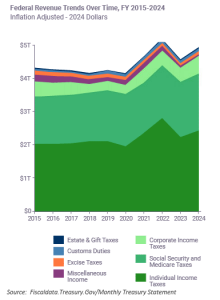
After the Great Depression and World War II, tariffs declined as global trade increased and as a result, they are now a meager source of revenue compared to individual income taxes, Social Security taxes, and Medicare taxes (shown in shades of green below). The chart breaks down sources of Federal Revenue for the last decade, with tariffs listed as “Customs Duties”. Note that even during the 2017-2021 period of the Trump presidency which saw new tariffs, they were still not a significant source of Federal revenue.
Are Tariffs a ‘sales tax’? Who pays the cost?
A tariff is not a ‘sales tax’ in the traditional sense. However, importers who pay the tariff typically raise prices to pass on the increased the cost of bringing goods to market to their end customers. Thus, tariffs result in higher costs on imported goods.

If Tariffs raise costs, what’s the benefit?
Tariffs protect domestic producers by making foreign goods less competitive and harder to sell.

For illustration, imagine a U.S. company that produces chocolate bars for $2.50 each competing with a Swiss company that produces similar bars for $2 each. A sweet-toothed President looking to protect jobs in the U.S. chocolate industry might decide that a tariff of 50% would be applied to all imported chocolate, effectively raising the cost of Swiss chocolate bars to consumers by $1 to $3/bar, making them the more expensive choice. This would likely lead to consumers buying American rather than Swiss chocolate bars.

Tariffs have frequently been employed in the past to combat unfair trade practices. For instance, if the Swiss government was subsidizing their chocolatiers to allow them to sell their bars for $0.50 each, a sizable tariff could help even the playing field. Foreign countries’ support of their manufacturing can take many forms: cheap credit, low wages, currency manipulation, and lax environmental laws can provide unfair advantages in trade.

Levying or lifting of tariffs can also be used to form strategic alliances. For instance, NAFTA (1994-2020) and its replacement policy USMCA (2020 – today) reduced barriers to trade across North America and established a process to handle economic disputes between the members. It also further extended U.S. influence beyond our borders.

What are the downsides of Tariffs?
Tariffs frequently lead to trade wars, where one country levies a tariff and in response the targeted country levies a tariff in return. For instance, in response to President Trump’s tariffs on aluminum and steel, the European Union taxed a variety of U.S. products such as bourbon and Harley-Davidson motorcycles. In a similar vein, China responded to Trump’s tariffs by adding their own tariffs to soybeans and pork, which hurt American farmers.

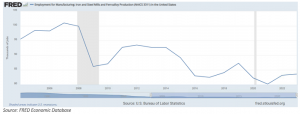
While a targeted tariff can help protect domestic businesses against a foreign rival, in cases where there is little to no domestic production, a tariff is often inflationary and results in higher costs without a meaningful economic benefit. For example, the U.S. continues to have a tariff on certain steel and aluminum products, yet the chart below from the U.S. Bureau of Labor Statistics illustrates how the number of jobs in the steel industry in 2024 is virtually identical to what it was in 2018 and has trended significantly lower over time.
Tariffs are here to stay, but their impact is dependent on their application

The goal with tariffs is to reshape a trade imbalance and reduce unfair trade. Unfortunately, they are not a magic solution capable of halting the advance of foreign competition. For instance, many companies in targeted countries like China avoid tariffs by shipping goods through other countries like Vietnam or Mexico.

Tariffs will continue to be a part of American economic policy for the foreseeable future. However, this is not without risk. Since tariffs result in higher prices, they can slow the pace of progress when battling inflation.


Capital Markets

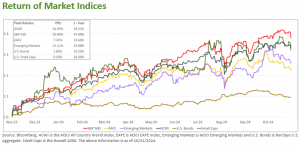
Equity markets were lower in October, breaking the pattern of five months of back-to-back gains. The All-Country World Index (ACWI) declined -2.2%, the S&P 500 declined -0.9%, while the EAFE retreated -5.4%. U.S. Small caps declined -1.4%. Emerging market equities fell -4.3%. U.S. Bond prices fell -2.5% for the month.
This document contains forward-looking statements, predictions and forecasts (“forward-looking statements”) concerning our beliefs and opinions in respect of the future. Forward-looking statements necessarily involve risks and uncertainties, and undue reliance should not be placed on them. There can be no assurance that forward-looking statements will prove to be accurate, and actual results and future events could differ materially from those anticipated in such statements.

Little Learners, Big Budgets: Empowering Young Minds with Financial Wisdom

The importance of Financial Education in Wealth Transfer

Creating generational wealth involves more than just passing on financial assets. It’s about preparing the next generation to nurture their legacy and focus on managing and growing wealth responsibly. Focusing efforts on financial education at an early age is key to setting younger generations up for success.

One of the biggest challenges is educating the next generation on important issues like financial literacy, self-discipline, and wealth preservation. How do families start this conversation with their heirs? Will they understand these concepts at a young age? While these conversations with the next generation can be difficult, there are avenues to facilitate productive discussions.

Interactive Engagement to Ignite Young Imaginations

There are many resources such as Mint, Smart About Money, Monarch and Greenlight, that teach young children about financial literacy and investment concepts through interactive engagement. With technological advancements, introducing them to online tools can help automate and simplify their financial management. Many programs offer family-friendly curricula, multimedia learning centers, games, and budgeting tools, making financial education both enjoyable and accessible.

Incorporate philanthropic endeavors into your conversation. What are their hobbies and how can this tie into charity? With the holiday season approaching, this could be an opportune time to bring up how they may give thanks as part of a philanthropic approach.

Transforming Financial Responsibility into Opportunity

Infusing relevance, excitement, and collaboration into discussions with your children can ease the weight of financial conversations. Reframing specific conversations to empower them will allow for greater results. For example, rather than saying “you need to learn about budgeting so you can save more”, you can try “what would you like to buy so we can talk about saving to pursue your goal”. This type of collaboration will induce trust and relationship building, while discussing the importance of being financially prudent. Share your childhood stories with them. This can provide them with a sense of connection and understanding on your accomplishments.

Building Healthy Financial Habits

Building best practices and habits as early as possible will make an impact. Prioritize saving by creating a goal. Whether it’s saving for that pair of sneakers or saving $10 per week for an emergency fund. When they start working, prioritize saving by automatically setting aside a portion of their income for savings before allocating funds to other expenses. Prioritize participation in employer-sponsored retirement plans, such as 401(k) plans, especially if the employer offers a matching contribution. Maximizing employer matches provides a significant boost to retirement savings. Demonstrating the effects of compounding at an early age can be eye-opening, and instilling sound financial practices and habits from an early age can make a lasting difference.

Conclusion: Preparing the Next Generation for Success

Connecting your heirs with financial advisors opens the door to meaningful dialogue about money management. By involving professionals, young children can gain insights and learn directly from experts, making financial concepts more relatable and understandable. Reach out to your Crestwood Team to explore ways to engage the next generation effectively.

Crestwood Advisors Joins Industry Leaders in Launching the Net Positive Consortium

Crestwood Advisors is proud to be a founding member of the Net Positive Consortium, a groundbreaking initiative that unites over a dozen of the wealth management industry’s leading firms to foster civic engagement, promote diversity and drive meaningful change through best practices. With consortium members collectively managing over $200bn in client assets, this initiative focuses on five key pillars: workforce development, community support, environmental sustainability, client service, and industry leadership. Through collaboration and shared commitment, we aim to elevate our impact, champion inclusion and pay it forward.

Click here to read more!


October Economic Update: The Fed Makes the First Cut

Equity markets finished September higher, after a rough start with the S&P 500 down over 4% during the first week, the biggest weekly pullback of the year. Investors initially fretted over softer than expected August employment that featured negative revisions to prior months and a disappointing ISM manufacturing report. These data points exacerbated existing worries about U.S. election uncertainty, potential further escalation in Middle East conflicts, U.S. labor disputes (port workers and Boeing) and ongoing economic woes in the Chinese economy.

However, several developments reversed this pessimism. The Fed announced a 0.5% rate cut at their September meeting while telegraphing another likely 0.5% in cuts before year-end. The September cut was supported by positive data showing continued disinflation, a stable (albeit slowing) labor market, still-healthy consumer spending, and continued earnings growth projected for U.S. corporations. The soft-landing narrative was further buttressed by initial unemployment claims falling to the lowest level since May.

A 0.5% drop in policy rates is significant paired with the Fed’s updated Statement of Economic Projections (aka their “Dot Plot”) penciling in another 1% in cuts during 2025 and 0.5% in 2026. Car loans, credit cards, some adjustable-rate mortgages and some other forms of borrowing are based on the Prime Rate, which typically runs approximately 3% above the Fed Funds rate. Thus, a full 1% drop in the Fed Funds rate by year-end would represent a meaningful reduction in borrowing costs for many U.S. consumers.

When Will Fed Rate Cuts Help Homebuyers and Refinancers?

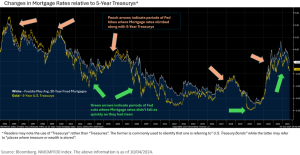
The short answer is “Eventually.” Unlike the Fed Fund rate, which is decided by the Fed, mortgage rates tend to be closely related to 5-year Treasury yields, which are driven primarily by supply and demand factors. These yields tend to rise when the economic outlook is strong and fall when the economic outlook is weak. Over time, Treasury rates tend to follow the direction of changes in the Fed Fund rate.

  • The caveat is that mortgage rates don’t always adjust at the same pace:
    When the 5-year yield is rising, borrowing rates tend to go up quickly as lenders are eager to offer loans at higher and higher rates while the economic outlook appears strong. From their perspective, this is a win-win: they’re charging higher rates to borrowers in an environment where defaults are less likely.
  • Not surprisingly, when 5-year Treasury yields are falling, lending rates don’t fall quite as fast as they rose. In other words, when the economic future looks more uncertain, lenders prefer to keep rates higher for longer to hedge against future risk.
  • This phenomenon is observable in the chart below: the gap between 5-Year Treasurys (yellow line) and 30-year average Fixed Mortgage Rates (white line) is minimal when rates are rising (as in 2022) but tends to widen when rates are flat or declining.

The takeaway: Homebuyers and refinancers should be optimistic that lower rates on mortgages are coming, however they should also expect that these lower borrowing costs for consumers may lag the decline in Fed rate cuts.

Chinese Equity Markets: Avaricious Stimulus

During the last week of September, Chinese equities rose nearly 20% in response to the Chinese government’s announcement of a tidal wave of stimulus measures intended to jump start their economy. The stimulus included cuts to mortgage rates, a decline in down payment requirements for second homes, relaxed capital reserve requirements for banks, and a large stimulus program that explicitly incents brokers, insurance companies and other entities to buy Chinese stocks.

While this caused Chinese stocks to move into positive territory for the year, it does little to address fundamental issues plaguing their economy. China still faces weak retail sales, falling real estate prices, and a crippling dependence on government investment, rather than consumption, to maintain growth. Perhaps worst of all is that the heavy hand of communist rule has undermined shareholder rights, especially those of foreigners. In June this year, foreign direct investment in China turned negative for only the second time since 2005.

Despite the recent rise in Chinese equity prices, we continue to believe investors should be wary of rallies driven by government spending and policies intended to entice speculative investments.

Capital Markets

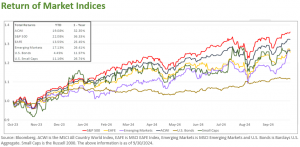
Equity and fixed income markets rose in September. The All-Country World Index (ACWI) rose +2.17%, the S&P 500 rose +2.02%, while the EAFE rose +0.62%. Emerging markets surged with a gain of +6.68%, driven primarily by the aforementioned move in Chinese equities. U.S. Bond prices rose +1.34% for the month.


This document contains forward-looking statements, predictions and forecasts (“forward-looking statements”) concerning our beliefs and opinions in respect of the future. Forward-looking statements necessarily involve risks and uncertainties, and undue reliance should not be placed on them. There can be no assurance that forward-looking statements will prove to be accurate, and actual results and future events could differ materially from those anticipated in such statements.