Crestwood’s Katherine M. Sheehan, Managing Director and Wealth Strategist, joined Gary Heldt on the latest episode of the Grow Your Business & Grow Your Wealth podcast to discuss how smart planning protects both your business and your legacy. In the episode, Katherine explains what every entrepreneur should know about estate and succession planning.
November 2025 Economic Update: Everything is K
“When you come to a fork in the road, take it.” – Yogi Berra
The term “K-shaped recovery” gained prominence in 2020 during the uneven rebound from the Covid-19 recession. Popularized by economist Peter Atwater, the concept describes how, following an economic downturn, certain economic groups and industry sectors recover rapidly while others stagnate. A K-shaped recovery differs from the more familiar V-shaped recovery (a sharp decline followed by a strong rebound) or U-shaped recovery (a slower return to growth). The K-shape is defined by unequal growth: some “arms” of the economy rise while others continue to fall, creating a pattern that resembles the letter “K.”
In the years since the pandemic, this “K” pattern has persisted, and we currently have a K-shaped economy. Wealth has grown disproportionately among high-income households, large corporations (especially tech and capital-light firms), and asset‐owners, while lower‐income households, small and medium employers, and service-industries reliant on physical presence continue to struggle.
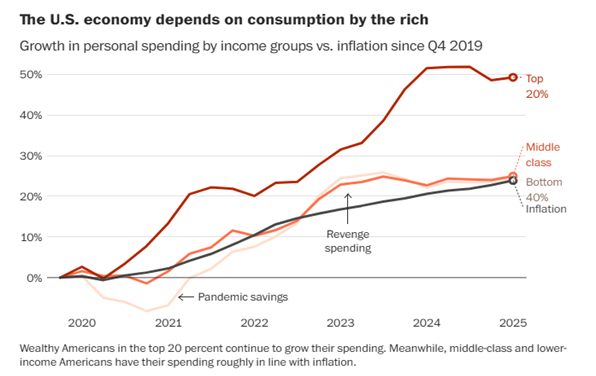
Consumer spending is a primary driver of the U.S. economy and a key indicator of economic growth and illustrates the K-phenomenon. Before the onset of Covid, spending patterns were broadly similar across income groups. However, the chart below illustrates that spending by the highest 20% of earners outpaced that of other groups as we emerged from the pandemic, and the gap continues to widen.

Source: Moody’s
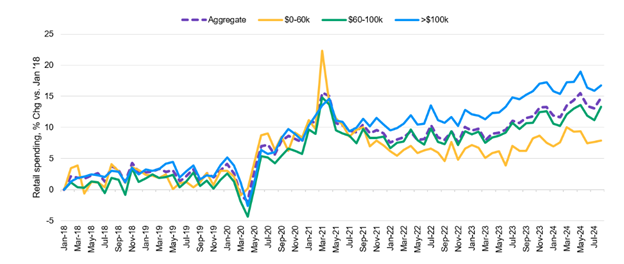
Similarly, a report from October 2024 from the Federal Reserve shows that retail spending of the bottom 80% of Americans, as measured by income, has roughly kept pace with inflation, while the highest 20% of earners have increased their spending by close to 50% in the post-pandemic period!

Source: Hacıoğlu Hoke, Sinem, Leo Feler, and Jack Chylak (2024). “A Better Way of Understanding the US Consumer: Decomposing Retail Sales by Household Income,” FEDS Notes. Washington: Board of Governors of the Federal Reserve System, October 11, 2024, https://doi.org/10.17016/2380-7172.3611.
What’s Driving the K-Shaped Economy?
There are four primary factors driving the K-shaped economy that help to explain the widening disparity between winners and losers among both producers and consumers. These include:
- The Impact of Technology
The rapid adoption of artificial intelligence, automation, and digital platforms has accelerated productivity and profitability in key high-tech sectors. Workers and companies equipped to leverage technology are pulling ahead, while those dependent on manual or low-skill labor are being left behind. - Uneven Wage and Employment Growth
The post-pandemic labor market remains divided. High-income professionals in technology, finance, and healthcare enjoy steady job growth and salary increases, while many service-sector and blue-collar workers face stagnant wages or reduced hours. Automation and AI-driven efficiencies have increased productivity while displacing many lower-wage roles. - The Unequal Impact of Inflation and Interest Rates
Inflation and elevated interest rates have widened the gap between economic winners and losers. Wealthier households with greater savings and investment portfolios can absorb higher prices and even benefit from rising interest income. Meanwhile, lower-income families, who spend a higher share of income on essentials like food, energy, and rent, feel the strain. Rising credit card balances and delinquency rates show how unevenly these costs are distributed. - Asset Price Divergence aka “The Wealth Effect”
Financial markets have surged over the past two years. Homeowners and investors have seen their wealth grow as real estate and stock values appreciate. In contrast, renters, and those without substantial assets, have missed out on these wealth effects, widening the financial gap between households.
Implications for Investors
Aggregate metrics like GDP growth, corporate profits and stock market indices reflect activity as a whole rather than how each segment is faring. Overall, the U.S. economy appears healthy. But underneath the surface there is deep inequality, fragility in many out-of-favor sectors, and risks that reflect an asymmetric weakness in the economy.
For investors, the K-shaped economy creates both opportunities and risks, as returns will vary sharply across sectors and industries.
Sector Divergence Reflects “Two Economies”
In 2025, stock market performance mirrors the same K-shaped pattern. Technology stocks related to AI have soared while consumer staples and other sectors lagged.
According to S&P sector data through the end of October:
- The Upper-Arm of the K Leaders: The Technology sector saw a total return of +29.9% and the Communications sector +26.8%, fueled by corporate investment in AI, automation and productivity tools. The Industrial and Utility sectors saw a rise of +18.9% and +20.2%, respectively.
- The Lower-Arm Laggards: By contrast, all other sectors saw single-digit returns: the Financial sector (+9.6%), Consumer Discretionary sector (+7.8%), Healthcare sector (+6.3%), Energy sector (+5.8%), Materials sector (+3.8%), Real Estate sector (nearly flat at +0.2%).
Source: Standard and Poor’s
Rising Inequality Alters Market Dynamics
As wealth becomes more concentrated, stock market participation increasingly reflects the spending and investment behavior of affluent households. Gains in financial markets boost high-income spending, which supports certain sectors, while the rest of the economy remains subdued. For investors, paying close attention to demographic and income-driven consumption trends is more important than ever.
Defensive Positioning for Uneven Growth
In a K-shaped environment, diversification across economic segments becomes crucial. Investors should favor companies with pricing power, strong balance sheets, and exposure to higher-income consumers. Long-time readers will note that the first two criteria are also hallmarks of Quality-focused investing, which we have frequently advocated.
The K-shape is becoming a defining feature of the modern U.S. economy. For investors, understanding this divergence is essential to navigating risk and identifying opportunity as the winners in 2025 likely will continue to be firms that cater to higher-income consumers and those that best leverage technology and maintain pricing power.
Capital Markets
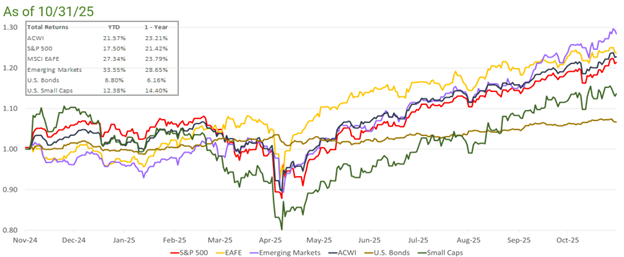
Following on the recent pattern of market rises after each rate cut, once again all boats rose with the tide in October. The All-Country World Equity Index (ACWI) and S&P 500 both rose 2.3%. US Small Cap equities, measured by the Russell 2000, gained 1.8%. International Developed stocks, as measured by the EAFE, increased by 1.2%. Emerging market equities had another strong month, surging 4.2% Not to be left out, US bond prices rose 0.6% for the month.

Source: Bloomberg. EAFE is MSCI EAFE Index(1), Emerging Markets is MSCI Emerging Markets(2) and U.S. Bonds is Barclays U.S. Aggregate(3). ACWI is the MSCI ACWI Index(4). Small Caps is the Russell 2000 Index(5). S&P 500 is the S&P 500 Index(6). The above information is as of 10/31/2025.
Cybersecurity During the Holidays
With the holidays fast approaching, many people are getting ready to visit family, take a long-awaited vacation, and shop for gifts. However, the hustle and bustle of the season can also increase your exposure to cyber threats, as hackers seize opportunities to exploit heightened online activity.
Here are some suggestions that can help protect you and your data and keep you cybersafe:
Strengthen Your Login Credentials
When logging in to your online accounts, the following methods can be effective in defending yourself against a data breach:
- Use long passwords or passphrases. Make your passwords at least 15 characters long, focusing on something memorable but difficult to guess. Length matters more than complexity, although many websites do require a mix of upper-case and lower-case letters, numbers, and symbols.
- Update your password if it’s been compromised. While you don’t need to change your passwords routinely, you can use a trusted tool, such as “Have I Been Pwned,” to check your passwords against known data breaches.
- Use a unique password for every account. Never reuse passwords. A password manager app can safely generate and store them for you, so you don’t need to keep track.
- Enable multi-factor authentication (MFA) wherever possible. This provides an extra layer of protection by utilizing additional authentication methods such as a code sent via text or email, an authenticator app, or a security question.
Think Before You Share
Be mindful about what you and your family post on social media, especially when you travel.
- Wait until your trip is over to post vacation photos. By sharing real-time updates about your location, you may inadvertently alert criminals that your home is unattended.
- Be cautious about sharing personal information, including audio or video content. Hackers are increasingly using AI tools to create convincing fake content to execute phishing and other scams.
- Take time to review your network, remove unfamiliar connections, and adjust your privacy settings to control who can see your posts.
Use Secure Connections
When you’re in a public location, such as an airport or cafe, using unsecured Wi-Fi can make your information vulnerable.
- Use a virtual private network (VPN) to encrypt your data, particularly to execute financial transactions or access sensitive data.
- When in doubt, use your mobile data connection, which is typically safer.
- Regularly update your devices with the latest software and security patches.
Shop Online with Caution
As online shopping surges during the holidays, cybercriminals gear up to take advantage – for example, setting up fake e-commerce websites designed to steal your personal and financial information.
- Make sure you shop trusted retailers by typing their URL directly into your browser rather than clicking the link in a promotional email.
- Ensure the websites you visit use secure encryption (URL should include “https”).
- Use a credit card that offers buyer protection.
- Review your statements for suspicious charges.
- Reconsider storing your payment information on the retailer’s site which can expose you to greater risk should the company suffer a data breach.
Lock Your Digital Wallet
While digital wallets offer a convenient method for making purchases, they also present risks should you lose your phone.
- Lock your phone and/or your wallet, requiring a face scan, fingerprint, or password to access your account.
- Enable the “find my phone” feature as well as transaction alerts so you receive purchase notifications.
- Carefully review your statement to ensure there are no fraudulent charges.
Beware of Skimming
Criminals can also steal your data using skimming devices secretly installed in ATM machines, point-of-sale terminals, and fuel pumps.
- Choose a gas pump or point-of-sale terminal in view of an attendant and an ATM in a well-lit, high-traffic location inside a business or bank branch.
- When it’s an option, tap to pay instead of inserting your card into the reader.
- Look for signs of tampering, such as a loose or damaged keypad or card reader.
Enjoy the Holidays, Safely
Taking a few simple precautions can go a long way toward protecting your data and giving you peace of mind so you can focus your attention on enjoying friends, family, and some well-deserved rest.
If you have concerns about your financial security, don’t hesitate to contact your Crestwood team for guidance. Not yet a Crestwood client? Please reach out to contact us. We are here to help.
Source: National Institute of Standards and Technology U.S. Department of Commerce. (2025, August 20). How Do I Create a Good Password? And what else can I do to secure my online accounts? https://www.nist.gov/cybersecurity/how-do-i-create-good-password
This document is provided for general informational purposes only by Crestwood Advisors, an investment adviser. Crestwood Advisors does not endorse, sponsor, or promote any of the products or companies listed or mentioned in this material. Any references to specific products or services are purely incidental and are included solely to illustrate potential strategies or concepts. The inclusion of such references does not imply any form of partnership, relationship, or approval by the Firm.
Webinar: Preparing for an Exit – A Business Owner’s Guide to Their Sale of Lifetime
Be Proactive in This Year’s “Season of Giving”
The final months of the year are often called the “season of giving,” a time when generosity peaks during the holidays. But this year you may want to plan your charitable giving a little earlier than usual.
The One Big Beautiful Bill Act (OBBBA), recently passed by Congress, mandates some important tax law changes that take effect in 2026. Ignoring these changes this year risks leaving both your finances and your favorite causes shortchanged.
The New Rules Ahead
Starting in 2026, the rules governing charitable deductions shift in ways that may reduce the tax efficiency of gifts for many taxpayers:
- New floor for itemizers: Only donations above 0.5% of your adjusted gross income (AGI) will be deductible. Smaller, routine gifts may no longer yield tax benefits.
- Deduction cap for high earners: For those in the 37% tax bracket, charitable deductions will be limited to a maximum tax savings of thirty-five cents on the dollar, reducing some incentives for larger gifts.
- Universal deduction reinstated, but still modest: Non-itemizers will be allowed to deduct up to $1,000 ($2,000 for joint filers) for cash gifts, but this benefit is small and not indexed to inflation.
- Higher estate/gift tax exemption: The OBBBA sets the lifetime estate/gift tax exemption at an increased $15 million per individual or $30 million per married couple (indexed for inflation). A high federal estate tax exemption leaves fewer subject to estate tax and therefore less motivated to do large scale charitable planning for tax mitigation purposes.
Why Initiative-taking Planning Matters Now
Because the OBBBA changes take effect in 2026, 2025 is a pivotal year. Donors who plan ahead during this year’s season of giving can take advantage of the current, more favorable rules while they still apply. Steps you might consider now include:
- Front-loading: If you are in the highest tax bracket, you might consider front-loading large future or multi-year gifts in 2025 to lock in the full 37% deduction.
- Bunching: To overcome the 0.5% floor in 2026, consider combining or “bunching” multiple years of smaller charitable gifts into one year so that the total amount donated exceeds the threshold and yields the full deduction. Consider donating appreciated stock, or other non-cash assets that help exceed the floor while providing other tax benefits.
- QCDs: If you are age 70½ or older and have a traditional IRA, making charitable gifts via Qualified Charitable Distributions (QCDs) remain untouched by both the .5% floor or the 35% ceiling discussed above. Because the distribution is made directly to a charity, you avoid recognizing the amount as taxable income and bypass the deduction limit issues.
A Call to Thoughtful Giving
In 2025, the season of giving is also a season of transition. Donors who act now may be better positioned to support their chosen causes while preserving the maximum value of their contributions.
Determining the right course of action for your charitable giving strategy can be complex, especially in this year of change. Your Crestwood team can work with you and your tax advisor to determine the best strategy for your situation. Planning today ensures your generosity goes further, both this year and for many years to come.
If you are not yet working with Crestwood, please reach out.
This document is provided for general informational purposes only by Crestwood Advisors, an investment adviser. Crestwood Advisors does not provide legal advice, and this document should not be construed as containing legal advice. For legal advice, consult with a licensed attorney. This document should not be construed as containing tax advice. For tax advice, consult with your tax adviser.
October 2025 Economic Update: The Fed Cut Rates and Closing Time for the US Government
One Small Cut, More to Come
In last month’s Economic Update, we identified four areas of particular interest regarding the upcoming September meeting of the Federal Reserve’s Open Market Committee (FOMC).
The Interest Rate Decision
We expected the Committee would lower the federal funds rate by 0.25% to 4.00% -4.25% based on a generally held view that the economy was slowing. In a nearly unanimous 11-1 decision, members voted to drop rates by a quarter percent. The lone dissenter was the newly appointed Fed Governor, Stephan Miran, who was in favor of a more aggressive 0.50% reduction.
Forward Guidance
The FOMC updated its Statement of Economic Projections (SEP), commonly referred to as the “Dot Plot,” at the September meeting.
As noted last month, the SEP outlines where individual Fed members expect inflation and interest rates to trend over the coming quarters and provides members’ future year-end target ranges. Investors watch the Dot Plot closely for insight into the Fed’s future policy path and interest rate expectations which, in turn, influence everything from bond yields to equity valuations.
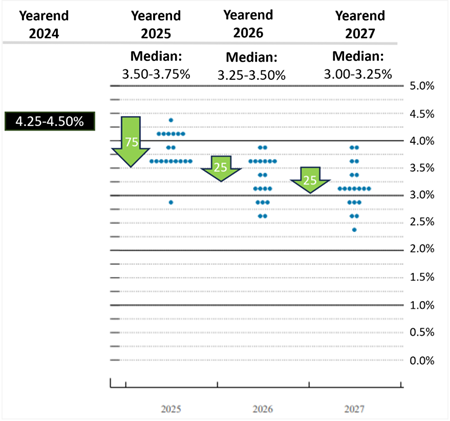
The chart below shows the updated SEP dot plot for September. Each blue dot on the chart represents the opinion of one of the 19 FOMC participants.
September 2025 Fed Dot Plot Showing Projected Target Range of Fed Funds Rate and moves per calendar year (Green Arrows)
Source: September 17, 2025 FOMC Summary of Economic Projections and Bondsavvy calculations.
The median of the September dot plot projections sees the Fed Funds rate falling by a further 0.5% in 2025, an additional 0.25% in 2026 and 2027.
The dot plots as a group have shifted down 0.25% for each calendar year, apart from the outlier (Miran) who projected a significantly lower rate in 2025 and 2027 than the rest of the FOMC.
Dissent!
Stephen Miran, who formerly served as Chairman of Economic Advisers in the current Trump Administration, argued the Federal Funds rate is currently about 2% too high, proposing that structural shifts in immigration, tariffs, regulation, and tax policy have pushed the “neutral” rate downward. The neutral rate is the theoretical “sweet spot” where the economy has both full employment and stable inflation.
Miran asserted that the inflationary pressure from policy changes is overstated, especially pressure attributed to tariffs, and that more aggressive easing is necessary to forestall deterioration in labor markets.
While Miran’s views are consistent with those of the Administration, they stand in contrast to the majority view on the FOMC that changes to American policy (tariffs, immigration) continue to be a near-term reinflationary risk.
Inflation and Labor Market Trends
Powell emphasized that while inflation has eased from its peaks, it “remains somewhat elevated,” especially noting that goods prices have driven part of the pickup in inflation recently. PCE rose 2.0% over the 12 months ending in August. While overall unemployment remains low, Powell described it as a “low-firing, low-hiring environment” noting that younger people entering the workforce are having a hard time finding work.
Overall, economic data is somewhat mixed. Labor markets are slowing, but not collapsing, which is consistent with the Fed lowering interest rates. However, the economy seems to be humming along. Q2 GDP came in at 3.8% quarter over quarter, boosted by healthy consumption. The US consumer continues to spend. Forecasts for Q3 show this trend continuing. According to the Atlanta Fed, the GDPNow forecast for Q3 is projected to come in at 3.8%, which suggests the economy is still on reasonable footing, even if the economic terrain appears uneven.
Closing Time – The Federal Government Shuts Down (Again)
Effective October 1st, the Federal Government has shut down.
Over the last 50 years, the US government has shut down a remarkable 21 times. Most shutdowns have been brief, lasting only a few days.
The current shutdown is interesting for several reasons:
- In the past, these typically occurred at times when Congress had already passed some funding resolutions, so the shutdown only impacted a subset of government agencies. In the current case, Congress has not passed any annual spending bills, so this would result in funding for all agencies to lapse.
- Office of Management and Budget Director Russell Vought has indicated that in addition to the usual furloughs, the administration may start to permanently fire federal employees in the days to come.
- The longest shutdown of the last 50 years was the most recent one: December 2018’s 35-day shutdown during the previous Trump administration.
What are the Effects of a Shutdown?
The immediate effect is furlough – temporary unemployment – of ~40% of federal employees considered non-essential. Furloughed employees are reimbursed for lost pay when they return to work. These employees hold a variety of roles across the economy, so their absence manifests in a host of ways: travelers would expect longer travel times at the airport (fewer TSA employees), potential changes at the grocery store (fewer USDA food inspectors), closures of national parks (fewer park workers) and so forth. If the shutdown is brief, the economic disruption is primarily felt by the furloughed Federal workers.
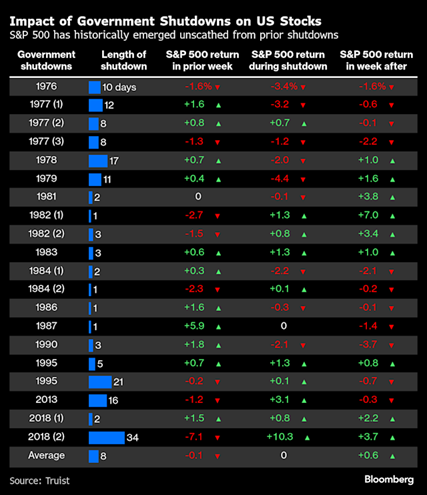
Historically, financial markets have typically shrugged off government shutdowns. Goldman Sachs notes that 10 yr Treasury yields and the USD, which are a barometer of the global financial system’s faith in the smooth functioning of the US government, have typically weakened following government shutdowns and subsequently taken time to recover once the government reopens. However, these effects are not long-lasting.
US equity markets have likewise seen muted impacts from shutdowns, as shown in the chart below:
When might we see a resolution?
There is no reliable way to predict the duration of the shutdown. Military pay, which stands to be impacted this time around, has historically encouraged a deadline for reopening. The first military pay date at risk is October 15th. Another deadline for a possible resolution could be the second week of October, when funding for the Women Infants and Children (WIC) nutrition program is set to run out of money.
Given the uncertain, and likely temporary market impact associated with the shutdown, we recommend clients maintain their long-term investment focus and avoid a change in strategy as a result of the current shutdown.
Capital Markets
As the Fed moved to cut rates, all boats rose with the tide in September. Equity markets saw the biggest moves, with the All Country World Index (ACWI) rising 3.7%. The S&P 500 was slightly behind, climbing 3.6% for the month. Emerging market equities surged 7.2% while International Developed stocks, as measured by the EAFE, increased by 2%. US Small Cap equities, measured by the Russell 2000, had another strong month, increasing by 3.1%. US bond prices rose 1.1% for the month.
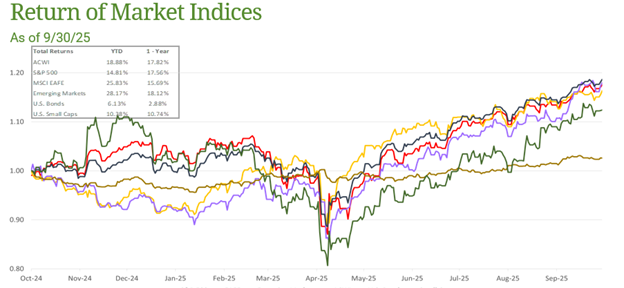
Source: Bloomberg. EAFE is MSCI EAFE Index(1), Emerging Markets is MSCI Emerging Markets(2) and U.S. Bonds is Barclays U.S. Aggregate(3). ACWI is the MSCI ACWI Index(4). Small Caps is the Russell 2000 Index(5). S&P 500 is the S&P 500 Index(6). The above information is as of 9/30/2025.
Crestwood Advisors Earns Spot on Forbes/SHOOK Top RIA List for Fourth Consecutive Year
Boston-based firm climbs to No. 56 in 2025 national ranking of leading wealth managers
BOSTON (October 2, 2025) – Crestwood Advisors (“Crestwood”), a boutique investment advisory and wealth management firm based in Boston and with offices in Connecticut and Rhode Island, is proud to announce its inclusion on the Forbes/SHOOK America’s Top RIA Firms list for the fourth consecutive year.
Crestwood ranked No. 56 in 2025, moving up from No. 59 in 2024, underscoring the firm’s steady growth and enduring commitment to client service.
“Our place on this list is a direct reflection of the trust our clients put in us,” said Crestwood President and Managing Partner Leah R. Sciabarrasi, CFP®. “We’re honored to be recognized nationally for delivering advice that helps families and institutions achieve lasting financial confidence.”
The Forbes ranking, developed by SHOOK Research, identifies the nation’s top 250 registered investment advisors (RIAs) in the U.S. through a rigorous combination of qualitative and quantitative measures. The evaluation process considers factors such as assets under management, revenue growth, compliance records, and client service. This year, SHOOK received more than 50,000 nominations and conducted over 33,000 interviews with advisors and firm leaders to determine the final list.
Now in its fourth year, the Forbes/SHOOK Top RIA Firms list continues to spotlight wealth management firms that set the standard for excellence. Collectively, the 250 firms honored in 2025 oversee more than $1.9 trillion in assets, reflecting the strength and depth of the independent advisory community. The full methodology for the ranking can be found here.
Crestwood did not pay a fee to appear on the published list or to market the award.
Please view Crestwood Advisors’ list of important disclosures regarding awards and recognitions here.
Investing in Your Health: The Right Plan for Every Age
Open enrollment is just around the corner. This is the time not only to review your coverage for 2026, but also to consider how healthcare expenses fit into your financial plan for today and for the future.
Advances in healthcare are making it easier than ever to take charge of your own well-being. From wearable fitness trackers that monitor steps, sleep, and heart health to telemedicine that delivers care without the waiting room, convenience and accessibility are on the rise. For those seeking more personalized options, concierge medicine provides direct access to physicians, while GLP-1 medications and luxury wellness treatments are becoming increasingly popular.
Thanks to these innovations, many Americans can expect to live into their 90s and beyond with a high quality of life.
But What’s the Cost?
Many of these advances are not covered by insurance. It is easy to underestimate the lifetime price tag, especially as you age. Fidelity estimates that the average 65-year-old couple retiring today will need $345,000 for healthcare in retirement, not including long-term care.1
Chronic conditions, rising drug prices, or an unexpected diagnosis can quickly derail even the best-laid plans. Without planning, families often find themselves self-funding significant healthcare expenses, so it is important to plan for both the expected and the unexpected.
When You’re Just Starting Out
If you’re under 26 years old, you may still qualify to stay on your parents’ health insurance plan, potentially saving thousands in premiums.
If you’re enrolled in a high-deductible health plan, consider contributing to a Health Savings Account (HSA). While many people use HSAs for current medical costs, their real power lies in the potential to invest for long-term growth. HSAs offer unique triple-tax advantages:
- Contributions are tax-deductible
- Growth is tax-free
- Withdrawals for qualified medical expenses are tax-free
As You Advance in Your Career
As your income and financial assets grow, start setting aside funds earmarked for healthcare, separate from lifestyle spending. This is especially important if you’re considering retiring before age 65 (when you are eligible for Medicare) and need to fund your own healthcare plan.
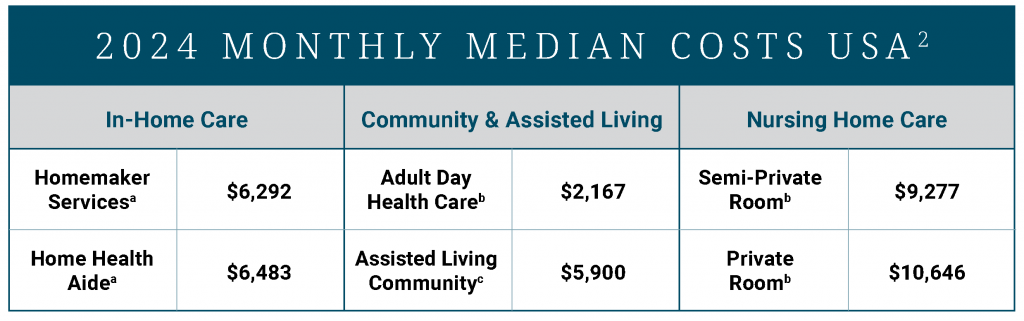
Expenses such as in-home care, community and assisted living, and nursing home care are expensive and not covered by Medicare. Self-funding can be a valid strategy for high-net worth individuals. Long-term care insurance can also help cover all or a portion of those expenses. The best time to begin evaluating long-term care insurance is when you’re in your 50s or early 60s, when premiums are still reasonable and you have more options available.

a Based on annual rate divided by 12 months (assumes 44 hours per week)
b Based on annual rate divided by 12 months
c As reported, monthly rate, private, one bedroom
After You Have Retired
Budgeting becomes increasingly important in retirement. Healthcare costs often rise with age, and unexpected expenses can strain your savings if you’re not prepared. Your Crestwood advisory team can help you create a withdrawal strategy that allows your money to last throughout retirement and cover your healthcare expenses when you need them the most.
Reach Out to Crestwood
Modern healthcare gives us the tools to live longer, healthier lives, but it also requires thoughtful financial planning. We help clients invest for a future they can enjoy. If you are not yet a Crestwood client, please contact us to see how we can help you invest in your health at every age.
Sources:
1 Fidelity Investments. (2025, July 30). Fidelity Investments® Releases 2025 Retiree Health Care Cost Estimate, a Timely Reminder for All Generations to Begin Planning. https://newsroom.fidelity.com/pressreleases/fidelity-investments–releases-2025-retiree-health-care-cost-estimate–a-timely-reminder-for-all-gen/s/3c62e988-12e2-4dc8-afb4-f44b06c6d52e#_edn1 (Visited September 2025).
2 Genworth | CareScout®. Calculate the cost of long-term care near you. https://www.carescout.com/cost-of-care?os=wtmb5utkcxk5ref%3Dapp&ref=app (Visited September 2025).
This document is provided for general informational purposes only by Crestwood Advisors, an investment adviser. Crestwood Advisors does not provide legal advice, and this document should not be construed as containing legal advice. For legal advice, consult with a licensed attorney. This document should not be construed as containing tax advice. For tax advice, consult with your tax adviser.
Oh, The Places You’ll Go! Traveling with Intention
Vacations are more than just time away. They are an opportunity to recharge, reconnect, and rediscover what truly matters to you. Whether that’s rest, adventure, learning, or making a positive impact, purposeful travel starts with a simple question:
What does this trip mean to me?
Some travelers are looking for pure relaxation, others want to improve their wellness or broaden their knowledge, and some feel most fulfilled when they give back to the communities they visit. Whatever you are seeking, being intentional about your travels can make them more rewarding.
Here are a few ways to shape your journey – and resources – to help along the way:
Lean into what brings you joy
- Relaxation: Consider destinations known for restorative stays, such as Mr & Mrs Smith (curated boutique hotels) or Relais & Châteaux (luxury properties with a focus on wellness and culinary excellence).
- Wellness: Explore programs through the Healing Hotels of the World or wellness-focused resorts like Canyon Ranch and Miraval.
- Education & Enrichment: Research National Geographic Expeditions or Smithsonian Journeys for immersive learning trips.
- Supporting Communities: Organizations like Pack for a Purpose (packing supplies for schools and clinics) or Globe Aware (short-term service experiences) can connect you to opportunities that make an impact.
Immerse yourself locally
To further support the communities you visit:
- Use resources like EatWith (dine with local hosts) or Airbnb Experiences (unique, locally led activities).
- Prioritize locally owned accommodations through platforms such as Fairbnb.coop (where part of your booking fee funds community projects).
Design a trip on your terms
No matter where your travel plans take you, a trusted travel advisor can help bring your vision to life:
- Travel + Leisure’s A-List offers access to vetted travel advisors specializing in specific destinations and travel styles.
- Membership-based services like Virtuoso or Scott Dunn design tailor-made trips with exclusive experiences.
- If you prefer to plan independently, a tool like Journee can help you structure a “surprise” itinerary built exclusively around your interests.
Make purposeful travel part of your wealth plan
Memorable experiences rarely happen by chance – they’re planned. At Crestwood, we encourage clients to view travel as part of their life journey. By building these experiences into your financial plan, you ensure they become both achievable and enjoyable.
We believe your wealth should support a life well-lived – one that balances joy, growth, and impact. If you’re not yet working with us, we’d be delighted to start that conversation.
This document is provided for general informational purposes only by Crestwood Advisors, an investment adviser. Crestwood Advisors does not endorse, sponsor, or promote any of the products or companies listed or mentioned in this material. Any references to specific products or services are purely incidental and are included solely to illustrate potential strategies or concepts. The inclusion of such references does not imply any form of partnership, relationship, or approval by the Firm.
The Check is NOT in the mail
The end of paper checks is coming soon.
If you currently pay your federal taxes or get your income tax refunds via physical check, take note, change is coming. President Trump signed Executive Order 14247 on March 25, 2025, which mandates the U.S. government stop issuing and accepting paper checks for all federal payments and disbursements, including tax refunds and payments as well as social security benefits, by September 30, 2025. After September 30, all payments received and made will be made electronically.
Why the shift?
According to a fact sheet issued by the White House, the switch to digital is expected to be more cost-effective, faster, and more secure, as paper checks can be delayed, lost, or stolen. As thieves grow more sophisticated, they have resorted to techniques such as chemical washing, which allows them to alter the name and the amount before cashing them fraudulently. Electronic payments can help reduce these risks and offer better protection for recipients.
Steps to take now
If you still send or receive physical checks for your tax payments, refunds or social security payments you must take the following steps to comply with the new rules:
- Set Up Direct Deposit
- If you expect a refund, you must provide your bank account and routing numbers on your tax return
- Choose an Electronic Payment Method
- Taxpayers may submit payments using:
- IRS Direct Pay (linked to your bank account)
- The Electronic Federal Tax Payment System (EFTPS)
- Debit card, credit card, or digital wallet options approved by the IRS
- Taxpayers may submit payments using:
- Update Your IRS Account
- Log in to your online IRS account to confirm or add payment and refund preferences
- Act Before the Deadline
- To avoid delays in processing, taxpayers must update their information and use electronic methods before September 25th
What happens if you don’t have a bank account?
The executive order allows for “limited exceptions” for individuals without access to banking or electronic payments, though details on how this will be handled are still unclear. However, since the percentage of individuals without a traditional checking or savings account continues to drop, the order is not expected to affect most people.
Need Assistance?
Taxpayers can visit www.irs.gov/payments or call 1-800-829-1040 for guidance on setting up electronic payments or direct deposit. Assistance is also available at local IRS Taxpayer Assistance Centers.
If you would like to learn more about this change, please reach out to your Crestwood team. If you are not yet working with Crestwood, please contact us to discuss your individual circumstances.
This document is provided for general informational purposes only by Crestwood Advisors, an investment adviser. Crestwood Advisors does not provide legal advice, and this document should not be construed as containing legal advice. For legal advice, consult with a licensed attorney. This document should not be construed as containing tax advice. For tax advice, consult with your tax adviser.