2026 Brings New Rules For Your 401(K) Accounts

As we move into 2026, retirement savers are facing important rule changes in employer plans like 401(k), 403(b), and 457(b) accounts. These changes affect base contribution limits, “catch-up” contribution limits for those over 50 and between the ages of 60-63, and the tax treatment of “catch-up” contributions for higher-income savers.

Key 401(k) Changes for 2026

The Limit for Base 401(k) Contributions Rises

For 2026, the maximum elective deferral, the amount an employee can contribute from their salary to a 401(k) plan, increases to $24,500, up from $23,500 in 2025. This adjustment reflects inflation and gives savers more room to build their nest eggs each year. Note: this change applies to contributors regardless of age.

Catch-Up Contributions Rise for Older Savers

So-called “catch-up” contributions, additional amounts that older savers can put aside beyond the standard limits, are also rising in 2026. These enhanced catch-up limits are designed to help those closer to retirement age accelerate savings, especially if they started late or temporarily paused contributions in the past.

  • If you are 50 years of age or older in 2026, you can contribute an additional $8,000 on top of the regular $24,500 limit, for a total employee contribution of $32,500. That’s a bump up from the previous catch-up limit of $7,500.
  • If you are between the ages of 60 and 63, a new “super catch-up” contribution limit applies. You can contribute up to $11,250 extra in 2026, taking your overall potential employee contribution limit to $35,750.

Catch-Up Contributions Must Be Roth for High Earners

Perhaps the most significant shift for 2026 impacts how catch-up contributions are taxed.

  • Under a SECURE 2.0 provision taking effect in 2026, catch-up contributions made by participants with prior-year FICA wages over $150,000 must be designated as Roth contributions rather than traditional pre-tax contributions. This means you will pay tax on your catch-up contribution today rather than deferring the tax until retirement.

Note that your 401(k) plan must offer a Roth option for these contributions to take place. If your 401(k) doesn’t have a Roth feature, you might not be able to make catch-up contributions at all under the new rule. Check with your HR or plan administrator about whether your plan supports Roth contributions and, if not, whether it plans to add them.

Keeping Pace with the New Rules

By knowing the rules and planning ahead, you can make smarter decisions about when and how to save. The right moves in 2026 can help you grow your retirement nest egg while managing your tax bill and securing a more predictable income stream for later years.

If you’re unsure about how the new rules will impact your financial plan, please consult with a Crestwood financial advisor or tax professional.

Internal Revenue Service. “401(k) Limit Increases to $24,500 for 2026, IRA Limit Increases to $7,500.” IRS, 13 Nov. 2025, www.irs.gov/newsroom/401k-limit-increases-to-24500-for-2026-ira-limit-increases-to-7500

Crafting Your Legacy

The legacy you leave behind should not be defined solely by the sum total of your estate, but by the goals, values, and purpose that shape how your wealth is created, managed, and transferred, your “why.” Strategic planning, when informed by your intentions, provides a powerful framework for crafting your legacy.

Be Intentional
Creating a strategy for your legacy begins with clarity of purpose. Before technical tools and legal structures are put in place, you must first define what you want your wealth to represent. Core values such as responsibility, generosity, independence, education, and service often shape these intentions. When planning is aligned with these principles, financial decisions gain coherence and direction. This alignment also helps ensure that wealth is not distributed arbitrarily, but intentionally, in a way that reflects both your personal beliefs and long-term goals.

Every decision in strategic planning, how your assets are structured and invested, when they are transferred, and to whom or to what, defines your priorities. When these decisions are motivated by your core values, your wealth becomes a narrative rather than just numbers on a statement. Your plan will tell a story about what matters to you, what you believe, and what you encourage future generations to embody, and that story translates into effective legal, financial, and philanthropic structures to ensure your values and intentions endure across time.

Learn how to invest with intention and continue working towards your legacy goals, even when markets are volatile.

Behavioral Investing: Overcoming Biases for Better Decision Making

February 12, 2026
12:00 pm – 1:00 pm ET
Register Now

Prepare the Next Generation.
Succession planning is essential for ensuring continuity, particularly in families with closely held businesses or significant shared assets. Effective succession planning goes beyond defining heirs and key roles, it involves preparing the next generation to manage wealth and business interests, in alignment with the family’s values and intentions. This may include defining leadership roles, establishing governance structures, and providing education or mentorship. By doing so, individuals can reduce the risk of conflict, mismanagement, or dissipation of wealth. Succession planning ensures that assets are not only transferred but entrusted with clear expectations and a shared sense of purpose.

Support Your Values.
Charitable giving offers one of the most direct ways to align wealth with values. Philanthropy allows you to support causes that reflect your beliefs, passions, and vision for a better future. Whether focused on education, healthcare, faith-based initiatives, social equity, or environmental conservation, charitable giving transforms wealth into a force for positive change.

Strategic charitable planning also enables you to give in ways that are sustainable and impactful over time. Charitable trusts, donor-advised funds, and family foundations can provide structure and continuity, allowing charitable intentions to endure beyond a single lifetime. In this way, philanthropy becomes not just an act of generosity but a defining element of your legacy.

Lifetime Gifting.
Gifting is another powerful strategy for both preserving wealth and expressing what is meaningful to you. By transferring assets to family members during your lifetime, you can reduce the size of your taxable estate while directly supporting the development and well-being of your loved ones.

More importantly, gifting provides an opportunity to model your values in action. Thoughtful gifts can be used to encourage education, entrepreneurship, or responsible financial behavior. When paired with open communication, gifting can reinforce lessons about stewardship, gratitude, and accountability. Rather than creating entitlement, values-driven gifting helps cultivate independence and purpose, ensuring that wealth serves as a foundation for growth rather than a source of complacency.

Estate Tax Mitigation.
Tax efficiency is a critical component of preserving wealth and honoring your intentions. Taxes can significantly erode an estate, reducing the resources available to support family members or philanthropic goals.

Estate tax mitigation strategies seek to minimize unnecessary tax exposure through techniques such as leveraging exemptions, utilizing trusts, and timing asset transfers appropriately to help ensure that more wealth is preserved for its intended purposes.

Guide Your Legacy.
Strategic planning guided by core values and clear intentions can play a key role in shaping the legacy you leave behind. Such strategies allow wealth to serve not only as financial security, but as a lasting expression of your purpose, responsibility, and vision. In the end, a well-planned legacy is not measured by the numbers you see on a statement, but by how faithfully it carries forward the values that give it meaning. As you look ahead to the coming year and beyond, think about the steps you can take to ensure that your legacy is the one you intend.

If you would like support in helping you plan for your legacy, your Crestwood team is here to help you move into the next stage with confidence.

January 2026 Economic Update: Looking Back at 2025

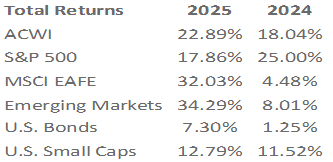
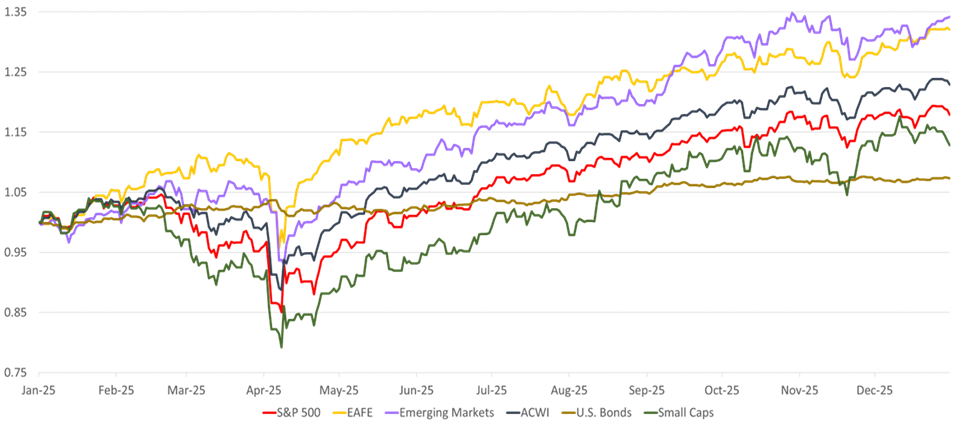
2025 was a year of economic uncertainty and concern, but also of resilience and growth. In this month’s Economic Update, we look back at the issues that dominated our thinking on the economy and financial markets each quarter and then look forward to what we’re focused on in 2026.

Q1: Fear of the Unknown
As the Trump administration in Washington found its footing, expectations for global trade reform loomed large. In Q1, our attention was on the impact that tariffs could have on inflation and economic growth, and how the unpredictability of outcomes could spook the financial markets.

A reactionary massive surge in imports contributed to a contraction in GDP of 0.5% in quarter1. At the same time, inflation remained elevated, leading the Fed to keep its restrictive monetary policy in place. In this uncertain environment, the US stock market struggled for direction as investors feared that recession, or even stagflation, might be on the horizon. By quarter’s end, volatility had returned to the market, and the S&P 500 had lost 4.3%.

In our March update, we reminded investors of the resilience of American institutions and advised them to remain patient, focusing on long-term goals rather than short-term volatility. This advice would serve them especially well in the quarter to come.

Q2: Liberation Day Selloff and Recovery
The second quarter began with the Liberation Day announcement of sweeping tariffs on America’s trading partners. The size and scope of the tariffs caught investors off guard, resulting in a swift selloff across equity markets, including an 11% decline in the S&P 500.

We pointed out that periods of extreme uncertainty may persist for a time, but they are not permanent, and that markets react favorably once a measure of predictability returns.

The announcement of a three-month “pause” in the tariff rollout signaled such a window of predictability. By the end of the quarter, equity markets had recovered, and the S&P was up nearly 6% YTD.

Q3: Shooting the Messenger and Divergence at the Fed
Tariff risk persisted into the third quarter; however, delayed implementation timelines and constructive progress in trade negotiations helped ease market concerns. In Q3, the Bureau of Labor Statistics revised estimates on job growth downward. The reaction was swift: President Trump fired the head of the BLS, the dollar weakened, and equity markets declined. Though the Fed was divided on the pace of rate cuts, the slowing economic data proved enough to convince them to cut rates by 0.25% in September. Equity markets responded favorably, with the S&P 500 rising by a healthy 7.8% in the quarter.

Q4: Closing Time and K-Shaped Data
The fourth quarter began with the shutdown of the Federal government. While every shutdown is unique, we expected the impact on equities to be modest and temporary, and recommended clients stay the course rather than trading on this news. This was indeed sound advice. Despite becoming the longest shutdown on record, the impact on equity markets was mild.

As economic growth took center stage toward year-end, we brought attention to the distinctive nature of the current K-shaped data, which evidenced a bifurcated mix of “winners and losers” in equity markets, higher vs. lower-income households, and other areas of the economy.

The fourth quarter was a victor lap for patient equity investors. The government reopened, and the Fed committed to a “normalization” path with 0.25% rate cuts in October and December.

Looking Ahead: 2026 Rhymes, but will not Repeat

We believe three trends will play out in 2026:

  1. Steady Fundamentals. The US economy remains resilient, benefitting from pro-growth fiscal policy, healthy corporate balance sheets, and robust consumer spending, with the anticipated 2026 tax rebate likely to provide a modest incremental boost to household consumption and aggregate demand.
  2. (Relative) Rate Stability. We expect monetary policy to normalize with a bias towards slowly lowering rates. Incoming Fed members are likely to be sympathetic to the administration’s preference for lower rates. Compared to the last 6 years, where rates rose from zero to over 5% rapidly and then gradually trickled down, we are entering a period of relative stability. In addition, there is a potential for lower rates regardless of economic trends. Stability and lower rates benefit both companies and investors.
  3. Earnings Expansion 2. Meaningful earnings growth likely won’t be confined to AI stocks and the Magnificent 7 3 in 2026. There is a pronounced shift in earnings expectations toward companies beyond the Magnificent 7. While Mag 7 stocks are still expected to deliver strong earnings growth, the change in year-over-year expectations is modest – only +2% higher in 2026 (+22.7% vs. +22.3% for 2025). By contrast, analyst earnings estimates for the other 493 companies are 33% higher for 2026 than in 2025 (+12.5%vs. +9.4%).

The combination of these three trends points toward a favorable backdrop for investors in 2026. However, we continue to recommend a diversified and flexible portfolio philosophy, rather than chasing last year’s “winners” and shunning last year’s “losers.”

No one could have predicted the events of 2025 that we recapped above, but veteran investors know that every new year holds unexpected twists. As we noted many times throughout 2025, the best maxim for long-term investment success is “Patience and Discipline.”

Capital Markets
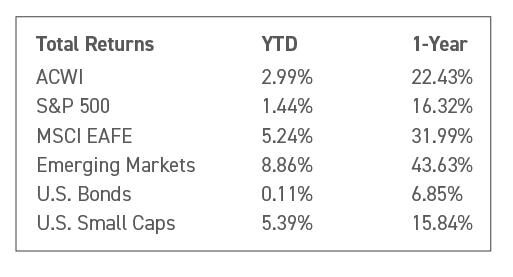
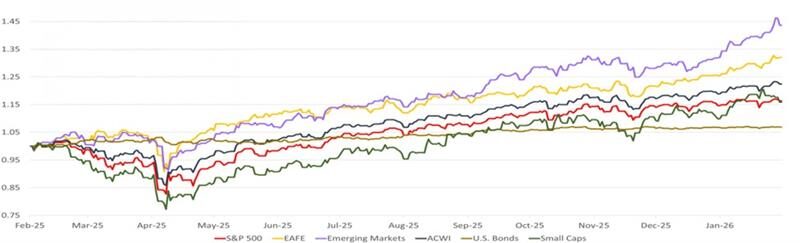
December was a soft month for US investment returns, while overseas equities saw an appreciable rise. The All-Country World Equity Index (ACWI) rose 1%. Both Developed Non-US equities, as measured by the EAFE and Emerging Market Equities, as measured by the MSCI EM Equity Index, rose by 3%. The S&P 500 finished nearly flat for the second month in a row (+0.1%). Likewise, bonds as measured by Bloomberg’s US Aggregate index were nearly flat, declining by 0.2%. US Small Caps declined 0.6% for the month.

Source: Bloomberg. EAFE is MSCI EAFE Index(1), Emerging Markets is MSCI Emerging Markets(2) and U.S. Bonds is Barclays U.S. Aggregate(3). ACWI is the MSCI ACWI Index(4). Small Caps is the Russell 2000 Index(5). S&P 500 is the S&P 500 Index(6). The above information is as of 12/31/2025.


1 Since GDP is a measure of domestic production, imports represent foreign 2 production and thus are subtracted from the GDP calculation as these are already accounted for in domestic spending.

2 Source: FactSet Earnings Insight 12/19/25

3 The Magnificent 7 currently include Nvidia, Apple, Microsoft, Amazon, Alphabet (Google), Meta (Facebook), and Tesla. While Broadcom replaced Tesla as one of the 7 largest stocks in the S&P 500 by market capitalization, Tesla is still commonly included in the Mag 7 group.


This document contains forward-looking statements, predictions and forecasts (“forward-looking statements”) concerning our beliefs and opinions in respect of the future. Forward-looking statements necessarily involve risks and uncertainties, and undue reliance should not be placed on them. There can be no assurance that forward-looking statements will prove to be accurate, and actual results and future events could differ materially from those anticipated in such statements.

ISOs, the AMT, and New Rules in the OBBBA

The One Big Beautiful Bill Act (OBBBA) introduces several tax-law changes that significantly affect how the Alternative Minimum Tax (AMT) applies beginning in 2026. While the law keeps the higher AMT exemption amounts originally introduced under the Tax Cuts and Jobs Act (TCJA), it lowers the income thresholds where the exemption begins to phase out and accelerates the phaseout rate once those thresholds are crossed.

Starting in 2026, the exemption’s phaseout thresholds revert to lower levels than under TCJA: $500,000 for single filers, and $1,000,000 for married (joint) filers, before income-based reduction of the exemption. Simultaneously, the phaseout rate doubles, from 25% under TCJA rules to 50% under the OBBBA.

These changes make the AMT more likely to affect higher-income taxpayers and anyone with large AMT “preference items,” most notably, Incentive Stock Option or “ISO” exercises.

The Impact on ISOs
For people with Incentive Stock Options, the AMT impact becomes particularly important. When you exercise an ISO and hold the shares, the “bargain element” (the difference between the stock’s market value at exercise and your strike price) is not regular taxable income, but it is included in AMT income. Under OBBBA’s tightened phaseout thresholds, this AMT add-on can tip many taxpayers into AMT liability—even those who previously avoided it under TCJA’s more generous rules.

In addition, OBBBA modifies the SALT deduction cap, allowing a higher deduction for many taxpayers. But under the AMT system, SALT deductions are added back, meaning a larger SALT deduction can unintentionally contribute to triggering AMT when combined with ISO exercises.

Because of these changes, many ISO holders may face greater AMT exposure beginning in 2026 than they have before.

What to Do
Everybody’s tax situation is different. But if you are in a high tax bracket and have access to ISOs as part of your compensation, you may include the following as part of your tax plan this year:

Model your AMT exposure before exercising ISOs. Consider front-loading ISO exercises this year rather than waiting, if it also makes sense financially and you can afford any cash outlays or holding risks.

Plan your SALT deduction more carefully. If you live in a high-tax state or expect large state and local taxes, combining that with ISO exercises may magnify AMT risk.

Keep in mind your AMT carryforward credit potential. If you do trigger AMT in a year because of timing (e.g., a big ISO exercise), you might be eligible to recover some of the extra AMT paid in future years via the “minimum tax credit.”

Most importantly, check with your financial and tax advisors if you have both ISOs and large itemized deductions. Ignoring or not fully understanding and planning for the changes to the AMT tax regimen in the OBBBA may subject you to significant additional tax exposure.

If you would like to learn more about ISOs, the AMT, and the OBBBA, please reach out to your Crestwood team. If you are not yet working with Crestwood, please contact us to discuss your individual circumstances.


This document is provided for general informational purposes only by Crestwood Advisors, an investment adviser. Crestwood Advisors does not provide legal advice, and this document should not be construed as containing legal advice. For legal advice, consult with a licensed attorney. This document should not be construed as containing tax advice. For tax advice, consult with your tax adviser.

Life Doesn’t Stand Still. Your Financial Plan Shouldn’t Either.

Life rarely follows a straight path. Careers grow and shift; families evolve, and opportunities appear in ways we cannot always predict. Each moment impacts your financial life, which is why a financial plan cannot be something you build once and leave untouched. It must move with you.

At Crestwood, we view planning as an ongoing conversation between two things. The first is the life you are building, with its goals, responsibilities, and turning points. The second is the financial structure that supports it, from investing and cash flow to tax planning and long-term protection. One defines the direction. The other provides the strategies to reach it. Without clarity around your life, the numbers are incomplete.  Without thoughtful analysis, your goals remain hopes rather than actions.

Transitions are where planning does its best work.
Every major life change requires decisions. Some come from joyful moments like welcoming a child, buying a home, or earning a promotion. Others arrive through challenges such as illness, a shift in family structure, or a sudden change in your work. And then there are the transitions that bring a layer of complexity that people often do not expect.

For example, when compensation begins to include stock, options, or long-term incentives, you may find yourself managing vesting schedules, taxes, and concentration risk. When you own a business and begin thinking about an eventual sale, there is a long list of choices around structure, timing, valuation, and what life will look like after you step away. When you are approaching retirement, the focus shifts from growing assets to creating reliable income, managing taxes over decades, and building a thoughtful legacy plan.

Though these situations look different on the surface, they all share a common theme: every transition touches your financial life, and each one is easier to navigate with a clear plan.

Planning to Meet your Milestones
Below are the types of life events that often trigger the need for planning.

Marriage
Merging two financial systems is an important moment to align values, review tax considerations, update insurance, and ensure beneficiary and estate planning documents reflect your shared priorities.

Birth or Adoption of a Child
New responsibilities come with new challenges and expectations. Planning for education, guardianship choices, insurance updates, and building long-term financial stability all become part of the conversation.

Buying or Renovating a Home
A home changes your balance sheet and your cash flow. It is helpful to revisit housing costs, mortgage structure, property taxes, and the role real estate plays in your long-term plan.

Career Change
A shift in income, benefits, or equity compensation can affect savings goals and tax planning. Reviewing your budget, emergency fund, and employer-sponsored benefits helps keep your plan on track.

Divorce
This transition often requires redefining financial independence. Asset division, new spending patterns, insurance adjustments, and updated estate planning documents become priorities.

Illness or Disability
Health changes can alter both income and expenses. Planning helps prepare through stronger cash reserves, updated insurance coverage, and thoughtful contingency strategies.

Retirement
Moving from earning to drawing from your assets is one of the most significant transitions in your financial life. A detailed plan can help you understand income sustainability, tax-efficient withdrawal strategies, healthcare considerations, and legacy goals.

Unexpected Windfall or Inheritance
A sudden increase in wealth can create opportunity along with new questions. A structured plan helps address tax implications, investment decisions, and long-term alignment with your goals.

A financial plan is not a document; it is a process that moves with you.
Whether you are navigating equity compensation, preparing for the sale of a business, approaching retirement, or simply entering a new season of life, transitions create the need for good decisions. Planning provides clarity, reduces uncertainty, and helps you act with intention instead of reaction.

As you look ahead to the coming year, think about the changes that may be ahead in your own life. Some will be predictable, and others may arrive unexpectedly. A strong plan can help you prepare for both.

If you would like support updating your financial plan or building one for the first time, your Crestwood team is here to help you move into the next stage with confidence.

December 2025 Economic Update: Three Positive Trends for 2026

November saw a convergence of three storms of worry from investors: doubts about the continuing run-up of AI-themed stocks, lack of access to economic data because of the government shutdown, and mixed messages about the Fed’s next move.

While uncertainty will persist, we expect the three trends outlined below to form a durable engine for corporate earnings growth, providing fundamental support for market valuations into 2026.

Trend #1: Economic Resilience and Pro-Growth Fiscal Policy

  • Healthy Corporate Fundamentals: Corporate balance sheets remain generally sound. The confluence of lower financing costs and productivity-driven earnings growth creates a powerful backdrop for sustained profit. As the chart below illustrates, margins have been rising for years, and AI has the potential to further this trend.
  • Wealth Effects and Spending Power: Despite ongoing uncertainty around policies like tariffs and reduced immigration, the consumer remains supported by low unemployment and the wealth effects of rising asset prices. As a result, consumer spending continues to provide a strong floor for corporate revenue expectations.
  • Targeted Fiscal Stimulus: The long-term effects of infrastructure bills and tax cuts from the One Big Beautiful Bill will continue to feed into the economy, promoting targeted investments in key sectors and ensuring U.S. GDP growth remains at or above trend.

Source: Bloomberg. The above information is as of 12/08/2025.

Trend #2 Monetary Policy Normalization: Lower Rates and Valuation Support

The Federal Reserve’s ongoing pivot from a restrictive stance to neutral will be a meaningful tailwind. As inflation pressures ease, the Fed is anticipated to execute further interest rate cuts through 2026, fundamentally altering the calculus for risk assets. The result:

  • Decreased Cost of Capital: Lower rates reduce corporate borrowing costs, supporting both capital investment tied to the AI transition, increased share repurchases and additional M&A activity, all of which support equity valuations. Likewise, lower rates act as a potential tailwind to make consumer borrowing more affordable (lower costs for mortgages, car loans, and credit cards).
  • Lowering the Discount Rate: The Discount Rate is a financial hurdle that a potential investment must exceed to be worth your time and money. This is the opportunity cost for investors choosing a very low risk asset (ex: cash or CDs) versus a higher risk asset with more potential return (ex: equities). Lower interest rates reduce the relative appeal of low risk-assets and support higher stock market valuations.
  • Support for Cyclical Sectors: While financial markets react relatively quickly to lower rates, the impact on the economy takes more time and can lag by 6-12 months. We are just starting to see the boost to rate-sensitive and cyclical sectors of the market that underperformed during the higher rate environment.

Trend #3: The Transition of AI Investment from Hype to Productivity

While the initial waves of AI investment favored companies directly involved in development like semiconductor and cloud infrastructure firms, the 2026 narrative is set to shift toward enterprise adoption and tangible productivity gains.

  • Sustained IT Infrastructure Spending: The build-out of data centers and the proliferation of number-crunching semiconductors is expected to continue at a staggering pace in 2026. While this spending will likely eventually slow, these multi-year projects which are still underway. This monumental capital expenditure acts as an economic stimulus and directly feeds the revenues of the hardware and infrastructure sectors.
  • Operating Leverage Expansion: As publicly traded companies outside the tech sector embed AI into their operations, we expect meaningful gains in operating leverage. Efficiency improvements spanning R&D, supply chains, and customer service should translate directly into higher profit margins.
  • Revaluation Driven by Innovation: The market is likely to reward a broader set of companies that demonstrate clear, measurable Return on Investment (ROI) from their AI investments. This dynamic supports a re-rating of valuations for high-quality firms that translate AI adoption into new revenue streams and improved profitability.

Implications for Investors
Collectively, these three trends suggest a favorable backdrop for investors in 2026. Short-term market movements will continue to be driven by macro data releases, like the whipsaw market reaction to the September revised job report and speculation around Fed rate cuts. However, long-term focus should remain on measured investment in companies positioned to capitalize on the coming productivity boom, supported by a constructive shift in monetary policy. As always, patience and remaining invested for the long-term are the best approaches.

Capital Markets
November was a volatile month for markets as investors fretted over the possibility of the Fed potentially changing course on rates. The All-Country World Equity Index (ACWI) and S&P 500 both finished nearly flat (+0.02% and +0.25% respectively) after a mid-month drop of close to 4%. US Small Cap equities, measured by the Russell 2000, finished up by close to 1% (+0.96%) but saw an even larger intramonth swing, dropping over 6% briefly. International Developed stocks, as measured by the EAFE, were less influenced by US interest rate worries and increased by 0.65%. Emerging market equities reversed course after last month’s strong performance, dropping 2.38% for the month. US bond prices rose 0.62% for the month.

Source: Bloomberg. EAFE is MSCI EAFE Index(1), Emerging Markets is MSCI Emerging Markets(2) and U.S. Bonds is Barclays U.S. Aggregate(3). ACWI is the MSCI ACWI Index(4). Small Caps is the Russell 2000 Index(5). S&P 500 is the S&P 500 Index(6). The above information is as of 11/30/2025.

This document contains forward-looking statements, predictions and forecasts (“forward-looking statements”) concerning our beliefs and opinions in respect of the future. Forward-looking statements necessarily involve risks and uncertainties, and undue reliance should not be placed on them. There can be no assurance that forward-looking statements will prove to be accurate, and actual results and future events could differ materially from those anticipated in such statements.

Consider Gifting Wealth Today

The holidays are the season for giving, so it is the appropriate time to consider the advantages of gifting during your lifetime rather than passing assets to your family upon your death. Lifetime gifts can help manage income taxes, support family members when they need it most, and allow you to witness the impact of your generosity.

The Many Advantages of Lifetime Gifting

Supporting the People You Care About
One of the most meaningful reasons to give during your lifetime is the opportunity to help family members when it matters most. Financial support can make a significant difference during major life events, such as buying a first home, paying for education, starting a business, or navigating unexpected challenges. Giving today allows you to see the impact of your support and strengthen family relationships across generations.

How the Gift and Estate Tax Rules Work
The IRS considers a “gift” to be any transfer of money or property for less than fair market value. This includes cash, securities, real estate, vehicles, or forgiven loans.

Every individual has a lifetime gift and estate tax exemption, which represents the amount you can give during life or leave at death before federal taxes may apply. For 2025, the exemption is $13.99 million per individual (or $27.98 million for married couples). This amount will increase to $15 million per individual in 2026.

In addition, the annual gift tax exclusion allows individuals to give up to $19,000 per recipient without using any of their lifetime exemption. Married couples can combine their exclusions to give $38,000 per person per year, enabling families to transfer meaningful wealth over time.

Families with many children, grandchildren, or loved ones often use the annual exclusion to gradually move assets out of their estate in a tax-efficient way. You can also make direct payments for tuition or medical expenses, which do not count as gifts and do not use any exemption.

Transferring Growth Out of Your Estate
A key benefit of lifetime gifting is the ability to shift future growth to the next generation. When you gift assets, such as stocks, real estate, or closely held business interests, any future appreciation occurs outside your taxable estate.

For example, if you give $1 million of stock today and it later grows to $2 million, all that future appreciation occurs outside of your taxable estate. If you were to keep the stock until death, both the original value and the additional $1 million of growth would be included in your estate for tax purposes.

Income Tax Considerations
Family Gifting:
Lifetime gifting can also create income tax planning opportunities, particularly when the gift involves appreciated investments. For example, transferring stocks or other appreciated assets to family members who are in lower income tax brackets may allow future gains to be taxed at more favorable rates when the assets are eventually sold. This can be a thoughtful way to reduce a family’s overall tax burden while helping the next generation build long-term wealth.

It is also important to understand how cost basis works when gifting. Assets given during your lifetime retain your original cost basis, which means the recipient may owe capital gains tax on the appreciation if they choose to sell. By contrast, assets that pass at death generally receive a step-up in basis, eliminating the unrealized gain at that time. Being aware of these differences can help you decide which assets are appropriate for lifetime gifts and which to hold on to for the longer term.

When gifting appreciated stock to children, it is important to consider the kiddie tax. While transferring assets to a child in a lower tax bracket can reduce capital gains taxes, unearned income above a certain threshold, such as dividends, interest, or realized gains, is taxed at the parents’ marginal rate. This can reduce or eliminate the intended tax advantage. Understanding how the kiddie tax works can help determine which family members are best suited to receive appreciated assets and realize gains in the most tax-efficient manner.

Gifts to Charity:
Charitable giving operates under a different set of rules and can be a valuable part of your broader tax and legacy strategy. Donating highly appreciated securities directly to a charity, donor-advised fund, or charitable trust can eliminate capital gains tax on the appreciation and may provide an income tax deduction, depending on your circumstances. This approach allows you to support causes that are meaningful to you while also achieving tax efficiency.

Gifts to charities should be considered separately from family gifting, as the goals, tax treatment, and planning strategies often differ. Your advisor can help determine how charitable giving may complement your overall financial and estate plan.

The Emotional Rewards of Giving
Beyond the financial benefits, lifetime gifting offers something immeasurable: the joy of seeing your generosity support the next generation. Whether it allows a grandchild to graduate without debt or helps a family member find stability during a critical moment, giving can bring deep personal satisfaction. It also creates opportunities to share your values and strengthen family bonds.

The Bottom Line
Lifetime gifting can be a powerful way to support loved ones while also managing your long-term financial and estate planning goals. Because every family’s situation is unique, decisions around gifting should be made in collaboration with your Crestwood team, estate planning attorney, and tax professional.

Reach Out to Crestwood
We help clients and their families make sound decisions for the future, including developing a strategy for gifting. If you are not yet a Crestwood client, please contact us to see how we can help you and your loved ones realize their dreams

Crestwood’s Katherine Sheehan Joins Gary Heldt on the Latest Episode of the Grow Your Business & Grow Your Wealth Podcast

Crestwood’s Katherine M. Sheehan, Managing Director and Wealth Strategist, joined Gary Heldt on the latest episode of the Grow Your Business & Grow Your Wealth podcast to discuss how smart planning protects both your business and your legacy. In the episode, Katherine explains what every entrepreneur should know about estate and succession planning.

Watch the interview here.

November 2025 Economic Update: Everything is K

When you come to a fork in the road, take it.” – Yogi Berra

The term “K-shaped recovery” gained prominence in 2020 during the uneven rebound from the Covid-19 recession. Popularized by economist Peter Atwater, the concept describes how, following an economic downturn, certain economic groups and industry sectors recover rapidly while others stagnate. A K-shaped recovery differs from the more familiar V-shaped recovery (a sharp decline followed by a strong rebound) or U-shaped recovery (a slower return to growth). The K-shape is defined by unequal growth: some “arms” of the economy rise while others continue to fall, creating a pattern that resembles the letter “K.”

In the years since the pandemic, this “K” pattern has persisted, and we currently have a K-shaped economy. Wealth has grown disproportionately among high-income households, large corporations (especially tech and capital-light firms), and asset‐owners, while lower‐income households, small and medium employers, and service-industries reliant on physical presence continue to struggle.

Consumer spending is a primary driver of the U.S. economy and a key indicator of economic growth and illustrates the K-phenomenon. Before the onset of Covid, spending patterns were broadly similar across income groups. However, the chart below illustrates that spending by the highest 20% of earners outpaced that of other groups as we emerged from the pandemic, and the gap continues to widen.

Source: Moody’s

Similarly, a report from October 2024 from the Federal Reserve shows that retail spending of the bottom 80% of Americans, as measured by income, has roughly kept pace with inflation, while the highest 20% of earners have increased their spending by close to 50% in the post-pandemic period!

Source: Hacıoğlu Hoke, Sinem, Leo Feler, and Jack Chylak (2024). “A Better Way of Understanding the US Consumer: Decomposing Retail Sales by Household Income,” FEDS Notes. Washington: Board of Governors of the Federal Reserve System, October 11, 2024, https://doi.org/10.17016/2380-7172.3611.

What’s Driving the K-Shaped Economy?
There are four primary factors driving the K-shaped economy that help to explain the widening disparity between winners and losers among both producers and consumers. These include:

  • The Impact of Technology
    The rapid adoption of artificial intelligence, automation, and digital platforms has accelerated productivity and profitability in key high-tech sectors. Workers and companies equipped to leverage technology are pulling ahead, while those dependent on manual or low-skill labor are being left behind.
  • Uneven Wage and Employment Growth
    The post-pandemic labor market remains divided. High-income professionals in technology, finance, and healthcare enjoy steady job growth and salary increases, while many service-sector and blue-collar workers face stagnant wages or reduced hours. Automation and AI-driven efficiencies have increased productivity while displacing many lower-wage roles.
  • The Unequal Impact of Inflation and Interest Rates
    Inflation and elevated interest rates have widened the gap between economic winners and losers. Wealthier households with greater savings and investment portfolios can absorb higher prices and even benefit from rising interest income. Meanwhile, lower-income families, who spend a higher share of income on essentials like food, energy, and rent, feel the strain. Rising credit card balances and delinquency rates show how unevenly these costs are distributed.
  • Asset Price Divergence aka “The Wealth Effect”
    Financial markets have surged over the past two years. Homeowners and investors have seen their wealth grow as real estate and stock values appreciate. In contrast, renters, and those without substantial assets, have missed out on these wealth effects, widening the financial gap between households.

Implications for Investors
Aggregate metrics like GDP growth, corporate profits and stock market indices reflect activity as a whole rather than how each segment is faring. Overall, the U.S. economy appears healthy. But underneath the surface there is deep inequality, fragility in many out-of-favor sectors, and risks that reflect an asymmetric weakness in the economy.

For investors, the K-shaped economy creates both opportunities and risks, as returns will vary sharply across sectors and industries.

Sector Divergence Reflects “Two Economies”
In 2025, stock market performance mirrors the same K-shaped pattern. Technology stocks related to AI have soared while consumer staples and other sectors lagged.

According to S&P sector data through the end of October:

  • The Upper-Arm of the K Leaders: The Technology sector saw a total return of +29.9% and the Communications sector +26.8%, fueled by corporate investment in AI, automation and productivity tools. The Industrial and Utility sectors saw a rise of +18.9% and +20.2%, respectively.
  • The Lower-Arm Laggards: By contrast, all other sectors saw single-digit returns: the Financial sector (+9.6%), Consumer Discretionary sector (+7.8%), Healthcare sector (+6.3%), Energy sector (+5.8%), Materials sector (+3.8%), Real Estate sector (nearly flat at +0.2%).

Source: Standard and Poor’s

Rising Inequality Alters Market Dynamics
As wealth becomes more concentrated, stock market participation increasingly reflects the spending and investment behavior of affluent households. Gains in financial markets boost high-income spending, which supports certain sectors, while the rest of the economy remains subdued. For investors, paying close attention to demographic and income-driven consumption trends is more important than ever.

Defensive Positioning for Uneven Growth
In a K-shaped environment, diversification across economic segments becomes crucial. Investors should favor companies with pricing power, strong balance sheets, and exposure to higher-income consumers. Long-time readers will note that the first two criteria are also hallmarks of Quality-focused investing, which we have frequently advocated.

The K-shape is becoming a defining feature of the modern U.S. economy. For investors, understanding this divergence is essential to navigating risk and identifying opportunity as the winners in 2025 likely will continue to be firms that cater to higher-income consumers and those that best leverage technology and maintain pricing power.

Capital Markets
Following on the recent pattern of market rises after each rate cut, once again all boats rose with the tide in October. The All-Country World Equity Index (ACWI) and S&P 500 both rose 2.3%. US Small Cap equities, measured by the Russell 2000, gained 1.8%. International Developed stocks, as measured by the EAFE, increased by 1.2%. Emerging market equities had another strong month, surging 4.2% Not to be left out, US bond prices rose 0.6% for the month.

Source: Bloomberg. EAFE is MSCI EAFE Index(1), Emerging Markets is MSCI Emerging Markets(2) and U.S. Bonds is Barclays U.S. Aggregate(3). ACWI is the MSCI ACWI Index(4). Small Caps is the Russell 2000 Index(5). S&P 500 is the S&P 500 Index(6). The above information is as of 10/31/2025.

Cybersecurity During the Holidays

With the holidays fast approaching, many people are getting ready to visit family, take a long-awaited vacation, and shop for gifts. However, the hustle and bustle of the season can also increase your exposure to cyber threats, as hackers seize opportunities to exploit heightened online activity.

Here are some suggestions that can help protect you and your data and keep you cybersafe:

Strengthen Your Login Credentials
When logging in to your online accounts, the following  methods can be effective in defending yourself against a data breach:

  • Use long passwords or passphrases. Make your passwords at least 15 characters long, focusing on something memorable but difficult to guess. Length matters more than complexity, although many websites do require a mix of upper-case and lower-case letters, numbers, and symbols.
  • Update your password if it’s been compromised. While you don’t need to change your passwords routinely, you can use a trusted tool, such as “Have I Been Pwned,” to check your passwords against known data breaches.
  • Use a unique password for every account. Never reuse passwords. A password manager app can safely generate and store them for you, so you don’t need to keep track.
  • Enable multi-factor authentication (MFA) wherever possible. This provides an extra layer of protection by utilizing additional authentication methods such as a code sent via text or email, an authenticator app, or a security question.

Think Before You Share
Be mindful about what you and your family post on social media, especially when you travel.

  • Wait until your trip is over to post vacation photos. By sharing real-time updates about your location, you may inadvertently alert criminals that your home is unattended.
  • Be cautious about sharing personal information, including audio or video content. Hackers are increasingly using AI tools to create convincing fake content to execute phishing and other scams.
  • Take time to review your network, remove unfamiliar connections, and adjust your privacy settings to control who can see your posts.

Use Secure Connections
When you’re in a public location, such as an airport or cafe, using unsecured Wi-Fi can make your information vulnerable.

  • Use a virtual private network (VPN) to encrypt your data, particularly to execute financial transactions or access sensitive data.
  • When in doubt, use your mobile data connection, which is typically safer.
  • Regularly update your devices with the latest software and security patches.

Shop Online with Caution
As online shopping surges during the holidays, cybercriminals gear up to take advantage – for example, setting up fake e-commerce websites designed to steal your personal and financial information.

  • Make sure you shop trusted retailers by typing their URL directly into your browser rather than clicking the link in a promotional email.
  • Ensure the websites you visit use secure encryption (URL should include “https”).
  • Use a credit card that offers buyer protection.
  • Review your statements for suspicious charges.
  • Reconsider storing your payment information on the retailer’s site which can expose you to greater risk should the company suffer a data breach.

Lock Your Digital Wallet
While digital wallets offer a convenient method for making purchases, they also present risks should you lose your phone.

  • Lock your phone and/or your wallet, requiring a face scan, fingerprint, or password to access your account.
  • Enable the “find my phone” feature as well as transaction alerts so you receive purchase notifications.
  • Carefully review your statement to ensure there are no fraudulent charges.

Beware of Skimming
Criminals can also steal your data using skimming devices secretly installed in ATM machines, point-of-sale terminals, and fuel pumps.

  • Choose a gas pump or point-of-sale terminal in view of an attendant and an ATM in a well-lit, high-traffic location inside a business or bank branch.
  • When it’s an option, tap to pay instead of inserting your card into the reader.
  • Look for signs of tampering, such as a loose or damaged keypad or card reader.

Enjoy the Holidays, Safely
Taking a few simple precautions can go a long way toward protecting your data and giving you peace of mind so you can focus your attention on enjoying friends, family, and some well-deserved rest.

If you have concerns about your financial security, don’t hesitate to contact your Crestwood team for guidance. Not yet a Crestwood client? Please reach out to contact us. We are here to help.


Source: National Institute of Standards and Technology U.S. Department of Commerce. (2025, August 20). How Do I Create a Good Password? And what else can I do to secure my online accounts? https://www.nist.gov/cybersecurity/how-do-i-create-good-password

This document is provided for general informational purposes only by Crestwood Advisors, an investment adviser. Crestwood Advisors does not endorse, sponsor, or promote any of the products or companies listed or mentioned in this material. Any references to specific products or services are purely incidental and are included solely to illustrate potential strategies or concepts. The inclusion of such references does not imply any form of partnership, relationship, or approval by the Firm.