Financial Advisors Adapting New Business Models for Millennials: How younger advisors can teach older advisors a thing or two about millennial finances

Financial Advisors Adapting New Business Models for Millennials:

Move over baby boomers because in 2019 millennials surpassed you by becoming the largest generation in the United States. With this generation’s increase of financial inheritance compared to the previous generation, financial advisors need to adapt new business models to attract and retain younger clients.

One suggestion is that advisors should consider a subscription fee schedule. “Create a model based on an annual fee, monthly fee or percentage of income,” says Billy Spencer, a wealth planner at Crestwood Advisors.

Click to read more from Financial Advisor here.

Year of the Tiger: End with a Roar!

Year of the Tiger: End with a Roar!

2022 Planning Opportunities

So far, 2022, which is the Chinese Year of the Tiger, has been a tumultuous and eventful year full of change! We are likely to continue to experience significant volatility as the Fed continues to raise interest rates in hopes of curtailing inflation, and there remains a hefty amount of uncertainty in the economy, the markets, and the world.

As we approach the end of the year, this can be a good time to take stock and be courageous and assertive regarding your current financial picture and long-term life goals.

Here are a few considerations:

Capital Gains and Losses
Where appropriate, we are working to take advantage of tax optimization strategies within your portfolios, as we do throughout the year, including tax-loss harvesting strategies. Additionally, holdings with large gains, including legacy stock, are often good candidates for charitable contributions.

Roth IRA Conversions
If you plan to do a Roth IRA conversion, the transfer will need to take place by the end of the year. A Roth conversion transforms all or part of a Traditional IRA into a Roth IRA. The amount converted is taxed in the year of the conversion as ordinary Income. The benefit is that this allows the Roth assets to avoid future federal taxes on distributions. If you can afford the tax now (using outside assets) and your income situation makes sense, this can be a powerful long-term strategy.

An additional benefit of Roth IRAs is there are no RMDs (Required Minimum Distributions), making these particularly appealing for investors with long horizons.

Backdoor Roth IRAs
“Backdoor” Roth IRAs are still appealing to high earners who are prohibited from contributing to Roth IRAs and do not have traditional IRAs. They can use after-tax dollars to create a Traditional IRA and convert it to a Roth IRA with minimal or no tax consequences.

Employer Retirement Plans and HSAs
You may wish to double-check on your 401(k) and HSA at work to see if you are contributing the maximum amount allowed by the IRS.

• For 2022 the maximum employee 401(k) contribution is $20,500, with an additional $6,500 “catch-up” allowed if you are age 50 or older by the end of the year.

• If you are covered by a High Deductible Health Plan (HDHP) and have access to contribute to a Health Savings Account (HSA), you can contribute pre-tax dollars which can then be used tax-free to pay for qualified medical expenses in the future (near or long term). HSA funds can also be used to pay for long-term care policy premiums, COBRA coverage, health care coverage while unemployed, Medicare premiums, or other health coverage once age 65 or older. If you do not need the money for health-related expenses, after age 65 the funds can be withdrawn just like an IRA where you pay ordinary Income tax.

Family Gifting and Estate Tax Planning
The annual gift tax exclusion for 2022 is $16,000 per individual and $32,000 for married couples per recipient. There is still no limit to the number of recipients each year.

Direct payment of tuition or medical bills is not subject to the annual exclusion limit if made to the institution. As an example, a married couple could give $32,000 to one child without owing any gift tax on the transfer or reducing their lifetime exclusion amount. Family gifting can be used as an estate planning tool to reduce the estate annually by gifting to children, grandchildren, and others.

The federal lifetime estate tax exemption is over $12.06 million per person for 2022 ($24.12 million for a married couple). It is important to note that this exemption is expected to sunset in 2025, so we remain in an attractive window to take advantage before the exemption drops to $5 million per individual (plus an adjustment for inflation) in 2026.

For families who may have to contend with estate taxes, a wide variety of trusts and tax planning techniques are available, including:
CLATS (Charitable Lead Annuity Trusts) grant a charitable income tax deduction combined with a tax-efficient way to transfer assets to the next generation.
Dynasty Trusts shield assets for multiple generations from creditors, divorce claims, as well as future estate tax rate increases.
GRATS (Grantor Retained Annuity Trusts) allow the individual to pass appreciation of an asset to the next generation while retaining control of the principal.
ILITs (Irrevocable Life Insurance Trusts) protect life insurance proceeds from estate taxes.
Lifetime QTIPs (Qualified Terminable Interest Properties) allow an individual to leave assets for a surviving spouse and determine how the remaining assets are distributed after the survivor dies.
SLATs (Spousal Lifetime Access Trusts) protect assets from future estate taxes while allowing the spouse to have access during their lifetime.

Charitable Giving
Gifts to qualified charities are a great way to benefit the causes you believe in as well as reduce your tax liabilities. The choice of whether to give cash or securities should be made in combination with your Crestwood advisory team as well as your tax advisor.

Donor Advised Funds (DAF) may be more advantageous than traditional gifting strategies, depending on your circumstances. For investors facing a particularly large tax year due, a DAF allows them to “super-size” multiple years’ worth of gifts into a single tax year for a larger tax deduction while allowing the donor the flexibility to make distributions to charitable causes at their discretion over multiple years.

Charitable individuals with Traditional IRAs have another avenue for tax-efficient gifting of up to $100,000 per individual. Qualified Charitable Distributions (QCDs) are a tax-free distribution directly from your IRA to a qualified charity if you are age 70.5 or older. As an additional benefit, a QCD can be used to satisfy your Required Minimum Distribution (RMD) for the year.

A Time for Resilience
As the Year of the Tiger begins its final stretch, let us know if you have any questions about how these topics affect your family’s financial situation.

Have you moved to a new state, had a new grandchild, or have any other major changes taken place that your planning team should be aware of as we near 2023?

The tiger also represents natural leadership which can be reflected on your end and ours as we work together to stay ahead of important planning opportunities and challenges.

Your team at Crestwood is available and ready to assist you, so please do not hesitate to reach out to us. Let’s go out with a roar!

Crestwood Advisors Recognized on Inaugural Forbes/Shook Top 100 RIA Firms List 2022

forbes top 100 shook

FOR IMMEDIATE RELEASE

Boston advisory firm continues year of growth with prestigious national accolade

Boston, Mass. (October 27, 2022) – Crestwood Advisors (“Crestwood”), a boutique investment advisory and wealth management firm based in Boston, is pleased to announce it has been named to the inaugural Forbes/Shook Top RIA Firms list of the top 100 firms in the nation, ranking at No. 57.

This is the second national list Crestwood has made this fall. In September, the firm was ranked No. 93 on the prestigious Barron’s 2022 Top 100 RIA Firms list.

As a growing advisory firm committed to client success, Crestwood’s nearly 50 financial planning and investment professionals across New England strive to meet clients wherever they are in life, providing guidance, tools and financial solutions to help individuals and families succeed.

“It is an honor to be included in this inaugural Forbes list,” said Crestwood CEO/Managing Partner Michael Eckton. “It confirms what we already know – that the dedication to quality client services by our team of seasoned professionals is a recipe for ongoing success. We are grateful every day for their hard work and the personalized approach they take to managing our clients’ investments.”

This first Forbes/Shook Top RIA list represents firms with assets totaling $730 billion. It was created by Shook Research using quantitative and qualitative data to determine the rankings.

The full methodology can be found here.

Please see Crestwood Advisors important disclosures regarding awards and recognition’s here.


Crestwood CIO discusses market outlook on TD Ameritrade Network

Crestwood CIO discusses market outlook on TD Ameritrade Network

Why is it good to be bullish, believing prices will rise, when the majority are bearish, believing prices will fall?


“There are two important indicators this week: the job openings survey and the September job report. Job growth cooling would show Federal Reserve policies are taking hold. The percentage of bearish individual investors has jumped over 60%. History says it is good to be bullish when the majority are bearish,” John Ingram, Chief Investment Officer, Partner, told Oliver Renick on TD Ameritrade Network’s Market on Close.


Click to watch the interview here.

Crestwood Co-Founders talk team career paths on RIA Podcast

Crestwood Co-Founders talk team career paths on RIA Podcast

John Morris and Michael Eckton, Co-founders of Crestwood Advisors, spoke on Seth Greene’s podcast, The RIA Podcast, about the importance of team culture and ensuring client satisfaction with their financial goals at Crestwood. “We aim to deliver optimal excellent experiences for the clients that we serve so they can then share that experience with other people,” said Morris.


Listen to the full podcast here.

Crestwood Wealth Planner Gives Advice to Young Advisors Entering the Industry with Financial Advisor

Crestwood Wealth Planner Gives Advice to Young Advisors Entering the Industry with Financial Advisor

FA-IQ reached out to advisors to ask: What’s a piece of advice you have for young advisors entering the industry?

“Join a firm that genuinely cares about its clients! You’ll learn more, become a better advisor, and probably have more fun while doing so,” said Luke Neumann, a wealth planner at Crestwood Advisors.

Read the full article now to find out more about Luke’s advice for young advisors!

Financial Advisor IQ

Crestwood Advisors Ranked No. 93 in Barron’s Top 100 RIA Firms List 2022

barrons 2022 top ria ranking

FOR IMMEDIATE RELEASE

Boston advisory firm caps year of growth with prestigious national accolade

Boston, Mass. (September 20, 2022) – Crestwood Advisors (“Crestwood”), a boutique investment advisory and wealth management firm based in Boston, is thrilled to announce it has been named to the Barron’s 2022 Top 100 RIA Firms list.

Crestwood ranked No. 93 on the prestigious national list.

This year’s list was Barron’s 7th annual ranking of independent advisory companies. The rankings are based on assets managed by the firms, technology spending, staff diversity, succession planning, and other metrics. The goal of this list is to highlight the nation’s best financial advisors with the intention of raising industry standards.

As a growing advisory firm committed to client success, Crestwood’s nearly 50 financial planning and investment professionals across New England strive to meet clients wherever they are in life, providing guidance, tools and financial solutions to help individuals and families succeed.

“We are beyond excited to make this distinguished national list,” said Crestwood CEO/Managing Partner Michael Eckton. “Such recognition is a testament to the hard work and dedication our team gives to our clients and our business every single day. Our goal is to use this continued success to attract quality professionals and invest in our business so that we may continue to best serve clients and be recognized among the ‘best’ RIAs in the country.”

To read more on the methodology of the award please click here.

Please see Crestwood Advisors important disclosures regarding awards and recognition’s here.

Navigating Inflation

Rising interest rates and recession fears continue to weigh on investors as the Consumer Price Index (CPI) report for August was stubbornly high at 8.3%.  With rising interest rates impacting bond markets, most investors have seen both their equity and bond portfolios lose value.  This environment may remain challenging until there is clarity on inflation as the Fed’s stance is firm that they intend to fight inflation regardless of the consequences to the U.S. economy.

Inflation metastasizes across the economy

Earlier this summer, inflation spiked to 9.1%, a 30-year high, ending a goldilocks period of low interest rates, contained inflation and steady growth. The initial spike in inflation was driven by surging demand for goods aided by stimulus payments to individuals, strong wage growth and rising commodity prices.  Initially, inflation was believed to be transitory and due to supply chain congestion, but as higher prices spread into housing, services and wages, inflation has admittedly become more entrenched across the economy.

The Fed – higher rates

The Fed’s primary tool to combat inflation is raising interest rates which increases borrowing costs for consumers.  Consumers who use credit will see higher costs to buy goods – especially more expensive items like homes and cars.  The Fed anticipates that higher rates will lead consumers to reduce spending and slow aggregate demand which will help to cool out-of-control inflation.  One input, pending home sales for July were down -22.5% year over year as higher interest rates sharply reduced home affordability.

Reducing inflation will take time

As Tuesday’s August CPI showed, the Fed’s battle against inflation will take time. There are three main reasons why we expect inflation to remain stubbornly high:

  1. The U.S. consumer is healthy.  Low debt service ratios, soaring prices for houses, rising wages and generous stimulus payments have helped consumers’ balance sheets and bolstered spending. So far, higher interest rates have had little effect on the U.S. consumer who continues to drive GDP growth.
  2. Sticky components of inflation are high.  Inflation has spread into areas of the economy where prices are slow to change like services, wages, and housing.  In particular, shelter prices (rents) have followed soaring home prices. Shelter is an important component of CPI (32%) and core CPI (40%).  In August’s CPI report, shelter prices increased 6.3% year over year, rising at the fastest rate since 1991. Over the past 20 years shelter has helped to anchor low inflation, now shelter is doing the opposite.
  3. Tight labor markets.  With the U.S. economy running at or near full employment of 3.7% and with job openings at 2x the number of unemployed persons, labor markets are the tightest in post WWII history. It will be challenging for the Fed to slow the economy enough to create the slack needed in the labor markets to cool wage growth. There are some signs that workers who may have left the workforce due to the pandemic are returning to work, but the labor market remains very tight.

Typically, actions by the Federal Reserve take 3-6 months to have an impact on the economy, so we expect to see demand gradually decline as consumers feel an increasing impact of higher interest rates. We expect the Fed to continue to raise interest rates until they see sustained signs of lower prices and some slack in labor markets.  The August CPI number highlights that the Fed has a long way to go to tame inflation.

Recession fears

Our base case remains that U.S. economic growth continues to slow but remains positive year over year.  Considering economists estimate the long-term growth rate of the U.S. economy to be 1.0%-2.5%, the chance a slowdown dips the economy into a recession is higher than normal.  Importantly, a deep recession similar to the Global Financial Crises in 2008/2009 is unlikely.  Consumers remain in great financial shape with lower debt service and higher household wealth.  Similarly, banks who sailed through the pandemic are much better prepared for any downturn.  We expect any recession would be a shallow one.

Russia rankles Europe

In response to sanctions for their invasion of Ukraine, Russia has sharply restricted natural gas flowing to Europe.  Germany is particularly vulnerable as before the war 55% of Germany’s consumption of natural gas came from Russia.  In anticipation of higher winter demands, Germany has been building natural gas storage, curtailing consumption, and switching to other sources for electrical generation.  Uncertainty runs high as no one can predict Russia’s actions, but a prolonged shutoff could affect GDP growth as gas will need to be rationed.

Positioning

We continue to focus on quality for both fixed income and equity investments. For fixed income investors, we have built an allocation to short-duration, high-quality bonds to protect from rising interest rates and credit concerns.  Shortening duration has been important to help offset falling prices as interest rates have risen sharply this year.  Investors have favored high quality bonds over lower quality bonds as slowing economic growth and higher borrowing costs may stress some issuers.

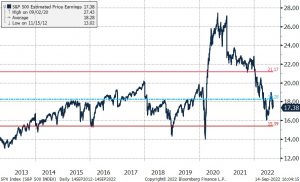
In the U.S. stock market, we remain focused on quality companies with solid growth prospects.  Earnings growth has been solid as the S&P 500 index posted 6.2% earnings growth in the second quarter. With the S&P 500 down -16.1% YTD, market valuations have improved dramatically. The below chart shows the forward price to earnings multiple (a measure of how much stocks cost), has fallen from 22.8x at the beginning of the year to 17.4 which is just below the 10-year average of 17.8.

We remain underweight international equities and defensively positioned in European equities.  Though the energy crisis and war in Ukraine are concerns, European earnings have held up relatively well and are helped by the U.S. Dollar strength.

We continue to be patient and opportunistic as we evaluate companies and make portfolio adjustments. To that end, we have added several new investments in strong businesses that now offer compelling valuations. Additionally, your position in short term bonds, including U.S. Treasuries, offers an attractive yield, high degree of safety and a source of potential liquidity. Finally, while incurring losses is never our goal, the volatility & weakness throughout 2022 has provided us opportunities to focus on new opportunities and tax-loss harvesting across taxable portfolios.

Times like these are never easy as an investor; however, historically, these volatile periods present opportunities to long term investors. As always, we caution against reacting to short-term volatility and encourage sticking with well-considered, long-term investment plans.

Crestwood Advisors Welcomes New Portfolio Manager, Wealth Advisor in Connecticut

Crestwood Advisors Welcomes New Portfolio Manager, Wealth Advisor in Connecticut

FOR IMMEDIATE RELEASE

Boutique RIA firm experiencing continued team growth in Fairfield County

Boston, Mass. (August 30, 2022) – Crestwood Advisors (“Crestwood”), a boutique investment advisory and wealth management firm based in Boston, today announced the growth of its Connecticut teams with the recent additions of Alexandra Blake and Jason Hendricks.

Alexandra Blake | Alex joins Crestwood as Director, Wealth Advisor. She brings more than 12 years of experience helping high-net-worth families develop customized asset allocations, wealth planning and strategic investment recommendations. She previously served as a Director at Next Capital Management and a Vice President at BBR Partners, where she provided investment and wealth management advice to multi-generational families. Alex has an undergraduate degree from Lehigh University and a master’s degree from Columbia University.

Jason Hendricks, CFP®, CSRIC™| Jay joins Crestwood as a Portfolio Manager. He brings over 16 years of financial experience as an advisor and portfolio manager in Connecticut. Before joining Crestwood, Jay spent 14 years as a Senior Portfolio Manager at Bank of America Private Bank, formerly U.S. Trust, where he consistently ranked among the top portfolio managers in Fairfield County for the last decade. He graduated from Vassar College with a degree in psychology and is currently pursuing his Chartered Financial Consultant® credential.

As a growing advisory firm committed to client success, our nearly 50 financial planning and investment professionals across New England strive to meet clients wherever they are in life, providing guidance, tools and financial solutions to help individuals and families succeed.

Since the start of 2021, the Crestwood team has expanded by nearly 20 percent, which has played a key role in supporting new client growth in the local market with best-in-class services guided by decades of experience, integrity and wisdom.

“We are thrilled to welcome Alex and Jay to our growing team,” said Crestwood CEO/Managing Partner Michael Eckton. “With their unique industry experiences and perspectives, we’re confident they’ll not only go above and beyond to address our clients’ financial goals but also add depth to the experiences and relationships of current clients while enabling us to comfortably absorb continued growth of new clients.”