Helping the Next Generation of Women Succeed

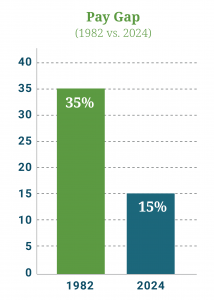
Despite significant progress in closing the gender pay gap, women have not yet achieved full equality. This year, Equal Pay Day falls on March 25th, signifying how far into the new year women have to work, on average, to earn what men had by the end of the year.

Pay Gap (1982 vs. 2024)1
Although the gap has narrowed, it still exists. If you have a daughter, granddaughter, or other young women in your life, here are some ways to help give them an edge.

  1. Teach Them to Negotiate

Negotiation is a powerful tool. Women who advocate for themselves can secure higher salaries, better benefits, and advance their career opportunities. Strategies for negotiation can include:

  • Research market salaries using platforms like LinkedIn, Glassdoor, as well as professional networks to understand fair compensation. Many employers expect applicants to negotiate, yet only 32% of men and 28% of women do.2
  • Demonstrate their worth by highlighting achievements, skills, and experiences that add value to an employer.
  • Remember to request benefits, such as professional memberships and educational reimbursements, which can further enhance their careers.
  • Choose employers wisely by seeking companies with strong diversity initiatives and a track record of supporting women.
  1. Discuss Career Choices Early

Throughout their lives, women face important career and life decisions — being informed will enable them to make the choices that align with their personal and financial goals. For example, according to a McKinsey study, men and women often have divergent career trajectories which contribute significantly to the wage gap. Even today, more women than men leave the workforce to be family caregivers or choose jobs that offer greater flexibility and fewer demands but often lower pay. This can result in fewer promotions and raises with a compounded impact adding up to about $500,000 dollars over a 30-year career.3 Encourage the young women in your lives to thoughtfully consider these factors and develop a plan that supports their long-term goals.

  1. Be a Changemaker

If you are a business owner, executive, or leader, you have the power to create an inclusive workplace. Support gender pay equity by:

  • Advocating for transparent salary practices.
  • Investing in mentorship and career development programs for women.
  • Fostering a culture where women feel valued and empowered.

At Crestwood, we believe in taking meaningful action toward gender equity. As an early signer of the 100% Talent Compact with the Boston Women’s Workforce Council, we are committed to closing gender and racial wage gaps. Through this initiative, we actively support policies and practices that drive workplace equity. Learn more about this initiative here.

Shaping the Future

Academic success equips young women with knowledge, but navigating their career paths and financial futures requires additional guidance. As parents, grandparents, and mentors, we can teach the next generation the art of managing their life journeys — and how to mind the pay gap.

For further assistance and information on guiding your children along their wealth journey, please reach out to your Crestwood team.


Sources:
1Gender pay gap in U.S. has narrowed slightly over 2 decades, Pew Research Center, March 4, 2025
2 When negotiating starting salaries, most U.S. women and men don’t ask for higher pay, Pew Research Center, April 5, 2023
3Tough trade-offs: How time and career choices shape the gender pay gap, Anu Madgavkar, Kweilin Ellingrud, Sven Smit, Chris Bradley, Olivia White, and Kanmani Chockalingam, McKinsey Global Institute, February, 2025

Who Are You Working For?

In their 1966 hit album, Revolver, the Beatles cautioned that the “Taxman” tries to take it all. We may not sing as well as the Beatles, but if you don’t want to pay more taxes than you need to, Crestwood Advisors can help.

At Crestwood, we take a holistic view of your tax situation – past, present, and future – to help you keep more of what you earn. We’ll work with you to create a tax strategy that is personalized to you and your family, considering all personal and professional factors and any changes that may lie ahead. Taxes can take a big bite out of your earnings; your team at Crestwood will recommend strategies to help manage how large of a bite, including:

Tax-Loss Harvesting

Many individuals have heard about tax-loss harvesting – the practice of selling assets that have declined in value in order to “harvest” a capital loss. This loss can be used to offset capital gains on the sale of assets that have appreciated in value since their purchase. For example, suppose you’re preparing to sell your home before moving to a warmer climate for retirement, and you expect to make a substantial profit on the sale. If you also hold an investment that has declined in value, selling those underperforming securities can create a capital loss. You can then use this loss to help reduce the taxable gain you’ll owe on your home.

In this scenario, you might even use the proceeds from selling the underperforming investments toward your new property purchase. While some firms only pursue tax-loss harvesting at the end of the year, at Crestwood, we look for these opportunities throughout the year to help manage your tax liabilities.

Philanthropic Strategies

Your approach to charitable giving can significantly impact your taxes. While many people simply write a check, that may not be the most strategic option—for you or for the organizations you support. For example, donating appreciated securities allows charitable recipients to benefit from the higher value of your gift while protecting you from capital gains taxes. Alternatively, giving through structures such as a donor-advised funds (DAFs) can give you additional flexibility: you can take a tax deduction in a high-income year and decide later which specific causes you want to support.

Before making any recommendations on when and how much to give, we evaluate both your current and projected tax situation to identify the most beneficial approach. In some cases, consolidating your donations into a single year may be advantageous, while in others, spreading out contributions might make more sense. By tailoring your plan, we aim to maximize the impact of your gifts while aligning with your financial and philanthropic goals.

Required Minimum Distribution (RMD) Planning

The tax consequences of RMDs can take recipients by surprise, often placing them in a higher tax bracket than expected. We factor the impact of RMDs into your entire tax strategy, thinking about timing and the best way to take your distributions. Assuming you meet the eligibility requirements, you may want to use your RMD to make a Qualified Charitable Distribution (QCD). A QCD is not subject to taxation and does not count toward your maximum charitable deduction if you are itemizing your deductions. So, if you always make an annual donation to a cherished cause, a QCD can be an effective way to give.

Looking Forward to Retirement

When retirement is on the horizon, we’ll incorporate your anticipated change in income into your plan. This may mean delaying distributions from retirement accounts or executive compensation to the future, where possible, when you may be in a lower tax bracket. We’ll also help you manage your Income-Related Monthly Adjustment Amount (IRMAA) to potentially minimize the premium you pay on Medicare Parts B and D based on your Modified Adjusted Gross Income (MAGI). We will also explore your current retirement accounts and whether a Roth conversion might be beneficial.

We may also recommend a Roth conversion in which part or all of a traditional IRA or 401(k) is converted to a Roth IRA. Although the amount you convert is taxed as ordinary income in the conversion year, future account growth and distributions are free from Federal taxes.

Contact Crestwood

At Crestwood, we are committed to helping you achieve your financial goals. We encourage you to reach out to let us know about life changes you foresee or when they happen, so that we can adjust your tax strategy and address your evolving needs. We stand ready to work with your outside accounting, legal, and other experts to coordinate your strategy and help ensure that you get integrated advice and guidance to help grow and preserve your wealth.

If you have any questions about tax optimization, please reach out to your advisory team. And if you are not yet working with Crestwood, please contact us to start a conversation.

This document is provided for general informational purposes only by Crestwood Advisors, an investment adviser. Crestwood Advisors does not provide legal advice, and this document should not be construed as containing legal advice. For legal advice, consult with a licensed attorney. This document should not be construed as containing tax advice. For tax advice, consult with your tax adviser.

Are you up to date on the Social Security Fairness Act?

On January 5, 2025, the Social Security Fairness Act (Act) was signed into law. The Act eliminates the Windfall Elimination Provision (WEP) and Government Pension Offset (GPO), which negatively impacted the Social Security benefits for many individuals who received pensions on work for which they did not pay Social Security taxes and, therefore, was not covered by Social Security. Many of these retirees also received public pensions.

What this Might Mean for You

If your benefits were reduced due to WEP and GPO, you may be eligible for the following: 

Retroactive Payments: You may receive a one-time lump sum covering the benefits lost between January 2024 and December 2024. The Social Security Administration (SSA) has announced that most retroactive payments should be distributed by the end of March 2025. In order to receive your benefits, please double check that you have the correct direct deposit information or address on file with the SSA by logging into your my Social Security Account (if you do not have an account you can set one up there). As always, beware of scams, and anyone asking you to send personal or financial information.

NOTE: If you have filed for spouse’s or widow(er)’s benefits but are not receiving any monthly benefits due to GPO, please call the SSA at 1-800-772-1213 to update your direct deposit information.

Filing for Spousal and Survivor Benefits: If you did not file for spousal or survivor benefits knowing that they would be eliminated under the GPO, you may be entitled to Social Security benefits under the Act. However, you must file for benefits in order to receive any benefits for which you are now eligible. If you never applied for retirement or spousal benefits, you can apply online or call 1-800-772-1213. You cannot apply for surviving spouse benefits online, but you can call the SSA at 1-800-772-1213 to apply.


Sources:

Social Security Fairness Act: Planning Considerations For the Repeal Of The Windfall Elimination Provision (WEP) And Government Pension Offset (GPO), Kitces, January 15, 2025

Social Security Fairness Act: Windfall Elimination Provision (WEP and Government Pension Offset (GPO) update, Social Security Administration, updated March 3, 2025

March Economic Update: The Three R’s – Understanding Tariffs Today in a Historical Context

Given the recent volatility in the stock market, investors are left wondering about the potential disruptive effects of tariffs.

Douglas Irwin, a professor at Dartmouth, is a widely recognized as an expert on both historical and contemporary U.S. trade policy. He uses three R’s to summarize the history of tariffs in the US: Revenue, Restriction, and Reciprocity.

Prior to the establishment of federal income taxes, tariffs were used for Revenue. For the last 70 years, tariffs have generated approximately 2% of federal Revenue, but when the US was a pre-industrial society, it accounted for nearly 100%. During the Civil War, the addition of excise taxes on items like liquor, tobacco, and most retail goods helped to generate revenue in addition to tariffs. After the war, the revenue generated from the combination of excise taxes and tariffs created a surplus, allowing the US to pay off the war debt. After reducing government debt, Congress debated ways to increase economic growth by reducing taxes and tariffs.

Congress had two choices: lower the tariff rate, which would make imports cheaper, or raise the tariff rate to make imports so expensive that consumption declines and therefore the amount of revenue generated by tariffs would also decline. William McKinley, who would later become president, was chair of the House Ways and Means Committee in Congress and argued for the latter. Tariffs at these high levels fell in the category of Restriction, referred to as Protectionism at the time, since the goal was to protect domestic production.

In the short run, McKinley’s approach worked: prices rose quickly, and US industry filled in the gap left by foreign producers. The drop in imports reduced tariff revenue and alleviated the problematic surplus in federal revenue. McKinley won the presidency in 1896. He then shifted to using tariffs for the third R: Reciprocity. As part of a tariff package, Congress gave McKinley the authority to reduce tariffs selectively so he could use this as leverage to renegotiate trade agreements. By the end of his first term, economies around the world were beginning to boom and the US was so successful that it needed to expand surplus production to foreign markets. As a result, Protectionism was doing more harm than good.

President McKinley planned to reduce tariffs(1) but he was assassinated in 1901. Vice President Teddy Roosevelt then took office. Roosevelt wasn’t as focused on trade policy, and as a result, it took a decade before tariffs began to decrease after the establishment of the federal income tax system. In the years that followed, Reciprocity became a key bargaining tool, ultimately leading to free trade agreements.

Where are we now?

President Trump has described the goal of higher tariffs as encompassing all three Rs – raising Revenue, Restricting foreign competition, and using them as a tool for Reciprocity in trade negotiations.

This presents a challenge of balancing objectives, as all three cannot be accomplished simultaneously:

• If tariffs are to generate a significant amount of Revenue, they must be set at a modest level to still allow enough foreign goods to come in to be taxed.
• If tariffs are too high, their Restriction will result in a drop-off in consumption and therefore less Revenue.
• However, if tariffs aren’t high enough, the prospect of lowering them won’t provide leverage for trade negotiations, thus limiting the potential for beneficial Reciprocal agreements.

Since modern industrialized economies have supply chains with parts and materials from across the globe, high tariffs have the potential to be much more disruptive than McKinley’s day when the US was a relatively isolated nation. Thus, the confirmation of tariffs on Canada, Mexico, and China taking effect immediately with additional tariffs on other nations to come represents an upheaval of the existing trade environment. Since President Trump has made clear that he favors using tariffs as negotiating tools, it remains unclear how long they will be in place.

The near-term implications are:

  1.  Businesses and investors may feel uncertain about how best to put capital to work. This uncertainty manifests in stock market volatility.
  2. Retaliatory tariffs from affected nations are inevitable.
  3. The immediate outcome will be higher prices for consumers and businesses in countries on both sides of a trade war, along with an increased risk of reinflation.

Historically, equity market volatility has been the norm

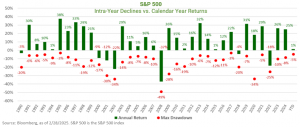
Every calendar year sees periods of market declines. History shows us that volatility is not a predictor of market returns, as illustrated in the chart below. Many of the downturns in the below chart have been caused by economic issues, political crises, wars, debt crises and even a pandemic. At the time, these situations may appear to be lasting disruptions to the US economy, prosperity, and investors’ ability to grow capital. It is difficult to see that short-term dislocations are just that – short-term.

Over time, American institutions have proven to be incredibly resilient and, indeed, the US has been the land of opportunity. As Warren Buffett said, “For 240 years, it’s been a terrible mistake to bet against America.”

The takeaway: Investors should remain patient and disciplined, focusing on long-term goals rather than short-term volatility.

Capital Markets

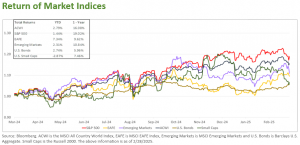
Equity returns in February were mixed. The S&P 500 fell 1.42%, the All-Country World Index (ACWI) declined 0.7%, and the Russell 2000 fared the worst, falling 5.45%. Meanwhile, developed international equities rose by 1.8% and emerging market equities increased by 0.35%. Bonds rose by 2.20%.


This document contains forward-looking statements, predictions and forecasts (“forward-looking statements”) concerning our beliefs and opinions in respect of the future. Forward-looking statements necessarily involve risks and uncertainties, and undue reliance should not be placed on them. There can be no assurance that forward-looking statements will prove to be accurate, and actual results and future events could differ materially from those anticipated in such statements.

(1) McKinley, the self-described “Tariff Man”, gave a speech in 1901 to a large crowd in Buffalo, New York saying “The period of exclusiveness is past. Reciprocity treaties are in harmony with the spirit of the times. Measures of retaliation are not. If perchance, some of our tariffs are no longer needed for revenue or to encourage and protect our industries at home, why should they not be employed to extend and promote our markets abroad?” McKinley assassinated the following day, died shortly after.


Crestwood Advisors Recognized as a 2025 Top RIA by Worth Media Group

BOSTON (March 3, 2025) – Crestwood Advisors (“Crestwood”), a boutique investment advisory and wealth management firm based in Boston with offices in Connecticut and Rhode Island, is proud to announce its inclusion in Worth Media Group’s list of Top Registered Investment Advisory (RIA) Firms for 2025.

This prestigious accolade highlights firms that demonstrate excellence in wealth management, client service, and fiduciary responsibility.

“At Crestwood, we pride ourselves on offering tailored advice and innovative strategies that address the unique needs of our clients,” said Crestwood President and Managing Partner Leah R. Sciabarrasi, CFP®. “Our placement on Worth’s list in 2025 – and in years prior – is a testament to the collaborative efforts and dedication across our entire team.”

Crestwood Advisors is committed to exceeding client expectations by providing holistic wealth management solutions tailored to individual financial goals. Through a fiduciary-driven, team-based approach, the firm offers personalized planning, investment strategies, and estate guidance – grounded in trust, integrity, and continuous learning. By combining deep expertise with empathetic listening and forward-thinking advice, Crestwood helps clients navigate life’s financial journey with confidence.

View the full list of Worth’s Top RIA Firms for 2025 and learn more about the methodology here.

Crestwood did not pay a fee to appear on the published list or to market the award.

###

About Crestwood Advisors
Crestwood Advisors is an independent, fee-only, wealth management firm with approximately $6.7 billion in assets under management as of October 31, 2024. Founded in 2003, Crestwood Advisors provides investment management with financial planning strategies to help high-net-worth individuals and families identify and prioritize their goals and build sustainable wealth so that they may enjoy more financially secure and purposeful lives. For more information, please visit https://www.crestwoodadvisors.com.