Crestwood Advisors Recognized on Annual Forbes/Shook Top RIA List for 2024 for the Third Consecutive Year

Boston-based advisory firm celebrates notable rise in prestigious national ranking

Boston, Mass. (October 8, 2024) – Crestwood Advisors (“Crestwood”), a boutique investment advisory and wealth management firm based in Boston with offices in Connecticut and Rhode Island, is pleased to announce it has been named to the annual Forbes/SHOOK America’s Top RIA Firms list for 2024. The firm climbed 17 spots this year, ranking No. 59, up from No. 76 in 2023.

“We are incredibly proud to be included once again in such a prestigious Forbes ranking of this competitive industry,” said Crestwood CEO/Managing Partner Michael Eckton. “This recognition highlights the dedication and expertise of our team and the trust our loyal clients place in us to deliver exceptional service year after year.”

The Forbes 2024 Top RIA Firms List, developed by SHOOK Research, recognizes the top 250 registered investment advisors (RIAs) in the U.S. based on both qualitative and quantitative factors. The rigorous selection process involves an analysis of key metrics such as revenue trends, assets under management, compliance records, and overall industry experience.

SHOOK Research conducted in-depth interviews with leadership and staff, assessing firms based on leadership, growth and dedication to client service. This year’s evaluation included more than 46,200 nominations, 21,400 telephone interviews and thorough reviews of thousands of RIAs through in-person or virtual meetings. More than 25,000 firms across the U.S. were invited to participate in the ranking process.

In its third year, the Forbes Top RIA list continues to set the standard for evaluating advisory firms across the country. The full methodology for the ranking can be found here.

Crestwood did not pay a fee to appear on the published list or to market the award.

Please view Crestwood Advisors’ list of important disclosures regarding awards and recognitions here.


###

About Crestwood Advisors
Crestwood Advisors is an independent, fee-only, wealth management firm with over $5.7 billion in assets under management. Founded in 2003, Crestwood Advisors provides investment management with financial planning strategies to help high-net-worth individuals and families identify and prioritize their goals and build sustainable wealth so that they may enjoy more financially secure and purposeful lives. For more information, please visit https://www.crestwoodadvisors.com.


Homeowners Insurance Under Pressure

Homeowners across the country face a growing challenge of skyrocketing home insurance costs as natural disasters become more frequent. Whether it’s hurricane season in the southeast or summer wildfires across the northwest many homeowners are questioning if they can afford the risk, or the rising premiums. While insurance remains essential for some, others are considering alternative approaches to managing these costs. Two prominent figures, Senator Rick Scott and author Suze Orman, offer two starkly different stances on this issue.

Rick Scott’s Homeowner Insurance Deduction Bill
In an effort to ease the financial burden on homeowners, Senator Rick Scott introduced the Homeowner Insurance Deduction Bill in August. This proposed legislation will allow taxpayers to deduct up to $10,000 of their homeowners insurance premiums from federal taxes. Scott’s motivation is clear: with insurance costs climbing due to natural disasters, he hopes this bill will help alleviate the strain on homeowners’ wallets and incentivize them to maintain adequate coverage. His approach is all about balancing affordability with responsibility, ensuring homeowners don’t go unprotected.

Suze Orman’s Bold Move to Drop Homeowners Insurance
On the other hand, Suze Orman has taken a more radical approach. She recently made headlines by announcing that she’s dropped her homeowners insurance altogether, citing the escalating costs as no longer worthwhile for her personal financial strategy. Orman, who has the financial flexibility to self-insure, decided the premiums were a poor investment given her ability to cover potential losses herself. However, she cautions that this path is not for everyone. For those without substantial financial reserves, maintaining some form of insurance is crucial.

Less Drastic Adjustments
There are other ways to reduce costs of insurance while still maintaining coverage. Many homeowners are opting for partial coverage, insuring only against specific risks like fire or hurricanes, instead of paying for comprehensive policies. Another option is increasing deductibles, which lowers premiums but means you’d be responsible for covering more of the costs in the event of a claim. These middle-ground strategies allow homeowners to stay protected while controlling the rising expense of insurance.

What Should Homeowners Consider?
These contrasting strategies highlight the wide range of options homeowners should consider when dealing with rising insurance costs. Whether you lean toward maintaining full coverage or exploring alternatives, it’s essential to take a hard look at your personal situation. Here are some key points to think about:

• Risk Exposure: Do you live in a high-risk area for hurricanes, wildfires, or other natural disasters? Cutting coverage could leave you vulnerable to significant losses.
• Financial Cushion: Can you afford to repair or rebuild your home out-of-pocket like Suze Orman? If not, you should purchase homeowners insurance and discuss with your advisor what the best policy is to meet your needs.
• Potential Tax Relief: If Rick Scott’s bill passes, it could offer you up to $10,000 in deductions—potentially making the cost of premiums more manageable.

Ultimately, deciding whether to adjust or even drop homeowners insurance depends on your financial situation, risk tolerance, and long-term goals. What works for one person may not work for another, which is why it’s so important to evaluate your options carefully.

For guidance tailored to your needs, reach out to our team at Crestwood. We are here to help you find the right solution for you and your family.


Crestwood Advisors Makes BBJ’s 2024 List of Largest Independent Investment Advisers in Massachusetts

We are proud to announce Crestwood Advisors has earned a place on the Boston Business Journal’s 2024 list of the “Largest Independent Investment Advisers in Massachusetts,” ranking #16.

“This acknowledgment reflects our team’s unwavering commitment to providing personalized financial strategies that empower our clients to reach their goals,” said Crestwood CEO/Managing Partner Michael Eckton.

To read more on this recognition and the methodology of the ranking click here.

Crestwood Advisors Secures Coveted Spot on Barron’s 2024 Top 100 RIA Firms List

Fast-growing New England advisory moves up to No. 81 in prestigious national ranking, highlighting continued excellence in financial advisory services

Boston, Mass. (September 18, 2024) – Crestwood Advisors (“Crestwood”), a boutique investment advisory and wealth management firm based in Boston and with offices in Connecticut and Rhode Island, is pleased to announce that it has been named once again to the Barron’s 2024 Top 100 RIA Firms list.

This year, the firm has moved up to No. 81, a notable improvement from last year’s ranking of No. 93.

“We are honored to be ranked among Barron’s Top 100 RIA Firms, and even more so to see our advancement this year,” said Crestwood CEO/Managing Partner Michael Eckton. “We recognize that this honor is possible only through the continued partnerships between our incredible clients and dedicated team.”

Each year, Barron’s publishes its Top 100 RIA Firms list, ranking independent advisory companies based on a comprehensive set of criteria. These criteria include assets under management, technology investments, staff diversity, succession planning, and other key metrics.

The full methodology for the Barron’s 100 list can be found here. Crestwood did not pay a fee to appear on the published list.

Please see Crestwood Advisors’ important disclosures regarding awards and recognitions here.


###

About Crestwood Advisors
Crestwood Advisors is an independent, fee-only, wealth management firm with over $5.7 billion in assets under management. Founded in 2003, Crestwood Advisors provides investment management with financial planning strategies to help high-net-worth individuals and families identify and prioritize their goals and build sustainable wealth so that they may enjoy more financially secure and purposeful lives. For more information, please visit https://www.crestwoodadvisors.com.


September Economic Update: All Eyes on the Fed

August began with a pullback in the stock market, with the S&P 500 falling over 6% in the first three trading days and the “Magnificent Seven” stocks dropping nearly 10% in the first week. The selloff was fueled by concerns that the Federal Reserve had been too slow to cut interest rates. The labor market has softened considerably with July’s nonfarm payrolls significantly missing expectations and with June’s figures also revised downward. The unemployment rate in July ticked up to 4.3%, compared to the consensus of 4.1%, sparking discussions that the economy was headed for a hard landing.

Following the July labor report, expectations for a Fed rate cut soared, with the market pricing in a high probability of a 0.5% cut in September given hard landing concerns. The market reaction was further intensified by an unwinding of the yen carry trade, given the divergence between Fed and Bank of Japan policies, after the BoJ unexpectedly raised rates at a time when the US and most other central banks are lowering them.

As we discussed last month, we believe the rise in unemployment in July was likely due to a temporary increase in the labor force and weather-related layoffs. It was therefore unsurprising when the August jobs report, released last week, showed a decrease in the unemployment rate to 4.2%. Additionally, the job market showed signs of stabilizing, with the ratio of job openings to unemployed workers falling to a healthy 1.07, in-line with the pre-pandemic average since 2004.

Last month saw the Fed release the FOMC Minutes from the July meeting which shared insight into where the Fed is most focused. Members concluded that the risks to achieving the Committee’s employment and inflation goals were becoming more balanced, though the economic outlook remained uncertain. They noted that consumer spending had slowed from the strong pace of last year, reflecting restrictive monetary policy, easing labor market conditions, and slowing income growth. Some members also pointed out that lower-and-moderate-income households were facing increasing financial pressures, as seen in rising credit card delinquency rates and a growing number of households paying the minimum due on their balances.

The equity market rebounded and erased the early-month declines as soft landing odds rose over the course of the month and the Fed essentially confirmed it would cut in September as recession risks remain low. Powell said that the upside risks to inflation have diminished, downside risks have cooled, and the Fed was committed to doing everything it could to support a strong labor market.

Skipping Stones: What are the implications of a shift in Fed policy?

We don’t know for certain how the Fed’s actions will unfold, but in his speech at Jackson Hole, Federal Chair Powell made clear that “The time has come for policy to adjust. The direction of travel is clear, and the timing and pace of rate cuts will depend on incoming data, the evolving outlook, and the balance of risks.” We expect the initial result of a lower Fed Funds rate will be modest: a proportionate decline in the yield of money markets, savings accounts, and new Treasury Bills.

Secondary effects will likely take time to manifest. Banks will lower CD rates, and investors seeking yield may shift funds from cash and short term Treasury Bills to bonds with longer maturities which in turn puts downward pressure on yields farther along the curve. Mortgage rates and other loans, which tend to track changes in 5-Year Treasuries, have been falling, albeit slowly. The average rate on the 30-year mortgage is now at 6.7% which is below last year’s peak of 8.1%. Eventually, lower rates could provide a tailwind to consumers who face higher interest costs.

Like a stone thrown into still water, the magnitude of the secondary effects – the splash and the ripples – will be dependent on the size of each rate move and how quickly each subsequent move follows. We believe that a single 0.25% pebble or even a handful of pebbles thrown before the end of the year (such as three 0.25% cuts), would likely cause much less of a disruption than a chunky 0.75% boulder.

Capital Markets

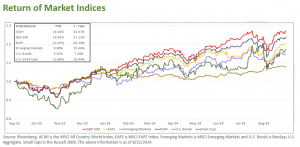
Both equity and fixed income markets rose in August, except for U.S. Small Caps. The All-Country World Index (ACWI) rose +2.57%, the S&P 500 rose +2.43%, while the EAFE rose +3.27%. Small Caps gave back part of July’s 10% surge, falling -1.5% in August. Emerging markets finished with a gain of +1.64%. U.S. Bond prices rose +1.4% for the month.

This document contains forward-looking statements, predictions and forecasts (“forward-looking statements”) concerning our beliefs and opinions in respect of the future. Forward-looking statements necessarily involve risks and uncertainties, and undue reliance should not be placed on them. There can be no assurance that forward-looking statements will prove to be accurate, and actual results and future events could differ materially from those anticipated in such statements.

Managing Director and Wealth Strategist Explores Critical QSBS Planning Strategies with Tax Notes

“Planning opportunities will most certainly be missed if people are unaware of Qualified Small Business Stock (QSBS),” says Managing Director and Wealth Strategist Katherine M. Sheehan, J.D., AEP®, in her recent piece on Tax Notes.

Katie delves into the intricacies of QSBS and outlines key estate, gift and income tax planning opportunities that advisors should know to help clients maximize the benefits of QSBS.

Click here to read the full article.

Director and Wealth Manager Discusses Back-to-School Financial Strategies with InvestmentNews

Summer is coming to an end, which means it’s time for students to head back to school. At Crestwood, we aim to help our clients plan for their children’s future – including how to finance their education.

Crestwood Director and Wealth Manager Billy Spencer, CFP®, CFT-I™, FBS® recently spoke with InvestmentNews on financial strategies and tips we share with clients to help prepare for back-to-school season.

“With the resources that you have, whether that’s through student loans, stipend from parents or earnings from the child working, they can use that awareness around where the money’s going to allocate it well and have it aligned with what they value and what their needs are,” he said.

Click here to read the full article.

August Economic Update: Labor Pains

U.S. stocks started July on a high note bolstered by healthy second quarter earnings. While both equity and fixed income markets rose, sentiment had begun to shift with investors rotating out of growth and stocks as the month went on.

Several recurring themes whittled away at investors’ appetite for risk:

  • Companies reported investing heavily in AI without a corresponding immediate increase in revenue or earnings which called into question the timeline between capex and monetization.
  •  June retail sales data remained healthy, but corporations continued to note signs of deterioration in their earnings calls.
  •  Investors continued to speculate about the presidential race, given early polling suggesting President Biden’s withdrawal and VP Harris’s entrance may have made the contest more challenging for Trump. Markets and corporate boards tend to prefer landslides (more certain outcomes) vs. close calls (less certain outcomes).
    The July Fed meeting ended as expected with no change to rates. Fed Chair Powell noted at the press conference which followed that if the Fed sees the softening economic data it hopes for, a cut could be on the table in September. He acknowledged that the case for rate cuts was strengthened by some weaker labor market and manufacturing data.

Labor Report Startles Investors but it’s Premature to Declare a Recession

The Bureau of Labor Statistics announced that nonfarm payrolls rose 114,00 in July vs. the consensus estimate of 175,000. That shortfall coupled with slight downward revisions to job growth numbers for May and June suggests the economy grew at a slower pace than expected. Of note, a shortfall in payroll growth is not the same as a contraction in payrolls, but nonetheless this spooked investors. In addition, the unemployment rate rose from 4.1% to a still low 4.3%, whereas expectations were for the rate to remain unchanged. While the three-month average of payroll gains was virtually unchanged at 170,000, this was overshadowed by the July headline.

As a result, some economists were quick to claim that based on the July unemployment data the U.S. is already in a recession, pointing to the “Sahm rule”, named after former Fed economist Claudia Sahm. The rule suggests the economy is already in a recession if the three-month average of the unemployment rate rises 0.5% or more above the prior 12-month low of that average.

This speculation propelled an already anxious market into a bout of volatility, particularly in the tech space. Tech leaders like Nvidia which have propelled the market higher by rising over 170% YTD fell over 6% in one day. Likewise, semiconductor stocks like Broadcom, AMD, Qualcomm, Intel and others saw similar drops.

While the Sahm rule does have a strong historical record, Dr. Sahm stated in an interview with CNBC on August 2nd “We are not in a recession now – contrary the historical signal from the Sahm rule – but the momentum is in that direction. A recession is not inevitable and there is substantial scope to reduce interest rates.” She elaborated, saying “The Fed has a big lever still to pull, they have a lot of interest rate cuts they could go through if they need to.” She added “This economy is in a good place – it just needs some pressure taken off it.”.

What Might be Skewing the Numbers?

Workers on temporary layoffs accounted for a startling 70% of the increase in the number of unemployed in July. Yardeni Research Inc points out that according to the Bureau of Labor Statistics household employment survey, 1.54 million workers were either not working or had only part-time employment specifically due to weather in July, a vast increase compared to the 280,000 figure in June. In fact, the July figure was so large that it is one of the top five monthly readings for workers impacted by weather since 2018.

Another factor in the labor data is a surge of individuals joining the work force. Nancy Vanden Houten, Lead U.S. Economist at Oxford Economics states that it’s unlikely we’re in a recession currently as the labor force participation rate among prime age workers increased in July hitting 84% – the highest rate since 2001. This is a sign of strength rather than weakness. She noted “In a recession, individuals are more apt to get discouraged and leave the labor force.”

The Fed has repeatedly stressed that they are watching the data closely and focus on trends, rather than a single data point. This is necessary because monthly data is calculated and then subject to two further revisions while also being subject to wide margins of error. For instance, according to the Bureau of Labor Statistics, from 2021-2023 the Nonfarm Payroll monthly numbers were subject to a total of 108 revisions with 107 of those reviews resulting in different final numbers.

Chicago Fed President Austan Goolsbee pointed out in a CNBC interview on August 5th that the jobs growth number came in 61,000 short of expectations but noted “The payroll jobs number is plus or minus 100,000 a month so be a little careful over-concluding about things in the margin of error.”

What This Means for Investors

We believe the US economy is slowing but this is to be expected and is not a cause for alarm. The decline in the inflation rate as well as the softening labor market both support the case that the Fed is likely to cut rates in the months to come. It’s impossible to predict the pace or exact timing of cuts, however equity markets have historically risen in their wake, thus staying invested remains the best course of action.


Capital Markets

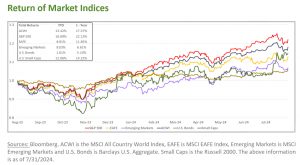
Both equity and fixed income markets rose in July. The All-Country World Index (ACWI) rose +1.6%, the S&P 500 rose +1.2%, while the EAFE rose +2.9%. As we noted last month, there continues to be a wide dispersion both in valuation and performance between large and small cap stocks. Small Caps saw a notable gain, rising +10.2% for the month on hopes for Fed rate cuts to come soon. Emerging markets were the slowest to rise, finishing with a slight gain of +0.4%. U.S. Bond prices rose +2.3% for the month.
Watching the Sunset: Potential Tax Cuts and Jobs Act Planning Considerations

The Tax Cuts and Jobs Act (TCJA) of 2017 significantly changed the U.S. tax code, impacting individuals and businesses. As we approach the potential sunset of many provisions at the end of 2025, high net-worth families must prepare for potential shifts back to pre-TCJA rules. The TCJA lowered income tax rates, doubled the estate tax exemption, and altered various deductions and credits. The expiration of these provisions would revert to higher tax rates and a lower estate tax exemption. In light of this, these areas are worth considering:

Tax rates.  First and foremost, the potential increase in individual income tax rates impacts every taxpayer. The TCJA reduced the top marginal tax rate from 39.6% to 37%. High-earning individuals may need to consider strategies such as accelerating income, utilizing Roth conversions, or harvesting capital gains at lower tax rates.

Deductions.  Changes to the state and local tax (SALT) deduction and personal exemptions would also impact tax planning. The TCJA capped the SALT deduction at $10,000, significantly impacting taxpayers in high-tax states. If this cap is lifted, taxpayers in those states may benefit from increased deductions. Additionally, the return of personal exemptions, eliminated under the TCJA, could provide further tax relief.

Corporate tax rate and qualified business income.  Business owners should prepare for changes in corporate tax rates and deductions. The TCJA reduced the corporate tax rate from 35% to 21%. Pass-through entities that benefited from a 20% deduction on qualified business income (QBI) may also see this deduction disappear.

Estate tax exemptions.  The estate tax exemption stands at $13.61 million per individual in 2024, allowing couples to shield nearly $27.22 million from estate taxes. If the TCJA provisions expire, this exemption would drop to approximately $5 million per individual, adjusted for inflation, to roughly $7 million per person. This would result in more estates subject to the 40% federal tax. High net-worth families should consider strategies such as gifting, utilizing trusts, and other wealth transfer techniques to minimize the potential tax burden on their heirs.

The possible sunset of the TCJA presents a complex landscape for high-net-worth clients. Proactive financial planning will help navigate changes in tax laws. Contact your Crestwood Advisors team today to discuss how potential changes might affect you and to develop a plan tailored to your circumstances.

Source: Henry-Moreland, B. (2024). TCJA Sunset: Planning For Changes In Marginal Tax Rates. Nerd’s Eye View | Kitces.com. https://www.kitces.com/blog/tax-cut-and-jobs-act-tcja-sunset-marginal-tax-rates-personal-exemption-phaseout-pease-limitation-qbi-deduction/

The above is provided for general informational purposes only by Crestwood Advisors, an investment adviser. Crestwood Advisors does not provide legal or tax advice, and this document should not be construed as containing legal or tax advice. For legal or tax advice, consult with a licensed attorney or accountant.

Partner and Chief Investment Officer Discusses Navigating Popular Trades with Financial Planning

Jumping on the latest trend may seem like a great idea in the moment, but will it set you up for the future you desire?

Partner and Chief Investment Officer John Ingram shared his thoughts on investing in Nvidia and other currently popular trades with Financial Planning.

“We all need guardrails to prevent us from buying an Nvidia at the top of the market — if this is a top. And I’m not predicting that it is, but if it is a top, do our guardrails prevent us from buying it at this price and then losing our shirt on the way down?” he said.

Click here to read the full article.