March Economic Update: The Three R’s – Understanding Tariffs Today in a Historical Context

Given the recent volatility in the stock market, investors are left wondering about the potential disruptive effects of tariffs.

Douglas Irwin, a professor at Dartmouth, is a widely recognized as an expert on both historical and contemporary U.S. trade policy. He uses three R’s to summarize the history of tariffs in the US: Revenue, Restriction, and Reciprocity.

Prior to the establishment of federal income taxes, tariffs were used for Revenue. For the last 70 years, tariffs have generated approximately 2% of federal Revenue, but when the US was a pre-industrial society, it accounted for nearly 100%. During the Civil War, the addition of excise taxes on items like liquor, tobacco, and most retail goods helped to generate revenue in addition to tariffs. After the war, the revenue generated from the combination of excise taxes and tariffs created a surplus, allowing the US to pay off the war debt. After reducing government debt, Congress debated ways to increase economic growth by reducing taxes and tariffs.

Congress had two choices: lower the tariff rate, which would make imports cheaper, or raise the tariff rate to make imports so expensive that consumption declines and therefore the amount of revenue generated by tariffs would also decline. William McKinley, who would later become president, was chair of the House Ways and Means Committee in Congress and argued for the latter. Tariffs at these high levels fell in the category of Restriction, referred to as Protectionism at the time, since the goal was to protect domestic production.

In the short run, McKinley’s approach worked: prices rose quickly, and US industry filled in the gap left by foreign producers. The drop in imports reduced tariff revenue and alleviated the problematic surplus in federal revenue. McKinley won the presidency in 1896. He then shifted to using tariffs for the third R: Reciprocity. As part of a tariff package, Congress gave McKinley the authority to reduce tariffs selectively so he could use this as leverage to renegotiate trade agreements. By the end of his first term, economies around the world were beginning to boom and the US was so successful that it needed to expand surplus production to foreign markets. As a result, Protectionism was doing more harm than good.

President McKinley planned to reduce tariffs(1) but he was assassinated in 1901. Vice President Teddy Roosevelt then took office. Roosevelt wasn’t as focused on trade policy, and as a result, it took a decade before tariffs began to decrease after the establishment of the federal income tax system. In the years that followed, Reciprocity became a key bargaining tool, ultimately leading to free trade agreements.

Where are we now?

President Trump has described the goal of higher tariffs as encompassing all three Rs – raising Revenue, Restricting foreign competition, and using them as a tool for Reciprocity in trade negotiations.

This presents a challenge of balancing objectives, as all three cannot be accomplished simultaneously:

• If tariffs are to generate a significant amount of Revenue, they must be set at a modest level to still allow enough foreign goods to come in to be taxed.
• If tariffs are too high, their Restriction will result in a drop-off in consumption and therefore less Revenue.
• However, if tariffs aren’t high enough, the prospect of lowering them won’t provide leverage for trade negotiations, thus limiting the potential for beneficial Reciprocal agreements.

Since modern industrialized economies have supply chains with parts and materials from across the globe, high tariffs have the potential to be much more disruptive than McKinley’s day when the US was a relatively isolated nation. Thus, the confirmation of tariffs on Canada, Mexico, and China taking effect immediately with additional tariffs on other nations to come represents an upheaval of the existing trade environment. Since President Trump has made clear that he favors using tariffs as negotiating tools, it remains unclear how long they will be in place.

The near-term implications are:

  1.  Businesses and investors may feel uncertain about how best to put capital to work. This uncertainty manifests in stock market volatility.
  2. Retaliatory tariffs from affected nations are inevitable.
  3. The immediate outcome will be higher prices for consumers and businesses in countries on both sides of a trade war, along with an increased risk of reinflation.

Historically, equity market volatility has been the norm

Every calendar year sees periods of market declines. History shows us that volatility is not a predictor of market returns, as illustrated in the chart below. Many of the downturns in the below chart have been caused by economic issues, political crises, wars, debt crises and even a pandemic. At the time, these situations may appear to be lasting disruptions to the US economy, prosperity, and investors’ ability to grow capital. It is difficult to see that short-term dislocations are just that – short-term.

Over time, American institutions have proven to be incredibly resilient and, indeed, the US has been the land of opportunity. As Warren Buffett said, “For 240 years, it’s been a terrible mistake to bet against America.”
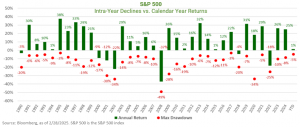
The takeaway: Investors should remain patient and disciplined, focusing on long-term goals rather than short-term volatility.

Capital Markets

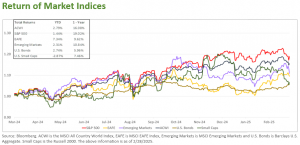
Equity returns in February were mixed. The S&P 500 fell 1.42%, the All-Country World Index (ACWI) declined 0.7%, and the Russell 2000 fared the worst, falling 5.45%. Meanwhile, developed international equities rose by 1.8% and emerging market equities increased by 0.35%. Bonds rose by 2.20%.
 

This document contains forward-looking statements, predictions and forecasts (“forward-looking statements”) concerning our beliefs and opinions in respect of the future. Forward-looking statements necessarily involve risks and uncertainties, and undue reliance should not be placed on them. There can be no assurance that forward-looking statements will prove to be accurate, and actual results and future events could differ materially from those anticipated in such statements.

(1) McKinley, the self-described “Tariff Man”, gave a speech in 1901 to a large crowd in Buffalo, New York saying “The period of exclusiveness is past. Reciprocity treaties are in harmony with the spirit of the times. Measures of retaliation are not. If perchance, some of our tariffs are no longer needed for revenue or to encourage and protect our industries at home, why should they not be employed to extend and promote our markets abroad?” McKinley assassinated the following day, died shortly after.


Crestwood Advisors Recognized as a 2025 Top RIA by Worth Media Group

BOSTON (March 3, 2025) – Crestwood Advisors (“Crestwood”), a boutique investment advisory and wealth management firm based in Boston with offices in Connecticut and Rhode Island, is proud to announce its inclusion in Worth Media Group’s list of Top Registered Investment Advisory (RIA) Firms for 2025.

This prestigious accolade highlights firms that demonstrate excellence in wealth management, client service, and fiduciary responsibility.

“At Crestwood, we pride ourselves on offering tailored advice and innovative strategies that address the unique needs of our clients,” said Crestwood President and Managing Partner Leah R. Sciabarrasi, CFP®. “Our placement on Worth’s list in 2025 – and in years prior – is a testament to the collaborative efforts and dedication across our entire team.”

Crestwood Advisors is committed to exceeding client expectations by providing holistic wealth management solutions tailored to individual financial goals. Through a fiduciary-driven, team-based approach, the firm offers personalized planning, investment strategies, and estate guidance – grounded in trust, integrity, and continuous learning. By combining deep expertise with empathetic listening and forward-thinking advice, Crestwood helps clients navigate life’s financial journey with confidence.

View the full list of Worth’s Top RIA Firms for 2025 and learn more about the methodology here.

Crestwood did not pay a fee to appear on the published list or to market the award.

###

About Crestwood Advisors
Crestwood Advisors is an independent, fee-only, wealth management firm with approximately $6.7 billion in assets under management as of October 31, 2024. Founded in 2003, Crestwood Advisors provides investment management with financial planning strategies to help high-net-worth individuals and families identify and prioritize their goals and build sustainable wealth so that they may enjoy more financially secure and purposeful lives. For more information, please visit https://www.crestwoodadvisors.com.

February Economic Update: Q&A regarding Tariffs on China, Mexico and Canada

What new tariffs were announced?

This past weekend, President Trump announced tariffs on 25% of nearly all Canadian and Mexican imports as well as an additional 10% tariff on Chinese goods with a planned effective date of February 4th. However, later on Monday it was announced there would be a one-month pause regarding the planned tariffs with Mexico and Canada pending further negotiations.

How did Canada, Mexico and China initially respond?

There are no one-sided trade wars, thus all three countries quickly announced plans to retaliate. Before the one-month “pause”, Mexico announced it would respond with tariffs as well as other, unspecified actions. Likewise, Canada initially announced targeted tariffs on ~$106 billion of U.S. goods, representing ~40% of its imports from the U.S.

On Tuesday, China announced 15% tariffs on U.S. coal and LNG and 10% tariffs on U.S. crude oil, agricultural machinery, large-displacement cars and pickup trucks. China has also stated that it will file a WTO (World Trade Organization) lawsuit in response to the tariffs.

Do tariffs apply to ALL incoming goods from these countries?

While tariffs may be structured to apply to all goods from a specific country, it is more common to see targeted rather than all-encompassing tariffs. There will likely be exceptions and varying rates for different industries. For instance, over 50% of the crude oil for U.S. refining is imported from Canada; to mitigate some of the impact, energy imports were set at 10% rather than the 25% tariff set on other goods. An announcement of flat across-the-board tariffs is more likely to be a starting position rather than the end point of any economic negotiation.

Are the new tariffs here to stay?

Tariffs are not set with an expiration date and trade agreements change over time. During President Trump’s earlier term, the U.S. renegotiated trade agreements with Canada and Mexico which resulted in the end of the North American Free Trade Agreement (NAFTA) which had been in place since 1994 and the adoption of the United States-Mexico-Canada Agreement (USMCA) in 2020.

Canada and Mexico are by far our biggest trading partners. For perspective, in 2023, the amount of two-way trade the U.S. had with China was only 36% of what we did with Canada and Mexico(1). In fact, the amount of two-way trade we had with Canada and Mexico was comparable to what the U.S. traded with all of Europe combined.(1)Thus, it is likely that the Canada and Mexico tariffs will change, and we will eventually see some version of a ‘USMCA 2.0’ trade deal, which would be more favorable to all parties rather than engaging in a long-term trade war.

Trade relations with other countries range between tolerant competition (ex: the Eurozone) and economic hostility (China, Russia). Thus, tariffs applied against those countries are likely to be more persistent. For example, the announced 10% tariff on Chinese goods is an increase in tariffs that were already in place.

To make long-term, durable structural changes to the U.S. economy, aligned with President Trump’s stated goal of reversing the decades-long decline in U.S. manufacturing, tariffs and trade agreements would likewise need to be long-term in nature. On-again/off-again tariffs are unlikely to result in permanent changes.

What could the impact on GDP and U.S. inflation be?

If the original planned tariffs on goods from Mexico, Canada, and China were implemented, JPMorgan estimates that these would lower U.S. economic growth by 0.5-1% in 2025 and increase inflation by the same amount. Gregory Daco, chief economist at the tax and consulting firm EY (formerly known as Ernst & Young) estimates the inflation would be 0.4% higher and U.S. growth 1.5% lower in 2025.

The impact of tariffs solely focused on China would be smaller, however it is premature to estimate the total impact of tariffs on the horizon as President Trump has said that additional tariffs will happen on goods from the European Union at some point, as well.

Traditionally, tariffs result in higher prices. For example, 81% of frozen French fries in the U.S. are sourced from Canada. So, barring a fry-related exemption, or higher costs being absorbed within the supply chain, U.S. consumers could see fry prices rise by 25%.

Why are stock markets and economists reacting poorly to the tariff announcement?

As we wrote in our November 2024 Economic Update: Tariff Talk:

Tariffs frequently lead to trade wars, where one country levies a tariff and in response the targeted country levies a tariff in return. For instance, in response to President Trump’s tariffs on aluminum and steel, the European Union taxed a variety of U.S. products such as bourbon and Harley-Davidson motorcycles. In a similar vein, China responded to Trump’s tariffs by adding their own tariffs to soybeans and pork, which hurt American farmers.

While a targeted tariff can help protect domestic businesses against a foreign rival, in cases where there is little to no domestic production, a tariff is often inflationary and results in higher costs without a meaningful economic benefit.

Business leaders and investors both prize predictability above all else. As uncertainty increases, both groups tend to become more cautious and wary about committing capital to a shifting landscape. Thus, investors should anticipate near-term volatility as large-scale trade negotiations unfold.

Should we change our long-term investment strategy in light of tariffs?

All projections and prognostications should be viewed cautiously, as the exact impacts of tariffs are impossible to predict with accuracy. Tariffs take an extended period to be fully felt by an economy and negotiations are ongoing.

The announcement that tariffs on Mexico would be paused resulted in an intraday reversal of some of the equity declines and serves as a good example why investors should exercise patience. Policy changes often create short-term volatility and require time to fully materialize.

The best remedy to hedge against the risks both known and unknown is to be disciplined and maintain a diversified strategy that aligns with your long-term financial goals. Resist the temptation to make sweeping changes solely based on headlines and possibilities.

Capital Markets

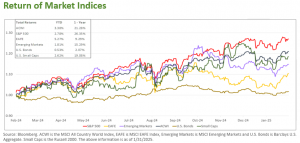
After equities and bonds pulled back in December, markets rebounded in January. AI-related stocks sold off at the end of the month due to concerns over U.S. dominance in the AI sector and Nvidia’s continued leadership. Even with this decline, equities had a strong month. The All-Country World Index (ACWI) rose 3.38%, the S&P 500 climbed 2.78%, developed international equities as measured by the EAFE index rose 5.27% and emerging market equities increased by 1.81%. Bonds were nearly flat but still rose 0.53%.

This document contains forward-looking statements, predictions and forecasts (“forward-looking statements”) concerning our beliefs and opinions in respect of the future. Forward-looking statements necessarily involve risks and uncertainties, and undue reliance should not be placed on them. There can be no assurance that forward-looking statements will prove to be accurate, and actual results and future events could differ materially from those anticipated in such statements.
(1)Source: U.S. Department of Commerce International Trade Administration, Census Bureau

Small/Mid Cap Stocks: An Attractive Opportunity

Crestwood believes equities offer strong growth potential for long term investors. We continuously analyze capital markets trends and data to inform our long-term equity strategy and identify shorter-term opportunities. Our analysis indicates that, given current market conditions, U.S. Small/Mid (SMID) cap stocks have the potential to outperform large cap stocks.

SMID Currently Trading at a Wide Discount

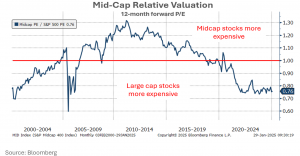
For much of the past 30 years, U.S. Small/Mid (SMID) cap stocks have traded at a premium valuation compared to their U.S. large-cap counterparts. Traditionally, investors sought SMID cap stocks to gain exposure to higher expected earnings growth to complement more mature and relatively slower-growing large-cap stock holdings. However, since early 2021, SMID cap stocks have traded at valuation discounts relative to large-caps in a range not experienced since the 2000 tech bubble. We believe this discount represents an attractive investment opportunity.
Below is a chart demonstrating the price-to-earnings ratio of the mid-cap stock index to that of the large-cap S&P 500 index for the past 20 years. Notably, mid-cap stocks currently trade at a 24% discount to large-cap stocks.

In the shadow of the Mag 7

For the past two years, investors have focused on the Magnificent Seven (Mag 7) companies – Apple, Microsoft, Alphabet, Amazon, Meta Platforms, Nvidia and Tesla – which have been a significant driver of large-cap stock market performance. Since January 2023, these stocks surged 254%, compared to the S&P 500’s 63% gain. Impressively, the Mag 7 companies have grown earnings by over 130%, capturing investor enthusiasm, especially for those benefiting from the development of artificial intelligence platforms. Enthusiasm for AI focused companies has overshadowed small-cap and mid-cap stocks which have fallen out of favor.

Attractive characteristics

When examining valuation as an investment factor, it is essential to ensure underlying fundamentals are healthy. Sometimes investments may appear inexpensive but carry low valuations for good reason and are priced appropriately. When looking at the stocks in the small-cap and mid-cap indexes however, we believe their fundamentals are healthy and improving:

1. Faster Growing: Over the past seven years, SMID cap earnings have grown faster than large cap earnings and they are expected to continue growing faster in the coming years.
2. Improving Businesses: Over the same time frame, SMID caps have improved free cash flow yields, margins, and returns on invested capital to comparable levels to large caps.
3. No Substantial Increases in Debt: Both SMID and large-cap debt levels are at their historical averages.

Why Now?

Several catalysts make now an opportune time to increase our exposure to SMID cap stocks:

1. Economic growth: SMID cap earnings tend to be more cyclical and rise and fall with economic growth. The current economic outlook is for healthy consumer spending and a resilient job market
2. Deal Activity: Anticipation of reduced regulatory scrutiny under the Trump administration is fueling expectations of increased merger and acquisition (M&A) activity. Higher M&A activity is a positive catalyst for SMID caps as they are often targets for these types of deals.
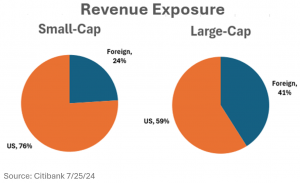
3. New Administration Tariffs: How substantial, impactful, or disruptive the tariffs may or may not be is still widely unknown. However, SMID caps have roughly half the exposure to foreign revenue as large caps, making them an attractive diversifier against potential global trade disruptions caused by tariffs.

In summary, SMID cap stocks are notably underappreciated by the broader market, presenting a compelling investment opportunity. Given today’s favorable economic environment, we believe their strong fundamentals combined with attractive valuations offer an appealing opportunity and may offer an important return and diversification benefit to client portfolios.

Sources: Bloomberg, Citibank. Mid-Cap stocks are represented by the S&P 400 Index, Large-Cap stocks are represented by the S&P 500 Index. The Magnificent Seven (Mag 7) returns are represented by the Bloomberg Magnificent 7 Index.

January Economic Update: 2024 in Review

As we look back at 2024, we want to summarize the major economic highlights of the year.

Economic Data Mostly Positive
US economic growth, job creation, and inflation continued to improve through 2024, though progress came with some caveats.

Stable GDP Growth: GDP came in at a 1.6% for Q1 2024, the lowest since Q2 2022, but Q2 2024 came in at 3.0% and Q3 2024 at 3.1%.
Non-farm employment rose by ~2.2 million jobs from January through December, though the unemployment rate moved up to 4.1%, 0.5% higher than December 2023. 4.1% is still a low figure compared to the longer-term average of 6.2% but does reflect a slowing pace of US growth.
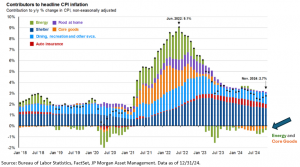
Inflation improving (for now). The consumer price index (CPI) was up 2.7% and core CPI was up 3.3% year/year in November. This is a marked improvement from the 3.3% and 3.9% pace in December 2023. However, as shown in the chart below, it’s noteworthy that declining prices in core goods (in orange) slowed in the second half of the year and lower energy costs (in green) contributed to much of the decline in total inflation for the year. This suggests that independent of other potential inflationary factors (wage pressure, tariffs, etc.) we could see inflation pick up, should energy prices reverse course.

Fed Preached Patience before Cutting Rates
Early in 2024, investors questioned when the Fed would begin the process of easing from the 5.25-5.5% peak, maintained since August of 2023. It took until August 2024 before Fed Chair Powell’s announcement that “the time has come for policy to adjust”.

September’s FOMC meeting resulted in a 0.5% cut, followed by 0.25% cuts at the November and December meetings. Notes from the December FOMC meeting, as well as a revised Summary of Economy Projections (aka the “Dot Plot”) suggest the Fed may delay further cuts in the near term with rates falling a further 0.25-0.5% by the end of 2025. That’s both a slower pace and a higher end rate than many investors expected.

US Equity Markets Rally Immediately Post Election Before Ending on Mixed Note

The market’s initial reaction was positive, with both the S&P 500 and the Russell 2000 logging their best monthly performances of 2024 during November. This reflected investor optimism about several factors, notably:

A further lowering of the corporate tax rate from 21% to either 20% or 15%. This would be a huge boon to corporate earnings and like push stock prices higher. For perspective, the highest 2016 marginal rate was 35%.
An extension of the 2017 personal income tax rate cuts set to expire in 2026. If this were to sunset, US consumers would have less money to spend on discretionary purchases.
Deregulation: This could boost domestic energy production, lower the barrier to mergers and acquisitions, and usher in a pro-crypto administration.

However, a narrowly averted government shutdown in December raised questions about how effectively President Trump will be able to use Republican congressional majorities. Equity markets pulled back amidst a backdrop of speculation about tariffs, disruption with long-time trading partners (Mexico, Canada) and the US potentially assuming control of Canada, the Panama Canal and/or Greenland. Collectively these are distractions and potential disruptions from the pro-business policies noted above.

Corporate Earnings – Strong but Top Heavy
S&P 500 constituents posted average year/year EPS growth of 5.8% in Q3, which was the fifth consecutive quarter of positive earnings growth. Q4 results are forthcoming, but S&P 500 firms are forecast to record annual earnings growth of 9.5%, which exceeds the ten-year average of 8.0%. The Mag 7 names (Apple, Microsoft, Amazon, Alphabet, Meta, NVIDIA and Tesla) accounted for a disproportionate share of earnings growth estimated at 33% vs 4% for the “Non-Magnificent 493”.

Looking ahead, analyst estimates for 2025 in aggregate are an optimistic 14.8% based on expectations of durable EPS growth, progress on inflation and a favorable regulatory backdrop from the incoming administration. Importantly, analysts expect broader based earnings growth with a stronger contribution from companies outside the Mag 7 names which dominated earnings and returns last year.

Capital Markets
Both equities and bonds pulled back in December, capping off an otherwise strong year. The S&P achieved its second straight year of 20%+ gains for the first time since 1998, hitting 57 new record highs in the process. Small caps were a winner in November, but reversed course in December, falling -8.4%. The All-Country World Index (ACWI) and the S&P 500 both declined -2.5%, while developed international equities a measured by the EAFE index fared slightly better with a -2.3% decline. Emerging market equities were down only slightly by -0.3%. Bonds declined -1.6%.

This document contains forward-looking statements, predictions and forecasts (“forward-looking statements”) concerning our beliefs and opinions in respect of the future. Forward-looking statements necessarily involve risks and uncertainties, and undue reliance should not be placed on them. There can be no assurance that forward-looking statements will prove to be accurate, and actual results and future events could differ materially from those anticipated in such statements.

Year-End Financial Planning Guide for Families: Key Considerations for 2024

As we approach year end, this guide highlights essential financial considerations, offering actionable steps and practical advice to help secure your family’s financial well-being.

Smart Tax Planning Strategies

Year-end tax planning can yield substantial savings for families who take a proactive approach.

  • Charitable giving can play a crucial role in tax planning. Consider a Donor Advised Fund (DAF) to bunch multiple years’ worth of charitable contributions into a single tax year to maximize the benefit of itemizing deductions.
  • If you are over 70½, qualified charitable distributions (QCDs) from IRAs of up to $105,000 per individual or $210,00 for a married couple filing jointly can satisfy required minimum distributions (RMDs) while providing tax advantages.
  • Consider a Roth Conversion to convert IRA dollars into Roth dollars which will grow tax free going forward.

Estate Planning for Family Security

Estate planning extends far beyond a simple will creation. A comprehensive estate plan ensures your assets are distributed according to your wishes while minimizing tax implications for your heirs.

  • Review and update wills and other directives.
  • Check beneficiary designations on retirement accounts and life insurance, including contingent beneficiaries.
  • Consider establishing or updating trusts (especially considering state estate taxes).
  • Review powers of attorney and healthcare directives.
  • Evaluate gifting strategies for tax efficiency.
  • Consider charitable giving vehicles.

Maximizing Retirement Security

Now is the time to review your contribution levels to workplace retirement plans and Individual Retirement Accounts (IRAs). In November, the IRS announced a significant changes for 2025, including raising the limits for catch up contributions for workers age 60 to 63.

  • If you are not maxing out your 401(k), at a minimum, ensure you are contributing enough to receive your employer’s maximum matching contribution.
  • If you have set a fixed contribution amount, review and adjust your contributions for 2025 to ensure you reach new annual limits.
    • 401(k): $23,500 ($31,000 for those 50 and older and $34,750 for those age 60 to 63)
    • IRA: $7,000 ($8,000 for those 50 and older)
    • Consider making these as Roth contributions if your future income/taxes will be higher.
  • Review investment allocations to ensure they align with your risk tolerance and timeline.

Secure Your Family’s Future Through Insurance

Insurance coverage forms a crucial part of your family’s financial safety net. The end of the year presents an ideal time to review your insurance policies and ensure they still align with your family’s needs.

  • Life insurance coverage should reflect your current family situation, including any changes in dependents, income, or debt obligations.
  • Health insurance decisions take on particular importance during open enrollment periods. Consider whether your current health plan still offers the most cost-effective coverage for your family’s medical needs.
  • Consider maxing out contributions to a tax-efficient HSA plan if you are eligible ($4,300 for an individual or $8,550 for a family in 2025).
  • Often overlooked, long-term disability insurance, deserves consideration as it protects your income should you become unable to work.

Strategic Debt Management

In today’s dynamic interest rate environment, smart debt management can significantly impact your family’s financial health.

  • Review all outstanding debts, from mortgages to credit cards, for opportunities to reduce interest costs through refinancing or consolidation.
  • If you have high levels of consumer debt, consider creating a structured debt repayment strategy that balances aggressive debt reduction with other financial priorities.
  • Mortgage holders should evaluate whether current rates and terms still serve their best interests.

Remember that not all debt is created equal – focus first on eliminating high-interest consumer debt while maintaining strategic use of lower-cost debt that might offer tax advantages.

Education Planning using 529 accounts

Saving for education can help prepare bright young minds for a fulfilling future career. If you plan to help fund the cost of a university degree, consider the following:

  • Review contribution limits and state tax benefits.
  • The 2024 Federal Gift Tax Exemption is $18k per giver, per receiver (a couple can gift $36k to a child’s 529 plan). This increases to $19k in 2025.
  • Consider front-loading 529 plan contributions (up to five years-worth all at once). Please consult with your tax accountant on how to report these contributions.
  • Evaluate investment allocations based on children’s ages.
  • Explore options for unused 529 funds, including transfers to siblings or a Roth IRA.

Emergency Fund Assessment

A cornerstone of any sound financial strategy remains a robust emergency fund. While the traditional advice of saving three to six months of essential expenses holds true, today’s higher interest rates present a nice opportunity. High-yield savings accounts offer the opportunity to earn meaningful returns while maintaining liquidity.

Family Financial Communication

An open dialogue about family finances builds stronger financial futures for the next generation. Set aside time for family financial discussions, adapting the conversation to include children at age-appropriate levels. These discussions can cover everything from daily spending decisions to long-term financial goals.

  • Schedule quarterly or semi-annual family budget reviews.
  • Use age-appropriate financial language for children:
    • Ages 5-10: Basic saving and spending concepts, including giving
    • Ages 11-15: Introduction to investing and compound interest
    • Ages 16+: Credit, college planning, Estate planning basics
  • Discuss family values and money relationships.
  • Plan family philanthropy initiatives.
  • Create financial responsibility transition plans for teens.
  • Review family business succession planning if applicable.

Take Action

Successful financial planning requires taking concrete steps toward your goals. Begin by making any necessary year-end contributions or adjustments to investment accounts. Update important documents and beneficiary designations. Set specific, measurable financial goals for the upcoming year. Finally, consider where Crestwood’s professional financial guidance might help you navigate complex financial decisions.

Remember, financial planning is an ongoing journey, not a destination. Regular reviews and adjustments will help ensure your family remains on track to meet both immediate needs and long-term aspirations.

This document is provided for general informational purposes only by Crestwood Advisors, an investment adviser. Crestwood Advisors does not provide legal advice, and this document should not be construed as containing legal advice. For legal advice, consult with a licensed attorney. This document should not be construed as containing tax advice. For tax advice, consult with your tax adviser.

December Economic Update: Politics and Perception Revisited

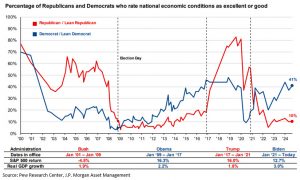
With the election results now in, many investors are wondering if they should adjust their portfolio strategy. We have written in the past about how political affiliation can frame investors’ perception about the economic environment.(1) This month, we discuss how that carries over to trading behavior.

Bias and Sell us

Politics have a marked influence on an investor’s perception of the market and their ability to evaluate risk. Interestingly, this phenomenon isn’t limited to “retail” investors trading via Robinhood, but extends even to sophisticated investors, such as hedge funds.(2)

Research on investor psychology reveals that investors of all skill levels report feeling more optimistic and view markets as less risky and more undervalued when their preferred political party is in power. Conversely, they often maintain a lower weighting in risk assets, like equities, when the opposing party holds power, regardless of market or economic conditions.(3)

For example, following the 2016 election, a greater proportion of GOP-identified mutual fund managers increased exposure to equities than Democrat-identified mutual fund managers. Likewise, retail investors in predominantly GOP-leaning zip codes increased their equity allocations more than those in Democrat-leaning areas.(4)

Thus, following the 2024 election left-leaning investors may be thinking about how to position their portfolios defensively while right-leaning investors may be seeking opportunities to invest more aggressively.

A Quick Refresher

As shown in the chart below, market returns during the Obama and Trump administrations were almost identical (+16%), far above the 30-year average of 10%. Despite similarly strong equity markets, surveys consistently show that individuals rated economic conditions more favorably when their preferred political party wins an election or was currently in power and less so when their party wasn’t in power.

Rather than Gambling on Red or Blue, Invest in Black and White

In the last few weeks, we have seen flows in and out of areas dubbed “Trump Trades” such as cryptocurrencies, banks, and pharma companies. However, it is difficult to do well in the long run by speculating on political agendas.

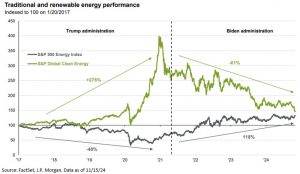
For instance, during the 2016 election cycle Trump campaigned to support the traditional oil and gas industries during his presidency. On the other hand, Biden campaigned to support renewables and promised to reduce exposure to fossil fuels.

However, sector performance was exactly the opposite of what politically focused investors expected. Under Trump, the S&P 500 Energy index, which held oil and gas companies fell 40%, while the S&P 500 Global Clean Energy index rose a remarkable 275%! Conversely, under Biden the S&P 500 Energy index nearly doubled, while the S&P 500 Global Clean Energy index fell more than 60%.

At the end of the day, market performance is shaped by macroeconomic forces. Fluctuations in supply and demand, along with changes in interest rates around the world, had a greater impact than any policies from the White House.

Ultimately, it is policy rather than political posturing that drives the economy. Thus, investors would do well to maintain diversified portfolios of companies with good balance sheets, strong cash flows, and solid business models regardless of political change. Your equity allocation should be driven by your financial plans and time horizons, rather than election outcomes. Maintaining a long-term focus is the key to achieving your financial success.

Capital Markets
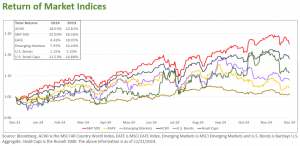
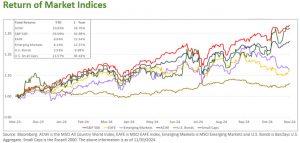
The S&P 500 is on pace to see the first back-to-back years of annual gains of 20%+ since the 1995-1998 market run, but U.S. small caps were the star of the month, rising by 10.8%. The All-Country World Index (ACWI) rose 3.8%, the S&P 500 climbed 5.7%. However, international equities underperformed due to a stronger dollar and trade concerns, with the EAFE down 0.7% and emerging market equities down 3.7%. U.S. Bond prices rose slightly by 1% for the month.

This document contains forward-looking statements, predictions and forecasts (“forward-looking statements”) concerning our beliefs and opinions in respect of the future. Forward-looking statements necessarily involve risks and uncertainties, and undue reliance should not be placed on them. There can be no assurance that forward-looking statements will prove to be accurate, and actual results and future events could differ materially from those anticipated in such statements.
1. See our May 2024 Economic Update “How Politics Influence Perception of the Economy”
2. Source: “Hedge Fund Politics and Portfolios”, DeVault and Sias June 2016
3. Source: “Political climate, optimism, and investment decisions”, Bonaparte et al, May 2017
4. Source: “Partisanship and Portfolio Choice: Evidence from Mutual Funds”, Cassidy and Vorsatz, January 2024


The Corporate Transparency Act: Do You Have A Filing Requirement?

The Corporate Transparency Act (“CTA”) became law on January 1, 2021, and implementation became effective January 1, 2024. The CTA created broad reporting requirements that apply to LLCs, limited partnerships (LPs) and other types of entities, a reporting company. There are also many entities that are exempt from reporting.

Reporting companies are required to disclose to the U.S. Financial Crimes Enforcement Network (FinCEN) the name, residential address, date of birth and unique identification number from an acceptable identification document (e.g., a driver’s license or passport) of all significant owners and persons who may exercise control over the reporting company, the beneficial owners.

Who Is a Beneficial Owner?
FinCEN defines a beneficial owner as any individual who, directly or indirectly exercises substantial control over a reporting company or owns or controls at least 25% of the ownership interests of the reporting company. FinCEN states that substantial control can be exercised in four ways: 1) senior officer 2) authority to appoint or remove senior officers 3) important decision maker and 4) an individual who has any other form of substantial control and they direct you to their Small Entity Compliance Guide for more clarity regarding number 4.

Do Trusts with LLC/LP Interests Have a Filing Requirement?
If a trust owns 25% or more of a reporting company, or exercises substantial control over a reporting company, it must then be determined who the beneficial owners of the trust are, and the trust beneficial owners must be included on the filing for the reporting company. It is not the trust/trustee’s responsibility to file; it is the entity’s responsibility to file.

The Good News
The reportable information is not public information, though FinCEN can disclose information to certain federal or state agencies engaged in national security, intelligence, or law enforcement activity. There is no cost to file with FinCEN, and reporting is not an annual requirement, though information must be updated within 30 days of any change.

The Bad News
The penalty for failure to file is draconian, up to $500/day, with the maximum fine not to exceed $10,000, a prison term of up to two years or both.

Deadlines
Reporting companies formed prior to 2024 must file by January 1, 2025.
Reporting companies formed in 2024 must file 90 days after formation (some may be past this deadline).
Reporting companies formed in 2025 or later must file 30 days after formation.

The FinCEN website has a lot of helpful information:

https://www.fincen.gov/boi

https://www.fincen.gov/sites/default/files/shared/BOI-FAQs-QA-508C.pdf

https://www.fincen.gov/sites/default/files/shared/BOI_Small_Compliance_Guide.v1.1-FINAL.pdf

But Wait! There was a Preliminary Injunction at the Eleventh Hour

On December 3, a judge in the Eastern District of Texas issued a national preliminary injunction against the CTA, prohibiting its enforcement, stating that “reporting companies need not comply with the CTA’s January 1, 2025, BOI reporting deadline pending further order of the Court.”
A few things to keep in mind: 1) The US government filed an appeal on December 5, 2) FinCEN issued an Alert in response to the ruling stating “while this litigation is ongoing, FinCEN will comply with the order issued by the U.S. District Court for the Eastern District of Texas for as long as it remains in effect. Therefore, reporting companies are not currently required to file their beneficial ownership information with FinCEN and will not be subject to liability if they fail to do so while the preliminary injunction remains in effect. Nevertheless, reporting companies may continue to voluntarily submit beneficial ownership information reports.” 3) This is not the only case that has been brought claiming that the CTA is unconstitutional, two other district courts have already rejected requests for a preliminary injunction (one in Virginia and one in Oregon) meaning two other judges were not convinced of the unconstitutionality of the CTA, while one court in Alabama has been successful in challenging the CTA, but that case was state specific. So, while this may be welcome news, it does not necessarily mean it is the end of the CTA as we know it. The injunction is preliminary and temporary until further notice, so anyone with a filing requirement should remain ready to meet the filing requirements should the injunction be lifted, and always should seek the guidance of their attorney as to the best way to move forward.