The CARES Act and How it May Affect You

cares act 1

In response to the evolving COVID-19 global pandemic, Congress has passed the Coronavirus Aid, Relief, and Economic Security (CARES) Act, a $2 trillion emergency fiscal stimulus package aimed at helping individuals, businesses, healthcare entities and state and local governments.  The CARES Act is the most recent of three bills focused on reducing the economic impact of COVID-19 and is the largest economic stimulus in American history.

Key provisions in the CARES Act:

The CARES Act includes direct payments to taxpayers. Individuals (single filers) who had less than $75,000 in adjusted gross income (AGI) in 2019 will receive a one-time payment of $1,200, while married couples with AGI up to $150,000 will get $2,400. Additionally, taxpayers will receive an extra $500 for each qualified child. Single filers with AGI above $99,000 and married filers with AGI above $198,000 will not receive payments.

Retirement account rules have been have been modified for 2020. Required Minimum Distributions have been waived for traditional IRAs and inherited IRAs. Distributions that have already been processed can be returned within 60-days and avoid taxable income.

For taxpayers who are under age 59 ½, the CARES Act waives the 10% penalty on withdrawals from retirement plans and IRAs for distributions up to $100,000 for IRA owners and participants in workplace retirement plans that have been impacted by this pandemic. The withdrawals qualify if the taxpayer, their spouse, or a dependent is diagnosed with COVID-19 or SARS-COV-2, or if they suffer adverse financial consequences due to the pandemic. The taxpayer may repay part or all of this withdrawal over three years, any portion that is not repaid may be included in income for tax purposes over this same period. Loan repayments that are due in 2020 may be delayed for one year.

A new charitable deduction is included in the bill for up to $300 in annual charitable contributions. To qualify, you have to give cash to a qualified charity and not to a donor-advised fund. It also relaxes the limit on charitable contributions for itemizers – increasing the deduction from 60% of AGI to 100% of gross income. These charitable changes are not currently limited to 2020.

Other factors that could impact you:

  • The CARES Act increases unemployment benefits $600 per week for up to four months as well as an expansion of benefits for those who would otherwise not qualify
  • Federal student loan payments can be deferred through September 30, 2020 and income tax exclusion for individuals who get student loan repayment assistance from their employer
  • Expanded insurance coverage for COVID-19 treatment and funding for health care providers and suppliers
  • Certain small businesses with up to 500 employees will be able to take out loans (up to $10M depending on payroll costs and other factors), which will be eligible for forgiveness if used to cover payroll and other expenses (like rent and utilities) along with some other ‘employee retention’ tax credit opportunities. Other benefits for businesses include a delay in the employer’s portion of Social Security payroll tax until January 1, 2021.

Beyond benefits for individuals and businesses, the CARES Act provides for $454 billion in emergency lending to municipalities, airlines and other businesses critical to US national security and another $150 billion allocated proportionally to state and local governments to offset amounts used to respond to the pandemic.

If you have any questions about the CARES Act, or what it means to you, please do not hesitate to contact your team at Crestwood Advisors.

Crestwood’s perspective on COVID-19’s economic impact

economic impact

During this very difficult time, we thought it would be helpful to frame our observations around the impact the coronavirus may have on the U.S. economy and investment markets in the near-term future. To be sure, we do not have a “crystal ball” and with the situation remaining quite fluid and circumstances evolving rapidly, our observations are simply how we are seeing the events that are unfolding now.

Importantly, for our broader society, the human costs of the spreading virus will likely be far higher than the economic costs and sadly, for many families, the impact may be devastating for both their health and economic circumstances. The various efforts across the country to “social distance” and many state mandates to “stay home” are intended to suppress the spread of the virus and reduce the death toll and degree of human suffering. We are all hopeful that the result of these efforts will be a gradual mitigation of the virus and, eventually, a re-opening of our economy.

The impending economic contraction will be severe, perhaps the worst ever

There is no economic precedent for the broad-based work stoppage that is occurring and early data is bad. Initial jobless claims released yesterday rose to 3.28 million workers from 220 thousand in February. This level is the worst since the data collection started in 1966 and almost 5x the previous worst reading of 671k in 1982. GDP growth expectations have fallen sharply with the impact of Q2 GDP growth estimated to be down as much as -24%.

We expect some dislocation and defaults

Recently, bond markets have been dysfunctional, in many respects as bad as they were in 2008. The Fed has been very active over the past two weeks in supporting companies and providing liquidity. They have cut the discount rate, purchased bonds – Treasuries, municipals and mortgages – and reignited several funding programs to support liquidity needs in money market funds, foreign exchange markets, international bank lending, commercial paper, primary dealers and even purchased bond ETFs. These quickly implemented, large-scale actions have staved off possible systemic risks and have returned trading activity to some sense of normalcy.

We expect some corporate bond defaults and downgrades.  The Fed is not supporting companies with poor credit ratings and it is reasonable to believe that there are many companies that are too levered and cannot survive +2 months of a shutdown. To be clear, your portfolios do not have exposure to high yield securities or junk bonds that might be most susceptible to default. The last several years have seen an enormous spike in BBB (or lower) debt issuance. BBB debt has grown to over 50% of the corporate bond market up from 17% in 2001. Companies whose debt is downgraded to junk bond status will have difficulty accessing funding and liquidity. For example, especially given the current price of oil, many energy companies are vulnerable and expected defaults are high in this sector. Over-levered retailers would be another area of obvious risk.

We are optimistic for an economic recovery and believe it may be surprisingly robust

After two months of lock-down and a dramatic slowdown in new coronavirus cases, Wuhan and the rest of China is returning to work. It will be important to watch for any resurgence of the virus, but for now, indicators like electricity and auto manufacturing are returning to levels approaching normal. While the U.S. is unlikely to return to work as early as Easter, the coronavirus will likely peak in the coming months and set the stage for a resumption of more normal economic activity later this summer.

This economic contraction is unlikely to be as deep as the 2008 Great Recession let alone the Great Depression. Numerous bodies of research studying recessions generally conclude that those recessions accompanied by a financial crisis tend to be longer and slower to recover. Recessions from financial crises tend to be worse because the banking sector/balance sheets are impaired, which significantly curtails loans and money growth. Currently, the U.S. banking system is in solid shape and in a much stronger financial position than in 2008. Banks now have almost 3x times more capital than in 2008 which provides a measure of safety for bad loans. Bank capital has increased on average from 2.5% to 6.6% of assets and bank funding is much more stable with banks relying more on deposits rather than short-term debt. Banks will certainly have some significant loan losses through this period, but we do not expect a banking crisis.

U.S. Monetary and fiscal stimulus has been massive. The U.S. government has rolled out over $2 trillion in fiscal stimulus which represents a whopping 9.2% of GDP. Additionally, the Fed has increased their balance sheet and is providing enormous liquidity to most markets. The combined monetary & fiscal policy is approaching $4 trillion. These packages may not completely offset the impending slowdown, but will certainly help now and when people return to work.

Stock market returns will likely stabilize and recover with the return of economic activity. Since 1928, the S&P 500 has had 6 prior periods when stocks fell from their highs -30% or more. Here are those periods and returns for 6 months, 1 year and 2 years after the market breached the -30% level:
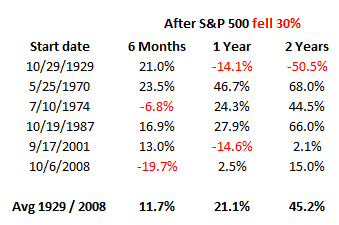
Stock markets experienced strong and quick rebounds after the declines in 1970, 1974 and 1987 and were slower to recover from 1929 and 2008 given the accompanying financial crisis. 2001 is an exception, because the down -30% in the stock market was due to the “dot-com bubble” bursting which preceded the recession, so the timing is different. If you exclude periods with banking crisis (1929 and 2008), average returns after a 30% drop have been strong.

Asset Allocation and Portfolio Adjustments

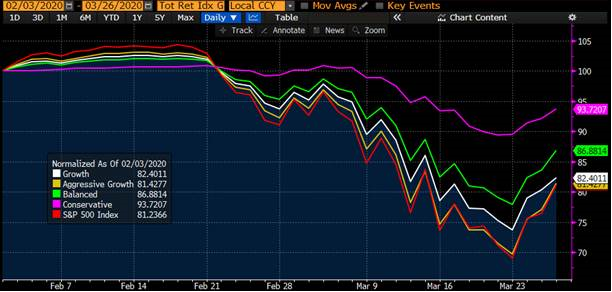
We remain constructive on your current asset allocation. When the markets are volatile and experiencing significant (and likely, temporary) declines, we can add meaningful value by encouraging clients to stick to their long term goals and the supporting strategic asset allocation. While there are numerous adjustments we will continue to make to improve portfolios, we do not believe that making wholesale changes to portfolios, including selling all stocks, is in the best long-term interests of achieving your individual goals.

A major goal of our client asset allocation is greater consistency. Every client has a portfolio constructed and broadly aligned with a risk/return profile that is appropriate for their unique long term goals and risk tolerance. Our “growth seeking” clients can expect a portfolio that has +/-75% exposure to risk assets and +/-25% exposure to lower risk assets regardless of our view of the stock market. We firmly believe that one of our “value adds” as an advisor is carefully working with you to develop that long term strategy and making every effort to adhere to it. We have written numerous Perspectives pieces (on our website) on the topic of trying to anticipate market movements and how challenging that can be: Importance-of-time-and-diversification, Predicting-the-stock-market-is-a-bad-idea and Profiting-from-an-emotional-market.

Asset Allocation has been effective. Since 2/1/2020 more conservative portfolios have buffered the declines in stocks:
Source:Bloomberg

What would cause us to change our allocations and own fewer stocks? Our allocations are based on long term growth expectations and diversification. We expect stocks to continue their growth pattern similar to their 100+ year history that has delivered superior though sometimes erratic returns. If there was an event that somehow reduced long term growth of global economies, then we would consider changing allocations. Over the long run we expect growth in population, productivity, earnings and capital. We remain invested and optimistic that the coronavirus, though serious and unprecedented, will not disrupt long term growth and economic development. Negative news always receives more attention and the recent deluge is overwhelming. We fully recognize it is difficult to remain positive and focused on the long term but we believe that the U.S. and other countries remain an attractive place to invest and grow capital.

Looking to be opportunistic. As we have shared with many of you, we continue to review individual businesses and asset classes that are selling at now discounted valuations and we are actively seeking ways to enhance returns and your financial security.

We thank you for your continued confidence.

Sincerely,
Crestwood Advisors

Business Update

coronavirus germ

The novel coronavirus (COVID-19) is having an increasing impact on businesses and our communities. While our business focus means that your financial matters and the investment markets are always important to us, we also care deeply about the impact on all of our daily lives and the health issues being created by the growing global pandemic. We hope all of our communities are able to effectively manage the current circumstances. We also feel it is important to share with you the steps we are taking to help keep everyone in the Crestwood Advisors family safe and healthy and to ensure that our business continues to operate seamlessly.

Crestwood has a long-standing and robust continuity plan in place to ensure that during any crisis we can continue to effectively manage portfolios and engage with clients. We have run our business using cloud-based solutions for years, which includes other infrastructure and contingency plans that provide for remote working across all areas of our business. We have routinely tested our plan and feel secure that we can and will successfully continue our business operations.
Beginning Monday, March 16, we are also implementing the following precautionary measures and strongly encouraging all of our employees to:

  • work from home
  • avoid business travel
  • avoid in-person meetings

Importantly, everyone at Crestwood remains focused on providing the highest quality guidance, service and support to you. As a team, we will continue to effectively coordinate our investment research, portfolio management and financial planning and we remain committed to engaging with you during these challenging times, including meetings via phone and/or video conferencing. As always, we are actively monitoring events in the investment markets and proactively striving to make important portfolio adjustments that can enhance your circumstances. We have been in constant contact with our custodial partners and are confident in the effectiveness of their contingency planning and that our business with them will not be interrupted with their evolving plans for a remote workforce.

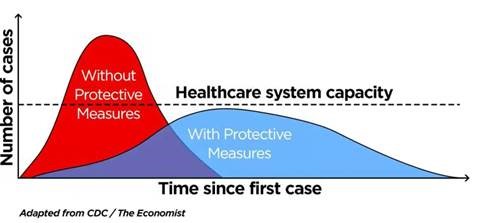
Fortunately, we have not yet been directly impacted by the coronavirus and everyone at Crestwood remains healthy. However, we are taking these extra measures to help our employees, their families and our clients stay safe as well as do what we can to help our local communities slow the spread of the coronavirus pandemic. As the likely familiar graphic below highlights, we are keenly aware of the potential stress on the capacity of our healthcare systems and other community services and hope that our collective efforts of “social distancing” make sure that those most vulnerable will continue to have access to any necessary important medical care.

While we have not been impacted, we know the situation remains fluid and are reviewing our plans daily. We will continue to monitor advisories from the CDC, WHO and our state and local community governments. Our focus will remain on providing you, our client, the highest level of service and communication during this difficult time.

Please do not hesitate to contact us at any time if you have any questions or concerns.

Michael A. Eckton, CFA
CEO & Managing Partner
617.523.8880

Coronavirus update

coronavirus germ

As global financial markets react to news that the novel Coronavirus (2019-nCoV) continues to spread, we want to share an overview of these latest developments.

About:

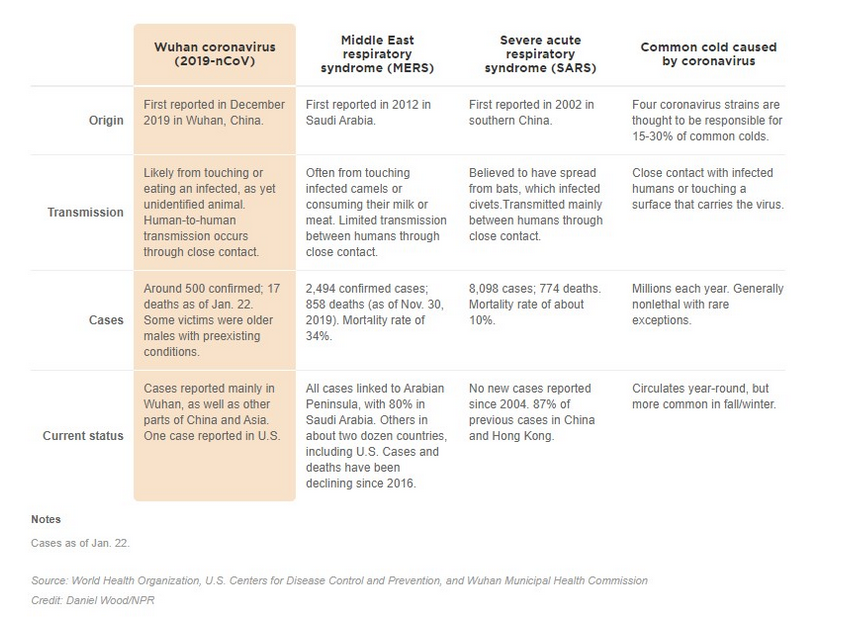
First confirmed in Wuhan, China in December, the coronavirus has grown to over 4,500 confirmed cases within China as we write this. The virus is similar to MERS and SARS where all three are coronaviruses, contracted and transmitted through close contact with animals or humans. Though concerning, the mortality rate for this virus is thus far lower than that for SARS and MERS.  However, recent reports that this novel coronavirus is contagious prior to symptoms showing may make it harder to contain. Observed symptoms include cough, fever, and possibly shortness of breath. Please see the chart below for a comparison.

Action:

China has instituted a travel ban on trains and planes departing the country, along with quarantining cities where the virus is believed to have originated or spread. Furthermore, China has completely banned trade of wild animals. Along with China, countries globally have released statements to discourage travel to China. Compared to SARS and MERS, 2019-nCoV public disclosure and action has been far more efficient, giving hope to controlling the virus more effectively than past coronaviruses.

Outlook:

Headline risk, uncertainty, and a known decrease in travel during the Lunar New Year (typically one of the most traveled times of year) have been the main reasons for recent market reaction, both domestically and internationally.  While the virus may have a negative impact on sectors relying on travel, tourism, and Chinese production, we believe any weakness will be temporary.

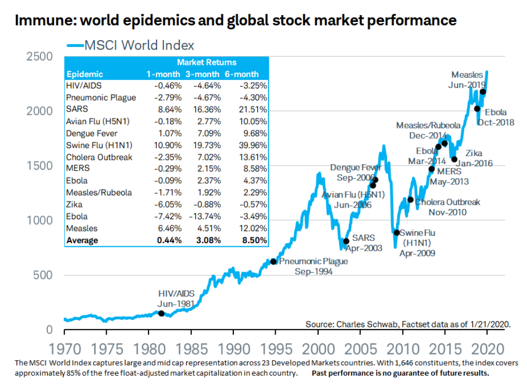
Based on our current understanding of available data, we do not see this novel coronavirus having a significant lasting negative effect on U.S. GDP growth. We continue to believe in the underlying strength of the economy given strong labor markets, high savings rates, and positive household financial balance sheets. Looking back at the SARS outbreak in 2002-2003, while unnerving, there was no long-term impact to the financial markets.

These types of events are always a reminder of the importance of long-term investment horizon, as temporary periods of weakness should be expected.


The SECURE Act and why it is important

The SECURE Act and why it is important

Congress passed a spending bill and the “Setting Every Community Up for Retirement Enhancement” Act (SECURE Act), just ahead of the New Year. While this legislation intends to help strengthen retirement security across America, it is important not to overlook the changes to contribution and distribution rules for many popular retirement plans effective as of January 1, 2020.

What are the key actions and considerations?

While those who inherited an IRA before the end of 2019 can continue their current required minimum distribution schedule, beneficiaries inheriting assets in 2020 and beyond will now need to withdraw all assets from inherited retirement accounts within 10 years following the death of the original account holder. Exceptions to the new 10-year distribution requirement include assets left to a surviving spouse, a minor child (until they reach the age of majority), a disabled or chronically ill individual, and beneficiaries who are less than 10 years younger than the decedent.

Eliminating the stretch IRA has the potential to generate about $15.7 billion in tax revenue over the next decade, according to the Congressional Research Service. Because of these changes, account holders should review beneficiary elections and reevaluate their retirement and estate planning strategies, including the use of trusts as beneficiaries.

The law increases the age individuals must begin taking required minimum distributions to 72 from 70 ½. This change applies to retirement account owners who will attain 70½ on or after January 1, 2020. The Act also removes the 70 ½ year age limit for IRA contributions. Now all individuals, regardless of age, can contribute to an IRA as long as they have earned income. Annuities will likely be prevalent investment options in 401k plans, due to new employer liability protection. Some retirement plan administration rules have also been modified.

While much of the legislation targets senior savers, retirees and employers, there are benefits for younger savers. The SECURE Act allows Americans who just had a baby or adopted a child to take a withdrawal of up to $5,000 from their retirement accounts, without the typical 10% penalty. New parents can opt to repay the withdrawal amount, but this is not a loan and does not need to adhere to the strict 401(k) repayment process. Also, the legislation allows for up to $10,000 to be used from 529 accounts for repayments of student loans or apprenticeship programs.

If you have any questions about the SECURE Act, or what it means to you, please do not hesitate to contact your team at Crestwood Advisors.