Wealth Manager Talks to Barron’s About Tackling Impulsive Spending in the Digital Age

Have you ever walked out of a store and wondered, “What did I just spend?” It’s a common feeling in today’s tap-to-pay world.

Recently, Wealth Manager Billy Spencer shared his insights with Barron’s on how technology fuels impulsive spending and what you can do to take back control. From removing saved credit cards to visualizing spending with Monopoly money, he discussed practical tips for smarter financial habits.

Click here to read more.

Crestwood Advisors President Discusses Next-Gen Readiness and Succession Planning with InvestmentNews

Succession planning is more critical than ever in the RIA industry, yet many firms are struggling to prepare for the future.

Recently, our President and Managing Partner, Leah Sciabarrasi, CFP®, spoke with InvestmentNews about the urgent need for next-gen readiness in wealth management. She shared her insights on how transparency and dialogue about career paths can empower advisors to drive firm success and ensure exceptional client service.

Click here to read the full article.

Year-End Financial Planning Guide for Families: Key Considerations for 2024

As we approach year end, this guide highlights essential financial considerations, offering actionable steps and practical advice to help secure your family’s financial well-being.

Smart Tax Planning Strategies

Year-end tax planning can yield substantial savings for families who take a proactive approach.

  • Charitable giving can play a crucial role in tax planning. Consider a Donor Advised Fund (DAF) to bunch multiple years’ worth of charitable contributions into a single tax year to maximize the benefit of itemizing deductions.
  • If you are over 70½, qualified charitable distributions (QCDs) from IRAs of up to $105,000 per individual or $210,00 for a married couple filing jointly can satisfy required minimum distributions (RMDs) while providing tax advantages.
  • Consider a Roth Conversion to convert IRA dollars into Roth dollars which will grow tax free going forward.

Estate Planning for Family Security

Estate planning extends far beyond a simple will creation. A comprehensive estate plan ensures your assets are distributed according to your wishes while minimizing tax implications for your heirs.

  • Review and update wills and other directives.
  • Check beneficiary designations on retirement accounts and life insurance, including contingent beneficiaries.
  • Consider establishing or updating trusts (especially considering state estate taxes).
  • Review powers of attorney and healthcare directives.
  • Evaluate gifting strategies for tax efficiency.
  • Consider charitable giving vehicles.

Maximizing Retirement Security

Now is the time to review your contribution levels to workplace retirement plans and Individual Retirement Accounts (IRAs). In November, the IRS announced a significant changes for 2025, including raising the limits for catch up contributions for workers age 60 to 63.

  • If you are not maxing out your 401(k), at a minimum, ensure you are contributing enough to receive your employer’s maximum matching contribution.
  • If you have set a fixed contribution amount, review and adjust your contributions for 2025 to ensure you reach new annual limits.
    • 401(k): $23,500 ($31,000 for those 50 and older and $34,750 for those age 60 to 63)
    • IRA: $7,000 ($8,000 for those 50 and older)
    • Consider making these as Roth contributions if your future income/taxes will be higher.
  • Review investment allocations to ensure they align with your risk tolerance and timeline.

Secure Your Family’s Future Through Insurance

Insurance coverage forms a crucial part of your family’s financial safety net. The end of the year presents an ideal time to review your insurance policies and ensure they still align with your family’s needs.

  • Life insurance coverage should reflect your current family situation, including any changes in dependents, income, or debt obligations.
  • Health insurance decisions take on particular importance during open enrollment periods. Consider whether your current health plan still offers the most cost-effective coverage for your family’s medical needs.
  • Consider maxing out contributions to a tax-efficient HSA plan if you are eligible ($4,300 for an individual or $8,550 for a family in 2025).
  • Often overlooked, long-term disability insurance, deserves consideration as it protects your income should you become unable to work.

Strategic Debt Management

In today’s dynamic interest rate environment, smart debt management can significantly impact your family’s financial health.

  • Review all outstanding debts, from mortgages to credit cards, for opportunities to reduce interest costs through refinancing or consolidation.
  • If you have high levels of consumer debt, consider creating a structured debt repayment strategy that balances aggressive debt reduction with other financial priorities.
  • Mortgage holders should evaluate whether current rates and terms still serve their best interests.

Remember that not all debt is created equal – focus first on eliminating high-interest consumer debt while maintaining strategic use of lower-cost debt that might offer tax advantages.

Education Planning using 529 accounts

Saving for education can help prepare bright young minds for a fulfilling future career. If you plan to help fund the cost of a university degree, consider the following:

  • Review contribution limits and state tax benefits.
  • The 2024 Federal Gift Tax Exemption is $18k per giver, per receiver (a couple can gift $36k to a child’s 529 plan). This increases to $19k in 2025.
  • Consider front-loading 529 plan contributions (up to five years-worth all at once). Please consult with your tax accountant on how to report these contributions.
  • Evaluate investment allocations based on children’s ages.
  • Explore options for unused 529 funds, including transfers to siblings or a Roth IRA.

Emergency Fund Assessment

A cornerstone of any sound financial strategy remains a robust emergency fund. While the traditional advice of saving three to six months of essential expenses holds true, today’s higher interest rates present a nice opportunity. High-yield savings accounts offer the opportunity to earn meaningful returns while maintaining liquidity.

Family Financial Communication

An open dialogue about family finances builds stronger financial futures for the next generation. Set aside time for family financial discussions, adapting the conversation to include children at age-appropriate levels. These discussions can cover everything from daily spending decisions to long-term financial goals.

  • Schedule quarterly or semi-annual family budget reviews.
  • Use age-appropriate financial language for children:
    • Ages 5-10: Basic saving and spending concepts, including giving
    • Ages 11-15: Introduction to investing and compound interest
    • Ages 16+: Credit, college planning, Estate planning basics
  • Discuss family values and money relationships.
  • Plan family philanthropy initiatives.
  • Create financial responsibility transition plans for teens.
  • Review family business succession planning if applicable.

Take Action

Successful financial planning requires taking concrete steps toward your goals. Begin by making any necessary year-end contributions or adjustments to investment accounts. Update important documents and beneficiary designations. Set specific, measurable financial goals for the upcoming year. Finally, consider where Crestwood’s professional financial guidance might help you navigate complex financial decisions.

Remember, financial planning is an ongoing journey, not a destination. Regular reviews and adjustments will help ensure your family remains on track to meet both immediate needs and long-term aspirations.

This document is provided for general informational purposes only by Crestwood Advisors, an investment adviser. Crestwood Advisors does not provide legal advice, and this document should not be construed as containing legal advice. For legal advice, consult with a licensed attorney. This document should not be construed as containing tax advice. For tax advice, consult with your tax adviser.

December Economic Update: Politics and Perception Revisited

With the election results now in, many investors are wondering if they should adjust their portfolio strategy. We have written in the past about how political affiliation can frame investors’ perception about the economic environment.(1) This month, we discuss how that carries over to trading behavior.

Bias and Sell us

Politics have a marked influence on an investor’s perception of the market and their ability to evaluate risk. Interestingly, this phenomenon isn’t limited to “retail” investors trading via Robinhood, but extends even to sophisticated investors, such as hedge funds.(2)

Research on investor psychology reveals that investors of all skill levels report feeling more optimistic and view markets as less risky and more undervalued when their preferred political party is in power. Conversely, they often maintain a lower weighting in risk assets, like equities, when the opposing party holds power, regardless of market or economic conditions.(3)

For example, following the 2016 election, a greater proportion of GOP-identified mutual fund managers increased exposure to equities than Democrat-identified mutual fund managers. Likewise, retail investors in predominantly GOP-leaning zip codes increased their equity allocations more than those in Democrat-leaning areas.(4)

Thus, following the 2024 election left-leaning investors may be thinking about how to position their portfolios defensively while right-leaning investors may be seeking opportunities to invest more aggressively.

A Quick Refresher

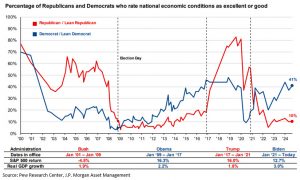
As shown in the chart below, market returns during the Obama and Trump administrations were almost identical (+16%), far above the 30-year average of 10%. Despite similarly strong equity markets, surveys consistently show that individuals rated economic conditions more favorably when their preferred political party wins an election or was currently in power and less so when their party wasn’t in power.

Rather than Gambling on Red or Blue, Invest in Black and White

In the last few weeks, we have seen flows in and out of areas dubbed “Trump Trades” such as cryptocurrencies, banks, and pharma companies. However, it is difficult to do well in the long run by speculating on political agendas.

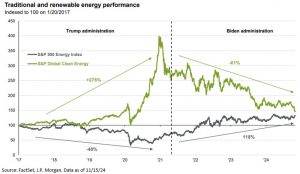
For instance, during the 2016 election cycle Trump campaigned to support the traditional oil and gas industries during his presidency. On the other hand, Biden campaigned to support renewables and promised to reduce exposure to fossil fuels.

However, sector performance was exactly the opposite of what politically focused investors expected. Under Trump, the S&P 500 Energy index, which held oil and gas companies fell 40%, while the S&P 500 Global Clean Energy index rose a remarkable 275%! Conversely, under Biden the S&P 500 Energy index nearly doubled, while the S&P 500 Global Clean Energy index fell more than 60%.

At the end of the day, market performance is shaped by macroeconomic forces. Fluctuations in supply and demand, along with changes in interest rates around the world, had a greater impact than any policies from the White House.

Ultimately, it is policy rather than political posturing that drives the economy. Thus, investors would do well to maintain diversified portfolios of companies with good balance sheets, strong cash flows, and solid business models regardless of political change. Your equity allocation should be driven by your financial plans and time horizons, rather than election outcomes. Maintaining a long-term focus is the key to achieving your financial success.

Capital Markets
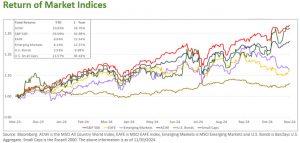
The S&P 500 is on pace to see the first back-to-back years of annual gains of 20%+ since the 1995-1998 market run, but U.S. small caps were the star of the month, rising by 10.8%. The All-Country World Index (ACWI) rose 3.8%, the S&P 500 climbed 5.7%. However, international equities underperformed due to a stronger dollar and trade concerns, with the EAFE down 0.7% and emerging market equities down 3.7%. U.S. Bond prices rose slightly by 1% for the month.

This document contains forward-looking statements, predictions and forecasts (“forward-looking statements”) concerning our beliefs and opinions in respect of the future. Forward-looking statements necessarily involve risks and uncertainties, and undue reliance should not be placed on them. There can be no assurance that forward-looking statements will prove to be accurate, and actual results and future events could differ materially from those anticipated in such statements.
1. See our May 2024 Economic Update “How Politics Influence Perception of the Economy”
2. Source: “Hedge Fund Politics and Portfolios”, DeVault and Sias June 2016
3. Source: “Political climate, optimism, and investment decisions”, Bonaparte et al, May 2017
4. Source: “Partisanship and Portfolio Choice: Evidence from Mutual Funds”, Cassidy and Vorsatz, January 2024


The Corporate Transparency Act: Do You Have A Filing Requirement?

The Corporate Transparency Act (“CTA”) became law on January 1, 2021, and implementation became effective January 1, 2024. The CTA created broad reporting requirements that apply to LLCs, limited partnerships (LPs) and other types of entities, a reporting company. There are also many entities that are exempt from reporting.

Reporting companies are required to disclose to the U.S. Financial Crimes Enforcement Network (FinCEN) the name, residential address, date of birth and unique identification number from an acceptable identification document (e.g., a driver’s license or passport) of all significant owners and persons who may exercise control over the reporting company, the beneficial owners.

Who Is a Beneficial Owner?
FinCEN defines a beneficial owner as any individual who, directly or indirectly exercises substantial control over a reporting company or owns or controls at least 25% of the ownership interests of the reporting company. FinCEN states that substantial control can be exercised in four ways: 1) senior officer 2) authority to appoint or remove senior officers 3) important decision maker and 4) an individual who has any other form of substantial control and they direct you to their Small Entity Compliance Guide for more clarity regarding number 4.

Do Trusts with LLC/LP Interests Have a Filing Requirement?
If a trust owns 25% or more of a reporting company, or exercises substantial control over a reporting company, it must then be determined who the beneficial owners of the trust are, and the trust beneficial owners must be included on the filing for the reporting company. It is not the trust/trustee’s responsibility to file; it is the entity’s responsibility to file.

The Good News
The reportable information is not public information, though FinCEN can disclose information to certain federal or state agencies engaged in national security, intelligence, or law enforcement activity. There is no cost to file with FinCEN, and reporting is not an annual requirement, though information must be updated within 30 days of any change.

The Bad News
The penalty for failure to file is draconian, up to $500/day, with the maximum fine not to exceed $10,000, a prison term of up to two years or both.

Deadlines
Reporting companies formed prior to 2024 must file by January 1, 2025.
Reporting companies formed in 2024 must file 90 days after formation (some may be past this deadline).
Reporting companies formed in 2025 or later must file 30 days after formation.

The FinCEN website has a lot of helpful information:

https://www.fincen.gov/boi

https://www.fincen.gov/sites/default/files/shared/BOI-FAQs-QA-508C.pdf

https://www.fincen.gov/sites/default/files/shared/BOI_Small_Compliance_Guide.v1.1-FINAL.pdf

But Wait! There was a Preliminary Injunction at the Eleventh Hour

On December 3, a judge in the Eastern District of Texas issued a national preliminary injunction against the CTA, prohibiting its enforcement, stating that “reporting companies need not comply with the CTA’s January 1, 2025, BOI reporting deadline pending further order of the Court.”
A few things to keep in mind: 1) The US government filed an appeal on December 5, 2) FinCEN issued an Alert in response to the ruling stating “while this litigation is ongoing, FinCEN will comply with the order issued by the U.S. District Court for the Eastern District of Texas for as long as it remains in effect. Therefore, reporting companies are not currently required to file their beneficial ownership information with FinCEN and will not be subject to liability if they fail to do so while the preliminary injunction remains in effect. Nevertheless, reporting companies may continue to voluntarily submit beneficial ownership information reports.” 3) This is not the only case that has been brought claiming that the CTA is unconstitutional, two other district courts have already rejected requests for a preliminary injunction (one in Virginia and one in Oregon) meaning two other judges were not convinced of the unconstitutionality of the CTA, while one court in Alabama has been successful in challenging the CTA, but that case was state specific. So, while this may be welcome news, it does not necessarily mean it is the end of the CTA as we know it. The injunction is preliminary and temporary until further notice, so anyone with a filing requirement should remain ready to meet the filing requirements should the injunction be lifted, and always should seek the guidance of their attorney as to the best way to move forward.


Director and Wealth Manager Discusses Emerging Trends in Philanthropy with Crain Currency

What’s your giving strategy for 2025? The new year signals fresh opportunities to give back—are you prepared?

Director and Wealth Manager Luke B. Neumann, recently spoke with Crain Currency about emerging trends in charitable giving, including the impact of potential tax changes and how donor-advised funds (DAFs) and qualified charitable distributions (QCDs) are shaping the future of philanthropy.

Read the full article to learn more about these developments and how they may affect the future of giving by clicking here

The Global Trading System – Time for a Reboot?

Since 1980, US trade policy has been largely pro-trade which has allowed unfettered access to US markets for goods and capital. During this time, countries like China aggressively increased exports via state-supported industries, which distorted the US economy through large trade deficits and lost manufacturing and capital inflows.

Undoubtedly, US consumers have benefitted from inexpensive imported goods. However, trade is a double-edged sword. Less expensive imports mean less demand for US goods which harms US manufacturers and workers. Falling living standards for workers, especially in rural areas, has increased voter frustration and spurred the rise of populism.

This article is meant to provide a basic framework for understanding trade deficits, capital flows, and the implications of remedies like tariffs. After the 2024 election, one thing is clear – voters are tired of listening to pro-trade rhetoric and want results, in the form of higher wages and living standards.

Unfair Trade  

Economists tell us that all countries can benefit from trade by exchanging goods from the industries in which they have a low-cost production advantage. While true, countries like China have taken extraordinary measures to support their export industries, benefits which US manufacturers do not enjoy. The Chinese government supports producers with access to cheap credit, lax environmental policies, repression of workers’ wages, and a favorable currency exchange rate. China spends considerable financial effort controlling the value of its currency, the Renminbi. Weakening the Renminbi reduces the prices of goods exported to the US and increases China’s competitiveness. China has used these beggar-thy-neighbor strategies to export subsidized goods to the US and other developed countries, taking market share and crushing competitors.

All the inexpensive imports have devastated US manufacturing. From its peak in 1979 to 2019, manufacturing employment in the US has been gutted, with the loss of approximately 6.8 million jobs including a loss of over 80% of employment in the textile industry.This decline has hit rural communities especially hard given the lack of other well-paying job opportunities in these areas. Since 1979, US manufacturing has declined from 22% of nonfarm employment to just 9% in 2019.ii As seen in the chart below, China comprises a whopping 29% of global manufacturing while only 17% of global GDP.iii  
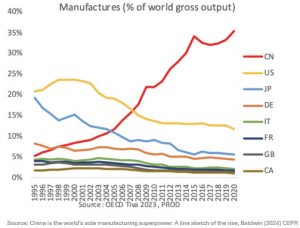
The pace of China’s manufacturing expansion is unprecedentediv and has forced down manufacturing across the developed world.

Trade Imbalances Distort Capital Flows, too

In exchange for goods, foreign surplus economies receive US Dollars which are typically re-invested in US Dollar assets. Exporting countries prefer not to exchange these US Dollars through currency markets for fear of depressing the value of the US Dollar and raising the value of their home currency (or whatever currency they purchased). This preference helps explain why trade deficits are not self-correcting as countries keep US Dollar assets to maintain a currency advantage. For September 2024, the reported monthly trade deficit was $84b, which means foreigners bought roughly $84b in US assets that month. Over time, these purchases of US assets accumulate and are substantial. As illustrated in the chart below, foreigners own over $7 trillion of US Treasuries, which is 22% of the total, and more than the amount the Federal Reserve holds via its quantitative easing programs.v
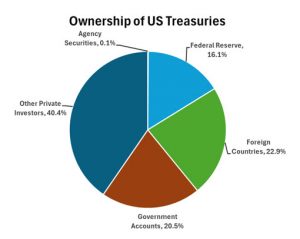
Economists incorrectly worry that countries may stop buying US debt; exporting countries have little choice but to buy US assets to maintain a trade advantage through exchange rates. The purchase of US assets represents a capital inflow of excess capital as the US has plenty of capital to meet its investment needs – just look at the $2.6t in dry powder at private equity firms.vi Excess capital can lead to asset bubbles and potential economic instability.

Tariffs and Measures to Reform Trade

Countries that run a trade surplus (China, Germany, and Vietnam, for example) should face incentives to consume more of their production at home. Those incentives could include tariffs, capital flow restrictions, and new trade agreements that focus on balanced trade with commitments to curb exports to the US and consume more US exports. During his campaign, President Trump promised a wide array of tariffs, even considering them a meaningful source of revenue for the US Treasury.

While all of these measures have shortcomings, there are a few concerns about tariffs:

  • Targeted country tariffs have shown little success. Since 2018, the US has enacted several country-specific tariffs that have had little impact on the overall trade deficit. While targeted tariffs reduced reported trade from China, many exporters rerouted Chinese goods through other countries like Vietnam, Taiwan, and Mexico and avoided paying tariffs.vii
  • Across-the-board tariffs will have unintended consequences. While solving the rerouting issue, broad tariffs would likely raise prices for items we may never produce like bananas or popular consumer items like iPhones. Further, across-the-board tariffs will likely increase prices generally, considering the time and investment it takes to relocate production to the US.

Global role of US Dollar

Another point of consideration is the role of the US Dollar as the world’s dominant currency. The US Dollar comprises 54% of foreign trade invoices and 59% of foreign currency reserves.viii Unfortunately, the US pays a cost for the global role of the US Dollar through increased capital inflows and a higher value of the US Dollar. While many believe a strong US Dollar shows US economic strength, it counteracts the effect of tariffs. The US should focus on lowering the value of the US Dollar to help domestic manufacturing and raise the cost of imported goods.

The US may consider a multifaceted approach to fixing trade – well-designed tariffs, limits on foreign asset purchases, and trade agreements focused on balanced trade. Importantly, the US needs to lower the value of the US Dollar through policies that could include reducing the role of the US Dollar in global finance. However, fixing the global trading system will take time.

Takeaways 

As we think about pending tariffs from the Trump administration, here are a few takeaways:

  • Change is coming: The 2024 election shows that voters believe the global trading system is badly broken and needs to be fixed.ix Tariffs aren’t perfect but may prove a good starting point for a discussion about what the US wants for fair trade.
  • Timing: Changes in tariffs will take some time to implement with the earliest impact near the end of 2025. Most likely, higher tariffs will take effect in 2026.
  • Higher prices: Imports are 14% of US GDPx, so across-the-board tariffs will have a large economic impact. Goldman Sachs’s tariff rule of thumb is every 10% increase in the US tariff rate would increase inflation by 1.0%.xi
  • Manufacturing rebuild: Rebuilding the manufacturing base will take time – think decades given complex supply chains and existing manufacturing bases. Manufacturing companies will want to see durable change before building a new plant, not tariff policies which could change every four years.

At Crestwood, we continue to watch for economic changes that may impact your investments. Importantly, we focus on constructing diversified portfolios designed to weather storms which include changes to industrial policy. Financial markets try to anticipate these changes and frequently overreact based on emotions. We believe it important to keep an eye on the long term and focus on durable changes to policy that may affect financial markets and possibly portfolios. Constructive policies on reshaping trade to a greater balance between imports and exports could have the potential to increase US GDP growth and raise living standards across the US. We will be watchful for policy changes and continue to position portfolios to meet clients’ long-term goals.


iForty years of falling manufacturing employment, Harris U.S Bureau of Labor Statistics: https://www.bls.gov/opub/btn/volume-9/forty-years-of-falling-manufacturing-employment.htm
iiIbid.
iii“Trade Intervention for Freer Trade” Pettis and Hogan 2024 Carnegie Endowment for International Peace: https://carnegieendowment.org/research/2024/10/trade-intervention-for-freer-trade?lang=en
ivIbid.
v“The US breached $34 trillion in national debt. Here’s who owns every dime.” Rosaria Straight Arrow News
https://san.com/cc/the-us-breached-34-trillion-in-national-debt-heres-who-owns-every-dime/
vi“Private equity dry powder growth accelerate in H1 2024” S&P Global https://www.spglobal.com/marketintelligence/en/news-insights/latest-news-headlines/private-equity-dry-powder-growth-accelerated-in-h1-2024-82385822
vii(Still) Made in China: how tariff hikes may trigger re-routing circumvention Shi and Liu 2019, CEPR https://cepr.org/voxeu/columns/still-made-china-how-tariff-hikes-may-trigger-re-routing-circumvention
viii“The changing role of the US dollar” Boocker and Wessel, Brookings
https://www.brookings.edu/articles/the-changing-role-of-the-us dollar/#:~:text=The%20dollar%20makes%20up%20a,of%20foreign%20trade%20invoices%20globally.
ix“Trade Intervention for Freer Trade” Pettis Hogan 2024 Carnegie Endowment for International Peace: https://carnegieendowment.org/research/2024/10/trade-intervention-for-freer-trade?lang=en
xSt Louis Federal Reserve FRED https://fred.stlouisfed.org/series/B021RE1A156NBEA
xi“Global Economic Comment: Economic Impacts of Tariff Proposals on USMCA Participants” Briggs, Phillips and Ramos 2024 Goldman Sachs