April is National Financial Literacy Month – Knowing the Basics Throughout Life

April is Financial Literacy

In March 2004, the U.S. Senate designated April as Financial Literacy Month to raise awareness of the importance of financial education and the consequences of a lack of knowledge about personal finances.

Financial literacy affects everyone: your family, friends, neighbors, colleagues, and community members. The concern arises because many do not receive the appropriate level of education on personal finances during their high school or college years.

When the time comes to make financial choices in adulthood, those without access to information or proper financial education risk making errors with critical decisions that can negatively affect their financial futures.

While getting an education early can help, more advanced financial topics arise as we move throughout our lives. Here are some basics and when you may start to face them. Learning these topics and being prepared to tackle them will help everyone!

Kids & Teenagers

o Value of a dollar: Learning the value of a dollar through chores or a part-time job can help develop an understanding of the concept of money.
o Compounding interest: Understanding compounding interest and how a dollar grows is a concept taught in school during most algebra classes.
o Spending plan: Teaching kids and teenagers how to allocate their money into different categories like spend, save, and donate will help them understand the purpose and uses of money.

Young Adulthood

o Credit score and debt management: Building credit and managing debt is a skill that can be difficult to navigate for all ages. Knowing the composition of your credit score, good vs. bad uses of debt, interest rates, and strategies for paying off debt is relevant for most adults.
o Investing: How, when, where, and why to invest should be understood at a basic level for young adults. The information available is vast, but individuals should look to respected financial institutions for education.
o Setting goals: Setting savings goals for short, medium, and long-term goals is necessary to have a path ahead for the future. Financial goals change as life does (marriage, children, etc.), so setting new goals will be required as time passes.

Adulthood – Building Careers and Families

o Net worth: Adults should develop a net worth statement showing assets minus liabilities. This is helpful to gauge your current financial standing and how close or far you are from meeting the goals you set.
o Employer benefits: Learning how to take advantage of and maximize employer benefits like retirement plans (401(k), 403(b), etc.), medical and dental benefits, and Health Savings Accounts (HSAs) is low-hanging fruit. Making the most of your benefits now allows for an easier road ahead.
o Protection: Ensuring financial protection with life, disability, and property and casualty insurance is essential at all ages but should be looked at closely as you accumulate assets and have more financial obligations. Also, having estate planning documents to protect you and your family is essential in adulthood.
Late Career and Retirement
o Financial plan: A financial plan is crucial as you begin to think about the next chapter. Understanding how much you have accumulated and how to make it last during retirement is at the forefront of most people’s minds when creating a financial plan.
o Long-term care planning: Having a plan for how you will pay for medical expenses and specialized care as you age makes a big difference when a major medical event does occur.
Advanced Ages
o Avoiding abuse: Protecting yourself from scams and thieves is important at all ages, but those at advanced ages are particularly vulnerable. Educating yourself on how to prevent and avoid loss and asking someone you trust for help overseeing your finances may save you stress and loss of money.
o Leaving a legacy: It may have been many years since you created your estate planning documents. Will your assets transfer as you currently desire? What type of legacy would you like to leave behind?

As your financial situation and decisions become more complex, having a team of experienced professionals who can educate and advise you is critical to a successful financial future. Contact your team at Crestwood if you have questions about your financial situation or have a family member/friend that could use our help.

Women Face Unique Challenges in Financial Planning

Women Face Unique Challenges in Financial Planning
  • From fewer years in the workforce due to motherhood, to longer life expectancy, women often face numerous financial challenges that affect their ability to maximize their financial goals. Unbalanced gender expectations, shortage in savings and limited financial literacy can lead to lower lifetime earnings and ultimately inadequate resources.
  • With thoughtful planning and strategies, women can create a path to achieve their financial goals, regardless of the unique hurdles they encounter. Building compassion, saving as soon as possible, and partnering with the appropriate professional will get you on the right track.

Women are now earning, controlling, and inheriting more money and assets than ever before. Despite these improvements, it is still challenging to balance building a career with the expectations of being a caregiver to their children and aging parents.

Leaving the workforce to care for a family is innately nurturing but may hinder women’s ability to save towards their 401(k) and benefit from their employer’s matching contributions. Conversely, daycare is costly, and parents may feel like they are missing out on their child’s development. This is the reality and sacrifice women face daily.

The decision to stay home permanently or temporarily can have an impact on women’s earning potential. Lower lifetime earnings can limit Social Security benefits, reduce potential pension income and retirement contributions, and result in a smaller nest egg in retirement.

A shortage in savings can become automated over time and create indecision and open-ended questions: How heavily do I rely on my partner’s income? What happens if we get divorced? How do I protect myself? These are all questions many women consider when making difficult life-changing decisions.

In addition to unbalanced gender expectations, women have a longer average life expectancy than men, yet many do not have a Financial Plan in place. Even with modest inflation assumptions of 2.5%, basic living expenses will increase dramatically during retirement, and women will need their resources to last 20-30 years longer than previous generations.

If you find yourself struggling to balance the demands of your time, you are not alone. Here are some strategies to help women feel empowered to take control of their financial destiny:

  • Show Compassion for yourself. Re-entering the workforce can be less intimidating. Whether you’ve been out of the workforce for 1 year or 5 years, you can always re-enter the workforce with pride and gain new skills in a different industry. Transferrable skills such as time management, organization, and communication can be applied to many other industries. Prioritizing your family is a valid choice and does not require an apology. Negotiate your salary to offset the wage gap because you deserve to be paid fairly. Promoting yourself with the deserved recognition will allow you to earn more and save more for retirement.


  • Build your confidence by leaning on each other. Women are more likely to have shared experiences in which to build a safe space and make the process less overwhelming. Share your stories and start conversations about financial literacy and education. Engage with people you feel comfortable with to collaborate and begin conversations. Listen to podcasts, videos, and financial publications to learn about basic investment terminology. Start with the Clever Girls Know Podcast, Habits to help you improve your self-discipline. This episode inspires women to master self-discipline, ditch debt, and learn more about growing your money. 


  • Save a little, as soon as possible. With longer life expectancy, women should start saving sooner during earning years and start investing in their retirement earlier.
    • Set up automatic savings to build an emergency fund.
    • Automate your saving for longer term goals like retirement.
    • Map out cash flow and expenses for a clear picture of where your dollars are going.
    • Establish a 529 account for your children as early as possible so you don’t feel constrained to fund heavily in the years closer to college.

For example, at a 6% college tuition inflation rate, assuming a moderate rate of return of 5.6%, you can set aside $1,000/ month for 18 years to fulfill 100% savings goal for $55K University. Save early in employer-sponsored plans to take advantage of the power of compound interest, earnings, and employer matches. Contributing $6,000 annually into a 401(k) plan at age 25 each year until 67, you can amass $1.19M at 67 with annual compounding ($258,000 in contributions and $934,000 in interest).


  • Get the right financial advice & participate in the planning process. With the appropriate team of Financial Planners, you can prioritize your financial and personal goals and set timelines for accomplishing them. Partner with a qualified investment professional to evaluate investment products and strategies and help determine your appropriate asset allocation to meet your specific goals, which may evolve over time. They are a resource for you to understand how the economy and financial markets affect your portfolio. Women tend to be less aggressive investors, and it is normal to not know everything about the stock market. Understanding asset allocation on a high level and staying with a long-term plan through market swings will lead to better investment and returns.

Women should allow themselves to be in the driver’s seat and build a baseline plan to have the financial freedom they desire. Reach out to Crestwood today so we can partner with you to gain greater control over your financial life!

Trusts Can Be an Effective Wealth Transfer Tool

Trusts Can Be an Effective Wealth Transfer Tool

Trusts can be an effective strategy for wealth transfers when interest rates rise to help fight inflation. The effect on the performance of trusts for estate planning vehicles is often linked to the federal funds rate.

“It’s important to emphasize that there is a very limited downside to most of these strategies,” said Alexandra Blake, director and wealth advisor at Crestwood Advisors. “Even if the investment return doesn’t beat the hurdle rate, the only sunk cost is the few thousand dollars to set up the initial vehicle.”

Click here to read the full story from Financial Advisor.

Financial Advisors Adapting New Business Models for Millennials: How younger advisors can teach older advisors a thing or two about millennial finances

Financial Advisors Adapting New Business Models for Millennials:

Move over baby boomers because in 2019 millennials surpassed you by becoming the largest generation in the United States. With this generation’s increase of financial inheritance compared to the previous generation, financial advisors need to adapt new business models to attract and retain younger clients.

One suggestion is that advisors should consider a subscription fee schedule. “Create a model based on an annual fee, monthly fee or percentage of income,” says Billy Spencer, a wealth planner at Crestwood Advisors.

Click to read more from Financial Advisor here.

Crestwood Wealth Planner Gives Advice to Young Advisors Entering the Industry with Financial Advisor

Crestwood Wealth Planner Gives Advice to Young Advisors Entering the Industry with Financial Advisor

FA-IQ reached out to advisors to ask: What’s a piece of advice you have for young advisors entering the industry?

“Join a firm that genuinely cares about its clients! You’ll learn more, become a better advisor, and probably have more fun while doing so,” said Luke Neumann, a wealth planner at Crestwood Advisors.

Read the full article now to find out more about Luke’s advice for young advisors!

Financial Advisor IQ

Navigating Inflation

Rising interest rates and recession fears continue to weigh on investors as the Consumer Price Index (CPI) report for August was stubbornly high at 8.3%.  With rising interest rates impacting bond markets, most investors have seen both their equity and bond portfolios lose value.  This environment may remain challenging until there is clarity on inflation as the Fed’s stance is firm that they intend to fight inflation regardless of the consequences to the U.S. economy.

Inflation metastasizes across the economy

Earlier this summer, inflation spiked to 9.1%, a 30-year high, ending a goldilocks period of low interest rates, contained inflation and steady growth. The initial spike in inflation was driven by surging demand for goods aided by stimulus payments to individuals, strong wage growth and rising commodity prices.  Initially, inflation was believed to be transitory and due to supply chain congestion, but as higher prices spread into housing, services and wages, inflation has admittedly become more entrenched across the economy.

The Fed – higher rates

The Fed’s primary tool to combat inflation is raising interest rates which increases borrowing costs for consumers.  Consumers who use credit will see higher costs to buy goods – especially more expensive items like homes and cars.  The Fed anticipates that higher rates will lead consumers to reduce spending and slow aggregate demand which will help to cool out-of-control inflation.  One input, pending home sales for July were down -22.5% year over year as higher interest rates sharply reduced home affordability.

Reducing inflation will take time

As Tuesday’s August CPI showed, the Fed’s battle against inflation will take time. There are three main reasons why we expect inflation to remain stubbornly high:

  1. The U.S. consumer is healthy.  Low debt service ratios, soaring prices for houses, rising wages and generous stimulus payments have helped consumers’ balance sheets and bolstered spending. So far, higher interest rates have had little effect on the U.S. consumer who continues to drive GDP growth.
  2. Sticky components of inflation are high.  Inflation has spread into areas of the economy where prices are slow to change like services, wages, and housing.  In particular, shelter prices (rents) have followed soaring home prices. Shelter is an important component of CPI (32%) and core CPI (40%).  In August’s CPI report, shelter prices increased 6.3% year over year, rising at the fastest rate since 1991. Over the past 20 years shelter has helped to anchor low inflation, now shelter is doing the opposite.
  3. Tight labor markets.  With the U.S. economy running at or near full employment of 3.7% and with job openings at 2x the number of unemployed persons, labor markets are the tightest in post WWII history. It will be challenging for the Fed to slow the economy enough to create the slack needed in the labor markets to cool wage growth. There are some signs that workers who may have left the workforce due to the pandemic are returning to work, but the labor market remains very tight.

Typically, actions by the Federal Reserve take 3-6 months to have an impact on the economy, so we expect to see demand gradually decline as consumers feel an increasing impact of higher interest rates. We expect the Fed to continue to raise interest rates until they see sustained signs of lower prices and some slack in labor markets.  The August CPI number highlights that the Fed has a long way to go to tame inflation.

Recession fears

Our base case remains that U.S. economic growth continues to slow but remains positive year over year.  Considering economists estimate the long-term growth rate of the U.S. economy to be 1.0%-2.5%, the chance a slowdown dips the economy into a recession is higher than normal.  Importantly, a deep recession similar to the Global Financial Crises in 2008/2009 is unlikely.  Consumers remain in great financial shape with lower debt service and higher household wealth.  Similarly, banks who sailed through the pandemic are much better prepared for any downturn.  We expect any recession would be a shallow one.

Russia rankles Europe

In response to sanctions for their invasion of Ukraine, Russia has sharply restricted natural gas flowing to Europe.  Germany is particularly vulnerable as before the war 55% of Germany’s consumption of natural gas came from Russia.  In anticipation of higher winter demands, Germany has been building natural gas storage, curtailing consumption, and switching to other sources for electrical generation.  Uncertainty runs high as no one can predict Russia’s actions, but a prolonged shutoff could affect GDP growth as gas will need to be rationed.

Positioning

We continue to focus on quality for both fixed income and equity investments. For fixed income investors, we have built an allocation to short-duration, high-quality bonds to protect from rising interest rates and credit concerns.  Shortening duration has been important to help offset falling prices as interest rates have risen sharply this year.  Investors have favored high quality bonds over lower quality bonds as slowing economic growth and higher borrowing costs may stress some issuers.

In the U.S. stock market, we remain focused on quality companies with solid growth prospects.  Earnings growth has been solid as the S&P 500 index posted 6.2% earnings growth in the second quarter. With the S&P 500 down -16.1% YTD, market valuations have improved dramatically. The below chart shows the forward price to earnings multiple (a measure of how much stocks cost), has fallen from 22.8x at the beginning of the year to 17.4 which is just below the 10-year average of 17.8.
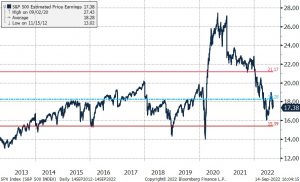
We remain underweight international equities and defensively positioned in European equities.  Though the energy crisis and war in Ukraine are concerns, European earnings have held up relatively well and are helped by the U.S. Dollar strength.

We continue to be patient and opportunistic as we evaluate companies and make portfolio adjustments. To that end, we have added several new investments in strong businesses that now offer compelling valuations. Additionally, your position in short term bonds, including U.S. Treasuries, offers an attractive yield, high degree of safety and a source of potential liquidity. Finally, while incurring losses is never our goal, the volatility & weakness throughout 2022 has provided us opportunities to focus on new opportunities and tax-loss harvesting across taxable portfolios.

Times like these are never easy as an investor; however, historically, these volatile periods present opportunities to long term investors. As always, we caution against reacting to short-term volatility and encourage sticking with well-considered, long-term investment plans.

Director, Equity Analyst Julie Praline Discusses Inflation Reduction Act Impacts

Director, Equity Analyst Julie Praline Discusses Inflation Reduction Act Impacts

As the Inflation Reduction Act seeks to support clean energy, many investors are questioning whether or not to invest in renewable energy companies.

“The broad [sustainable-energy and eco-friendly] sector will see a long-term boost from the Inflation Reduction Act, lifting demand [and] the profitability profile of some players,” says Director, Equity Analyst Julie Praline in a recent Financial Advisor Magazine story.

Read the full article here.