Mindful Money Moves: How Self-Awareness Can Strengthen Financial Decision-Making

When we think about the financial decisions we make, we like to believe they’re always rational. Spend less. Save more. Invest wisely. In practice, however, emotions, habits, and social influences often play a quieter but equally powerful role.

You may find yourself maintaining a long-standing vacation routine even though your family’s schedule and interests have shifted. You might delay replacing a vehicle while weighing timing, tax considerations, or resale value. Or perhaps you’re evaluating a significant discretionary purchase after seeing peers make similar upgrades. None of these choices are inherently wrong, but they are worth considering.

Self-awareness helps surface the behavioral forces behind financial decisions. Familiarity, loss aversion, and social influence can subtly shape outcomes. When recognized, these dynamics become tools rather than blind spots, allowing you to make choices that better align with your broader financial picture and long-term priorities.

Below are several approaches designed to complement the way successful families already evaluate complex decisions.

Thoughtful Approaches to High-Quality Financial Decisions

Create distance before committing.
Significant decisions benefit from space. Allowing time between intention and execution, whether days or weeks, can surface considerations around timing, liquidity, taxes, and opportunity cost that are easy to overlook in the moment.

Clarify the objective.
Before proceeding, articulate what the decision is meant to accomplish, enhancing lifestyle, simplifying complexity, supporting family priorities, or responding to external signals. Precision around purpose sharpens judgment.

Evaluate the full context.
Consider the choice alongside your broader financial architecture: balance sheet strength, upcoming liquidity needs, investment strategy, estate planning priorities, and philanthropic objectives.  Strong decisions rarely exist in isolation.

Stress-test the alternatives.
Examine credible paths rather than defaulting to a single course of action. What changes if you act now versus later? Do you allocate capital here versus elsewhere? A structured comparison often strengthens conviction.

Preserve intentional flexibility.
Well-designed financial lives include room for enjoyment and spontaneity, within a framework that protects what matters most. Defining that flexibility in advance allows decisions to feel confident rather than reactive.

We are hard-wired to respond emotionally, and opportunities to act are constant. When faced with a meaningful financial choice, pausing to ask, “How does this fit within my broader plan?” can materially change the outcome.

At Crestwood, we help families connect day-to-day decisions to long-term purpose through a comprehensive planning process that integrates investment strategy, tax efficiency, estate considerations, and philanthropy. If you would like to explore how behavioral insights fit within your own roadmap, your Crestwood team is always available to serve as a thoughtful sounding board.

This document is provided for general informational purposes only by Crestwood Advisors, an investment adviser. Crestwood Advisors does not endorse, sponsor, or promote any of the products or companies listed or mentioned in this material. Any references to specific products or services are purely incidental and are included solely to illustrate potential strategies or concepts. The inclusion of such references does not imply any form of partnership, relationship, or approval by the Firm.

2026 Brings New Rules For Your 401(K) Accounts

As we move into 2026, retirement savers are facing important rule changes in employer plans like 401(k), 403(b), and 457(b) accounts. These changes affect base contribution limits, “catch-up” contribution limits for those over 50 and between the ages of 60-63, and the tax treatment of “catch-up” contributions for higher-income savers.

Key 401(k) Changes for 2026

The Limit for Base 401(k) Contributions Rises

For 2026, the maximum elective deferral, the amount an employee can contribute from their salary to a 401(k) plan, increases to $24,500, up from $23,500 in 2025. This adjustment reflects inflation and gives savers more room to build their nest eggs each year. Note: this change applies to contributors regardless of age.

Catch-Up Contributions Rise for Older Savers

So-called “catch-up” contributions, additional amounts that older savers can put aside beyond the standard limits, are also rising in 2026. These enhanced catch-up limits are designed to help those closer to retirement age accelerate savings, especially if they started late or temporarily paused contributions in the past.

  • If you are 50 years of age or older in 2026, you can contribute an additional $8,000 on top of the regular $24,500 limit, for a total employee contribution of $32,500. That’s a bump up from the previous catch-up limit of $7,500.
  • If you are between the ages of 60 and 63, a new “super catch-up” contribution limit applies. You can contribute up to $11,250 extra in 2026, taking your overall potential employee contribution limit to $35,750.

Catch-Up Contributions Must Be Roth for High Earners

Perhaps the most significant shift for 2026 impacts how catch-up contributions are taxed.

  • Under a SECURE 2.0 provision taking effect in 2026, catch-up contributions made by participants with prior-year FICA wages over $150,000 must be designated as Roth contributions rather than traditional pre-tax contributions. This means you will pay tax on your catch-up contribution today rather than deferring the tax until retirement.

Note that your 401(k) plan must offer a Roth option for these contributions to take place. If your 401(k) doesn’t have a Roth feature, you might not be able to make catch-up contributions at all under the new rule. Check with your HR or plan administrator about whether your plan supports Roth contributions and, if not, whether it plans to add them.

Keeping Pace with the New Rules

By knowing the rules and planning ahead, you can make smarter decisions about when and how to save. The right moves in 2026 can help you grow your retirement nest egg while managing your tax bill and securing a more predictable income stream for later years.

If you’re unsure about how the new rules will impact your financial plan, please consult with a Crestwood financial advisor or tax professional.

Internal Revenue Service. “401(k) Limit Increases to $24,500 for 2026, IRA Limit Increases to $7,500.” IRS, 13 Nov. 2025, www.irs.gov/newsroom/401k-limit-increases-to-24500-for-2026-ira-limit-increases-to-7500

Crafting Your Legacy

The legacy you leave behind should not be defined solely by the sum total of your estate, but by the goals, values, and purpose that shape how your wealth is created, managed, and transferred, your “why.” Strategic planning, when informed by your intentions, provides a powerful framework for crafting your legacy.

Be Intentional
Creating a strategy for your legacy begins with clarity of purpose. Before technical tools and legal structures are put in place, you must first define what you want your wealth to represent. Core values such as responsibility, generosity, independence, education, and service often shape these intentions. When planning is aligned with these principles, financial decisions gain coherence and direction. This alignment also helps ensure that wealth is not distributed arbitrarily, but intentionally, in a way that reflects both your personal beliefs and long-term goals.

Every decision in strategic planning, how your assets are structured and invested, when they are transferred, and to whom or to what, defines your priorities. When these decisions are motivated by your core values, your wealth becomes a narrative rather than just numbers on a statement. Your plan will tell a story about what matters to you, what you believe, and what you encourage future generations to embody, and that story translates into effective legal, financial, and philanthropic structures to ensure your values and intentions endure across time.

Learn how to invest with intention and continue working towards your legacy goals, even when markets are volatile.

Behavioral Investing: Overcoming Biases for Better Decision Making

February 12, 2026
12:00 pm – 1:00 pm ET
Register Now

Prepare the Next Generation.
Succession planning is essential for ensuring continuity, particularly in families with closely held businesses or significant shared assets. Effective succession planning goes beyond defining heirs and key roles, it involves preparing the next generation to manage wealth and business interests, in alignment with the family’s values and intentions. This may include defining leadership roles, establishing governance structures, and providing education or mentorship. By doing so, individuals can reduce the risk of conflict, mismanagement, or dissipation of wealth. Succession planning ensures that assets are not only transferred but entrusted with clear expectations and a shared sense of purpose.

Support Your Values.
Charitable giving offers one of the most direct ways to align wealth with values. Philanthropy allows you to support causes that reflect your beliefs, passions, and vision for a better future. Whether focused on education, healthcare, faith-based initiatives, social equity, or environmental conservation, charitable giving transforms wealth into a force for positive change.

Strategic charitable planning also enables you to give in ways that are sustainable and impactful over time. Charitable trusts, donor-advised funds, and family foundations can provide structure and continuity, allowing charitable intentions to endure beyond a single lifetime. In this way, philanthropy becomes not just an act of generosity but a defining element of your legacy.

Lifetime Gifting.
Gifting is another powerful strategy for both preserving wealth and expressing what is meaningful to you. By transferring assets to family members during your lifetime, you can reduce the size of your taxable estate while directly supporting the development and well-being of your loved ones.

More importantly, gifting provides an opportunity to model your values in action. Thoughtful gifts can be used to encourage education, entrepreneurship, or responsible financial behavior. When paired with open communication, gifting can reinforce lessons about stewardship, gratitude, and accountability. Rather than creating entitlement, values-driven gifting helps cultivate independence and purpose, ensuring that wealth serves as a foundation for growth rather than a source of complacency.

Estate Tax Mitigation.
Tax efficiency is a critical component of preserving wealth and honoring your intentions. Taxes can significantly erode an estate, reducing the resources available to support family members or philanthropic goals.

Estate tax mitigation strategies seek to minimize unnecessary tax exposure through techniques such as leveraging exemptions, utilizing trusts, and timing asset transfers appropriately to help ensure that more wealth is preserved for its intended purposes.

Guide Your Legacy.
Strategic planning guided by core values and clear intentions can play a key role in shaping the legacy you leave behind. Such strategies allow wealth to serve not only as financial security, but as a lasting expression of your purpose, responsibility, and vision. In the end, a well-planned legacy is not measured by the numbers you see on a statement, but by how faithfully it carries forward the values that give it meaning. As you look ahead to the coming year and beyond, think about the steps you can take to ensure that your legacy is the one you intend.

If you would like support in helping you plan for your legacy, your Crestwood team is here to help you move into the next stage with confidence.

January 2026 Economic Update: Looking Back at 2025

2025 was a year of economic uncertainty and concern, but also of resilience and growth. In this month’s Economic Update, we look back at the issues that dominated our thinking on the economy and financial markets each quarter and then look forward to what we’re focused on in 2026.

Q1: Fear of the Unknown
As the Trump administration in Washington found its footing, expectations for global trade reform loomed large. In Q1, our attention was on the impact that tariffs could have on inflation and economic growth, and how the unpredictability of outcomes could spook the financial markets.

A reactionary massive surge in imports contributed to a contraction in GDP of 0.5% in quarter1. At the same time, inflation remained elevated, leading the Fed to keep its restrictive monetary policy in place. In this uncertain environment, the US stock market struggled for direction as investors feared that recession, or even stagflation, might be on the horizon. By quarter’s end, volatility had returned to the market, and the S&P 500 had lost 4.3%.

In our March update, we reminded investors of the resilience of American institutions and advised them to remain patient, focusing on long-term goals rather than short-term volatility. This advice would serve them especially well in the quarter to come.

Q2: Liberation Day Selloff and Recovery
The second quarter began with the Liberation Day announcement of sweeping tariffs on America’s trading partners. The size and scope of the tariffs caught investors off guard, resulting in a swift selloff across equity markets, including an 11% decline in the S&P 500.

We pointed out that periods of extreme uncertainty may persist for a time, but they are not permanent, and that markets react favorably once a measure of predictability returns.

The announcement of a three-month “pause” in the tariff rollout signaled such a window of predictability. By the end of the quarter, equity markets had recovered, and the S&P was up nearly 6% YTD.

Q3: Shooting the Messenger and Divergence at the Fed
Tariff risk persisted into the third quarter; however, delayed implementation timelines and constructive progress in trade negotiations helped ease market concerns. In Q3, the Bureau of Labor Statistics revised estimates on job growth downward. The reaction was swift: President Trump fired the head of the BLS, the dollar weakened, and equity markets declined. Though the Fed was divided on the pace of rate cuts, the slowing economic data proved enough to convince them to cut rates by 0.25% in September. Equity markets responded favorably, with the S&P 500 rising by a healthy 7.8% in the quarter.

Q4: Closing Time and K-Shaped Data
The fourth quarter began with the shutdown of the Federal government. While every shutdown is unique, we expected the impact on equities to be modest and temporary, and recommended clients stay the course rather than trading on this news. This was indeed sound advice. Despite becoming the longest shutdown on record, the impact on equity markets was mild.

As economic growth took center stage toward year-end, we brought attention to the distinctive nature of the current K-shaped data, which evidenced a bifurcated mix of “winners and losers” in equity markets, higher vs. lower-income households, and other areas of the economy.

The fourth quarter was a victor lap for patient equity investors. The government reopened, and the Fed committed to a “normalization” path with 0.25% rate cuts in October and December.

Looking Ahead: 2026 Rhymes, but will not Repeat

We believe three trends will play out in 2026:

  1. Steady Fundamentals. The US economy remains resilient, benefitting from pro-growth fiscal policy, healthy corporate balance sheets, and robust consumer spending, with the anticipated 2026 tax rebate likely to provide a modest incremental boost to household consumption and aggregate demand.
  2. (Relative) Rate Stability. We expect monetary policy to normalize with a bias towards slowly lowering rates. Incoming Fed members are likely to be sympathetic to the administration’s preference for lower rates. Compared to the last 6 years, where rates rose from zero to over 5% rapidly and then gradually trickled down, we are entering a period of relative stability. In addition, there is a potential for lower rates regardless of economic trends. Stability and lower rates benefit both companies and investors.
  3. Earnings Expansion 2. Meaningful earnings growth likely won’t be confined to AI stocks and the Magnificent 7 3 in 2026. There is a pronounced shift in earnings expectations toward companies beyond the Magnificent 7. While Mag 7 stocks are still expected to deliver strong earnings growth, the change in year-over-year expectations is modest – only +2% higher in 2026 (+22.7% vs. +22.3% for 2025). By contrast, analyst earnings estimates for the other 493 companies are 33% higher for 2026 than in 2025 (+12.5%vs. +9.4%).

The combination of these three trends points toward a favorable backdrop for investors in 2026. However, we continue to recommend a diversified and flexible portfolio philosophy, rather than chasing last year’s “winners” and shunning last year’s “losers.”

No one could have predicted the events of 2025 that we recapped above, but veteran investors know that every new year holds unexpected twists. As we noted many times throughout 2025, the best maxim for long-term investment success is “Patience and Discipline.”

Capital Markets
December was a soft month for US investment returns, while overseas equities saw an appreciable rise. The All-Country World Equity Index (ACWI) rose 1%. Both Developed Non-US equities, as measured by the EAFE and Emerging Market Equities, as measured by the MSCI EM Equity Index, rose by 3%. The S&P 500 finished nearly flat for the second month in a row (+0.1%). Likewise, bonds as measured by Bloomberg’s US Aggregate index were nearly flat, declining by 0.2%. US Small Caps declined 0.6% for the month.
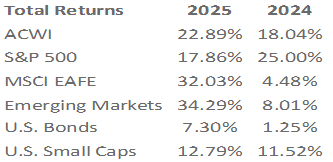
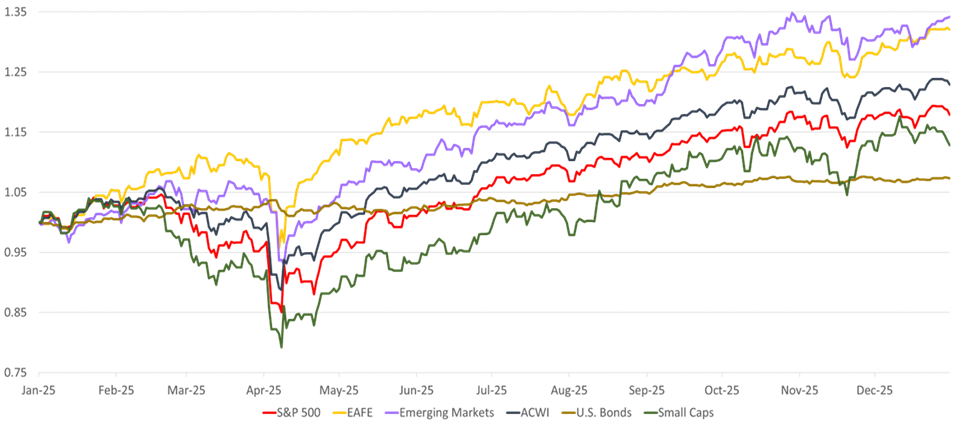
Source: Bloomberg. EAFE is MSCI EAFE Index(1), Emerging Markets is MSCI Emerging Markets(2) and U.S. Bonds is Barclays U.S. Aggregate(3). ACWI is the MSCI ACWI Index(4). Small Caps is the Russell 2000 Index(5). S&P 500 is the S&P 500 Index(6). The above information is as of 12/31/2025.


1 Since GDP is a measure of domestic production, imports represent foreign 2 production and thus are subtracted from the GDP calculation as these are already accounted for in domestic spending.

2 Source: FactSet Earnings Insight 12/19/25

3 The Magnificent 7 currently include Nvidia, Apple, Microsoft, Amazon, Alphabet (Google), Meta (Facebook), and Tesla. While Broadcom replaced Tesla as one of the 7 largest stocks in the S&P 500 by market capitalization, Tesla is still commonly included in the Mag 7 group.


This document contains forward-looking statements, predictions and forecasts (“forward-looking statements”) concerning our beliefs and opinions in respect of the future. Forward-looking statements necessarily involve risks and uncertainties, and undue reliance should not be placed on them. There can be no assurance that forward-looking statements will prove to be accurate, and actual results and future events could differ materially from those anticipated in such statements.