ISOs, the AMT, and New Rules in the OBBBA

The One Big Beautiful Bill Act (OBBBA) introduces several tax-law changes that significantly affect how the Alternative Minimum Tax (AMT) applies beginning in 2026. While the law keeps the higher AMT exemption amounts originally introduced under the Tax Cuts and Jobs Act (TCJA), it lowers the income thresholds where the exemption begins to phase out and accelerates the phaseout rate once those thresholds are crossed.

Starting in 2026, the exemption’s phaseout thresholds revert to lower levels than under TCJA: $500,000 for single filers, and $1,000,000 for married (joint) filers, before income-based reduction of the exemption. Simultaneously, the phaseout rate doubles, from 25% under TCJA rules to 50% under the OBBBA.

These changes make the AMT more likely to affect higher-income taxpayers and anyone with large AMT “preference items,” most notably, Incentive Stock Option or “ISO” exercises.

The Impact on ISOs
For people with Incentive Stock Options, the AMT impact becomes particularly important. When you exercise an ISO and hold the shares, the “bargain element” (the difference between the stock’s market value at exercise and your strike price) is not regular taxable income, but it is included in AMT income. Under OBBBA’s tightened phaseout thresholds, this AMT add-on can tip many taxpayers into AMT liability—even those who previously avoided it under TCJA’s more generous rules.

In addition, OBBBA modifies the SALT deduction cap, allowing a higher deduction for many taxpayers. But under the AMT system, SALT deductions are added back, meaning a larger SALT deduction can unintentionally contribute to triggering AMT when combined with ISO exercises.

Because of these changes, many ISO holders may face greater AMT exposure beginning in 2026 than they have before.

What to Do
Everybody’s tax situation is different. But if you are in a high tax bracket and have access to ISOs as part of your compensation, you may include the following as part of your tax plan this year:

Model your AMT exposure before exercising ISOs. Consider front-loading ISO exercises this year rather than waiting, if it also makes sense financially and you can afford any cash outlays or holding risks.

Plan your SALT deduction more carefully. If you live in a high-tax state or expect large state and local taxes, combining that with ISO exercises may magnify AMT risk.

Keep in mind your AMT carryforward credit potential. If you do trigger AMT in a year because of timing (e.g., a big ISO exercise), you might be eligible to recover some of the extra AMT paid in future years via the “minimum tax credit.”

Most importantly, check with your financial and tax advisors if you have both ISOs and large itemized deductions. Ignoring or not fully understanding and planning for the changes to the AMT tax regimen in the OBBBA may subject you to significant additional tax exposure.

If you would like to learn more about ISOs, the AMT, and the OBBBA, please reach out to your Crestwood team. If you are not yet working with Crestwood, please contact us to discuss your individual circumstances.


This document is provided for general informational purposes only by Crestwood Advisors, an investment adviser. Crestwood Advisors does not provide legal advice, and this document should not be construed as containing legal advice. For legal advice, consult with a licensed attorney. This document should not be construed as containing tax advice. For tax advice, consult with your tax adviser.

Life Doesn’t Stand Still. Your Financial Plan Shouldn’t Either.

Life rarely follows a straight path. Careers grow and shift; families evolve, and opportunities appear in ways we cannot always predict. Each moment impacts your financial life, which is why a financial plan cannot be something you build once and leave untouched. It must move with you.

At Crestwood, we view planning as an ongoing conversation between two things. The first is the life you are building, with its goals, responsibilities, and turning points. The second is the financial structure that supports it, from investing and cash flow to tax planning and long-term protection. One defines the direction. The other provides the strategies to reach it. Without clarity around your life, the numbers are incomplete.  Without thoughtful analysis, your goals remain hopes rather than actions.

Transitions are where planning does its best work.
Every major life change requires decisions. Some come from joyful moments like welcoming a child, buying a home, or earning a promotion. Others arrive through challenges such as illness, a shift in family structure, or a sudden change in your work. And then there are the transitions that bring a layer of complexity that people often do not expect.

For example, when compensation begins to include stock, options, or long-term incentives, you may find yourself managing vesting schedules, taxes, and concentration risk. When you own a business and begin thinking about an eventual sale, there is a long list of choices around structure, timing, valuation, and what life will look like after you step away. When you are approaching retirement, the focus shifts from growing assets to creating reliable income, managing taxes over decades, and building a thoughtful legacy plan.

Though these situations look different on the surface, they all share a common theme: every transition touches your financial life, and each one is easier to navigate with a clear plan.

Planning to Meet your Milestones
Below are the types of life events that often trigger the need for planning.

Marriage
Merging two financial systems is an important moment to align values, review tax considerations, update insurance, and ensure beneficiary and estate planning documents reflect your shared priorities.

Birth or Adoption of a Child
New responsibilities come with new challenges and expectations. Planning for education, guardianship choices, insurance updates, and building long-term financial stability all become part of the conversation.

Buying or Renovating a Home
A home changes your balance sheet and your cash flow. It is helpful to revisit housing costs, mortgage structure, property taxes, and the role real estate plays in your long-term plan.

Career Change
A shift in income, benefits, or equity compensation can affect savings goals and tax planning. Reviewing your budget, emergency fund, and employer-sponsored benefits helps keep your plan on track.

Divorce
This transition often requires redefining financial independence. Asset division, new spending patterns, insurance adjustments, and updated estate planning documents become priorities.

Illness or Disability
Health changes can alter both income and expenses. Planning helps prepare through stronger cash reserves, updated insurance coverage, and thoughtful contingency strategies.

Retirement
Moving from earning to drawing from your assets is one of the most significant transitions in your financial life. A detailed plan can help you understand income sustainability, tax-efficient withdrawal strategies, healthcare considerations, and legacy goals.

Unexpected Windfall or Inheritance
A sudden increase in wealth can create opportunity along with new questions. A structured plan helps address tax implications, investment decisions, and long-term alignment with your goals.

A financial plan is not a document; it is a process that moves with you.
Whether you are navigating equity compensation, preparing for the sale of a business, approaching retirement, or simply entering a new season of life, transitions create the need for good decisions. Planning provides clarity, reduces uncertainty, and helps you act with intention instead of reaction.

As you look ahead to the coming year, think about the changes that may be ahead in your own life. Some will be predictable, and others may arrive unexpectedly. A strong plan can help you prepare for both.

If you would like support updating your financial plan or building one for the first time, your Crestwood team is here to help you move into the next stage with confidence.

December 2025 Economic Update: Three Positive Trends for 2026

November saw a convergence of three storms of worry from investors: doubts about the continuing run-up of AI-themed stocks, lack of access to economic data because of the government shutdown, and mixed messages about the Fed’s next move.

While uncertainty will persist, we expect the three trends outlined below to form a durable engine for corporate earnings growth, providing fundamental support for market valuations into 2026.

Trend #1: Economic Resilience and Pro-Growth Fiscal Policy

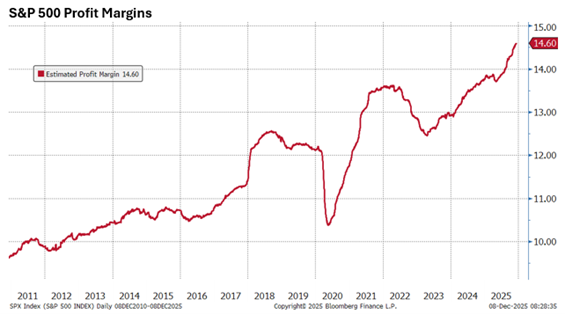
  • Healthy Corporate Fundamentals: Corporate balance sheets remain generally sound. The confluence of lower financing costs and productivity-driven earnings growth creates a powerful backdrop for sustained profit. As the chart below illustrates, margins have been rising for years, and AI has the potential to further this trend.
  • Wealth Effects and Spending Power: Despite ongoing uncertainty around policies like tariffs and reduced immigration, the consumer remains supported by low unemployment and the wealth effects of rising asset prices. As a result, consumer spending continues to provide a strong floor for corporate revenue expectations.
  • Targeted Fiscal Stimulus: The long-term effects of infrastructure bills and tax cuts from the One Big Beautiful Bill will continue to feed into the economy, promoting targeted investments in key sectors and ensuring U.S. GDP growth remains at or above trend.

Source: Bloomberg. The above information is as of 12/08/2025.

Trend #2 Monetary Policy Normalization: Lower Rates and Valuation Support

The Federal Reserve’s ongoing pivot from a restrictive stance to neutral will be a meaningful tailwind. As inflation pressures ease, the Fed is anticipated to execute further interest rate cuts through 2026, fundamentally altering the calculus for risk assets. The result:

  • Decreased Cost of Capital: Lower rates reduce corporate borrowing costs, supporting both capital investment tied to the AI transition, increased share repurchases and additional M&A activity, all of which support equity valuations. Likewise, lower rates act as a potential tailwind to make consumer borrowing more affordable (lower costs for mortgages, car loans, and credit cards).
  • Lowering the Discount Rate: The Discount Rate is a financial hurdle that a potential investment must exceed to be worth your time and money. This is the opportunity cost for investors choosing a very low risk asset (ex: cash or CDs) versus a higher risk asset with more potential return (ex: equities). Lower interest rates reduce the relative appeal of low risk-assets and support higher stock market valuations.
  • Support for Cyclical Sectors: While financial markets react relatively quickly to lower rates, the impact on the economy takes more time and can lag by 6-12 months. We are just starting to see the boost to rate-sensitive and cyclical sectors of the market that underperformed during the higher rate environment.

Trend #3: The Transition of AI Investment from Hype to Productivity

While the initial waves of AI investment favored companies directly involved in development like semiconductor and cloud infrastructure firms, the 2026 narrative is set to shift toward enterprise adoption and tangible productivity gains.

  • Sustained IT Infrastructure Spending: The build-out of data centers and the proliferation of number-crunching semiconductors is expected to continue at a staggering pace in 2026. While this spending will likely eventually slow, these multi-year projects which are still underway. This monumental capital expenditure acts as an economic stimulus and directly feeds the revenues of the hardware and infrastructure sectors.
  • Operating Leverage Expansion: As publicly traded companies outside the tech sector embed AI into their operations, we expect meaningful gains in operating leverage. Efficiency improvements spanning R&D, supply chains, and customer service should translate directly into higher profit margins.
  • Revaluation Driven by Innovation: The market is likely to reward a broader set of companies that demonstrate clear, measurable Return on Investment (ROI) from their AI investments. This dynamic supports a re-rating of valuations for high-quality firms that translate AI adoption into new revenue streams and improved profitability.

Implications for Investors
Collectively, these three trends suggest a favorable backdrop for investors in 2026. Short-term market movements will continue to be driven by macro data releases, like the whipsaw market reaction to the September revised job report and speculation around Fed rate cuts. However, long-term focus should remain on measured investment in companies positioned to capitalize on the coming productivity boom, supported by a constructive shift in monetary policy. As always, patience and remaining invested for the long-term are the best approaches.

Capital Markets
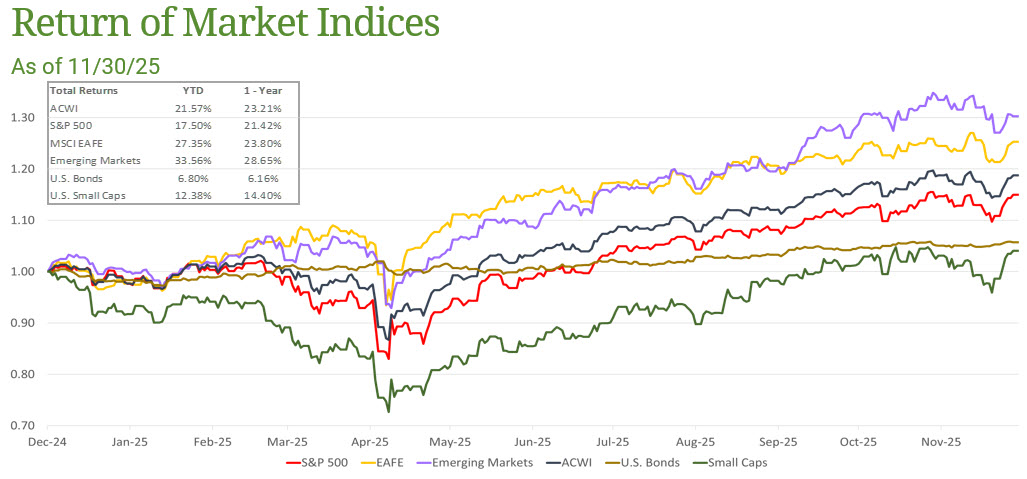
November was a volatile month for markets as investors fretted over the possibility of the Fed potentially changing course on rates. The All-Country World Equity Index (ACWI) and S&P 500 both finished nearly flat (+0.02% and +0.25% respectively) after a mid-month drop of close to 4%. US Small Cap equities, measured by the Russell 2000, finished up by close to 1% (+0.96%) but saw an even larger intramonth swing, dropping over 6% briefly. International Developed stocks, as measured by the EAFE, were less influenced by US interest rate worries and increased by 0.65%. Emerging market equities reversed course after last month’s strong performance, dropping 2.38% for the month. US bond prices rose 0.62% for the month.

Source: Bloomberg. EAFE is MSCI EAFE Index(1), Emerging Markets is MSCI Emerging Markets(2) and U.S. Bonds is Barclays U.S. Aggregate(3). ACWI is the MSCI ACWI Index(4). Small Caps is the Russell 2000 Index(5). S&P 500 is the S&P 500 Index(6). The above information is as of 11/30/2025.

This document contains forward-looking statements, predictions and forecasts (“forward-looking statements”) concerning our beliefs and opinions in respect of the future. Forward-looking statements necessarily involve risks and uncertainties, and undue reliance should not be placed on them. There can be no assurance that forward-looking statements will prove to be accurate, and actual results and future events could differ materially from those anticipated in such statements.