Consider Gifting Wealth Today

The holidays are the season for giving, so it is the appropriate time to consider the advantages of gifting during your lifetime rather than passing assets to your family upon your death. Lifetime gifts can help manage income taxes, support family members when they need it most, and allow you to witness the impact of your generosity.

The Many Advantages of Lifetime Gifting

Supporting the People You Care About
One of the most meaningful reasons to give during your lifetime is the opportunity to help family members when it matters most. Financial support can make a significant difference during major life events, such as buying a first home, paying for education, starting a business, or navigating unexpected challenges. Giving today allows you to see the impact of your support and strengthen family relationships across generations.

How the Gift and Estate Tax Rules Work
The IRS considers a “gift” to be any transfer of money or property for less than fair market value. This includes cash, securities, real estate, vehicles, or forgiven loans.

Every individual has a lifetime gift and estate tax exemption, which represents the amount you can give during life or leave at death before federal taxes may apply. For 2025, the exemption is $13.99 million per individual (or $27.98 million for married couples). This amount will increase to $15 million per individual in 2026.

In addition, the annual gift tax exclusion allows individuals to give up to $19,000 per recipient without using any of their lifetime exemption. Married couples can combine their exclusions to give $38,000 per person per year, enabling families to transfer meaningful wealth over time.

Families with many children, grandchildren, or loved ones often use the annual exclusion to gradually move assets out of their estate in a tax-efficient way. You can also make direct payments for tuition or medical expenses, which do not count as gifts and do not use any exemption.

Transferring Growth Out of Your Estate
A key benefit of lifetime gifting is the ability to shift future growth to the next generation. When you gift assets, such as stocks, real estate, or closely held business interests, any future appreciation occurs outside your taxable estate.

For example, if you give $1 million of stock today and it later grows to $2 million, all that future appreciation occurs outside of your taxable estate. If you were to keep the stock until death, both the original value and the additional $1 million of growth would be included in your estate for tax purposes.

Income Tax Considerations
Family Gifting:
Lifetime gifting can also create income tax planning opportunities, particularly when the gift involves appreciated investments. For example, transferring stocks or other appreciated assets to family members who are in lower income tax brackets may allow future gains to be taxed at more favorable rates when the assets are eventually sold. This can be a thoughtful way to reduce a family’s overall tax burden while helping the next generation build long-term wealth.

It is also important to understand how cost basis works when gifting. Assets given during your lifetime retain your original cost basis, which means the recipient may owe capital gains tax on the appreciation if they choose to sell. By contrast, assets that pass at death generally receive a step-up in basis, eliminating the unrealized gain at that time. Being aware of these differences can help you decide which assets are appropriate for lifetime gifts and which to hold on to for the longer term.

When gifting appreciated stock to children, it is important to consider the kiddie tax. While transferring assets to a child in a lower tax bracket can reduce capital gains taxes, unearned income above a certain threshold, such as dividends, interest, or realized gains, is taxed at the parents’ marginal rate. This can reduce or eliminate the intended tax advantage. Understanding how the kiddie tax works can help determine which family members are best suited to receive appreciated assets and realize gains in the most tax-efficient manner.

Gifts to Charity:
Charitable giving operates under a different set of rules and can be a valuable part of your broader tax and legacy strategy. Donating highly appreciated securities directly to a charity, donor-advised fund, or charitable trust can eliminate capital gains tax on the appreciation and may provide an income tax deduction, depending on your circumstances. This approach allows you to support causes that are meaningful to you while also achieving tax efficiency.

Gifts to charities should be considered separately from family gifting, as the goals, tax treatment, and planning strategies often differ. Your advisor can help determine how charitable giving may complement your overall financial and estate plan.

The Emotional Rewards of Giving
Beyond the financial benefits, lifetime gifting offers something immeasurable: the joy of seeing your generosity support the next generation. Whether it allows a grandchild to graduate without debt or helps a family member find stability during a critical moment, giving can bring deep personal satisfaction. It also creates opportunities to share your values and strengthen family bonds.

The Bottom Line
Lifetime gifting can be a powerful way to support loved ones while also managing your long-term financial and estate planning goals. Because every family’s situation is unique, decisions around gifting should be made in collaboration with your Crestwood team, estate planning attorney, and tax professional.

Reach Out to Crestwood
We help clients and their families make sound decisions for the future, including developing a strategy for gifting. If you are not yet a Crestwood client, please contact us to see how we can help you and your loved ones realize their dreams

Crestwood’s Katherine Sheehan Joins Gary Heldt on the Latest Episode of the Grow Your Business & Grow Your Wealth Podcast

Crestwood’s Katherine M. Sheehan, Managing Director and Wealth Strategist, joined Gary Heldt on the latest episode of the Grow Your Business & Grow Your Wealth podcast to discuss how smart planning protects both your business and your legacy. In the episode, Katherine explains what every entrepreneur should know about estate and succession planning.

Watch the interview here.

November 2025 Economic Update: Everything is K

When you come to a fork in the road, take it.” – Yogi Berra

The term “K-shaped recovery” gained prominence in 2020 during the uneven rebound from the Covid-19 recession. Popularized by economist Peter Atwater, the concept describes how, following an economic downturn, certain economic groups and industry sectors recover rapidly while others stagnate. A K-shaped recovery differs from the more familiar V-shaped recovery (a sharp decline followed by a strong rebound) or U-shaped recovery (a slower return to growth). The K-shape is defined by unequal growth: some “arms” of the economy rise while others continue to fall, creating a pattern that resembles the letter “K.”

In the years since the pandemic, this “K” pattern has persisted, and we currently have a K-shaped economy. Wealth has grown disproportionately among high-income households, large corporations (especially tech and capital-light firms), and asset‐owners, while lower‐income households, small and medium employers, and service-industries reliant on physical presence continue to struggle.

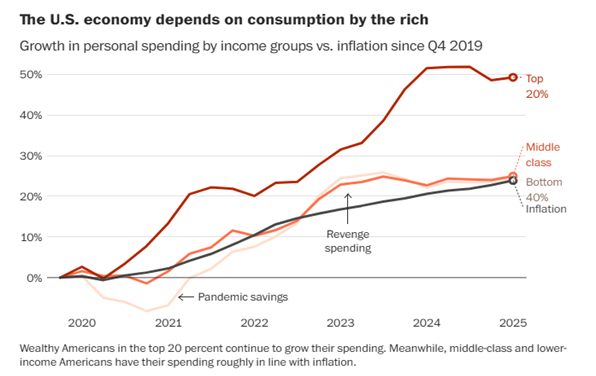
Consumer spending is a primary driver of the U.S. economy and a key indicator of economic growth and illustrates the K-phenomenon. Before the onset of Covid, spending patterns were broadly similar across income groups. However, the chart below illustrates that spending by the highest 20% of earners outpaced that of other groups as we emerged from the pandemic, and the gap continues to widen.

Source: Moody’s

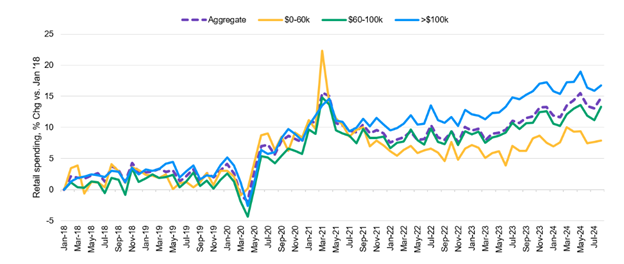
Similarly, a report from October 2024 from the Federal Reserve shows that retail spending of the bottom 80% of Americans, as measured by income, has roughly kept pace with inflation, while the highest 20% of earners have increased their spending by close to 50% in the post-pandemic period!

Source: Hacıoğlu Hoke, Sinem, Leo Feler, and Jack Chylak (2024). “A Better Way of Understanding the US Consumer: Decomposing Retail Sales by Household Income,” FEDS Notes. Washington: Board of Governors of the Federal Reserve System, October 11, 2024, https://doi.org/10.17016/2380-7172.3611.

What’s Driving the K-Shaped Economy?
There are four primary factors driving the K-shaped economy that help to explain the widening disparity between winners and losers among both producers and consumers. These include:

  • The Impact of Technology
    The rapid adoption of artificial intelligence, automation, and digital platforms has accelerated productivity and profitability in key high-tech sectors. Workers and companies equipped to leverage technology are pulling ahead, while those dependent on manual or low-skill labor are being left behind.
  • Uneven Wage and Employment Growth
    The post-pandemic labor market remains divided. High-income professionals in technology, finance, and healthcare enjoy steady job growth and salary increases, while many service-sector and blue-collar workers face stagnant wages or reduced hours. Automation and AI-driven efficiencies have increased productivity while displacing many lower-wage roles.
  • The Unequal Impact of Inflation and Interest Rates
    Inflation and elevated interest rates have widened the gap between economic winners and losers. Wealthier households with greater savings and investment portfolios can absorb higher prices and even benefit from rising interest income. Meanwhile, lower-income families, who spend a higher share of income on essentials like food, energy, and rent, feel the strain. Rising credit card balances and delinquency rates show how unevenly these costs are distributed.
  • Asset Price Divergence aka “The Wealth Effect”
    Financial markets have surged over the past two years. Homeowners and investors have seen their wealth grow as real estate and stock values appreciate. In contrast, renters, and those without substantial assets, have missed out on these wealth effects, widening the financial gap between households.

Implications for Investors
Aggregate metrics like GDP growth, corporate profits and stock market indices reflect activity as a whole rather than how each segment is faring. Overall, the U.S. economy appears healthy. But underneath the surface there is deep inequality, fragility in many out-of-favor sectors, and risks that reflect an asymmetric weakness in the economy.

For investors, the K-shaped economy creates both opportunities and risks, as returns will vary sharply across sectors and industries.

Sector Divergence Reflects “Two Economies”
In 2025, stock market performance mirrors the same K-shaped pattern. Technology stocks related to AI have soared while consumer staples and other sectors lagged.

According to S&P sector data through the end of October:

  • The Upper-Arm of the K Leaders: The Technology sector saw a total return of +29.9% and the Communications sector +26.8%, fueled by corporate investment in AI, automation and productivity tools. The Industrial and Utility sectors saw a rise of +18.9% and +20.2%, respectively.
  • The Lower-Arm Laggards: By contrast, all other sectors saw single-digit returns: the Financial sector (+9.6%), Consumer Discretionary sector (+7.8%), Healthcare sector (+6.3%), Energy sector (+5.8%), Materials sector (+3.8%), Real Estate sector (nearly flat at +0.2%).

Source: Standard and Poor’s

Rising Inequality Alters Market Dynamics
As wealth becomes more concentrated, stock market participation increasingly reflects the spending and investment behavior of affluent households. Gains in financial markets boost high-income spending, which supports certain sectors, while the rest of the economy remains subdued. For investors, paying close attention to demographic and income-driven consumption trends is more important than ever.

Defensive Positioning for Uneven Growth
In a K-shaped environment, diversification across economic segments becomes crucial. Investors should favor companies with pricing power, strong balance sheets, and exposure to higher-income consumers. Long-time readers will note that the first two criteria are also hallmarks of Quality-focused investing, which we have frequently advocated.

The K-shape is becoming a defining feature of the modern U.S. economy. For investors, understanding this divergence is essential to navigating risk and identifying opportunity as the winners in 2025 likely will continue to be firms that cater to higher-income consumers and those that best leverage technology and maintain pricing power.

Capital Markets
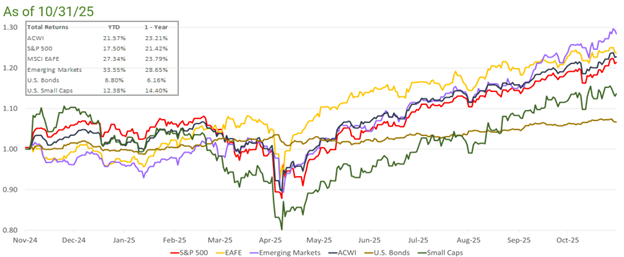
Following on the recent pattern of market rises after each rate cut, once again all boats rose with the tide in October. The All-Country World Equity Index (ACWI) and S&P 500 both rose 2.3%. US Small Cap equities, measured by the Russell 2000, gained 1.8%. International Developed stocks, as measured by the EAFE, increased by 1.2%. Emerging market equities had another strong month, surging 4.2% Not to be left out, US bond prices rose 0.6% for the month.

Source: Bloomberg. EAFE is MSCI EAFE Index(1), Emerging Markets is MSCI Emerging Markets(2) and U.S. Bonds is Barclays U.S. Aggregate(3). ACWI is the MSCI ACWI Index(4). Small Caps is the Russell 2000 Index(5). S&P 500 is the S&P 500 Index(6). The above information is as of 10/31/2025.