Investing in Your Health: The Right Plan for Every Age

Open enrollment is just around the corner. This is the time not only to review your coverage for 2026, but also to consider how healthcare expenses fit into your financial plan for today and for the future.

Advances in healthcare are making it easier than ever to take charge of your own well-being. From wearable fitness trackers that monitor steps, sleep, and heart health to telemedicine that delivers care without the waiting room, convenience and accessibility are on the rise. For those seeking more personalized options, concierge medicine provides direct access to physicians, while GLP-1 medications and luxury wellness treatments are becoming increasingly popular.

Thanks to these innovations, many Americans can expect to live into their 90s and beyond with a high quality of life.

But What’s the Cost?
Many of these advances are not covered by insurance. It is easy to underestimate the lifetime price tag, especially as you age. Fidelity estimates that the average 65-year-old couple retiring today will need $345,000 for healthcare in retirement, not including long-term care.1

Chronic conditions, rising drug prices, or an unexpected diagnosis can quickly derail even the best-laid plans. Without planning, families often find themselves self-funding significant healthcare expenses, so it is important to plan for both the expected and the unexpected.

When You’re Just Starting Out
If you’re under 26 years old, you may still qualify to stay on your parents’ health insurance plan, potentially saving thousands in premiums.

If you’re enrolled in a high-deductible health plan, consider contributing to a Health Savings Account (HSA). While many people use HSAs for current medical costs, their real power lies in the potential to invest for long-term growth. HSAs offer unique triple-tax advantages:

  • Contributions are tax-deductible
  • Growth is tax-free
  • Withdrawals for qualified medical expenses are tax-free

As You Advance in Your Career
As your income and financial assets grow, start setting aside funds earmarked for healthcare, separate from lifestyle spending. This is especially important if you’re considering retiring before age 65 (when you are eligible for Medicare) and need to fund your own healthcare plan.

Expenses such as in-home care, community and assisted living, and nursing home care are expensive and not covered by Medicare. Self-funding can be a valid strategy for high-net worth individuals. Long-term care insurance can also help cover all or a portion of those expenses. The best time to begin evaluating long-term care insurance is when you’re in your 50s or early 60s, when premiums are still reasonable and you have more options available.
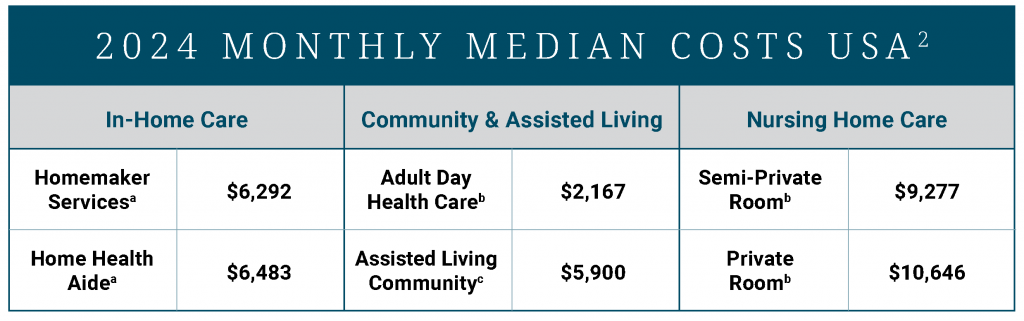
a Based on annual rate divided by 12 months (assumes 44 hours per week)
b Based on annual rate divided by 12 months
c As reported, monthly rate, private, one bedroom

After You Have Retired
Budgeting becomes increasingly important in retirement. Healthcare costs often rise with age, and unexpected expenses can strain your savings if you’re not prepared. Your Crestwood advisory team can help you create a withdrawal strategy that allows your money to last throughout retirement and cover your healthcare expenses when you need them the most.

Reach Out to Crestwood
Modern healthcare gives us the tools to live longer, healthier lives, but it also requires thoughtful financial planning. We help clients invest for a future they can enjoy. If you are not yet a Crestwood client, please contact us to see how we can help you invest in your health at every age.


Sources:
1 Fidelity Investments. (2025, July 30). Fidelity Investments® Releases 2025 Retiree Health Care Cost Estimate, a Timely Reminder for All Generations to Begin Planning. https://newsroom.fidelity.com/pressreleases/fidelity-investments–releases-2025-retiree-health-care-cost-estimate–a-timely-reminder-for-all-gen/s/3c62e988-12e2-4dc8-afb4-f44b06c6d52e#_edn1 (Visited September 2025).

2 Genworth | CareScout®. Calculate the cost of long-term care near you. https://www.carescout.com/cost-of-care?os=wtmb5utkcxk5ref%3Dapp&ref=app (Visited September 2025).

This document is provided for general informational purposes only by Crestwood Advisors, an investment adviser. Crestwood Advisors does not provide legal advice, and this document should not be construed as containing legal advice. For legal advice, consult with a licensed attorney. This document should not be construed as containing tax advice. For tax advice, consult with your tax adviser.

Oh, The Places You’ll Go! Traveling with Intention

Vacations are more than just time away. They are an opportunity to recharge, reconnect, and rediscover what truly matters to you. Whether that’s rest, adventure, learning, or making a positive impact, purposeful travel starts with a simple question:

What does this trip mean to me?
Some travelers are looking for pure relaxation, others want to improve their wellness or broaden their knowledge, and some feel most fulfilled when they give back to the communities they visit. Whatever you are seeking, being intentional about your travels can make them more rewarding.

Here are a few ways to shape your journey – and resources – to help along the way:

Lean into what brings you joy

  • Relaxation: Consider destinations known for restorative stays, such as Mr & Mrs Smith (curated boutique hotels) or Relais & Châteaux (luxury properties with a focus on wellness and culinary excellence).
  • Wellness: Explore programs through the Healing Hotels of the World or wellness-focused resorts like Canyon Ranch and Miraval.
  • Education & Enrichment: Research National Geographic Expeditions or Smithsonian Journeys for immersive learning trips.
  • Supporting Communities: Organizations like Pack for a Purpose (packing supplies for schools and clinics) or Globe Aware (short-term service experiences) can connect you to opportunities that make an impact.

Immerse yourself locally
To further support the communities you visit:

  • Use resources like EatWith (dine with local hosts) or Airbnb Experiences (unique, locally led activities).
  • Prioritize locally owned accommodations through platforms such as Fairbnb.coop (where part of your booking fee funds community projects).

Design a trip on your terms
No matter where your travel plans take you, a trusted travel advisor can help bring your vision to life:

  • Travel + Leisure’s A-List offers access to vetted travel advisors specializing in specific destinations and travel styles.
  • Membership-based services like Virtuoso or Scott Dunn design tailor-made trips with exclusive experiences.
  • If you prefer to plan independently, a tool like Journee can help you structure a “surprise” itinerary built exclusively around your interests.

Make purposeful travel part of your wealth plan
Memorable experiences rarely happen by chance – they’re planned. At Crestwood, we encourage clients to view travel as part of their life journey. By building these experiences into your financial plan, you ensure they become both achievable and enjoyable.

We believe your wealth should support a life well-lived – one that balances joy, growth, and impact. If you’re not yet working with us, we’d be delighted to start that conversation.


This document is provided for general informational purposes only by Crestwood Advisors, an investment adviser. Crestwood Advisors does not endorse, sponsor, or promote any of the products or companies listed or mentioned in this material. Any references to specific products or services are purely incidental and are included solely to illustrate potential strategies or concepts. The inclusion of such references does not imply any form of partnership, relationship, or approval by the Firm.

The Check is NOT in the mail

The end of paper checks is coming soon.

If you currently pay your federal taxes or get your income tax refunds via physical check, take note, change is coming. President Trump signed Executive Order 14247 on March 25, 2025, which mandates the U.S. government stop issuing and accepting paper checks for all federal payments and disbursements, including tax refunds and payments as well as social security benefits, by September 30, 2025. After September 30, all payments received and made will be made electronically.

Why the shift?
According to a fact sheet issued by the White House, the switch to digital is expected to be more cost-effective, faster, and more secure, as paper checks can be delayed, lost, or stolen. As thieves grow more sophisticated, they have resorted to techniques such as chemical washing, which allows them to alter the name and the amount before cashing them fraudulently. Electronic payments can help reduce these risks and offer better protection for recipients.

Steps to take now

If you still send or receive physical checks for your tax payments, refunds or social security payments you must take the following steps to comply with the new rules:

  1. Set Up Direct Deposit
    • If you expect a refund, you must provide your bank account and routing numbers on your tax return
  2. Choose an Electronic Payment Method
    • Taxpayers may submit payments using:
      • IRS Direct Pay (linked to your bank account)
      • The Electronic Federal Tax Payment System (EFTPS)
      • Debit card, credit card, or digital wallet options approved by the IRS
  1. Update Your IRS Account
    • Log in to your online IRS account to confirm or add payment and refund preferences
  2. Act Before the Deadline
    • To avoid delays in processing, taxpayers must update their information and use electronic methods before September 25th

What happens if you don’t have a bank account?

The executive order allows for “limited exceptions” for individuals without access to banking or electronic payments, though details on how this will be handled are still unclear. However, since the percentage of individuals without a traditional checking or savings account continues to drop, the order is not expected to affect most people.

Need Assistance?
Taxpayers can visit www.irs.gov/payments or call 1-800-829-1040 for guidance on setting up electronic payments or direct deposit. Assistance is also available at local IRS Taxpayer Assistance Centers.

If you would like to learn more about this change, please reach out to your Crestwood team. If you are not yet working with Crestwood, please contact us to discuss your individual circumstances.

This document is provided for general informational purposes only by Crestwood Advisors, an investment adviser. Crestwood Advisors does not provide legal advice, and this document should not be construed as containing legal advice. For legal advice, consult with a licensed attorney. This document should not be construed as containing tax advice. For tax advice, consult with your tax adviser.

Crestwood Advisors Named to Barron’s 2025 Top 100 RIA Firms List

New England advisory firm jumps to No. 74, demonstrating continued excellence in wealth management services

Crestwood Advisors (“Crestwood”), a boutique investment advisory and wealth management firm based in Boston and with offices in Connecticut and Rhode Island, is pleased to announce it has been named to the Barron’s 2025 Top 100 RIA Firms list.

This year, Crestwood climbed to No. 74, up from No. 81 in 2024 – a testament to the firm’s continued growth, client dedication, and excellence in delivering personalized financial advisory services.

“It is exciting to see Crestwood on this list again and to be recognized for the work we do every day,” said Crestwood President and Managing Partner Leah R. Sciabarrasi, CFP®. “This achievement is really about the strong relationships we have with our clients and the incredible team of people here who care deeply about helping those clients reach their goals.”

Now in its 10th year, the ranking evaluates independent advisory companies based on assets under management, growth, technology investments, succession planning, and other key factors.

The full methodology for the Barron’s 2025 Top 100 RIA Firms list can be found here. Crestwood did not pay a fee to appear on the published list.

Please see Crestwood Advisors’ important disclosures regarding awards and recognitions here.

September Economic Update: Q&A about the Upcoming Fed

The Federal Reserve meets next week, and once again, it faces a mixed economic picture.

On an encouraging note, inflation appears to be stabilizing. The latest Producer Price Index (PPI) fell 0.1% in August after a 0.7% increase in July.4 The Atlanta Fed’s GDPNow model is forecasting a healthy 3.1% growth rate for the third quarter.3

However, recent downward revisions to employment data and slower job growth suggest the economy may be cooling more than previously thought. The Fed’s challenge remains the same: striking the right balance between keeping inflation in check and supporting continued growth.

The prospect of one, possibly two, new Federal Reserve members has prompted a wave of questions about the Fed’s structure and decision-making process. This month, we will cover a few of the most common questions, as well as highlight what we are watching for at the next Fed meeting.

Q: How often does the Federal Open Market Committee (FOMC) meet?

A: The FOMC has eight regularly scheduled meetings per year where they share their review of financial and economic conditions and discuss the target for monetary policy in the context of their dual mandate of price stability and maximum employment.

Q: Who votes at the FOMC?

A: The FOMC has 12 voting members: the seven members of the Board of Governors, the president of the Federal Reserve Bank of New York, and four of the eleven other Reserve Bank presidents.

The four voting Reserve Bank presidents serve on rotating one-year terms, with seats filled from the following four groups with one president from each group:

  • Boston, Philadelphia, and Richmond
  • Cleveland and Chicago
  • Atlanta, St. Louis, and Dallas
  • Minneapolis, Kansas City, and San Francisco

Non-voting Reserve Bank presidents still attend the FOMC meetings and weigh in on discussions, even though they don’t have a vote.

Q: What happens when there is a Board vacancy?

A: The process begins with the President nominating a candidate. These nominations are expected to provide a “fair representation of the financial, agriculture, industrial, and commercial interests and geographical divisions of the country.”1.  Importantly, no two Governors may come from the same Federal Reserve District. Board membership is intended to reflect the various economic interests across the entire country.

A candidate must then undergo a thorough background check and submit financial and ethics disclosures. Next comes the Senate Banking Committee’s confirmation hearing, where the nominee shares their views on economic policy. If the Senate Banking Committee votes to move the nomination forward, it goes to the full Senate for debate and a final vote. Once confirmed, the nominee is sworn in and begins their term.

Governors serve a term of 14 years and appointments are staggered so that one term expires on January 31st of each even-numbered year. Once a Governor has served 14 years, they may not be re-appointed, however a Governor who served a shorter term could be re-appointed at a later date to serve up to the full 14-year term.

Once appointed, Fed Governors may not be removed based on their policy views. The staggered, lengthy terms are intended to help insulate the Federal Reserve system from day-to-day political pressures.

Q: What happens at the end of Chair Jerome Powell’s term?

A: Powell’s term as Chair of the Federal Reserve ends in May 2026. If he is not reappointed at that time, the President will nominate a new Chair from among the seven members of the Board of Governors, who will then be confirmed by the Senate for a four-year term.

Powell is eligible to remain a part of the Board of Governors until his term ends in January 2028.

Q: What are you watching at this upcoming meeting?

A: We are watching four areas:

  • The interest rate decision. A 0.25% rate cut is widely expected due to the declining inflation trend and weakening labor data. A larger cut would suggest the FOMC views economic conditions to be weaker than expected, while keeping rates unchanged would suggest they are concerned that inflation may reverse course.
  • Forward Guidance. The FOMC updates its Statement of Economic Projections (SEP), commonly referred to as the “Dot Plot”, four times a year. The SEP outlines where individual Fed members expect inflation and interest rates to trend over the coming quarters. When the dots cluster closely around certain levels, it suggests a consensus view; when they are more widely dispersed, it reflects significant differences of opinion among policymakers. Investors watch the Dot Plot closely for insight into the Fed’s future policy path and interest rate expectations, which in turn influence everything from bond yields to equity valuations.
  • Inflation and Labor Market Data. The Fed will build an outlook by drawing on a wide range of economic data and indicators. While precise forecasting is never possible, identifying consistent patterns across multiple data points can reveal underlying trends that might be overlooked when focusing on any single metric in isolation .
  • Dissent! The FOMC member opinions often have a high degree of consensus as, ultimately, they are all reviewing the same set of information from slightly different perspectives. Thus, outlier views can help highlight data points which are otherwise easily missed. For instance, as we noted in last month’s Economic Update2, Fed Governor Waller had opined weeks in advance the July meeting that there was a high likelihood of downward revisions in the labor market. This was long before the Bureau of Labor Statistics (BLS) disclosed that from March 2024 to March 2025, 911,000 fewer jobs were created than previously estimated. Both Bowman and Waller dissented from the decision at the last meeting to hold rates steady, favoring a rate cut sooner. We will be watching to see if they push for a larger cut or align with the likely consensus for a 0.25% reduction as this could signal an increasing appetite to cut further and/or faster.

Capital Markets
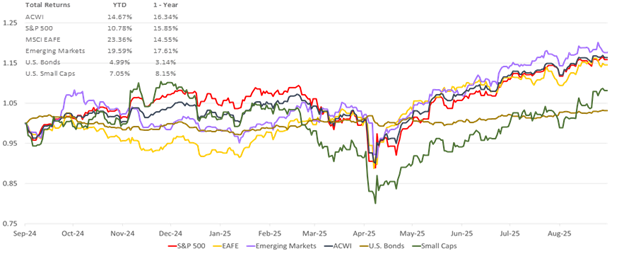
Equity markets rose broadly in August. The All Country World Index (ACWI) climbed 2.5%. The S&P 500 rose 2%. International Developed stocks, as measured by the EAFE, increased by 4.3%. Emerging Market equities (MSCI Emerging Markets Index) rose by 1.5%. US Small Cap equities, measured by the Russell 2000, lead the way with a rise of 7.1%, likely the result of a highly anticipated Fed rate cut in September. US bond prices rose 1.2% for the month.

1: Board of Governors of the Federal Reserve System. March 28, 2017. America’s Central Bank: The History and Structure of the Federal Reserve. Speech by Governor Powell on America’s central bank: the history and structure of the Federal Reserve – Federal Reserve Board

2: Crestwood August 2025 Economic Update: Shooting the Messenger and the Shifting Fed

3: Federal Reserve Bank of Atlanta. GDPNow. GDPNow – Federal Reserve Bank of Atlanta

4: U.S. Bureau of Labor Statistics. Economic New Release – Producer Price Index News Release summary. Producer Price Index News Release summary – 2025 M08 Results

This document contains forward-looking statements, predictions and forecasts (“forward-looking statements”) concerning our beliefs and opinions in respect of the future. Forward-looking statements necessarily involve risks and uncertainties, and undue reliance should not be placed on them. There can be no assurance that forward-looking statements will prove to be accurate, and actual results and future events could differ materially from those anticipated in such statements.

QSBS: An Acronym All Business Owners Should Know

If you are a business owner planning for the future, knowing about the “QSBS” exclusion could provide you with millions of dollars of capital gains tax savings when you sell your business. With the proper advice and advanced planning, this tax savings can be multiplied for businesses sold for more than $10 million.

The Qualified Small Business Stock (QSBS) exclusion is a powerful tax incentive under Section 1202 of the IRS tax code. It offers substantial capital gains tax exclusions for both business owners and investors in those businesses who meet specific criteria.

The QSBS exclusion was created in 1993 as part of the Revenue Reconciliation Act and recently enhanced through the One Big Beautiful Bill Act (OBBBA). The purpose of the QSBS exclusion is to promote entrepreneurship and innovation by channeling capital into small companies and rewarding owners of and investors in those businesses with favorable tax treatment.

As noted above, the amount of gain that can be excluded is substantial.

  • If the stock was acquired between 1993 and 2008, the taxpayer can exclude 50% of the gain from the sale.
  • If the stock was acquired in 2009 or part of 2010, then 75% of the gain can be excluded.
  • If the stock was acquired in 2010 after the September 27, 2010 enactment of the Creating Small Business Jobs Act, the taxpayer can exclude 100% of the gain, up to the greater of $10M or ten times the basis.
  • And for stock acquired on or after July 4, 2025, $15M of gain can be excluded.

So, does the company you own or invested in qualify, and what kind of capital gains exclusion is permitted under the incentive?

Capital gains may be excluded from the sale of QSBS stock when the following conditions are met:

  • The entity must be structured as a C corporation for tax purposes, and the stock must have been issued on or after 8/10/93.
  • The entity must be a qualified small business.
  • When the stock was issued, the gross assets of the business cannot have exceeded $50 million. Note that this is assets, not the valuation of the entity.
  • The stock must be an original issuance (not purchased from another investor).
  • The stock must be held for more than five years.

For stock issued on or after July 4, 2025, the OBBBA made significant and favorable changes:

  • Gross assets of the business cannot have exceeded $75M (up from $50M);
  • Introduction of a tiered application for exclusion percentages:
    • Hold for 3 years, you get 50%;
    • Hold for 4 years, you get 75%; and
    • Hold for 5 years, you get 100%.
  • And perhaps most notably, the exclusion amount is raised from $10M to $15M

So, if the business fits the bill, how can you plan for sales larger than $10M or $15M to maximize your tax savings even further?

Through a process called “stacking,” business owners can increase the number of individuals or entities eligible for the exemption, increasing the tax benefit while also removing the asset from their taxable estate in the process.

For example, a business owner can gift a portion of their QSBS shares to their spouse or to a trust for their children, effectively multiplying the number of exemptions allowed. Their QSBS status and holding period then follow the shares to the recipient – the new taxpayer who receives the benefit of the 1202 exclusion when selling the shares. When a taxpayer makes gifts of shares to multiple trusts, each trust receives the benefit of the 1202 exclusion, hence the term “stacking.”

Collectively, the trusts and the taxpayer can then exclude gains equaling $10M, or $15M depending on the acquisition date, multiplied by the number of trusts established. This is a powerful strategy, saving several million dollars in taxes.

IRS rules and restrictions can be complex, making it important to check with a qualified financial advisor and tax professional when considering this tax incentive. But for business owners who qualify, taking advantage of the QSBS exclusion can be one of the most rewarding strategies for their financial future as well as the future of their heirs.

If you would like to learn more about the benefits of the QSBS tax provision, please reach out to your Crestwood team. If you are not yet working with Crestwood, please contact us to discuss your individual circumstances.


This document is provided for general informational purposes only by Crestwood Advisors, an investment adviser. Crestwood Advisors does not provide legal advice, and this document should not be construed as containing legal advice. For legal advice, consult with a licensed attorney. This document should not be construed as containing tax advice. For tax advice, consult with your tax adviser.