Buying a Vacation Home: Retreat or Regret?

Does summer travel have you thinking about buying a vacation property for your family to enjoy year after year? Do you find yourself scrolling though real estate listings while you’re away, picturing a place to call your own? Well, it may be time to take the leap and invest in a vacation home.

While owning a second home may feel like a dream come true, it’s important to be sure it makes financial sense. With thoughtful planning, a vacation home can serve as both a long-term investment with the potential to appreciate and a meaningful legacy for the next generation.

Before you start scheduling property tours, here are some important factors to consider.

Does ownership suit your lifestyle?
If your family values tradition, shared experiences, and putting down roots, a vacation home may be a great fit. This type of investment works best when the property is easily accessible through a reasonable drive, a short flight, or a ferry ride. And if it aligns with your interests, such as boating, skiing, cycling, and hiking, that’s the icing on the cake.

However, if you tend to prefer variety in your travel plans, returning to the same place may start to feel limiting. You might feel obligated to use it instead of exploring new destinations. In addition, ownership will add to your responsibilities. Even if you hire a property manager, you may grow to resent paying for the obligations that owning another home undoubtedly creates.

Does the purchase make financial sense?
Real estate is an illiquid investment, so it’s important to be sure that purchasing a property won’t disrupt your broader financial plan. In addition to the purchase price, you will need to factor in the carrying costs, including home maintenance, utilities, HOA fees, and insurance. If you are considering renting the property, research the local laws and community rules to confirm it’s allowed. And remember that rental income is not guaranteed, and comes with its own set of risks, including potential renter property damage and wear and tear.

What are the tax implications?
How you use your vacation home will impact your potential tax benefits. Subject to specific qualifications around personal use and rental days, mortgage interest may be deductible within the same limits that apply to your primary residence. You may also be able to deduct expenses like property taxes, insurance premiums, and property management fees, depending on how the home is used. Your Crestwood team can help you determine the tax implications for your specific situation.

Plan Ahead for Ownership and Inheritance
How the property is titled—whether individually, jointly, through a trust, or within an LLC—can have long-term implications for liability, taxes, and estate planning. If your goal is to pass the home down to family, it’s worth considering how that transfer will occur and whether your loved ones are interested in keeping the property. Proactive planning can help reduce the potential for future conflict and ensure that your intentions are clearly documented and followed.

If you are thinking about a vacation home, reach out to Crestwood!
At Crestwood, we take a holistic, forward-looking approach to wealth that simplifies the complexities of financial decision-making. Before purchasing a vacation home, it’s important to understand how it fits into your overall financial picture. If you’d like to explore your possibilities, reach out to your Crestwood team. If you are not yet working with Crestwood, please contact us to start a conversation.


This document is provided for general informational purposes only by Crestwood Advisors, an investment adviser. Crestwood Advisors does not provide legal advice, and this document should not be construed as containing legal advice. For legal advice, consult with a licensed attorney. This document should not be construed as containing tax advice. For tax advice, consult with your tax adviser.

Creating a Meaningful Legacy: A Family Affair

Creating a Meaningful Legacy: A Family Affair

When people hear the word “legacy,” they often think of the assets we leave to our loved ones, the charities when we pass away, and the vehicles we utilize to facilitate that transfer, i.e. wills, trusts, etc. But a meaningful legacy goes far beyond financial assets. It’s about sharing your values, making an impact, and shaping how you’ll be remembered, by your family, your community, and future generations to come.

At Crestwood, we believe that thoughtful financial and estate planning can serve as a powerful tool for building the kind of legacy that reflects not only the assets you have amassed during your lifetime, and how you wish to leave them to your chosen beneficiaries but also the values you stand for and what is important to you. Whether you’re just starting the planning process or revisiting an existing plan, here are four key areas to consider as you begin to shape your legacy.

Define What Legacy Means to You
Before you consider the mechanics of estate planning, start with your vision. What matters most to you? What else, besides money, do you wish to leave behind and pass on to your beneficiaries?

Legacy can take many forms: providing opportunity for future generations, supporting charitable causes, preserving family traditions, and/or setting an example through the way you live.

Ask yourself the following questions when you begin to craft your estate plan:

  • What values have shaped my life?
  • Who or what do I want to impact long-term?
  • What do I hope my children or community remember about me?

Answers to these questions will frame the foundation of a legacy that’s both meaningful and lasting.

Align Your Estate Plan with Your Values
Once you’ve defined your vision, it’s important to ensure that your estate plan manifests it and contains the right tools to facilitate same, i.e. wills, revocable trusts, irrevocable trusts, charitable planning vehicles, and properly completed beneficiary designations to name just a few.

For example, if education is a core value, you might consider creating a 529 plan or establishing an irrevocable trust to fund your grandchildren’s education. If philanthropy is important to you, a donor-advised fund or charitable trust can help you support causes you care about long after you’re gone.

Communicate Your Intentions Clearly
Legacy planning isn’t just about documents. It’s about conversations. One of the most powerful things you can do is share your intentions with the people who matter most.

Too often, families are left to interpret an estate plan without understanding the reasons behind it. Writing a legacy letter, hosting a family meeting, or simply having a candid discussion about the decisions you have made and the plan you have executed can bring clarity and connection.

Live Your Legacy Now
Legacy isn’t only about what you leave behind. It’s also about how you live today.

Whether you are mentoring the next generation, volunteering, or supporting causes you care about, you are building your legacy in real time. Small, consistent actions like teaching family members about investing or sharing insights from your life experience can have a positive influence.

Building a Legacy, Together
At Crestwood, we help clients shape their legacy through highly personalized estate and financial planning. We can work with you to develop a plan in a way that is tax-efficient, value-driven, and customized to your needs. Whether you are planning for a family business or making sure future generations are supported responsibly, our role is to help you build a plan that honors both your intentions and your legacy.

If you are not yet a Crestwood client, please contact us to see how we can help you turn your vision into a lasting impact and create a meaningful legacy.

Crestwood Advisors Recognized in Financial Advisor Magazine’s 2025 RIA Ranking

BOSTON (July 15, 2025) – Crestwood Advisors (“Crestwood”), a boutique investment advisory and wealth management firm based in Boston with offices in Connecticut and Rhode Island, is proud to announce its inclusion in Financial Advisor Magazine’s 2025 RIA Ranking.

“We’re honored to be included in this year’s ranking, which reflects the dedication of our team and the ongoing trust our clients place in us,” said Crestwood President and Managing Partner Leah R. Sciabarrasi, CFP®. “This recognition speaks to the strength of our client relationships and our unwavering focus on delivering long-term value.”

Published annually, Financial Advisor Magazine’s 2025 list of top RIAs is one of the most respected industry lists for independent investment advisory firms. Rankings are based on assets under management (AUM) reported by firms, as well as growth over time and other firm-reported data. To qualify, firms must be independent RIAs, file their own ADV with the SEC and primarily serve individual investors.

Being named to this prestigious list underscores Crestwood’s ongoing commitment to thoughtful, client-centered wealth management. It reflects the confidence clients have in Crestwood to provide tailored strategies that align with their financial values and goals.

This recognition reinforces the firm’s drive to continue growing its capabilities and deepening its relationships in the communities it serves.

The full 2025 list can be found here. Crestwood did not pay a fee to appear on the published list.

###

About Crestwood Advisors
Crestwood Advisors is an independent, fee-only, wealth management firm with approximately $7.02 billion in assets under management as of December 31, 2024. Founded in 2003, Crestwood Advisors provides investment management with financial planning strategies to help high-net-worth individuals and families identify and prioritize their goals and build sustainable wealth so that they may enjoy more financially secure and purposeful lives. For more information, please visit https://www.crestwoodadvisors.com.

July Economic Update: The Deadline is not the Finish Line

July 9th was previously announced as end of the three-month pause on April’s Liberation Day tariffs, which were poised to send tariff rates to much higher levels. That date was also the deadline for the U.S. and the European Union to negotiate a new trade deal or else a 50% tariff on EU imports will be triggered. Recent statements by President Trump and Treasury Secretary Scott Bessent confirm that the US pushed the date to August 1st. Regardless of whether that new deadline is met, tariff policy and the global trading system will remain in flux for some time to come.

The equity market response to the initial tariff announcement in early April was severe with the S&P 500 dropping approximately 12% in the following week. In the wake of the announcement of the 90-day pause, and subsequent progress with US-China negotiations, the S&P 500 recovered and climbed to new highs. Unfortunately, the road to trade deals with 90 countries has many speed bumps.

The on again/off again application of the tariffs has given US importers time to front load purchases, which is likely to help spread the impacts to US consumers over time. However, it is important to appreciate that this stockpiling merely buffers price increases, it does not prevent them.

Due to the prolonged pause, there are those who believe that warnings about the impact of large tariffs were overstated because we haven’t seen it thus far. This is akin to being in an airplane and turning to your seatmate to declare “This is the smoothest flight I’ve ever had! No turbulence!” without realizing that your flight was delayed and your plane is still on the tarmac.

Investors should bear in mind that a reoriented tariff policy isn’t just a tremor but rather a trigger for a seismic shift in global trade. Restructuring global supply chains, shifting workforces, as well as building or retooling factories is a process that will take years. In the interim, companies will be faced with the choice to either increase prices to consumers or absorb costs and therefore, be less profitable. The reality is that even with tariff agreements, tariffs will be meaningfully higher than they were in the past and we must consider the investment environment of this new, more protectionist, global order.

The takeaway: As companies seek to adapt, investors will benefit from having a flexible framework when thinking about how and where they should invest. Public U.S. equity markets remain attractive, but there are opportunities overseas as well as in alternative assets.

Capital Markets

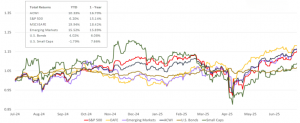
Equity markets rose broadly in June. Global equity markets, as measured by the MSCI All Country World Index (ACWI) rose by 4.53%. The S&P 500 hit record highs, rising by 5.08% for the month. US Small and Mid Caps, as measured by the Russell 2000, have been volatile this year but posted a 5.43% gain. Market strength was not confined to domestic markets. Developed International equity markets, measured by the EAFE, rose 2.22%. A weaker US Dollar helped Emerging Market Equities to see the largest move: a rise of 6.12%. Even bonds were in the black for the month with a 1.54% gain in the Bloomberg US Agg Bond Index.

Source: Bloomberg. EAFE is MSCI EAFE Index(1), Emerging Markets is MSCI Emerging Markets(2) and U.S. Bonds is Barclays U.S. Aggregate(3). ACWI is the MSCI ACWI Index(4). Small Caps is the Russell 2000 Index(5). S&P 500 is the S&P 500 Index(6). The above information is as of 06/30/2025.

We continue to focus on investing for the long term while remaining sensitive to potential short-term opportunities and risks. We encourage you to reach out to your Crestwood Advisor with any questions or concerns you may have. If you are not yet working with a Crestwood Advisor, we invite you to schedule some time to discuss how Crestwood works with individuals and families like yours to help them achieve their wealth goals.

This document contains forward-looking statements, predictions and forecasts (“forward-looking statements”) concerning our beliefs and opinions in respect of the future. Forward-looking statements necessarily involve risks and uncertainties, and undue reliance should not be placed on them. There can be no assurance that forward-looking statements will prove to be accurate, and actual results and future events could differ materially from those anticipated in such statements.


Risky Business. Why Customized Insurance is Important

Why customized insurance is important

While standard mass-market insurance can meet the needs of most people, high-net -worth individuals and families need customized solutions that are tailored to their needs.

Success brings new opportunities, but also new risks

High Value Home Insurance. More expensive homes require customized coverage that many agents are unable to provide. Cost replacement value insurance, multiple residence insurance, extra coverage for disasters, and working with a carrier that can respond quickly when you need them are key. Knowledgeable insurers will not only insure your home, but they will also provide sound advice on how to mitigate risks through a detailed survey of your properties. If you are thinking about your homeowner’s insurance, read our blog Homeowners Insurance Under Pressure.

Fine Art, Collectables, and Jewelry. The things you now own, and your family may cherish, may exceed the coverage that standard policies allow. Custom policies allow you to pinpoint your risks with precision and insure what matters most.

Liability. When you have a lot, you have a lot to lose. You may be managing multiple homes or have workers that could be injured on your property. You may own luxury or classic vehicles, boats, or planes.  You may employ domestic staff that may need worker’s compensation insurance. A custom evaluation of your exposures can be beneficial to your peace of mind. It often makes more sense to transfer the risk to an insurance company rather than carrying perpetual potential liability on your family’s balance sheet.

Your Trust and Estate Plan. Upon your passing, your assets may be subject to state or Federal Estate taxes. In addition to providing for these expenses, customized insurance strategies can provide liquidity for tax payments for less liquid assets such as businesses and properties. This allows more value to pass on to your beneficiaries rather than to tax collectors.

Your Life. A neutral party can help you examine different types of life and disability insurance to match the policies to your needs, age and other risk factors, while keeping your lifestyle in mind.

How Crestwood Can Help

As an independent wealth advisory firm, Crestwood views insurance as a component of your complete financial picture. We offer unbiased advice to help you manage your risk as well as your investments. Please contact us if you are not working with Crestwood.

There is no cost – and no risk – to starting the conversation!

This document is provided for general informational purposes only by Crestwood Advisors, an investment adviser. Crestwood Advisors does not provide legal advice, and this document should not be construed as containing legal advice. For legal advice, consult with a licensed attorney. This document should not be construed as containing tax advice. For tax advice, consult with your tax adviser.