Small/Mid Cap Stocks: An Attractive Opportunity

Crestwood believes equities offer strong growth potential for long term investors. We continuously analyze capital markets trends and data to inform our long-term equity strategy and identify shorter-term opportunities. Our analysis indicates that, given current market conditions, U.S. Small/Mid (SMID) cap stocks have the potential to outperform large cap stocks.

SMID Currently Trading at a Wide Discount

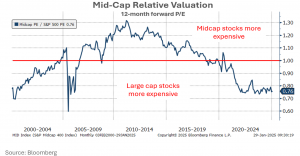
For much of the past 30 years, U.S. Small/Mid (SMID) cap stocks have traded at a premium valuation compared to their U.S. large-cap counterparts. Traditionally, investors sought SMID cap stocks to gain exposure to higher expected earnings growth to complement more mature and relatively slower-growing large-cap stock holdings. However, since early 2021, SMID cap stocks have traded at valuation discounts relative to large-caps in a range not experienced since the 2000 tech bubble. We believe this discount represents an attractive investment opportunity.
Below is a chart demonstrating the price-to-earnings ratio of the mid-cap stock index to that of the large-cap S&P 500 index for the past 20 years. Notably, mid-cap stocks currently trade at a 24% discount to large-cap stocks.
In the shadow of the Mag 7

For the past two years, investors have focused on the Magnificent Seven (Mag 7) companies – Apple, Microsoft, Alphabet, Amazon, Meta Platforms, Nvidia and Tesla – which have been a significant driver of large-cap stock market performance. Since January 2023, these stocks surged 254%, compared to the S&P 500’s 63% gain. Impressively, the Mag 7 companies have grown earnings by over 130%, capturing investor enthusiasm, especially for those benefiting from the development of artificial intelligence platforms. Enthusiasm for AI focused companies has overshadowed small-cap and mid-cap stocks which have fallen out of favor.

Attractive characteristics

When examining valuation as an investment factor, it is essential to ensure underlying fundamentals are healthy. Sometimes investments may appear inexpensive but carry low valuations for good reason and are priced appropriately. When looking at the stocks in the small-cap and mid-cap indexes however, we believe their fundamentals are healthy and improving:

1. Faster Growing: Over the past seven years, SMID cap earnings have grown faster than large cap earnings and they are expected to continue growing faster in the coming years.
2. Improving Businesses: Over the same time frame, SMID caps have improved free cash flow yields, margins, and returns on invested capital to comparable levels to large caps.
3. No Substantial Increases in Debt: Both SMID and large-cap debt levels are at their historical averages.

Why Now?

Several catalysts make now an opportune time to increase our exposure to SMID cap stocks:

1. Economic growth: SMID cap earnings tend to be more cyclical and rise and fall with economic growth. The current economic outlook is for healthy consumer spending and a resilient job market
2. Deal Activity: Anticipation of reduced regulatory scrutiny under the Trump administration is fueling expectations of increased merger and acquisition (M&A) activity. Higher M&A activity is a positive catalyst for SMID caps as they are often targets for these types of deals.
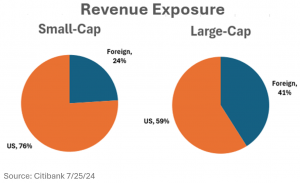
3. New Administration Tariffs: How substantial, impactful, or disruptive the tariffs may or may not be is still widely unknown. However, SMID caps have roughly half the exposure to foreign revenue as large caps, making them an attractive diversifier against potential global trade disruptions caused by tariffs.
In summary, SMID cap stocks are notably underappreciated by the broader market, presenting a compelling investment opportunity. Given today’s favorable economic environment, we believe their strong fundamentals combined with attractive valuations offer an appealing opportunity and may offer an important return and diversification benefit to client portfolios.

Sources: Bloomberg, Citibank. Mid-Cap stocks are represented by the S&P 400 Index, Large-Cap stocks are represented by the S&P 500 Index. The Magnificent Seven (Mag 7) returns are represented by the Bloomberg Magnificent 7 Index.

Westfair Business Journal Features Tim Paradis as New Partner

In case you missed it! Our recent announcement about Tim Paradis‘ promotion to partner was featured in the Westfair Business Journal. It’s great to see Tim’s hard work and leadership recognized locally, and we couldn’t be more excited about what’s to come for him and the team.

Click here to read the full story.


Crestwood Advisors Expands Leadership with New Partner

BOSTON (January 16, 2025) – Crestwood Advisors (“Crestwood”), a boutique investment advisory and wealth management firm based in Boston with offices in Connecticut and Rhode Island, is pleased to announce the promotion of Tim Paradis to Partner.

“I’m excited to continue my journey with Crestwood as a Partner and to be part of a team that is truly committed to putting our clients’ interests first,” said Tim. “I’m grateful for the opportunity to help shape the future of Crestwood, and I look forward to continuing our work together to support our clients and our colleagues.”

Tim, who joined Crestwood in 2023, brings nearly two decades of experience. Since joining Crestwood, he has played a key role in attracting new clients, strengthening existing relationships and taking on leadership responsibilities. In addition to supporting the firm’s growth, Tim has mentored colleagues across the firm, fostering development and collaboration within teams.

“Tim’s wealth of experience, passion for mentorship and unwavering commitment to our clients make him an invaluable part of the Crestwood family,” said Crestwood President and Managing Partner Leah R. Sciabarrasi, CFP®. “We’re excited to continue growing with him as a partner.”

Tim began his career in 2006, after a career as a mental health counselor and teacher. He uses his empathy and passion for education to form deep, personal connections with his clients. With more than 15 years of experience, Tim helps local executives, entrepreneurs, business owners, and families develop customized financial roadmaps. His holistic approach includes retirement planning, cash flow management, trusts and estates, tax planning, risk management and legacy conversations.

He is a CERTIFIED FINANCIAL PLANNER™ practitioner and holds a BA in Psychology from Saint Anselm College and a Certificate in Financial Planning from Merrimack College.

###

About Crestwood Advisors
Crestwood Advisors is an independent, fee-only, wealth management firm with approximately $6.7 billion in assets under management as of October 31, 2024. Founded in 2003, Crestwood Advisors provides investment management with financial planning strategies to help high-net-worth individuals and families identify and prioritize their goals and build sustainable wealth so that they may enjoy more financially secure and purposeful lives. For more information, please visit https://www.crestwoodadvisors.com.

January Economic Update: 2024 in Review

As we look back at 2024, we want to summarize the major economic highlights of the year.

Economic Data Mostly Positive
US economic growth, job creation, and inflation continued to improve through 2024, though progress came with some caveats.

Stable GDP Growth: GDP came in at a 1.6% for Q1 2024, the lowest since Q2 2022, but Q2 2024 came in at 3.0% and Q3 2024 at 3.1%.
Non-farm employment rose by ~2.2 million jobs from January through December, though the unemployment rate moved up to 4.1%, 0.5% higher than December 2023. 4.1% is still a low figure compared to the longer-term average of 6.2% but does reflect a slowing pace of US growth.
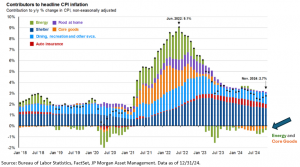
Inflation improving (for now). The consumer price index (CPI) was up 2.7% and core CPI was up 3.3% year/year in November. This is a marked improvement from the 3.3% and 3.9% pace in December 2023. However, as shown in the chart below, it’s noteworthy that declining prices in core goods (in orange) slowed in the second half of the year and lower energy costs (in green) contributed to much of the decline in total inflation for the year. This suggests that independent of other potential inflationary factors (wage pressure, tariffs, etc.) we could see inflation pick up, should energy prices reverse course.

Fed Preached Patience before Cutting Rates
Early in 2024, investors questioned when the Fed would begin the process of easing from the 5.25-5.5% peak, maintained since August of 2023. It took until August 2024 before Fed Chair Powell’s announcement that “the time has come for policy to adjust”.

September’s FOMC meeting resulted in a 0.5% cut, followed by 0.25% cuts at the November and December meetings. Notes from the December FOMC meeting, as well as a revised Summary of Economy Projections (aka the “Dot Plot”) suggest the Fed may delay further cuts in the near term with rates falling a further 0.25-0.5% by the end of 2025. That’s both a slower pace and a higher end rate than many investors expected.

US Equity Markets Rally Immediately Post Election Before Ending on Mixed Note

The market’s initial reaction was positive, with both the S&P 500 and the Russell 2000 logging their best monthly performances of 2024 during November. This reflected investor optimism about several factors, notably:

A further lowering of the corporate tax rate from 21% to either 20% or 15%. This would be a huge boon to corporate earnings and like push stock prices higher. For perspective, the highest 2016 marginal rate was 35%.
An extension of the 2017 personal income tax rate cuts set to expire in 2026. If this were to sunset, US consumers would have less money to spend on discretionary purchases.
Deregulation: This could boost domestic energy production, lower the barrier to mergers and acquisitions, and usher in a pro-crypto administration.

However, a narrowly averted government shutdown in December raised questions about how effectively President Trump will be able to use Republican congressional majorities. Equity markets pulled back amidst a backdrop of speculation about tariffs, disruption with long-time trading partners (Mexico, Canada) and the US potentially assuming control of Canada, the Panama Canal and/or Greenland. Collectively these are distractions and potential disruptions from the pro-business policies noted above.

Corporate Earnings – Strong but Top Heavy
S&P 500 constituents posted average year/year EPS growth of 5.8% in Q3, which was the fifth consecutive quarter of positive earnings growth. Q4 results are forthcoming, but S&P 500 firms are forecast to record annual earnings growth of 9.5%, which exceeds the ten-year average of 8.0%. The Mag 7 names (Apple, Microsoft, Amazon, Alphabet, Meta, NVIDIA and Tesla) accounted for a disproportionate share of earnings growth estimated at 33% vs 4% for the “Non-Magnificent 493”.

Looking ahead, analyst estimates for 2025 in aggregate are an optimistic 14.8% based on expectations of durable EPS growth, progress on inflation and a favorable regulatory backdrop from the incoming administration. Importantly, analysts expect broader based earnings growth with a stronger contribution from companies outside the Mag 7 names which dominated earnings and returns last year.

Capital Markets
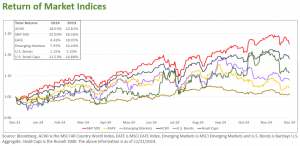
Both equities and bonds pulled back in December, capping off an otherwise strong year. The S&P achieved its second straight year of 20%+ gains for the first time since 1998, hitting 57 new record highs in the process. Small caps were a winner in November, but reversed course in December, falling -8.4%. The All-Country World Index (ACWI) and the S&P 500 both declined -2.5%, while developed international equities a measured by the EAFE index fared slightly better with a -2.3% decline. Emerging market equities were down only slightly by -0.3%. Bonds declined -1.6%.

This document contains forward-looking statements, predictions and forecasts (“forward-looking statements”) concerning our beliefs and opinions in respect of the future. Forward-looking statements necessarily involve risks and uncertainties, and undue reliance should not be placed on them. There can be no assurance that forward-looking statements will prove to be accurate, and actual results and future events could differ materially from those anticipated in such statements.