Little Learners, Big Budgets: Empowering Young Minds with Financial Wisdom

The importance of Financial Education in Wealth Transfer

Creating generational wealth involves more than just passing on financial assets. It’s about preparing the next generation to nurture their legacy and focus on managing and growing wealth responsibly. Focusing efforts on financial education at an early age is key to setting younger generations up for success.

One of the biggest challenges is educating the next generation on important issues like financial literacy, self-discipline, and wealth preservation. How do families start this conversation with their heirs? Will they understand these concepts at a young age? While these conversations with the next generation can be difficult, there are avenues to facilitate productive discussions.

Interactive Engagement to Ignite Young Imaginations

There are many resources such as Mint, Smart About Money, Monarch and Greenlight, that teach young children about financial literacy and investment concepts through interactive engagement. With technological advancements, introducing them to online tools can help automate and simplify their financial management. Many programs offer family-friendly curricula, multimedia learning centers, games, and budgeting tools, making financial education both enjoyable and accessible.

Incorporate philanthropic endeavors into your conversation. What are their hobbies and how can this tie into charity? With the holiday season approaching, this could be an opportune time to bring up how they may give thanks as part of a philanthropic approach.

Transforming Financial Responsibility into Opportunity

Infusing relevance, excitement, and collaboration into discussions with your children can ease the weight of financial conversations. Reframing specific conversations to empower them will allow for greater results. For example, rather than saying “you need to learn about budgeting so you can save more”, you can try “what would you like to buy so we can talk about saving to pursue your goal”. This type of collaboration will induce trust and relationship building, while discussing the importance of being financially prudent. Share your childhood stories with them. This can provide them with a sense of connection and understanding on your accomplishments.

Building Healthy Financial Habits

Building best practices and habits as early as possible will make an impact. Prioritize saving by creating a goal. Whether it’s saving for that pair of sneakers or saving $10 per week for an emergency fund. When they start working, prioritize saving by automatically setting aside a portion of their income for savings before allocating funds to other expenses. Prioritize participation in employer-sponsored retirement plans, such as 401(k) plans, especially if the employer offers a matching contribution. Maximizing employer matches provides a significant boost to retirement savings. Demonstrating the effects of compounding at an early age can be eye-opening, and instilling sound financial practices and habits from an early age can make a lasting difference.

Conclusion: Preparing the Next Generation for Success

Connecting your heirs with financial advisors opens the door to meaningful dialogue about money management. By involving professionals, young children can gain insights and learn directly from experts, making financial concepts more relatable and understandable. Reach out to your Crestwood Team to explore ways to engage the next generation effectively.

Director and Wealth Manager Explores Financial Considerations for Homeowners with ComparisonAdviser

Are you a new homeowner? Owning a home is not just a milestone—it’s a powerful way to build wealth! But with great ownership comes greater financial responsibility.

Recently, Director and Wealth Manager Timothy Paradis, CFP®, spoke with ComparisonAdviser about the complexities of homeownership and the importance of understanding costs and tax benefits, highlighting how financial advisors can assist homeowners.

Click here to read the full article.

Crestwood Advisors Joins Industry Leaders in Launching the Net Positive Consortium

Crestwood Advisors is proud to be a founding member of the Net Positive Consortium, a groundbreaking initiative that unites over a dozen of the wealth management industry’s leading firms to foster civic engagement, promote diversity and drive meaningful change through best practices. With consortium members collectively managing over $200bn in client assets, this initiative focuses on five key pillars: workforce development, community support, environmental sustainability, client service, and industry leadership. Through collaboration and shared commitment, we aim to elevate our impact, champion inclusion and pay it forward.

Click here to read more!


October Economic Update: The Fed Makes the First Cut

Equity markets finished September higher, after a rough start with the S&P 500 down over 4% during the first week, the biggest weekly pullback of the year. Investors initially fretted over softer than expected August employment that featured negative revisions to prior months and a disappointing ISM manufacturing report. These data points exacerbated existing worries about U.S. election uncertainty, potential further escalation in Middle East conflicts, U.S. labor disputes (port workers and Boeing) and ongoing economic woes in the Chinese economy.

However, several developments reversed this pessimism. The Fed announced a 0.5% rate cut at their September meeting while telegraphing another likely 0.5% in cuts before year-end. The September cut was supported by positive data showing continued disinflation, a stable (albeit slowing) labor market, still-healthy consumer spending, and continued earnings growth projected for U.S. corporations. The soft-landing narrative was further buttressed by initial unemployment claims falling to the lowest level since May.

A 0.5% drop in policy rates is significant paired with the Fed’s updated Statement of Economic Projections (aka their “Dot Plot”) penciling in another 1% in cuts during 2025 and 0.5% in 2026. Car loans, credit cards, some adjustable-rate mortgages and some other forms of borrowing are based on the Prime Rate, which typically runs approximately 3% above the Fed Funds rate. Thus, a full 1% drop in the Fed Funds rate by year-end would represent a meaningful reduction in borrowing costs for many U.S. consumers.

When Will Fed Rate Cuts Help Homebuyers and Refinancers?

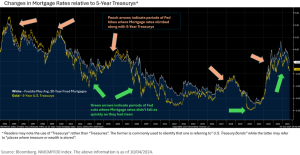
The short answer is “Eventually.” Unlike the Fed Fund rate, which is decided by the Fed, mortgage rates tend to be closely related to 5-year Treasury yields, which are driven primarily by supply and demand factors. These yields tend to rise when the economic outlook is strong and fall when the economic outlook is weak. Over time, Treasury rates tend to follow the direction of changes in the Fed Fund rate.

  • The caveat is that mortgage rates don’t always adjust at the same pace:
    When the 5-year yield is rising, borrowing rates tend to go up quickly as lenders are eager to offer loans at higher and higher rates while the economic outlook appears strong. From their perspective, this is a win-win: they’re charging higher rates to borrowers in an environment where defaults are less likely.
  • Not surprisingly, when 5-year Treasury yields are falling, lending rates don’t fall quite as fast as they rose. In other words, when the economic future looks more uncertain, lenders prefer to keep rates higher for longer to hedge against future risk.
  • This phenomenon is observable in the chart below: the gap between 5-Year Treasurys (yellow line) and 30-year average Fixed Mortgage Rates (white line) is minimal when rates are rising (as in 2022) but tends to widen when rates are flat or declining.

The takeaway: Homebuyers and refinancers should be optimistic that lower rates on mortgages are coming, however they should also expect that these lower borrowing costs for consumers may lag the decline in Fed rate cuts.

Chinese Equity Markets: Avaricious Stimulus

During the last week of September, Chinese equities rose nearly 20% in response to the Chinese government’s announcement of a tidal wave of stimulus measures intended to jump start their economy. The stimulus included cuts to mortgage rates, a decline in down payment requirements for second homes, relaxed capital reserve requirements for banks, and a large stimulus program that explicitly incents brokers, insurance companies and other entities to buy Chinese stocks.

While this caused Chinese stocks to move into positive territory for the year, it does little to address fundamental issues plaguing their economy. China still faces weak retail sales, falling real estate prices, and a crippling dependence on government investment, rather than consumption, to maintain growth. Perhaps worst of all is that the heavy hand of communist rule has undermined shareholder rights, especially those of foreigners. In June this year, foreign direct investment in China turned negative for only the second time since 2005.

Despite the recent rise in Chinese equity prices, we continue to believe investors should be wary of rallies driven by government spending and policies intended to entice speculative investments.

Capital Markets

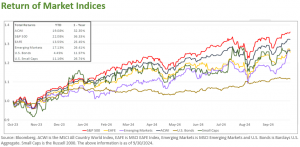
Equity and fixed income markets rose in September. The All-Country World Index (ACWI) rose +2.17%, the S&P 500 rose +2.02%, while the EAFE rose +0.62%. Emerging markets surged with a gain of +6.68%, driven primarily by the aforementioned move in Chinese equities. U.S. Bond prices rose +1.34% for the month.


This document contains forward-looking statements, predictions and forecasts (“forward-looking statements”) concerning our beliefs and opinions in respect of the future. Forward-looking statements necessarily involve risks and uncertainties, and undue reliance should not be placed on them. There can be no assurance that forward-looking statements will prove to be accurate, and actual results and future events could differ materially from those anticipated in such statements.

Crestwood Advisors Recognized on Annual Forbes/Shook Top RIA List for 2024 for the Third Consecutive Year

Boston-based advisory firm celebrates notable rise in prestigious national ranking

Boston, Mass. (October 8, 2024) – Crestwood Advisors (“Crestwood”), a boutique investment advisory and wealth management firm based in Boston with offices in Connecticut and Rhode Island, is pleased to announce it has been named to the annual Forbes/SHOOK America’s Top RIA Firms list for 2024. The firm climbed 17 spots this year, ranking No. 59, up from No. 76 in 2023.

“We are incredibly proud to be included once again in such a prestigious Forbes ranking of this competitive industry,” said Crestwood CEO/Managing Partner Michael Eckton. “This recognition highlights the dedication and expertise of our team and the trust our loyal clients place in us to deliver exceptional service year after year.”

The Forbes 2024 Top RIA Firms List, developed by SHOOK Research, recognizes the top 250 registered investment advisors (RIAs) in the U.S. based on both qualitative and quantitative factors. The rigorous selection process involves an analysis of key metrics such as revenue trends, assets under management, compliance records, and overall industry experience.

SHOOK Research conducted in-depth interviews with leadership and staff, assessing firms based on leadership, growth and dedication to client service. This year’s evaluation included more than 46,200 nominations, 21,400 telephone interviews and thorough reviews of thousands of RIAs through in-person or virtual meetings. More than 25,000 firms across the U.S. were invited to participate in the ranking process.

In its third year, the Forbes Top RIA list continues to set the standard for evaluating advisory firms across the country. The full methodology for the ranking can be found here.

Crestwood did not pay a fee to appear on the published list or to market the award.

Please view Crestwood Advisors’ list of important disclosures regarding awards and recognitions here.


###

About Crestwood Advisors
Crestwood Advisors is an independent, fee-only, wealth management firm with over $5.7 billion in assets under management. Founded in 2003, Crestwood Advisors provides investment management with financial planning strategies to help high-net-worth individuals and families identify and prioritize their goals and build sustainable wealth so that they may enjoy more financially secure and purposeful lives. For more information, please visit https://www.crestwoodadvisors.com.