Homeowners Insurance Under Pressure

Homeowners across the country face a growing challenge of skyrocketing home insurance costs as natural disasters become more frequent. Whether it’s hurricane season in the southeast or summer wildfires across the northwest many homeowners are questioning if they can afford the risk, or the rising premiums. While insurance remains essential for some, others are considering alternative approaches to managing these costs. Two prominent figures, Senator Rick Scott and author Suze Orman, offer two starkly different stances on this issue.

Rick Scott’s Homeowner Insurance Deduction Bill
In an effort to ease the financial burden on homeowners, Senator Rick Scott introduced the Homeowner Insurance Deduction Bill in August. This proposed legislation will allow taxpayers to deduct up to $10,000 of their homeowners insurance premiums from federal taxes. Scott’s motivation is clear: with insurance costs climbing due to natural disasters, he hopes this bill will help alleviate the strain on homeowners’ wallets and incentivize them to maintain adequate coverage. His approach is all about balancing affordability with responsibility, ensuring homeowners don’t go unprotected.

Suze Orman’s Bold Move to Drop Homeowners Insurance
On the other hand, Suze Orman has taken a more radical approach. She recently made headlines by announcing that she’s dropped her homeowners insurance altogether, citing the escalating costs as no longer worthwhile for her personal financial strategy. Orman, who has the financial flexibility to self-insure, decided the premiums were a poor investment given her ability to cover potential losses herself. However, she cautions that this path is not for everyone. For those without substantial financial reserves, maintaining some form of insurance is crucial.

Less Drastic Adjustments
There are other ways to reduce costs of insurance while still maintaining coverage. Many homeowners are opting for partial coverage, insuring only against specific risks like fire or hurricanes, instead of paying for comprehensive policies. Another option is increasing deductibles, which lowers premiums but means you’d be responsible for covering more of the costs in the event of a claim. These middle-ground strategies allow homeowners to stay protected while controlling the rising expense of insurance.

What Should Homeowners Consider?
These contrasting strategies highlight the wide range of options homeowners should consider when dealing with rising insurance costs. Whether you lean toward maintaining full coverage or exploring alternatives, it’s essential to take a hard look at your personal situation. Here are some key points to think about:

• Risk Exposure: Do you live in a high-risk area for hurricanes, wildfires, or other natural disasters? Cutting coverage could leave you vulnerable to significant losses.
• Financial Cushion: Can you afford to repair or rebuild your home out-of-pocket like Suze Orman? If not, you should purchase homeowners insurance and discuss with your advisor what the best policy is to meet your needs.
• Potential Tax Relief: If Rick Scott’s bill passes, it could offer you up to $10,000 in deductions—potentially making the cost of premiums more manageable.

Ultimately, deciding whether to adjust or even drop homeowners insurance depends on your financial situation, risk tolerance, and long-term goals. What works for one person may not work for another, which is why it’s so important to evaluate your options carefully.

For guidance tailored to your needs, reach out to our team at Crestwood. We are here to help you find the right solution for you and your family.


Crestwood Advisors Makes BBJ’s 2024 List of Largest Independent Investment Advisers in Massachusetts

We are proud to announce Crestwood Advisors has earned a place on the Boston Business Journal’s 2024 list of the “Largest Independent Investment Advisers in Massachusetts,” ranking #16.

“This acknowledgment reflects our team’s unwavering commitment to providing personalized financial strategies that empower our clients to reach their goals,” said Crestwood CEO/Managing Partner Michael Eckton.

To read more on this recognition and the methodology of the ranking click here.

Crestwood Advisors Secures Coveted Spot on Barron’s 2024 Top 100 RIA Firms List

Fast-growing New England advisory moves up to No. 81 in prestigious national ranking, highlighting continued excellence in financial advisory services

Boston, Mass. (September 18, 2024) – Crestwood Advisors (“Crestwood”), a boutique investment advisory and wealth management firm based in Boston and with offices in Connecticut and Rhode Island, is pleased to announce that it has been named once again to the Barron’s 2024 Top 100 RIA Firms list.

This year, the firm has moved up to No. 81, a notable improvement from last year’s ranking of No. 93.

“We are honored to be ranked among Barron’s Top 100 RIA Firms, and even more so to see our advancement this year,” said Crestwood CEO/Managing Partner Michael Eckton. “We recognize that this honor is possible only through the continued partnerships between our incredible clients and dedicated team.”

Each year, Barron’s publishes its Top 100 RIA Firms list, ranking independent advisory companies based on a comprehensive set of criteria. These criteria include assets under management, technology investments, staff diversity, succession planning, and other key metrics.

The full methodology for the Barron’s 100 list can be found here. Crestwood did not pay a fee to appear on the published list.

Please see Crestwood Advisors’ important disclosures regarding awards and recognitions here.


###

About Crestwood Advisors
Crestwood Advisors is an independent, fee-only, wealth management firm with over $5.7 billion in assets under management. Founded in 2003, Crestwood Advisors provides investment management with financial planning strategies to help high-net-worth individuals and families identify and prioritize their goals and build sustainable wealth so that they may enjoy more financially secure and purposeful lives. For more information, please visit https://www.crestwoodadvisors.com.


September Economic Update: All Eyes on the Fed

August began with a pullback in the stock market, with the S&P 500 falling over 6% in the first three trading days and the “Magnificent Seven” stocks dropping nearly 10% in the first week. The selloff was fueled by concerns that the Federal Reserve had been too slow to cut interest rates. The labor market has softened considerably with July’s nonfarm payrolls significantly missing expectations and with June’s figures also revised downward. The unemployment rate in July ticked up to 4.3%, compared to the consensus of 4.1%, sparking discussions that the economy was headed for a hard landing.

Following the July labor report, expectations for a Fed rate cut soared, with the market pricing in a high probability of a 0.5% cut in September given hard landing concerns. The market reaction was further intensified by an unwinding of the yen carry trade, given the divergence between Fed and Bank of Japan policies, after the BoJ unexpectedly raised rates at a time when the US and most other central banks are lowering them.

As we discussed last month, we believe the rise in unemployment in July was likely due to a temporary increase in the labor force and weather-related layoffs. It was therefore unsurprising when the August jobs report, released last week, showed a decrease in the unemployment rate to 4.2%. Additionally, the job market showed signs of stabilizing, with the ratio of job openings to unemployed workers falling to a healthy 1.07, in-line with the pre-pandemic average since 2004.

Last month saw the Fed release the FOMC Minutes from the July meeting which shared insight into where the Fed is most focused. Members concluded that the risks to achieving the Committee’s employment and inflation goals were becoming more balanced, though the economic outlook remained uncertain. They noted that consumer spending had slowed from the strong pace of last year, reflecting restrictive monetary policy, easing labor market conditions, and slowing income growth. Some members also pointed out that lower-and-moderate-income households were facing increasing financial pressures, as seen in rising credit card delinquency rates and a growing number of households paying the minimum due on their balances.

The equity market rebounded and erased the early-month declines as soft landing odds rose over the course of the month and the Fed essentially confirmed it would cut in September as recession risks remain low. Powell said that the upside risks to inflation have diminished, downside risks have cooled, and the Fed was committed to doing everything it could to support a strong labor market.

Skipping Stones: What are the implications of a shift in Fed policy?

We don’t know for certain how the Fed’s actions will unfold, but in his speech at Jackson Hole, Federal Chair Powell made clear that “The time has come for policy to adjust. The direction of travel is clear, and the timing and pace of rate cuts will depend on incoming data, the evolving outlook, and the balance of risks.” We expect the initial result of a lower Fed Funds rate will be modest: a proportionate decline in the yield of money markets, savings accounts, and new Treasury Bills.

Secondary effects will likely take time to manifest. Banks will lower CD rates, and investors seeking yield may shift funds from cash and short term Treasury Bills to bonds with longer maturities which in turn puts downward pressure on yields farther along the curve. Mortgage rates and other loans, which tend to track changes in 5-Year Treasuries, have been falling, albeit slowly. The average rate on the 30-year mortgage is now at 6.7% which is below last year’s peak of 8.1%. Eventually, lower rates could provide a tailwind to consumers who face higher interest costs.

Like a stone thrown into still water, the magnitude of the secondary effects – the splash and the ripples – will be dependent on the size of each rate move and how quickly each subsequent move follows. We believe that a single 0.25% pebble or even a handful of pebbles thrown before the end of the year (such as three 0.25% cuts), would likely cause much less of a disruption than a chunky 0.75% boulder.

Capital Markets

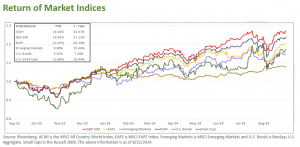
Both equity and fixed income markets rose in August, except for U.S. Small Caps. The All-Country World Index (ACWI) rose +2.57%, the S&P 500 rose +2.43%, while the EAFE rose +3.27%. Small Caps gave back part of July’s 10% surge, falling -1.5% in August. Emerging markets finished with a gain of +1.64%. U.S. Bond prices rose +1.4% for the month.

This document contains forward-looking statements, predictions and forecasts (“forward-looking statements”) concerning our beliefs and opinions in respect of the future. Forward-looking statements necessarily involve risks and uncertainties, and undue reliance should not be placed on them. There can be no assurance that forward-looking statements will prove to be accurate, and actual results and future events could differ materially from those anticipated in such statements.

Director and Wealth Manager Shares Insights on Client Onboarding with InvestmentNews

As client relationships form the backbone of any successful advisory firm, ensuring a smooth onboarding experience is crucial.

Director and Wealth Manager Billy Spencer, CFP®, CFT-I™, FBS®, recently shared his insights with InvestmentNews, stressing that client input is key: “If the client’s not having a chance to share what they’re looking for, any sort of advice that comes after that isn’t really tailored to what their needs are,” he said.

Click here to read the full article.