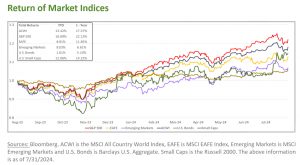
U.S. stocks started July on a high note bolstered by healthy second quarter earnings. While both equity and fixed income markets rose, sentiment had begun to shift with investors rotating out of growth and stocks as the month went on.
Several recurring themes whittled away at investors’ appetite for risk:
- Companies reported investing heavily in AI without a corresponding immediate increase in revenue or earnings which called into question the timeline between capex and monetization.
- June retail sales data remained healthy, but corporations continued to note signs of deterioration in their earnings calls.
- Investors continued to speculate about the presidential race, given early polling suggesting President Biden’s withdrawal and VP Harris’s entrance may have made the contest more challenging for Trump. Markets and corporate boards tend to prefer landslides (more certain outcomes) vs. close calls (less certain outcomes).
The July Fed meeting ended as expected with no change to rates. Fed Chair Powell noted at the press conference which followed that if the Fed sees the softening economic data it hopes for, a cut could be on the table in September. He acknowledged that the case for rate cuts was strengthened by some weaker labor market and manufacturing data.
Labor Report Startles Investors but it’s Premature to Declare a Recession
The Bureau of Labor Statistics announced that nonfarm payrolls rose 114,00 in July vs. the consensus estimate of 175,000. That shortfall coupled with slight downward revisions to job growth numbers for May and June suggests the economy grew at a slower pace than expected. Of note, a shortfall in payroll growth is not the same as a contraction in payrolls, but nonetheless this spooked investors. In addition, the unemployment rate rose from 4.1% to a still low 4.3%, whereas expectations were for the rate to remain unchanged. While the three-month average of payroll gains was virtually unchanged at 170,000, this was overshadowed by the July headline.
As a result, some economists were quick to claim that based on the July unemployment data the U.S. is already in a recession, pointing to the “Sahm rule”, named after former Fed economist Claudia Sahm. The rule suggests the economy is already in a recession if the three-month average of the unemployment rate rises 0.5% or more above the prior 12-month low of that average.
This speculation propelled an already anxious market into a bout of volatility, particularly in the tech space. Tech leaders like Nvidia which have propelled the market higher by rising over 170% YTD fell over 6% in one day. Likewise, semiconductor stocks like Broadcom, AMD, Qualcomm, Intel and others saw similar drops.
While the Sahm rule does have a strong historical record, Dr. Sahm stated in an interview with CNBC on August 2nd “We are not in a recession now – contrary the historical signal from the Sahm rule – but the momentum is in that direction. A recession is not inevitable and there is substantial scope to reduce interest rates.” She elaborated, saying “The Fed has a big lever still to pull, they have a lot of interest rate cuts they could go through if they need to.” She added “This economy is in a good place – it just needs some pressure taken off it.”.
What Might be Skewing the Numbers?
Workers on temporary layoffs accounted for a startling 70% of the increase in the number of unemployed in July. Yardeni Research Inc points out that according to the Bureau of Labor Statistics household employment survey, 1.54 million workers were either not working or had only part-time employment specifically due to weather in July, a vast increase compared to the 280,000 figure in June. In fact, the July figure was so large that it is one of the top five monthly readings for workers impacted by weather since 2018.
Another factor in the labor data is a surge of individuals joining the work force. Nancy Vanden Houten, Lead U.S. Economist at Oxford Economics states that it’s unlikely we’re in a recession currently as the labor force participation rate among prime age workers increased in July hitting 84% – the highest rate since 2001. This is a sign of strength rather than weakness. She noted “In a recession, individuals are more apt to get discouraged and leave the labor force.”
The Fed has repeatedly stressed that they are watching the data closely and focus on trends, rather than a single data point. This is necessary because monthly data is calculated and then subject to two further revisions while also being subject to wide margins of error. For instance, according to the Bureau of Labor Statistics, from 2021-2023 the Nonfarm Payroll monthly numbers were subject to a total of 108 revisions with 107 of those reviews resulting in different final numbers.
Chicago Fed President Austan Goolsbee pointed out in a CNBC interview on August 5th that the jobs growth number came in 61,000 short of expectations but noted “The payroll jobs number is plus or minus 100,000 a month so be a little careful over-concluding about things in the margin of error.”
What This Means for Investors
We believe the US economy is slowing but this is to be expected and is not a cause for alarm. The decline in the inflation rate as well as the softening labor market both support the case that the Fed is likely to cut rates in the months to come. It’s impossible to predict the pace or exact timing of cuts, however equity markets have historically risen in their wake, thus staying invested remains the best course of action.
Capital Markets
Both equity and fixed income markets rose in July. The All-Country World Index (ACWI) rose +1.6%, the S&P 500 rose +1.2%, while the EAFE rose +2.9%. As we noted last month, there continues to be a wide dispersion both in valuation and performance between large and small cap stocks. Small Caps saw a notable gain, rising +10.2% for the month on hopes for Fed rate cuts to come soon. Emerging markets were the slowest to rise, finishing with a slight gain of +0.4%. U.S. Bond prices rose +2.3% for the month.